

Influencer marketing has entered 2026 with more money, more scrutiny, and a much larger role in the marketing mix. Brands are increasing their investment, bringing more of the work in-house, and asking creator programs to prove their impact well beyond reach and engagement.
That growth has made the industry more demanding. Creator costs are rising. Attribution remains difficult. AI is speeding up discovery and production, while authenticity and audience quality still require human judgment. At the same time, social commerce is shortening the distance between creator content and a sale.
The 35 influencer marketing statistics below capture those changes.
Rather than treating them as isolated data points, we have organized them around the decisions marketers are making now: how much to invest, which creators to work with, what fair compensation looks like, how to measure performance, and where the channel is heading next.
Turn Industry Benchmarks Into a Campaign Estimate
Industry statistics provide useful context, but your potential return will depend on your budget, audience scale, and content mix. Use inBeat’s Influencer Marketing ROI Calculator to enter your campaign budget, average followers per influencer, and planned number of Stories, posts, and videos.
The calculator will generate an instant ROI estimate that you can use alongside the industry benchmarks below when planning your campaign.
Influencer Marketing Growth and Investment Statistics
The clearest signal so far in 2026 is that creator marketing is absorbing more serious advertising money. Market estimates vary because researchers define influencer marketing and creator advertising differently, but the direction is consistent: spending is growing, and creators are moving closer to the center of media planning.
1. Influencer Marketing Reached an Estimated $32.55 Billion in 2025
The global influencer marketing industry reached an estimated $32.55 billion in 2025. That is nearly twice the $16.4 billion estimate reported for 2022 and shows how quickly the channel has expanded in just three years.
That valuation puts influencer marketing at a scale that would have seemed improbable when brand collaborations mostly meant a sponsored post or gifted product.
Creator partnerships now sit across paid media, affiliate commerce, content production, and long-term ambassador programs. The category has grown because creators are being asked to do far more than lend their audience to a campaign.
2. US Creator Ad Spend Is Forecast to Reach $44 Billion in 2026
That growth becomes even clearer when we look at what advertisers are setting aside for creators. IAB forecasts that US creator ad spend will reach $44 billion in 2026, after rising to a projected $37 billion in 2025.
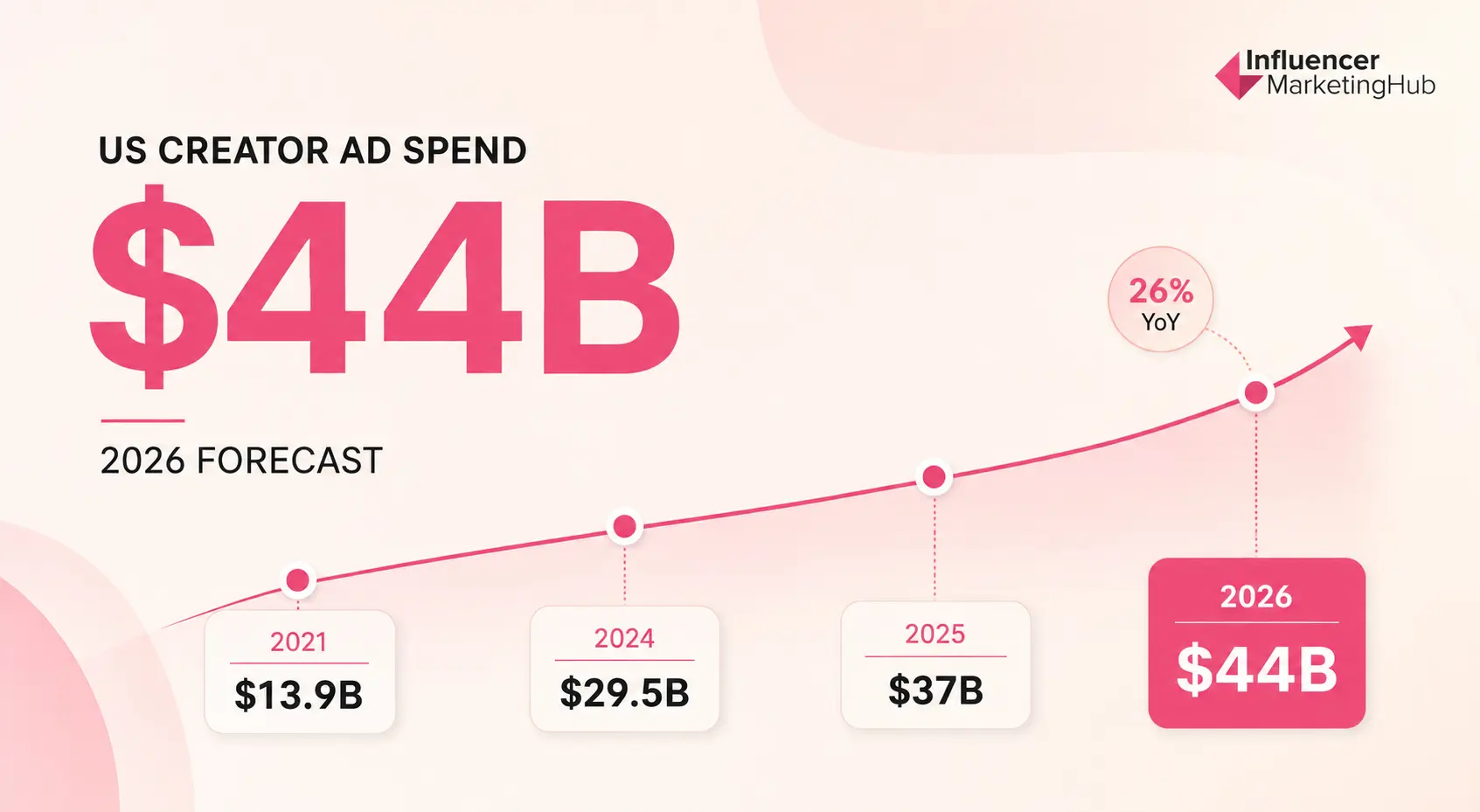
The figure represented 26% year-over-year growth, nearly four times the growth rate of the wider media industry. It also marked a sharp increase from $13.9 billion in 2021 and $29.5 billion in 2024.
If the forecast holds, US creator ad spend will have more than tripled in five years. Creators are now competing for money that once flowed almost automatically to search, social, display, and other established media channels. That changes the conversation from whether creators deserve a place in the plan to how large that place should be.
3. Nearly Half of Creator Ad Buyers Now Consider Creators a “Must Buy”
Higher spending also reflects a change in how advertisers classify the channel. According to IAB, 48% of creator ad buyers consider creators a “must buy”, placing them just behind paid search and social media.
A must-buy channel is part of the core plan rather than an optional activation added after larger media decisions have been made. Creator marketing is increasingly being considered during budget allocation, audience planning, and content development instead of being handed a leftover experimental budget.
4. Almost 88% of Marketers Expect Their Influencer Budgets to Increase
The spending outlook remains strongly expansionary. In our 2026 Influencer Marketing Benchmark Report, we found that 87.49% of respondents said they expected their influencer marketing budgets to increase. Only 5.55% anticipated a decrease.
When nearly nine in 10 marketers point in the same direction, budget growth becomes the working assumption. The harder question is whether teams have the creators, processes, and measurement systems to put that extra money to work effectively.
5. More Than 72% Expect Budget Increases of at Least 50%
The size of those planned increases is more striking than the number of marketers expecting growth. Some 72.% of respondents anticipate increasing their influencer budgets by 50% or more, according to our 2026 Influencer Marketing Benchmark Report.
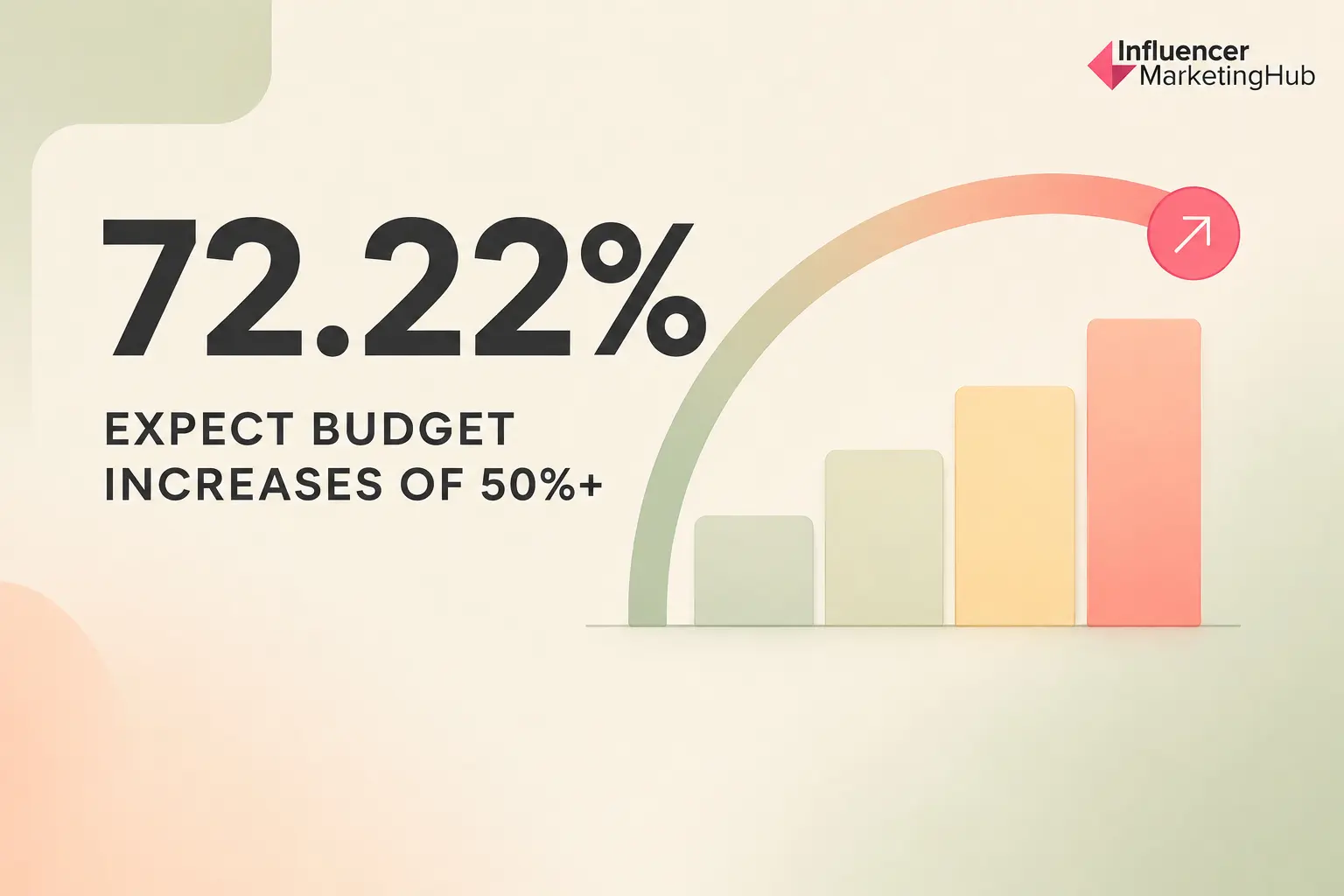
Growth at that level changes more than campaign volume. A brand cannot sustainably add 50% to its spend while relying on the same informal creator lists, approval process, contracts, and tracking spreadsheets. Larger budgets create a parallel need for stronger sourcing, faster content review, clearer usage rights, and measurement that can withstand closer financial scrutiny.
6. Average Reported Creator Marketing Budgets Increased 171% Year Over Year
Planned growth is already visible in reported spending. CreatorIQ found that average annual influencer marketing budgets increased 171% year over year. Overall, 71% of surveyed organizations said they had increased their investment.
Nearly two-thirds of the additional money came from paid media budgets. That suggests creator marketing is gaining funding by proving it can contribute content, distribution, and measurable outcomes across the funnel, rather than simply receiving a larger allocation because total marketing budgets grew.
The rise is too large to be explained by brands simply adding a few more sponsored posts. It points to larger programs, more creators, more paid amplification, and creator content being used across a wider part of the marketing mix.
That level of investment raises an immediate operational question. Who is actually responsible for managing the work?
Influencer Marketing Operations and Creator Strategy Statistics
As budgets grow, brands have to decide which capabilities belong internally and where outside specialists add the most value. The 2026 data points to an internally owned model supported by selective outsourcing, along with greater use of smaller creators and UGC producers.
7. Two-Thirds of Influencer Programs Are Managed Entirely In-House
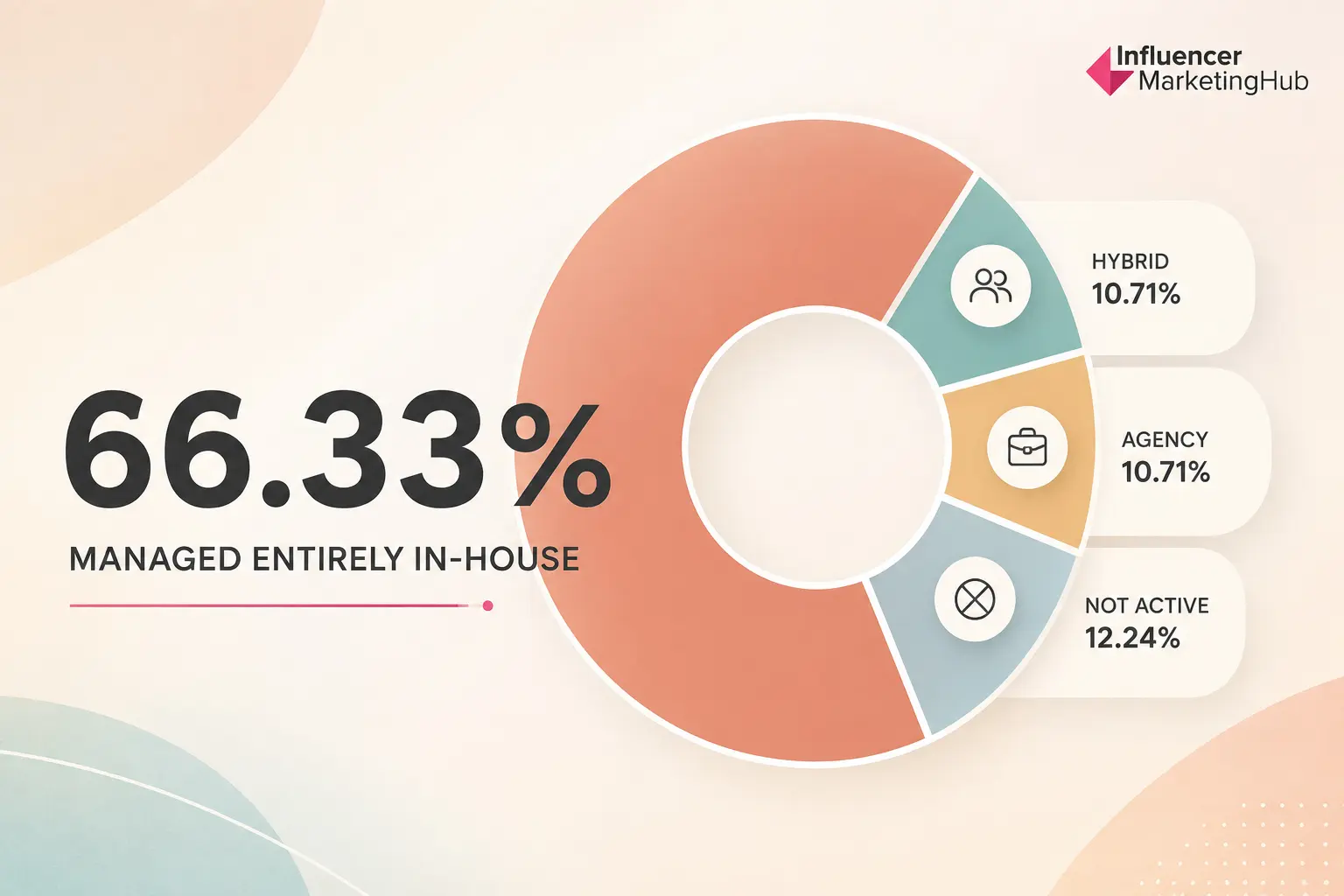
Influencer marketing is increasingly being treated as an internal growth function. Some 66.33% of our Influencer Marketing Benchmark respondents manage their programs entirely in-house. Another 10.71% use a hybrid arrangement, while the same share relies entirely on a dedicated influencer marketing agency.
Internal ownership gives brands direct control over creator relationships, performance data, institutional knowledge, and the definition of success. It also increases the operational load. Teams need the capacity to source creators, negotiate contracts, approve content, track deliverables, manage payments, and connect results to wider marketing objectives.
8. Creator Discovery and Vetting Is the Most Frequently Outsourced Function
Brands may own the program, but they still bring in outside support where the workload is heaviest. Creator discovery and vetting is the most commonly outsourced function at 19.44%, followed by content production at 15.28%, as per our Benchmark Report.
Paid amplification, authenticity checks, and long-term creator management each account for 12.5% of outsourcing selections. Reporting and analytics ranks last at 6.9%, suggesting brands are more comfortable outsourcing labor-intensive execution than handing over visibility into performance.
This creates a practical division of responsibility. Agencies can supply networks, specialist skills, and throughput, while the brand retains control of its data, KPIs, and investment decisions.
9. More Than Half of Marketers Plan to Expand Their Use of Nano Creators
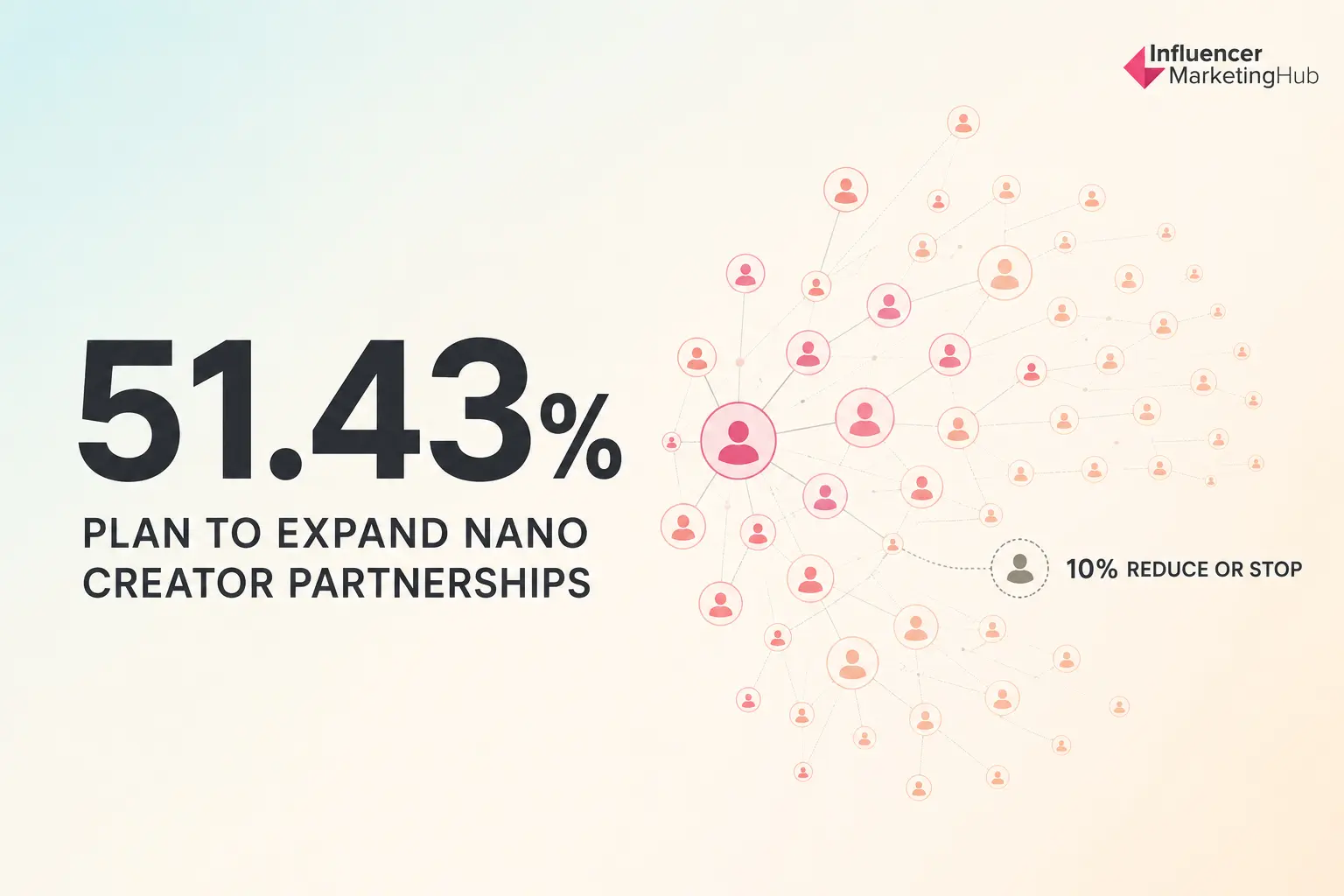
The need for better discovery becomes easier to understand when we look at creator volume. Some 51.43% of marketers plan to increase their use of nano creators or begin working with them. Only 10% expect to reduce or stop using the tier.
Nano creators can give brands access to specific communities, credible recommendations, and a larger supply of content at a lower individual cost. The tradeoff is coordination. What looks inexpensive at the creator level can become operationally demanding once a program includes dozens or hundreds of briefs, contracts, approvals, and payments.
10. Micro Creators Have the Strongest Expansion Signal
Micro creators show an even stronger growth pattern. A combined 52.83% of marketers plan to increase their use of micro creators or start working with them. Only 7.55% plan to reduce their use, and none said they intended to stop entirely.
This helps explain why micro creators remain so important to campaign planning. They give brands more audience scale than nano creators while retaining the focused communities and accessible pricing that make smaller partnerships attractive. They can also support always-on programs more efficiently than a strategy built around a small number of expensive launches.
11. Half of Marketers Plan to Expand UGC Creator Partnerships
The shift toward smaller partners extends beyond traditional influencers. Half of respondents plan to increase their use of UGC creators or begin working with them, with none reporting plans to reduce or stop.
UGC creators are typically hired for their production ability rather than access to a large audience. The brand receives platform-native creative that can be used in ads, product pages, email, or organic social content. That makes UGC particularly useful for teams that need more creative variations without paying for distribution every time.
12. Rising Creator Costs Are Marketers’ Leading Influencer Challenge
Smaller creators may be gaining share, but that has not removed pricing pressure. Rising creator costs are the leading challenge for 35.4% of marketers, well ahead of any other individual issue.
Measurement and attribution remain important, but the immediate concern for many teams is whether creator economics remain workable as programs scale. Brands need to understand more than the rate for a post. They also have to account for usage rights, production complexity, category exclusivity, revisions, paid amplification, and the internal cost of managing the relationship.
That pressure brings us to the creator side of the transaction, where headline budget growth has produced a far less even financial picture.
Influencer Pricing, Compensation, and Partnership Statistics
More money is entering creator marketing, but it is not reaching every creator equally. Current compensation data shows a market with modest payments at one end and heavy concentration at the other. It also shows why creators increasingly care about continuity, creative input, and fair compensation for extended usage.
13. Around 80% UGC Creator Costs Fall Below $500
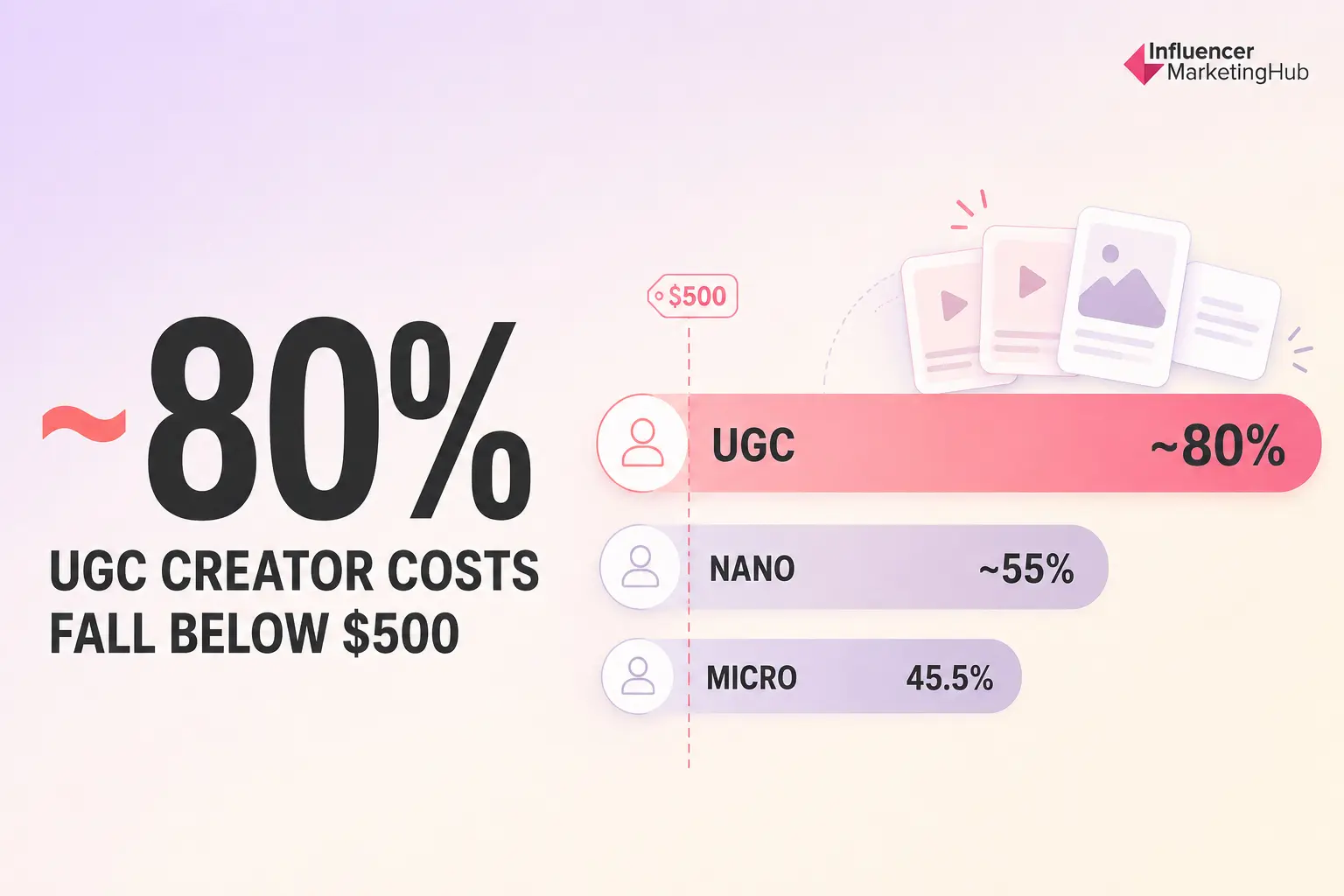
User-generated content remains one of the more accessible ways to increase creator content volume. In IMH’s 2026 survey, roughly 80% of UGC creator cost ranges were below $500. The corresponding share was approximately 55% for nano creators and 45.5% for micro creators.
Sub-$500 pricing helps explain why UGC has become attractive to brands that need a steady flow of ad creative.
Still, the cheapest asset is rarely the whole story. A simple product demonstration and a scripted video carrying months of paid usage ask very different things of the creator. The deliverables, production demands, revisions, and rights should shape the final rate.
14. Average Creator Earnings Were $11,400, but the Median Was Only $3,000
Average compensation can make creator income appear more stable than it is. Across 14,400 creators paid through CreatorIQ campaigns in 2025, average earnings were $11,400 while median earnings were $3,000.
The gap tells us that a relatively small group of high earners pulls the average upward. The median gives marketers a clearer view of the creator in the middle of the distribution, who may receive intermittent brand work even as overall market investment rises.
15. The Top 10% of Creators Receive 62% of Creator Payments
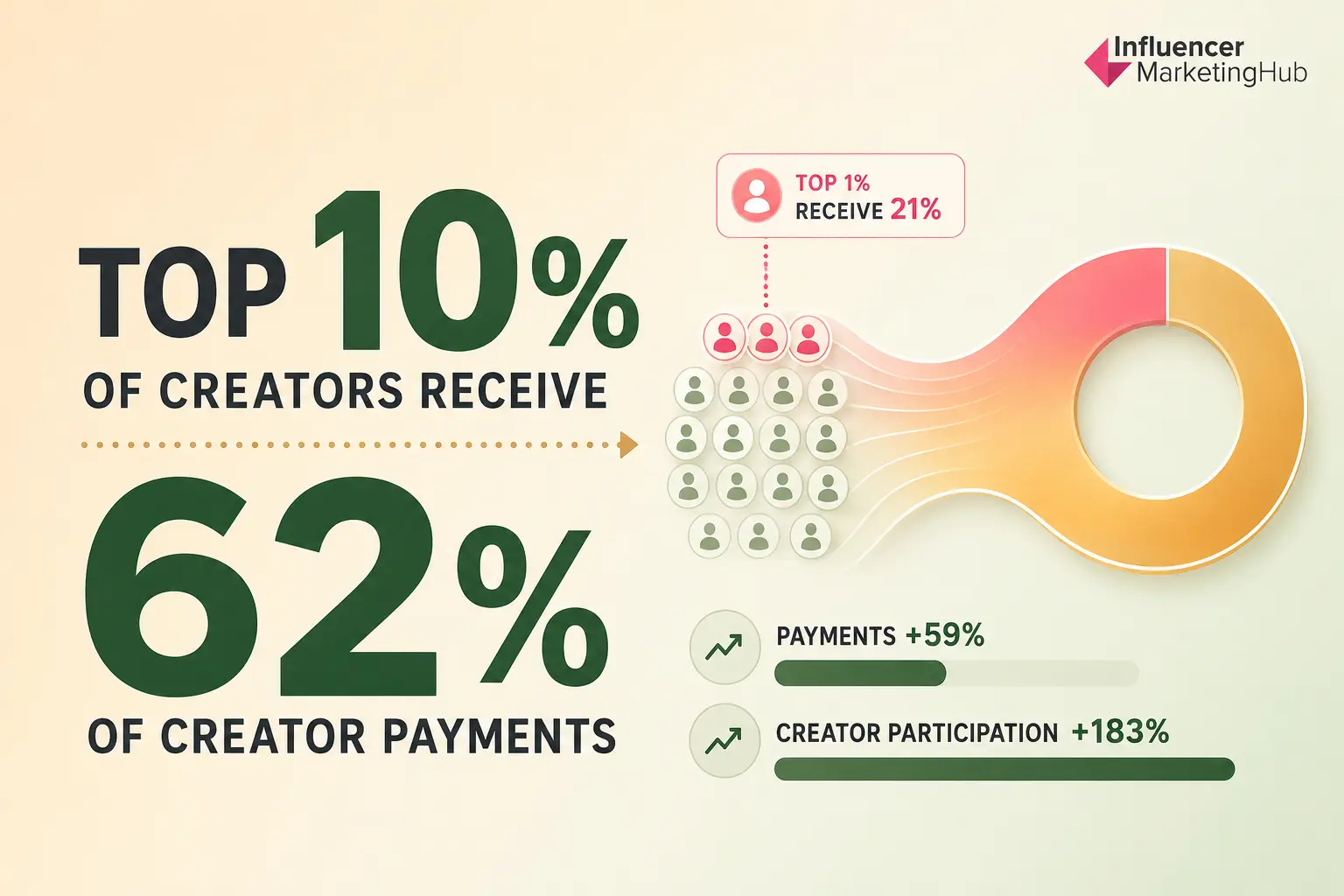
The concentration becomes clearer when payment volume is divided by creator group. The top 10% of creators received 62% of all creator payments, while the top 1% received 21%.
Total creator payments increased 59% year over year, but the number of creators participating in campaigns grew 183%. Creator supply is expanding much faster than payment volume, which means industry growth does not automatically create more stable earnings for the typical creator.
For brands, that imbalance represents both an opportunity and a warning. There is a large pool of capable creators beyond the highest-paid names, but sustainable partnerships still require compensation that reflects the work, rights, and business value involved.
16. Creative Control Matters to 99% of Creators
Compensation is only one part of a workable partnership. Some 99% of creators say creative control is important when working with brands.
Creators understand the language, pacing, references, and formats their audiences respond to. An influencer brief still needs clear claims, deliverables, deadlines, and brand-safety boundaries, but prescribing every line can remove the qualities that made the creator valuable in the first place.
The strongest briefs give creators a clear strategic destination and enough freedom to choose the route.
17. Creators Want Better Communication and More Consistent Collaboration
When CreatorIQ asked what would make partnerships more successful, 44% of creators selected better communication. More creative input followed at 43%, consistent or long-term collaboration at 41%, fairer pay or better usage compensation at 40%, and timely feedback at 39%.
These requests are highly practical. Unclear feedback creates revisions. Slow approvals disrupt publishing schedules. One-off deals require creators and brands to repeat the same onboarding and learning process.
A longer relationship gives both sides time to understand what works and improve the content rather than rebuilding the partnership for every campaign.
18. Usage Rights Are Increasingly Included in Creator Pricing
Creator content now travels well beyond the original post. Aspire reports that 77% of brands repurpose creator content in paid advertising, while 67% include usage rights in the creator’s initial contract or rate.
That is an important pricing development. A post published to a creator’s audience and an asset used for months across paid media do not deliver the same value to the brand. Contracts should specify where the content can appear, how long the brand can use it, whether paid amplification is permitted, and whether exclusivity limits the creator’s other work.
Once creator content is being purchased as both media and reusable creative, performance measurement becomes much more complicated, and much more important.
Influencer Marketing ROI and Measurement Statistics
The industry has made progress in connecting creators to business outcomes, but the measurement system remains fragmented. Marketers are trying to reconcile awareness, content value, platform engagement, affiliate sales, and longer-term brand effects inside one performance story.
19. Nearly Eight in 10 Enterprise Marketers Struggle to Measure Influencer ROI
Influencer marketing ROI sits comfortably at $5.78 for every dollar spent. But how successful are marketers in measuring it?
Well, according to Linqia’s survey of more than 200 enterprise marketers, 79% struggle to measure influencer marketing ROI.
The problem is rarely a complete absence of data. Marketers may have views, engagements, clicks, codes, affiliate sales, and platform reports, yet still lack a reliable way to connect those signals to incremental revenue or brand growth. Creator content can also influence a purchase without receiving credit when the customer later converts through search, retail, or another device.
However, we might see these numbers decreasing over time as brands adopt dedicated influencer marketing platforms to help them measure ROI. Platforms like Linqia combine campaign execution with real-time performance data, helping brands tie influencer content to measurable outcomes such as engagement, conversions, and overall campaign impact.
20. Attribution Is the Biggest Measurement Gap for 48% of Enterprise Marketers
That difficulty becomes more specific when marketers identify the missing capability. Some 48% name attribution as their biggest measurement gap, as per Linqia's data.
Attribution asks which interaction deserves credit for an outcome. That is difficult when a customer watches a creator video, searches for reviews, visits a product page, and purchases days later through another channel. Last-click reporting can understate creator influence, while assigning every exposed sale to an influencer can overstate it.
Brands need to define the question before choosing the method. Affiliate links and codes are helpful for direct response. Conversion lift, search lift, brand studies, and matched-market tests can capture effects that a click-based model misses.
21. Almost Two-Thirds Expect Influencer Campaigns to Pay Back Within a Month
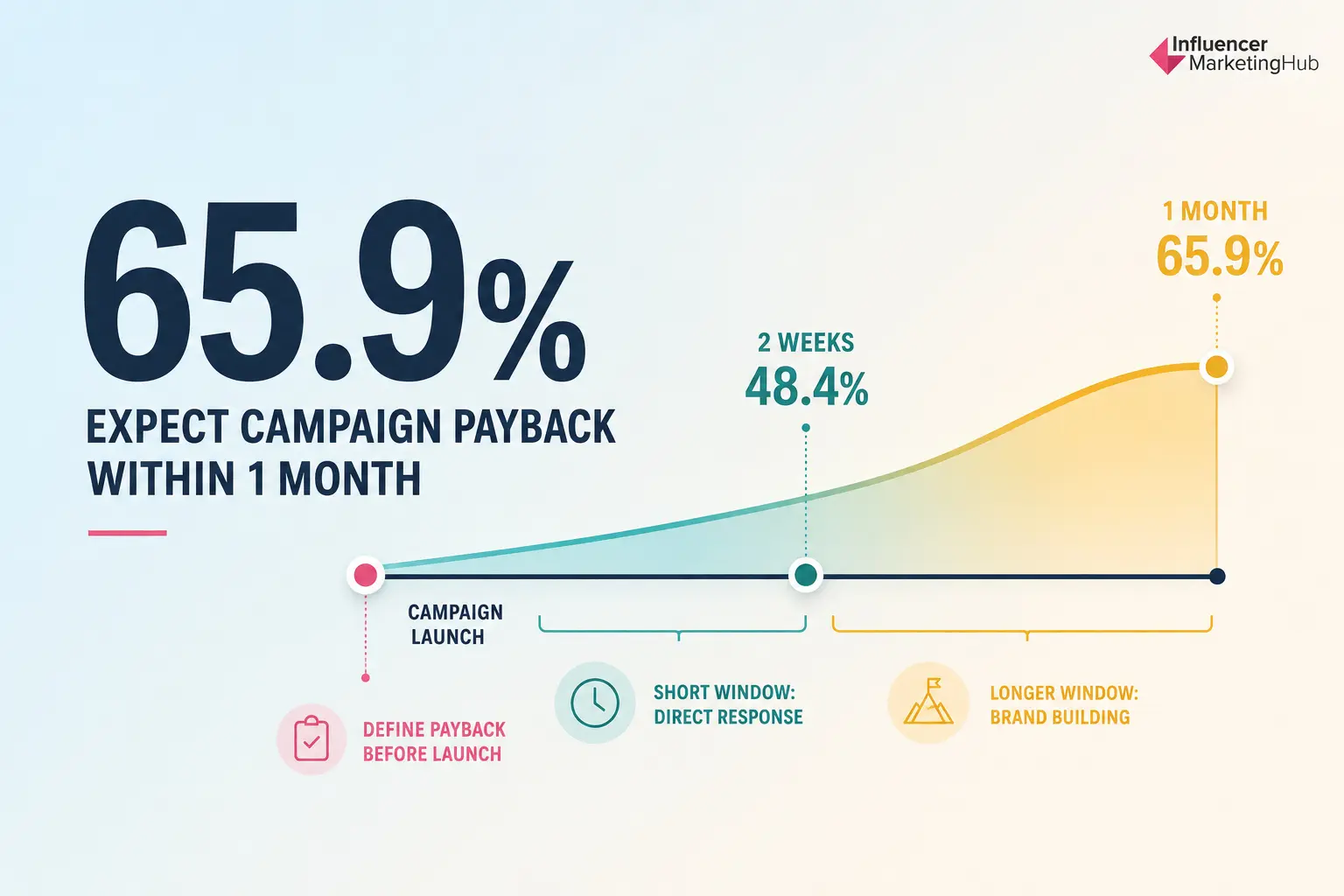
Even with those measurement limitations, marketers expect results quickly. Some 65.9% of marketers expect influencer activity to pay back within one month, including 48.4% who expect payback within two weeks, according to our 2026 Influencer Marketing Benchmark Report.
Short payback expectations can be reasonable for affiliate offers, TikTok Shop campaigns, app installs, or creator assets used in performance advertising. They are less suitable when the objective is awareness, consideration, or brand building.
Every campaign therefore needs an agreed definition of payback. It could mean attributed revenue, incremental profit, new-customer acquisition, lower creative costs, or another business result. Without that definition, teams can report the same campaign and still disagree about whether it worked.
22. Promo Codes Remain the Most Widely Used Influencer Tracking Tool
Simple tracking methods remain popular because they are easy to implement and explain. Promo or discount codes are used by 45.9% of marketers, followed by affiliate links at 26% and native shopping features at 25%, according to our 2026 Influencer Marketing Benchmark Report.
Codes can connect a transaction to a creator even when a link is not clicked, while affiliate links offer more detailed click and conversion data. Both methods have blind spots. Codes may be shared beyond the creator’s audience, and links can miss cross-device or delayed purchases.
The most credible measurement plans combine direct tracking with broader indicators such as search activity, product-page traffic, content performance, customer acquisition cost, and incremental lift.
23. Creators Produced 33 Times More Brand Content Than the Brands Themselves
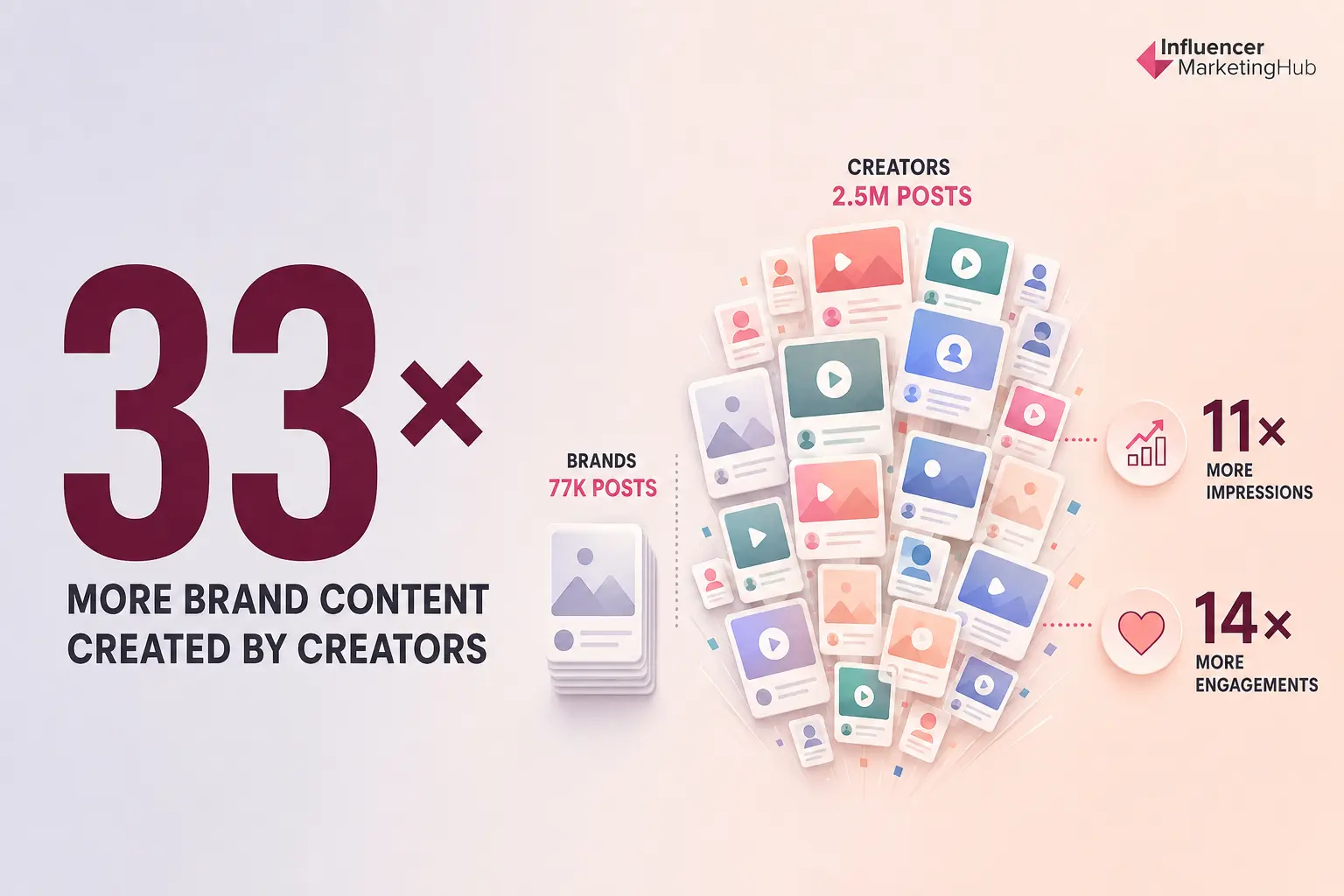
Sales are only part of the value creators provide. CreatorIQ analyzed Fortune 100 brands across TikTok, Instagram, and YouTube from January through August 2025 and found that creators produced 2.5 million posts featuring those brands, compared with 77,000 posts from brand-owned accounts.
That amounts to 33 times more content. Creator posts also generated 11 times more impressions and 14 times more engagements than the brands’ own content.
Put another way, creators were telling millions of versions of these brands’ stories while the brands were publishing from a comparatively small set of owned accounts. That gives a creator network a reach and variety of perspectives that even the world’s largest brands would struggle to produce internally.
24. Some 81% of Enterprise Marketers Say Creator Content Outperforms Brand Content
Measured scale is supported by marketer experience. Linqia found that 81% of enterprise marketers believe creator content outperforms brand-created assets. Every respondent said they repurpose creator content beyond the creator’s original post.
When four in five enterprise marketers see creator content winning against brand-made assets, reuse becomes part of the campaign plan rather than an afterthought. One creator video can move from an organic post into paid social, a landing page, a product listing, retail media, and email, extending its value well beyond the original collaboration.
Managing that volume of creators, assets, and performance data manually is difficult. AI has therefore moved quickly into the parts of the workflow where teams feel the most pressure.
AI, Virtual Influencer, and Fraud Statistics
AI is already embedded in creator marketing, but adoption is far from indiscriminate. Marketers are using it heavily for efficiency while remaining more cautious in areas where authenticity, relationships, and verification determine the quality of the outcome.
25. AI Is Already Used by 95% of Surveyed Brands
CreatorIQ reports that 95% of brand respondents use AI. The most common applications are caption generation at 45%, research at 44%, and video or graphic editing at 41%.
These use cases are concentrated around production and productivity. AI helps teams generate options, process information, and complete repetitive work faster. That is different from allowing it to decide which relationships to build or what a brand should stand for.
26. Creator Discovery Is AI’s Leading Influencer Marketing Use Case
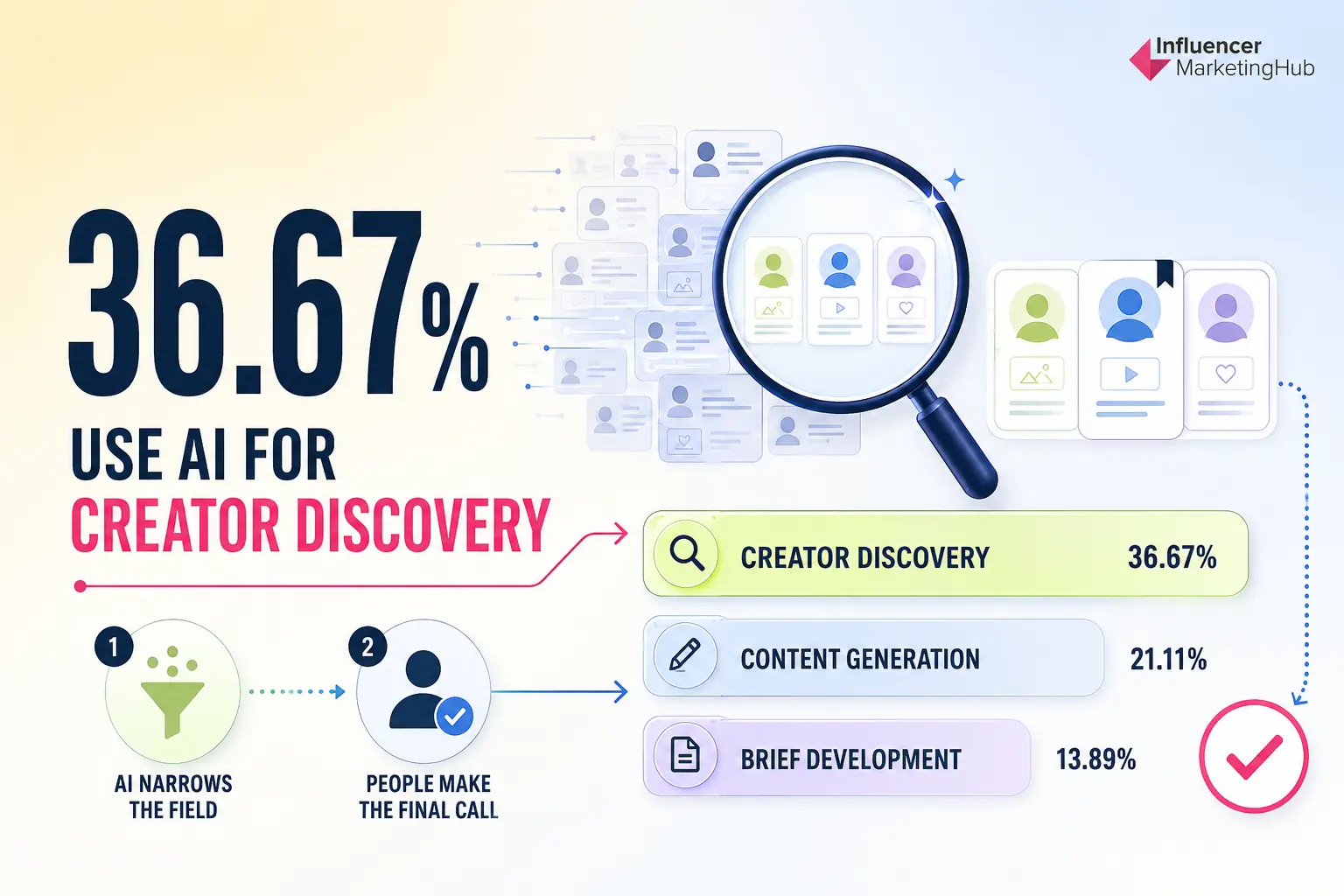
Within influencer workflows specifically, 36.67% of marketers use AI for creator discovery. Content generation follows at 21.11%, with brief development at 13.89%. This data comes from our 2026 Influencer Marketing Benchmark Report.
Discovery is a natural entry point because large creator databases are difficult to assess manually. AI can help filter accounts, analyze content themes, compare audience characteristics, and identify potential alignment more quickly.
The final decision still needs human review. Brand fit depends on tone, context, past behavior, audience credibility, and risks that may be missed when discovery is reduced to keywords and surface-level metrics.
This is precisely why brands choose to outsource key operations through dedicated influencer marketing platforms, tools, and software.
27. Some 89% of Enterprise Marketers Still Avoid Virtual Influencers
Marketers are comfortable using AI behind the scenes, but they are far more cautious about replacing the creator. Linqia reports that 89% of enterprise marketers avoid virtual influencers.
Virtual influencers offer control and production flexibility, yet they also raise questions about disclosure, credibility, emotional connection, and the value audiences place on lived experience. For most brands, the current preference is to use AI to support human creators rather than make artificial personalities the public face of the partnership.
28. Fake Followers Account for 56.5% of Reported Influencer Quality Issues
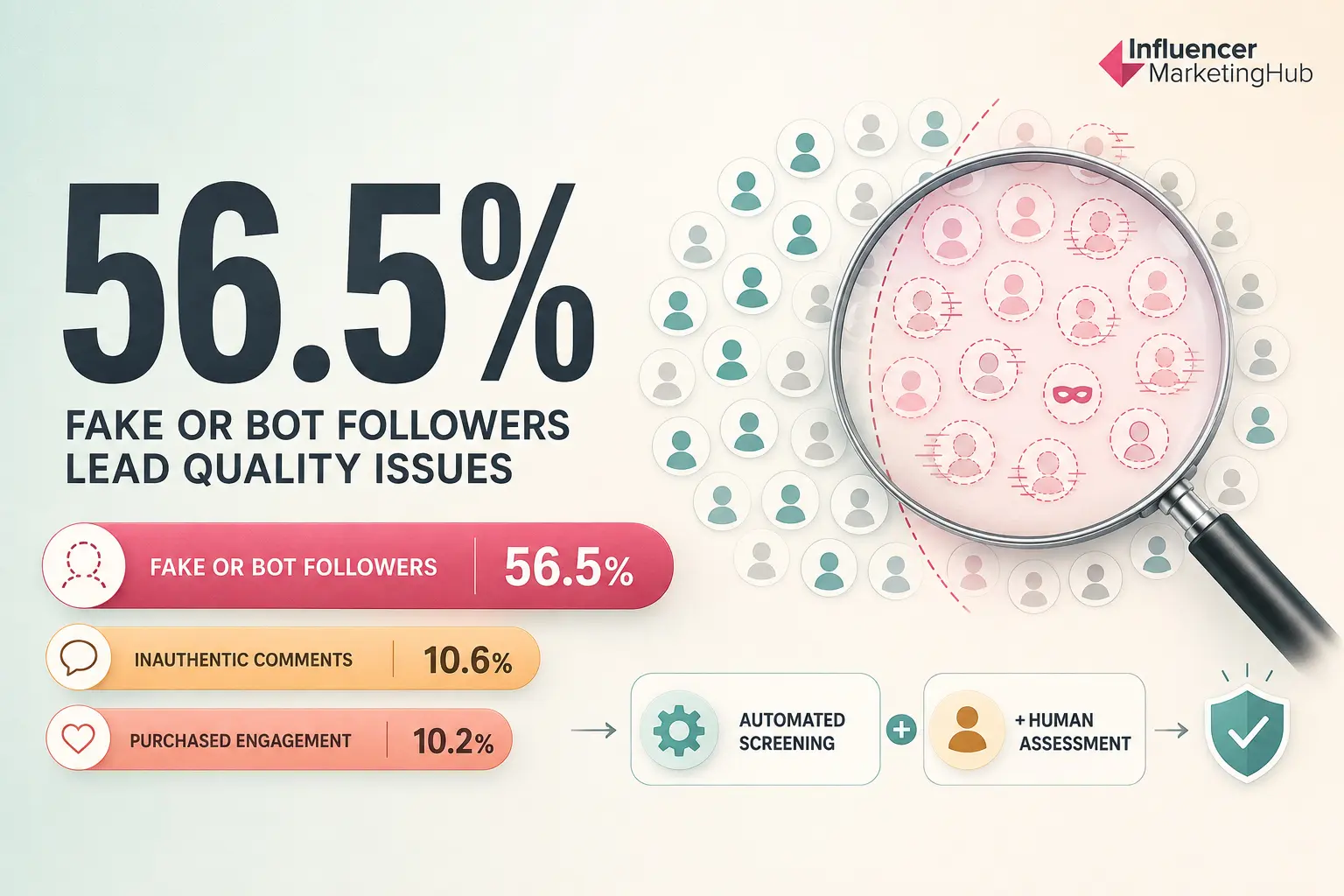
Human creators do not remove the need for verification. In our 2026 Influencer Benchmark Report, fake or bot followers account for 56.5% of selected fraud and quality issues. Inauthentic or templated comments contribute another 10.6%, while fake or purchased engagement accounts for 10.2%.
Follower count alone is therefore a weak basis for selection. Brands should examine audience growth patterns, follower geography, comment quality, engagement consistency, and previous sponsored performance before signing a creator.
AI can make those checks faster, but the data shows limited comfort with fully automating validation-heavy work. The safest model combines automated screening with a human assessment of the creator, content, and community.
Once the program has the right controls, the next decision is where that creator content should run.
Platform, Content Format, and Social Commerce Statistics
Platform leadership depends on the question being asked. TikTok attracts the strongest investment intention, Instagram remains the most commonly used, and each platform serves different creative and commercial roles. A useful strategy starts with the objective rather than a universal ranking.
29. TikTok Leads Marketers’ Platform Investment Intentions for 2026
TikTok appears in the 2026 influencer plans of 31% of the 2026 Influencer Marketing Benchmark survey respondents, making it the most frequently selected platform for investment intention.
TikTok’s lead gives it a distinct role in 2026: it is where many brands plan to place their next round of testing and growth. Its recommendation-driven feed allows creator content to travel beyond an existing follower base, while TikTok Shop brings discovery and conversion into the same experience. That combination makes the platform useful for testing creators, messages, and offers at speed.
30. Instagram Is Still the Most Commonly Used Creator Marketing Platform
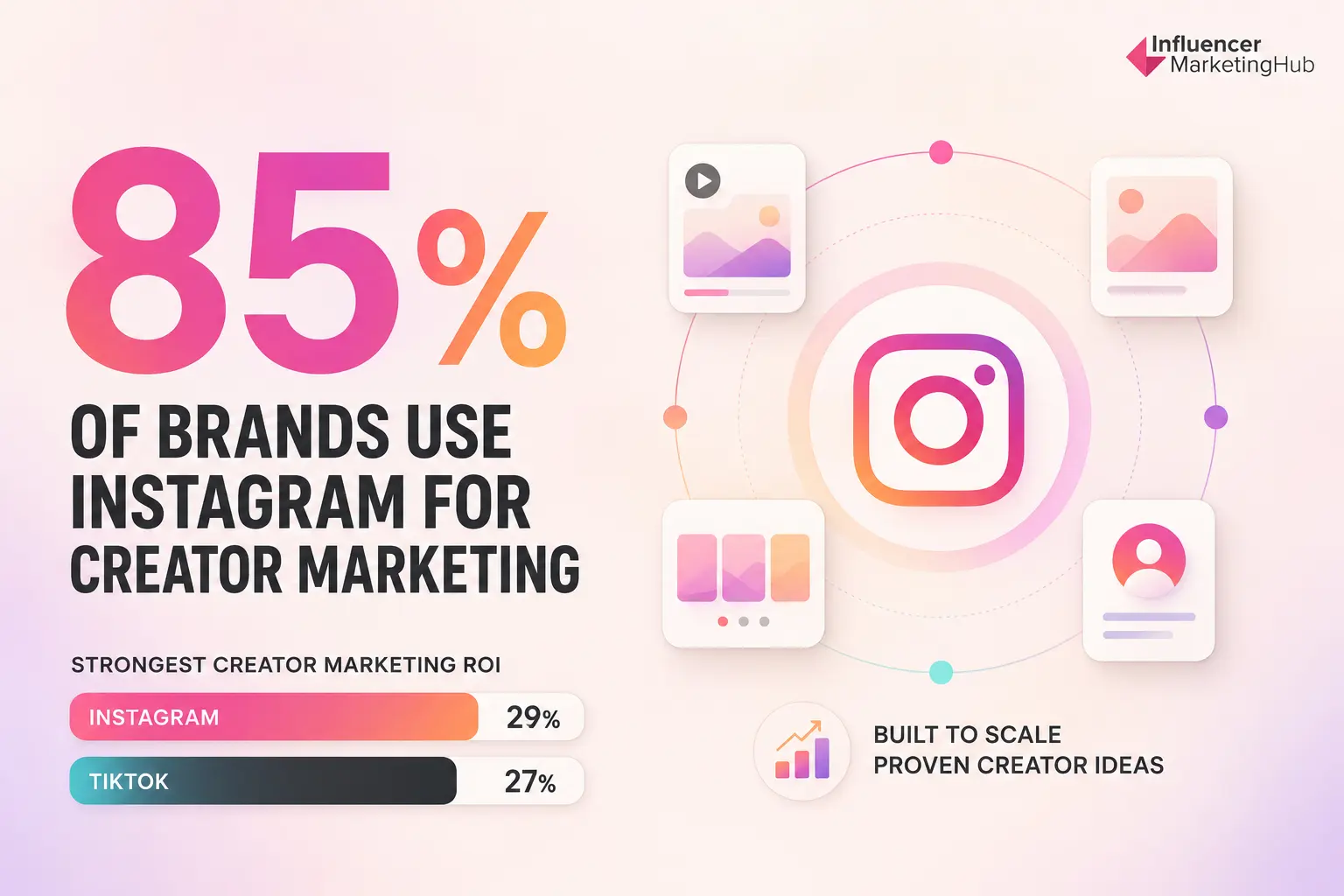
TikTok may be attracting the next wave of investment, but Instagram still carries years of creator relationships and campaign infrastructure. CreatorIQ found that 85% of brand respondents use Instagram for creator marketing.
Instagram also holds a narrow lead in perceived ROI. Some 29% of brand respondents say it produces their strongest creator marketing return, compared with 27% for TikTok.
Instagram’s mature creator ecosystem, familiar ad products, and established content workflows keep it central to many programs. TikTok offers a faster testing ground for discovery and commerce. For many brands, the practical choice is to assign each platform a role: TikTok for learning and momentum, Instagram for scaling proven creator ideas.
31. TikTok Leads Instagram Reels in Median Creator Engagement Across Every Tier
An analysis drawing on more than five million creator accounts found that TikTok’s median follower-based engagement ranges from 7.4% to 8.1%, depending on creator size. Instagram Reels ranges from 4.5% to 7.9%.
The difference is smallest among accounts with 1,000 to 10,000 followers, where TikTok records 8.1% and Instagram Reels 7.9%. It widens among creators with more than one million followers: 7.6% on TikTok compared with 4.5% on Instagram Reels.
These follower-based medians give marketers a practical starting point when evaluating potential partners. The fairest comparison is between creators on the same platform and within the same audience tier, where the benchmark can help reveal whether an account is outperforming or trailing its closest peers.
32. Long-Form and Short-Form Video Lead Content Effectiveness
The platform mix may be changing, but video remains the clearest creative priority. Some 83% of IMH respondents place long-form video among their three most effective content formats, while 80% do the same for short-form video.
The formats solve different problems. Short-form video supports fast testing, repeated exposure, and platform-native discovery. Long-form video gives creators more room to demonstrate products, explain complex decisions, and build a persuasive story.
Brands do not necessarily need to choose between them. A long-form creator collaboration can generate several short-form cuts, while successful short-form concepts can identify the subjects that deserve deeper treatment.
33. Nearly One-Third of Brands Are Already Selling Through TikTok Shop
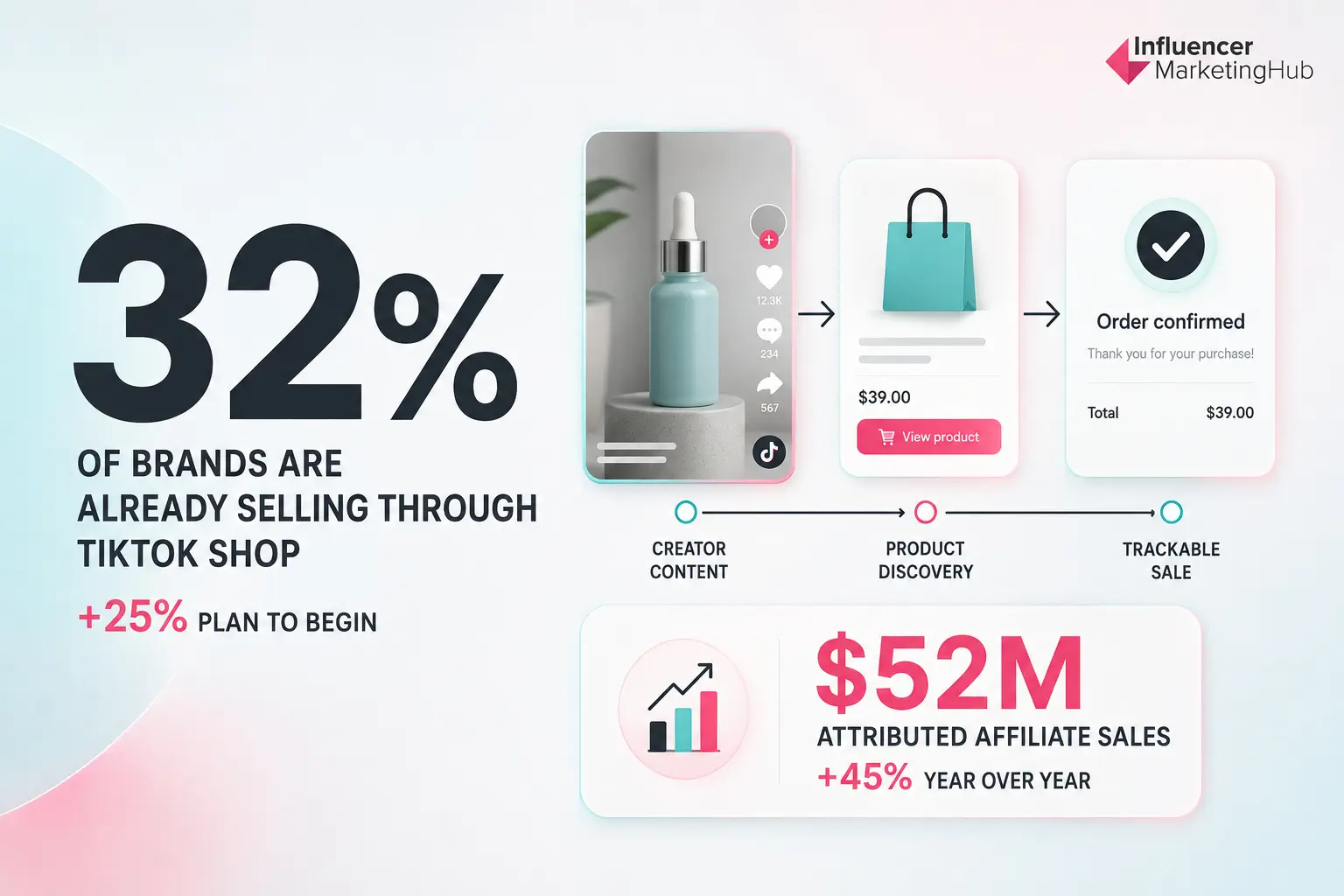
Video is increasingly connected to an immediate transaction. Aspire reports that 32% of brands are selling through TikTok Shop, with another 25% planning to begin.
Aspire also recorded $52 million in attributed affiliate sales through its platform, up 45% year over year. The growth shows what happens when creator discovery, product content, and a trackable purchase path start working together. Influencer marketing becomes easier to connect to revenue without losing the creator-led experience that generated the interest.
Social commerce gives brands a clearer route from content to sale, but it also increases the need for offer design, inventory readiness, accurate attribution, and compensation structures that reward creators for performance.
The commercial potential is clear. The final question is whether consumers continue to trust the people making those recommendations.
Influencer Marketing Consumer and Trust Statistics
Consumer research reveals a tension that every brand should understand. Influencers continue to shape purchases, yet the credibility supporting that influence is fragile. Transparency and honest product experience determine whether a commercial relationship strengthens trust or damages it.
34. Some 58% of Consumers Have Purchased Because of an Influencer Endorsement
More than half, 55.5%, of consumers report purchasing a product or service because of an influencer endorsement. The figures are even more surprising when we look at the fact that another 35% reported making between four and six purchases based on influencer content, according to a BBB National Programs' Influencer Index study.
The data confirms that creator influence extends beyond awareness and engagement. Recommendations can translate into repeated buying behavior, particularly when creators demonstrate how a product works, place it in a recognizable context, or answer questions a conventional advertisement leaves unresolved.
That influence also raises the standard for brand and creator responsibility. A recommendation that affects a purchase needs to be clear about the commercial relationship behind it.
35. Only 5% of Consumers Completely Trust Influencer Content
Purchase influence does not equal unconditional trust. In the same BBB National Programs study, only 5% of consumers said they completely trust influencer content. Although 74% trust it at least somewhat, that confidence can disappear quickly when a partnership is concealed.
Some 70% feel deceived when they discover that a brand relationship was not disclosed. By contrast, 79% say authentic reviews, even reviews that include something negative, increase their trust. Transparency about brand relationships raises trust for 71%.
The lesson for marketers is straightforward. Consumers do not require creators to pretend that sponsorships do not exist. They want the relationship disclosed and the recommendation to sound like a considered opinion rather than a purchased script.
What These Influencer Marketing Statistics Mean for 2026
Influencer marketing is growing because creators now contribute to several business needs at once. They produce content, distribute it through trusted voices, reach communities brands struggle to access directly, and increasingly connect attention to sales.
The expansion also exposes weak operating systems. Larger budgets will not automatically produce better results if a brand cannot select credible creators, move content through approvals, define usage rights, or connect campaign activity to an agreed business outcome.
The 2026 data points toward a more disciplined model. Brands are keeping strategic ownership and measurement close, using agencies where specialist capacity matters, expanding nano, micro, and UGC creator networks, and applying AI where it reduces manual work. At the same time, creator partnerships need clearer communication, fair compensation, creative freedom, and enough continuity to improve over time.
For marketers planning their next campaign, the priority is no longer simply adding more creators. It is building a system in which the right creators can produce credible content, that content can travel across channels, and every stakeholder understands how success will be judged.
Liked These Insights? Find Out More Essential Influencer Marketing Statistics for 2026
These influencer marketing stats should give you a better understanding of what the current landscape looks like and how you can shape your own strategy. You can use the data to understand which platforms to use, what types of influencers to work with, and how much you can budget for influencer marketing.
If you liked these insights, check out some of our other stats to inform your marketing for 2024:
Frequently Asked Questions
What trends are shaping the influencer marketing industry?
Technological innovations, changing consumer behaviors, and the need for transparency are impacting the way brands and influencers approach marketing campaigns.
Also, social media platforms are now becoming easier to use and more accessible, making it relatively easy for anyone to become influencers themselves.
How many followers do I need to have to become an influencer?
Ideally, you need between 1,000 and 10,000 followers to become an influencer, specifically a nano-influencer. If you’re just starting and building your follower base, make notes on important metrics, such as your engagement rates. Nano- and micro-influencers have higher engagement rates, which are more attractive to some brands than the number of followers, so make sure you drive engagement on your account regularly.
What are the most important metrics to track when measuring influencer marketing ROI?
The most important metrics to track when measuring influencer marketing ROI include:
- Engagement rate (likes, comments, shares, clicks)
- Conversion rate (leads, sales, sign-ups, downloads)
- Reach and impressions
- Cost per mille (CPM)
- Follower growth
By monitoring these key performance indicators, brands can gain a comprehensive understanding of the effectiveness and profitability of their influencer campaigns.

SUGGESTED

Influencer Marketing Benchmark Report 2026
Influencer marketing in 2026 is evolving fast. Learn how companies can leverage AI...

What is Influencer Marketing? The Ultimate Strategy Guide for 2026
Learn how influencer marketing drives brand awareness engagement and sales with our...
Influencer Marketing 2025: Balancing AI Efficiency, Budget Pressure, and Human-Centric Creativity
$32.55B market AI’s real impact shifting budgets TikTok’s US ban fallout and what 315...