
Influencer marketing and affiliate marketing have spent years meeting in the same budget spreadsheet while behaving like separate disciplines. One trades in creative, community, and attention; the other trades in links, actions, and attributable revenue. Odience is built at the point where those two disciplines finally share a workflow.
Odience reflects that performance-first worldview throughout its product: creators receive unique tracking links, conversions arrive through postbacks, suspicious traffic is filtered, results can be segmented by country and device, and approved earnings move into a wallet with several payout rails.
Many influencer platforms begin with a vast indexed database and lead marketers toward outreach. Odience begins with the commercial agreement. What action should a creator generate? What will that action be worth? Which audience, geography, social account, and landing page should produce it? The answers become a trackable offer that a creator can apply for, promote, analyze, and eventually cash out.
The operating model is deliberately uneven at this stage. Creators receive a self-service platform; brands receive a managed service supported by account managers. The team handles campaign setup, creator matching, applications, execution, and optimization while the brand-facing product remains in beta. That arrangement gives lean marketing teams a remarkably hands-off route into performance influencer marketing. It also defines the platform’s present boundary: Odience currently gives brands an operated growth channel. A complete do-it-yourself influencer SaaS suite sits further along its roadmap.
There is already meaningful scale behind the model. Odience has paid more than $2.8 million to creators across nearly 2,000 completed campaigns, and the platform reports coverage across 195 countries. Its public partnership roster includes Razer, Disney+, MacKeeper, Arknights: Endfield, Headway, Wargaming, Hero Wars, and IPVanish. For a young platform with a brand product still under construction, those numbers make the performance story worth taking seriously.
Odience brings affiliate economics into an influencer workflow. Creators choose suitable offers, receive trackable links, monitor audience actions and earnings, and request payouts from one account. Brands use Odience’s managed team to recruit creators and run CPA, revenue-share, or hybrid campaigns tied to measurable outcomes.
Pricing
Odience is free for creators to join and use. The brand proposition follows a performance model. The monthly platform fee is $0, while campaign economics are built around the results or hybrid compensation specified in each offer. Brands should expect commercial terms to vary with the campaign, payout model, creator requirements, geography, and level of managed support.
The platform supports three primary creator payout structures:
- CPA: A fixed amount for a qualifying action such as a sign-up, install, download, purchase, or another brand-defined conversion.
- Revenue Share: A percentage of the revenue generated through the creator’s unique link.
- CPA + Fixed: A hybrid deal combining guaranteed compensation with a performance payment.
Odience can also combine revenue share with CPA for individual partnerships. This flexibility matters because pure commission deals shift most of the risk to the creator, while hybrid structures give brands performance accountability and give creators some guaranteed value for the production work.
CPA offers may use Bronze, Silver, and Gold tiers. Every creator enters at Bronze, while Silver and Gold rates reflect sustained performance and are reassessed monthly. The structure gives strong converters a path toward better economics at any follower count. A creator’s first active partnership also triggers a $10 welcome bonus.
The payout mechanics deserve as much attention as the headline price. Confirmed commissions follow a net-30 schedule, payment requests are available once per calendar month, and the minimum depends on the payout method. Bank transfers and USDC require $100, PayPal and similar services require $25, and qualifying low-fee e-wallets require $5. Bitcoin thresholds move with transaction costs. Payment providers may charge processing fees, and all platform payouts are denominated in U.S. dollars.
Creators should also keep the dormant-account policy on their radar. An account becomes dormant after 150 consecutive days of inactivity across offers, earnings, and payout requests. It can then incur a monthly fee equal to 10% of its wallet balance, with a $100 minimum; a balance below $100 can be consumed in full. This makes regular withdrawals and basic account housekeeping part of using Odience responsibly.
The Details
Odience Features Rating
- Performance-Based Offer Marketplace
- CPA, Revenue Share, And Hybrid Compensation
- Creator-Specific Conversion Tracking
- Multi-Channel Affiliate Promotion
- Granular Performance Reporting
- Global Creator Wallet And Payouts
- Agency Roster Management
- Human Creator Validation And Brand Approval
- Traffic Quality And Conversion Validation
- Offer-Level Compliance And Brand Safety
Odience’s creator experience starts with a short but useful onboarding sequence. Registration works through Google or an email and password, followed by email verification. The creator then supplies a full name, mandatory birth date, display name, profile description, and at least one social account. Up to five interests can be selected to improve offer personalization. Accounts can also enable two-factor authentication, edit connected profiles, and configure offer and finance notifications separately for email and in-app delivery.
The platform is open to creators across the size spectrum. Odience explicitly welcomes accounts ranging from roughly 500 to 500,000 followers, placing audience relevance and conversion potential ahead of celebrity scale. Every creator connects their social profiles and passes a manual validation process. Odience uses those connections to collect follower counts, engagement signals, audience demographics, and other account-level information, with trusted third-party data adding further context. The service requires users to be at least 18 or the legal age of majority in their country.
This opt-in network gives Odience cleaner creator identities than a database assembled entirely from public profiles. It also creates a smaller and more controlled supply pool than the hundreds of millions of searchable profiles offered by discovery-first competitors. Brands currently experience this network through the account team. Campaign managers match creators using audience demographics, niche, platform presence, engagement, campaign goals, and historical performance, then oversee the relationship on the brand’s behalf.
The strongest public campaign evidence currently clusters around gaming, consumer software, apps, and digital entertainment. Odience’s recent addition of fashion brand ALOHAS shows the network widening into new consumer categories. Brands entering a newer vertical should use the campaign-planning stage to establish how much proven creator depth Odience already has in their target countries and niche.
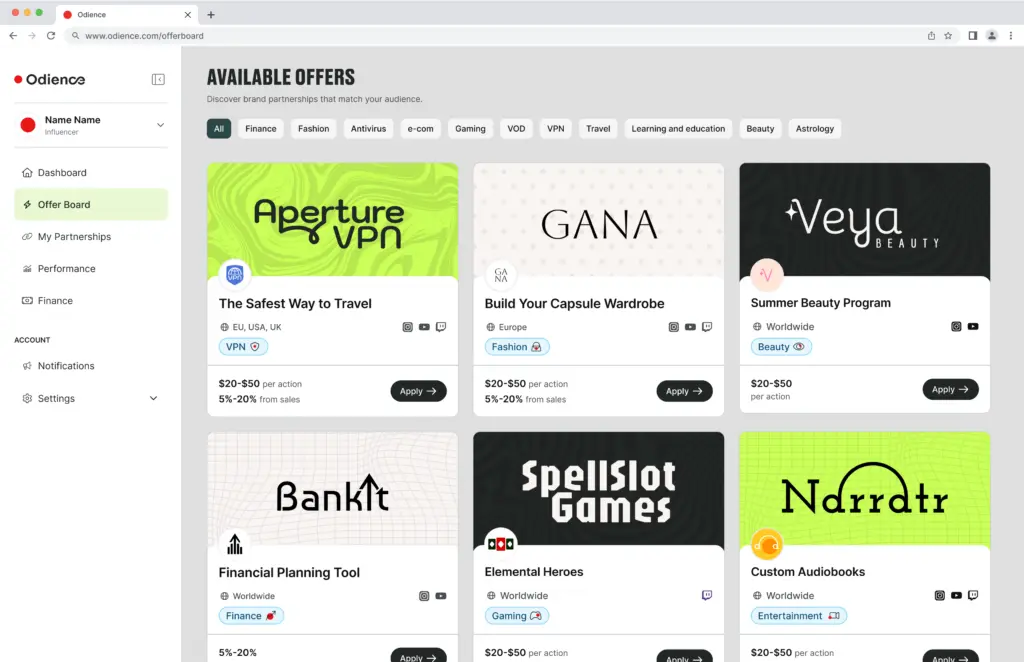
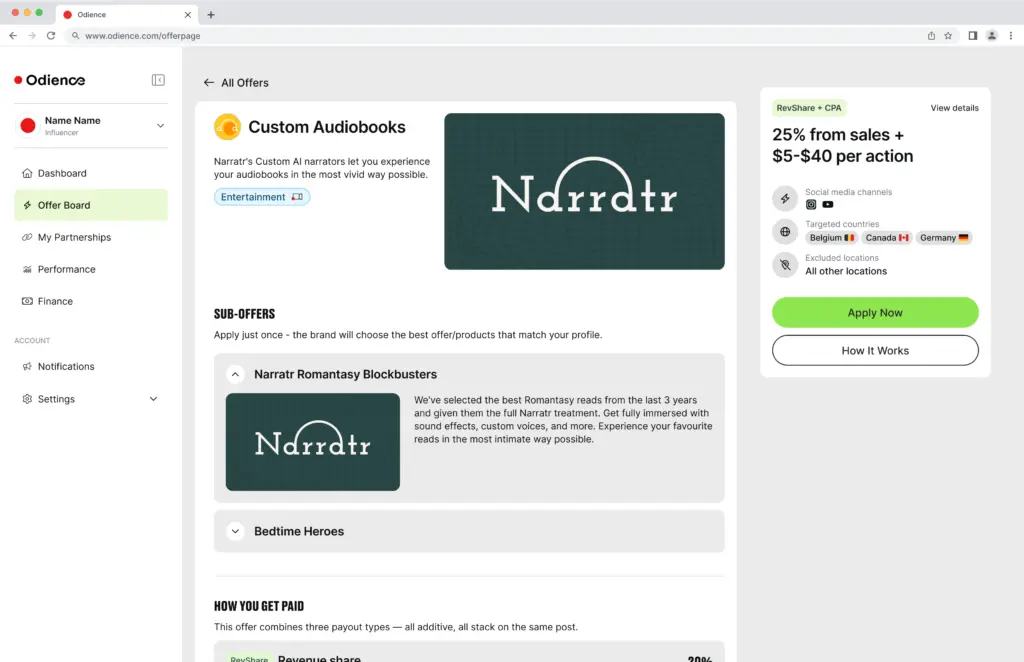
For creators, the central workspace is the Offer Board. Each offer card presents the brand and campaign name, category, payout type, eligible locations, supported social channels, and any connected sub-offers. Sub-offers allow one brand campaign to present multiple products or landing pages. An application covers every associated sub-offer, after which Odience and the brand review the creator’s suitability.
Approved creators receive a unique offer link. The link contains an identifier for the source of the traffic, while cookies and postback events connect downstream actions to the partnership. A campaign with multiple products produces a separate link for each landing page. A creator with several connected social accounts also receives channel-specific links, which lets Odience compare the activity generated by Instagram, TikTok, YouTube, Twitch, or another approved source.
This is a deceptively important detail. Affiliate attribution often becomes messy when one creator distributes the same link everywhere. Odience ties the link to the social account approved for the campaign and can flag a source mismatch when promotion comes from a different account or channel. That gives brands a more defensible view of which partnership and content environment produced the action.
The My Partnerships area keeps the workflow understandable after the creator applies. Applications can be grouped as active, pending, paused, declined, or ended. Declined applications may include a reason from the brand, while accepted offers expose the relevant links through both My Partnerships and the main dashboard. Links can be used across Instagram, TikTok, YouTube, Snapchat, Twitch, Kick, X, Facebook, and Discord, including placements such as bios, Stories, and live-chat environments when permitted by the campaign.
Behind that simple creator flow sits a heavily managed brand operation. The Odience team works with the advertiser to define the target countries, preferred platforms, compensation structure, landing pages, and campaign requirements. The offer then appears to suitable creators, applications are reviewed, approved partners receive their links, and account managers monitor performance and optimize the program. Brands gain execution capacity while Odience supplies the influencer team.
Odience’s fraud controls are central to that promise. Every creator is manually reviewed, connected accounts verify the origin of the promotion, and conversions pass through in-platform checks designed to identify bots, artificial traffic, incentive traffic, unsupported countries, and other suspicious activity. The commercial logic follows the same principle: earnings remain pending while the conversion is validated, then move into the available balance after approval.
The creator-facing reporting is one of the platform’s strongest pieces. The Detailed Reporting dashboard combines headline metrics, charts, a geographic map, and a granular table. Creators can filter by:
- Date range
- Country
- Social platform
- Offer
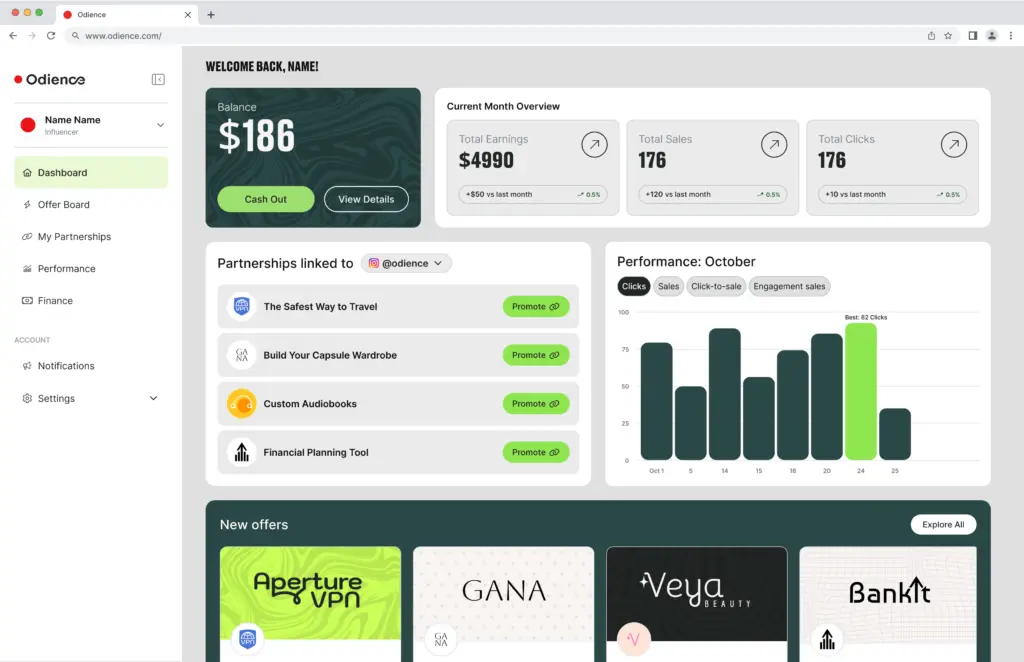
They can then group the data by social account, offer, sub-offer, country, date, traffic source, or device type. Permanent columns cover clicks, paid conversions, other funnel events, earnings, and fallback clicks. Fallback clicks identify traffic that failed to reach the intended offer because it came from a bot or an ineligible geography. That distinction is valuable: a creator can separate weak conversion performance from traffic that the campaign could never accept.
Reports can be downloaded in CSV, XLSX, or XML format. The range of exports supports further work in spreadsheets, finance systems, and internal reporting pipelines. All reports use Central European Time, and the timezone is fixed. Global creators may need to reconcile Odience’s daily totals with platform-native analytics or ecommerce systems operating in another timezone.
Finance is built directly into the product. Creators create a finance account, enter billing details as either an individual or a company, and choose a payout method separately. The wallet distinguishes pending from available funds, while Wallet Actions records the date, description, action type, amount, and running balance. Filters make it possible to isolate earnings, fees, bonuses, and other activity over custom date ranges.
When the balance clears the relevant threshold, the creator chooses an amount and payment account, then submits a cash-out request. Odience supports bank wire, PayPal, USDC, Bitcoin, Revolut, Skrill, and Capitalist. Transaction history shows payout status, and the platform automatically generates a downloadable PDF invoice after payment is issued. For creator agencies managing international talent, the combination of entity-level billing details, several payout rails, and automatic invoices removes a meaningful amount of operational friction.
Brand-side software depth is the area to watch next. Odience concentrates its current product on offer distribution, attribution, fraud control, reporting, and creator payments. Brand-accessible discovery, saved creator lists, CRM records, automated outreach, briefs, content approval, deliverable calendars, rights management, asset libraries, paid-media reuse, and white-labeled reports remain future-facing capabilities. The company’s stated destination is a secure, scalable, self-service affiliate platform for influencer partnerships, and opening the brand layer would turn today’s managed engine into a broader SaaS product.
The current model already has proof beyond payout volume. One extended creator partnership produced more than 100 videos for six brands and recorded a 19.6% conversion rate. That example points to the type of relationship where Odience makes the most sense: a creator stays with several aligned offers long enough to learn what converts, while the platform turns that learning into performance history and better future matching.
That also clarifies buyer fit. Odience is strongest for digital products, subscriptions, apps, ecommerce offers, and other businesses with an online action that can be defined and returned through a tracking system. Long-running creator partnerships give the platform more data and give creators time to improve how they present the offer. Pure awareness launches, offline-heavy retail campaigns, and teams requiring direct control over a large creator database or content-production workflow will find the current product narrower.
Conclusion
Odience calls itself an influencer affiliation platform, and that description is more useful than the usual “end-to-end” label. It tells buyers where the product places its center of gravity. The creator brings the audience and the content; the brand defines the valuable action; Odience handles the tracked path between them and the money that follows.
Attribution, postbacks, traffic quality, geographies, devices, conversion validation, balances, and payment rails are familiar territory for a performance advertising company. Odience has translated those mechanics into a creator experience that remains approachable: select an offer, apply, receive a channel-specific link, promote it, study the results, and withdraw the earnings.
The platform’s managed brand service is both an advantage and a dividing line. Brands gain experienced hands and avoid a monthly SaaS bill, while Odience’s team absorbs creator selection and day-to-day execution. Marketing departments looking for internal control, searchable discovery, relationship management, content approvals, and reusable asset workflows will need the brand-facing beta to mature.
As it stands, Odience is a focused and technically credible bridge between influencer trust and affiliate accountability. Its best features operate as one system: verified creator identities improve matching, channel-specific links improve attribution, fraud checks improve the quality of reported conversions, and the integrated wallet closes the loop by turning approved actions into creator payments. That coherence matters more than the length of the feature list.
With more than $2.8 million already paid to creators, nearly 2,000 completed campaigns, and brand participation from Razer, Disney+, Headway, Wargaming, and others, Odience has moved beyond the concept stage. Its next act depends on how much of the managed brand workflow becomes software. The creator side already makes performance partnerships unusually clear; a mature self-service brand side could make the same system considerably more powerful.