
Online businesses use crypto for customer payments, treasury management, asset conversion and embedded financial services, so the exchange behind those operations can affect everything from settlement to day-to-day fund management. With business accounts, institutional trading platforms and non-custodial services offering very different models, which crypto exchanges are the strongest fit for online businesses in 2026?
- Why Do Cryptocurrencies Rise in Value?
- How to Buy Cryptocurrencies?
- Can I Purchase Crypto Through a broker?
- New Cryptocurrencies Listed
- Best Cryptocurrency Exchanges
- What Each Business Actually Uses a Crypto Exchange For
- What Separates a Business Crypto Exchange From a Retail Platform?
- Crypto Exchange, Payment Gateway or Crypto-as-a-Service?
- Regulation, Custody and Counterparty Risk
- How to Choose the Right Crypto Exchange for Your Business
- Trading Cryptocurrency: The Bottom Line
- Frequently Asked Questions
Why Do Cryptocurrencies Rise in Value?
The value of cryptocurrencies is determined by supply and demand. People invest in cryptocurrencies because they believe that they will be worth more in the future or that they can make money by speculating on their price changes.
Cryptocurrencies are also deflationary, meaning that the total number of them in circulation decreases over time as fewer are mined. This deflationary nature contributes to an increase in their value over time.
How to Buy Cryptocurrencies?
Cryptocurrencies cannot be purchased from a regular currency exchange office. You must buy them online on a crypto exchange.
Crypto exchanges generally support the buying, selling, and trading of non-fungible tokens or NFTs. Some may also support fiat currencies such as US dollars or other cryptocurrencies like Bitcoin, Ethereum, and Litecoin.
Can I Purchase Crypto Through a broker?
Cryptocurrency brokers are a new and growing industry. A brokerage can make it easier to invest in cryptocurrencies with their easy-to-use interfaces that allow you to trade with ease and make sure that there is no complexity involved as they do the exchanges for you.
Some brokering services charge higher fees than other platforms, but they offer you the convenience of trading cryptocurrencies on your behalf without the hassle of having to do it yourself.
New Cryptocurrencies Listed
Best Cryptocurrency Exchanges
An online business may need crypto for customer payments, asset conversion, treasury management or embedded financial services. Those workflows place different demands on an exchange, from API performance and asset coverage to trading costs and account controls. The five platforms below stand out for different business priorities.
1. ChangeNOW
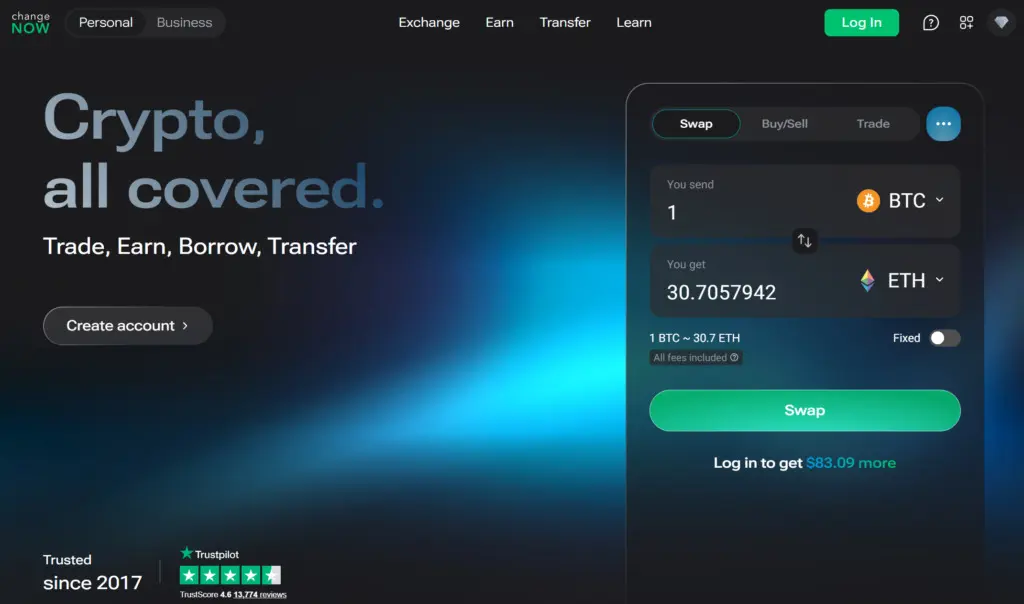
ChangeNOW is a strong option for businesses that need to add crypto conversion without taking custody of the assets being exchanged. Its business infrastructure includes an Exchange API, widget and white-label solutions, allowing wallets, fintech products and other online services to integrate swaps into their own interfaces.
The platform currently supports more than 1,000 currencies and over 1 million currency pairs. ChangeNOW reports an average exchange time of about one minute, while its infrastructure page reports 99.99% uptime and 350 ms response times. That combination makes it particularly relevant to businesses that need broad asset coverage and fast embedded conversion rather than a conventional trading interface.
2. Coinbase Business
Coinbase Business combines crypto trading and payments within a dedicated business account. Its current offering covers payments, transfers, trading and API-based workflows, while Coinbase also provides business-focused tools for checkout and payment collection. The company currently makes Coinbase Business available in the US and Singapore, with plans to enter additional markets.
That setup suits an online company that needs several crypto functions under one operational account. A business can use the same provider for receiving crypto, moving funds and managing its digital-asset activity, while API access can connect those processes with its own systems.
Coinbase also separates Business from its institutional Prime offering. That distinction gives smaller companies a dedicated business product while larger organizations can move to a more institutional setup as their requirements change.
3. Kraken Institutional
Kraken Institutional is built around trading infrastructure for corporations, asset managers, market makers and other professional participants. Its current institutional exchange offering reports a baseline round-trip latency of 2.5 milliseconds, 99.9% uptime and capacity exceeding one million requests per minute. Kraken also supports spot and futures trading through its API and offers OTC, custody and prime services.
Those specifications make Kraken particularly suitable for businesses running automated trading or managing larger treasury operations. API connectivity can link execution and market data with internal systems, while institutional services cover workflows that require more than occasional asset purchases.
5. CoinJar
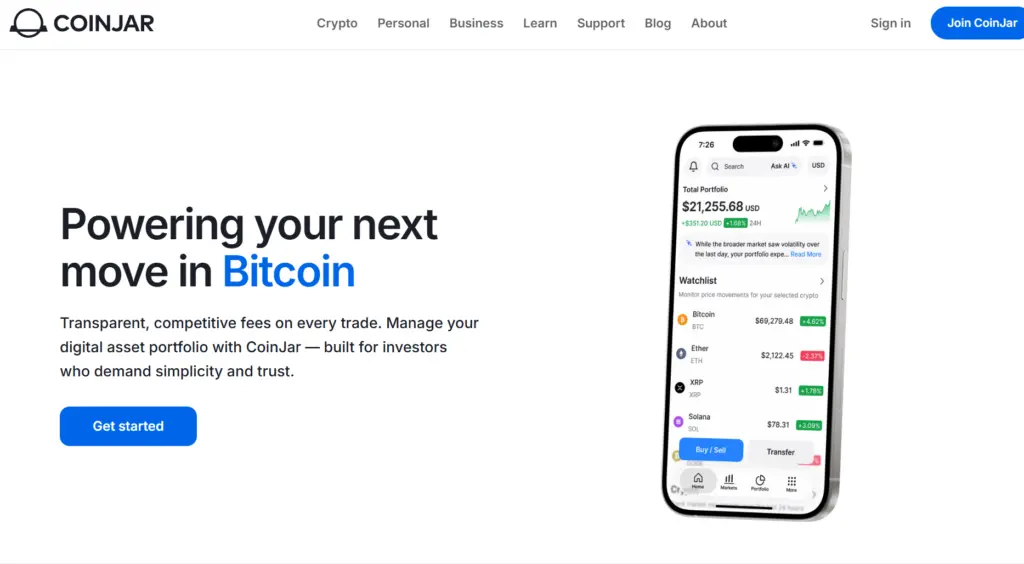
CoinJar is positioned specifically for professional traders, institutions and market makers. The platform supports more than 200 trading pairs, offers real-time trading and market-data APIs and provides a matching engine designed for low-latency execution. Its API can support algorithmic strategies, automated trading systems and custom trading applications.
Trading costs become especially relevant at higher volumes. CoinJar's current fee schedule lists a 0.06% taker fee and 0.02% maker fee for USD, AUD and GBP pairs once 30-day trading volume exceeds $6 million. Crypto-to-crypto and crypto-to-stablecoin pairs carry a 0.06% taker fee and 0% maker fee across volume tiers.
This makes CoinJar a useful candidate for companies where execution costs and API access are important to recurring trading activity.
6. Bisq

- Source: bisq.network

Bisq is an open-source, decentralized exchange that connects buyers and sellers. Launched in 2014, it was one of the first DAO or Decentralized Autonomous Organizations.
Unlike other crypto exchange platforms that are web-based and centralized, Bisq does not use any central server. This means it will take a very hard time for hackers to steal money from users since the information is only restricted to those involved in the transactions performed within your browser.
7. Huobi Global

- Source: huobi.com

Known for its strong presence in the Asian market, Huobi Global has a whole ecosystem of digital assets with over 400 cryptocurrencies that encompass staking, spot trading, crypto loans, and derivatives trading, to name a few. Moreover, the platform also supports fiat currencies such as the Chinese Yuan, making it an attractive option for those looking to invest in alternative coins or altcoins.
8. Crypto.com

- Source: crypto.com

Crypto.com, one of the world’s largest crypto exchanges and payment services providers, is a mobile app that aims to be your one-stop shop for anything crypto. It supports a wide range of cryptocurrencies, including Bitcoin, Ethereum, ad Litecoin, including their own products such as Crypto Earn, a rewards program where users can earn points when making purchases online using CRO coins. While the platform offers more tradable assets and lower trading fees, the interface is not as easy to navigate for those new to crypto trading.
9. KuCoin

- Source: kucoin.com

KuCoin is an up-and-coming cryptocurrency exchange platform that offers traders the opportunity to trade cryptocurrencies with fiat currencies like EUR, CZK, or USD. With more than eight million customers, it is one of the top 10 cryptocurrency exchange platforms by trading volume.
KuCoin offers a variety of services for API users, including quantitative trading strategies and discounts on fees to help you trade smartly. They also have a peer-to-peer loan feature that allows users to earn interest on their cryptocurrencies by loaning them out.
10. Bitstamp

- Source: bitstamp.net

Bitstamp is a global crypto trading platform that lets you trade between cryptocurrencies and traditional currencies. It has been around since 2011 and is a very reliable platform, given its intuitive and uncomplicated interface. It offers high liquidity, quick deposits and withdrawals, and premium access for traders.
What Each Business Actually Uses a Crypto Exchange For
The role of an exchange changes depending on where crypto sits in the business model. Customer payment settlement, corporate treasury and product infrastructure each create different operational requirements.
Accepting and Settling Customer Payments
SaaS platforms, e-commerce stores, marketplaces and digital services can use crypto as an additional payment rail. A customer may pay in BTC or a stablecoin, after which the business can retain the asset or convert it into another cryptocurrency or fiat currency.
The exchange becomes part of the settlement process when incoming funds need to be converted or managed across several currencies. Asset coverage, conversion speed, transaction records and suitable trading pairs become the main considerations.
Managing Corporate Crypto
Companies holding digital assets on their balance sheet need to buy, sell and rebalance those assets as part of treasury management. A business may retain part of its stablecoin revenue, convert funds before major expenses or adjust its holdings as its treasury policy changes.
Liquidity, execution costs and transaction reporting become increasingly relevant as these operations grow in frequency or size.
Building Crypto Into the Product
Wallets, fintech applications and marketplaces can place crypto functionality directly inside their own products. A user might initiate a token swap without leaving the company's interface, while the exchange infrastructure handles liquidity sourcing, routing and execution behind the scenes. ChangeNOW's trading engine provides a concrete example of this model, with the engine coordinating swaps across liquidity sources.
API reliability, execution and transaction status updates can directly affect the user experience when exchange infrastructure operates behind a company's interface. The integration also needs to work reliably with the company's internal systems.
What Separates a Business Crypto Exchange From a Retail Platform?
The use case determines what a business needs from an exchange, while the account structure determines whether the platform can support those needs as operations grow. Four areas are especially relevant:
| Business requirement | Why it matters |
| Account structure | Separates trading, finance and administrative access |
| Integration | Connects exchange activity with internal software and workflows |
| Trading and execution | Affects liquidity, fees, spreads and order execution |
| Custody and controls | Defines how assets are held, moved and approved |
These requirements become more important as transaction volumes increase or several employees and systems interact with company funds. Businesses also need transaction records that can feed into accounting, compliance and internal reporting.
Asset coverage alone says little about whether a platform fits a business workflow. The stronger criteria are how the account supports company operations, how transactions are executed and how assets are managed.
Crypto Exchange, Payment Gateway or Crypto-as-a-Service?
Crypto infrastructure serves different roles in an online business. Identifying that role helps determine which type of provider fits the operation.
| Infrastructure | Main function | Typical business need |
| Crypto exchange | Buy, sell and convert digital assets | Trading and treasury |
| Payment gateway | Process and settle crypto payments | Customer payments |
| Institutional platform | Provide professional market and asset services | Corporate and institutional finance |
| Crypto-as-a-Service | Add crypto functionality to an existing product | Fintech, wallets and marketplaces |
A crypto exchange provides access to digital-asset markets. A payment gateway handles customer payment flows, while an institutional platform serves organizations with advanced financial requirements. Crypto-as-a-Service embeds crypto functionality into an existing product.
This classification narrows the provider options before businesses compare regulatory status, custody models, counterparty exposure and operational controls.
Regulation, Custody and Counterparty Risk
A business also takes on risks connected to the provider itself. Four areas deserve attention before funds or business activity are moved to a crypto platform.
Regulation depends on the provider's jurisdiction and the services it offers. In the EU, the MiCA transitional period ended on July 1, 2026. Businesses should therefore verify that the provider has the required authorisation for their intended services.
Legal structure can affect the terms under which a business uses the platform. Global crypto brands may operate through different entities across markets, so the contracting entity and applicable legal terms should be clear.
Custody determines who controls the assets. With custodial services, the provider holds assets for the business. A non-custodial model can leave control with the business or its users. The applicable asset-handling and withdrawal arrangements should be understood before funds are transferred.
Counterparty risk covers problems affecting the provider itself, such as insolvency, operational failure or regulatory restrictions. Proof-of-reserves reports may provide visibility into reported on-chain assets, but they do not establish liabilities or overall financial health.
How to Choose the Right Crypto Exchange for Your Business
The best choice depends on the business function the exchange needs to support. This makes the five platforms easier to compare by their primary role:
| Business priority | Best fit |
| Non-custodial asset conversion | ChangeNOW |
| General online business operations | Coinbase Business |
| Corporate treasury and institutional trading | Kraken |
| Embedded crypto infrastructure | Binance |
| Professional trading and treasury | CoinJar |
Businesses with a clearly defined primary requirement can use this comparison to narrow their options. Companies with several crypto workflows may need to assess whether one provider can cover them all or whether different services are more appropriate for different functions.
Trading Cryptocurrency: The Bottom Line
The right crypto exchange for an online business depends on how crypto fits into its operations. Conversion-focused companies may prioritize non-custodial infrastructure, while businesses managing treasury or integrating crypto into a product need a different set of capabilities. The right choice ultimately comes from matching the platform's model with the company's operational needs, regulatory requirements and risk profile.
Frequently Asked Questions
What is the best crypto exchange for an online business?
It depends on the business model. ChangeNOW is suited to non-custodial conversion, Coinbase Business to general operations, Kraken to institutional trading, Binance to embedded infrastructure and CoinJar to professional trading.
Can a business open a crypto exchange account?
Yes. Many platforms offer business or institutional accounts, subject to their verification requirements, jurisdiction and eligibility criteria.
What is the difference between a business and institutional crypto account?
Business accounts support routine company operations, while institutional accounts target organizations with more advanced trading and asset-management requirements.
Should an online business use a crypto exchange or a payment gateway?
An exchange provides access to digital assets, while a payment gateway handles customer crypto payments and settlement. Some businesses may use both.
What should a business check before choosing a crypto exchange?
The provider should fit the company's primary crypto workflow, jurisdiction and risk requirements. Businesses should also confirm that the available service model matches their operational needs.


