
What if your customer never had to leave WhatsApp to complete a purchase? In a world where attention is shrinking and cart abandonment is chronic, brands are looking for smoother paths to conversion.
The rise of WhatsApp flows offers a bold answer: turn messaging into commerce by embedding structured, interactive checkout inside the chat thread itself.
In 2025, chat isn’t just for customer service or casual conversation — it’s becoming a frontline sales channel.
Brands across India, Latin America, and Southeast Asia are increasingly launching chat-native carts to capture high-intent shoppers directly in WhatsApp. As mobile connectivity widens and users grow more comfortable transacting via messaging, this pattern points to a future where WhatsApp business flows become the core of conversational commerce.
This article shows how to build a multi-step Flow and localize it per market, turning WhatsApp into a closed-loop checkout engine.
What Are WhatsApp Flows?
WhatsApp Flows is Meta’s native framework for building structured, step-by-step experiences directly inside a WhatsApp Business chat. Instead of sending shoppers to an external website, brands can now guide them through an entire checkout process—product selection, address entry, and confirmation—without leaving the conversation.
The experience is designed to mirror a mini-app inside chat, with fields, buttons, and validations that feel native to WhatsApp’s UI.
Meta first rolled out Flows globally in late 2024 to all verified WhatsApp Business accounts, describing them as “interactive forms within chat” that simplify checkout, booking, or lead capture.
The update built on earlier Click-to-WhatsApp (CTWA) ad funnels, but removed the need for a human agent or external landing page by embedding the entire workflow in chat.
From Conversations to Conversions
Click-to-WhatsApp ads still serve as valuable entry points, but they’re inherently unstructured; users tap an ad and open a chat with a pre-filled message, leaving the brand to manually collect details or share links.
Flows fix that bottleneck by transforming the chat into a form-driven process: A customer selects a product variant, confirms delivery details, and reviews the summary before checkout—all within the same thread. Each input is processed in real time through the brand’s connected system, reducing drop-offs common in web-based carts.
One of the earliest large-scale examples came from JioMart, Reliance Retail’s eCommerce arm in India. In partnership with Meta, JioMart launched an in-chat shopping experience where users could browse groceries, add items to cart, and complete payment through UPI—all on WhatsApp.
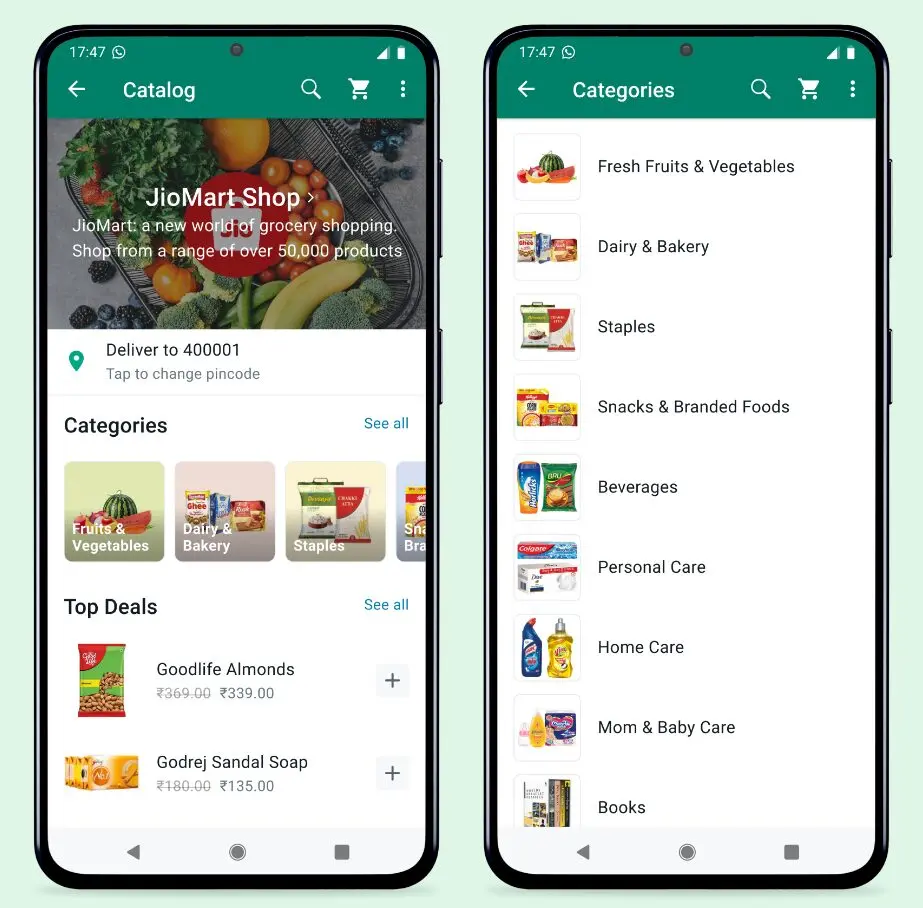
The rollout became a template for conversational commerce at scale.
How Flows Fit in the Commerce Stack
WhatsApp Flows now integrate natively with Meta’s advertising and measurement infrastructure. A user can enter via a CTWA ad, complete the Flow, and trigger events that feed directly into Meta’s Conversions API for performance tracking and remarketing.
This enables marketers to measure form completions, abandoned steps, and confirmed purchases with the same precision as website conversions.
In practice, Flows mark a shift from WhatsApp being just a messaging tool to becoming a fully transactional channel.
For brands operating in emerging markets where mobile web performance is unreliable, a chat-native checkout not only simplifies UX but also improves conversion rates by keeping users inside the environment they already trust.
When to Use Flows vs. Click-to-WhatsApp Campaigns
Flows and Click-to-WhatsApp (CTWA) campaigns both live within Meta’s messaging ecosystem, but their core roles differ.
CTWA is about starting conversations; Flows are about completing structured actions like purchases, bookings, or registrations. For successful campaigns, brands need to know when to lean on each.
CTWA: Entry & Engagement
Click-to-WhatsApp ads are ideal when your goal is opening a dialog. Whether you’re launching a campaign, planning a new product launch, or nurturing a high-consideration purchase, CTWA invites users into chat so you can qualify interest, answer questions, or personalize suggestions.
For instance, in 2024, Meta began offering AI-assisted chatbots embedded into CTWA ads—allowing brands to automatically respond, guide users through the beginning steps, or even start commerce conversations in an interactive manner.
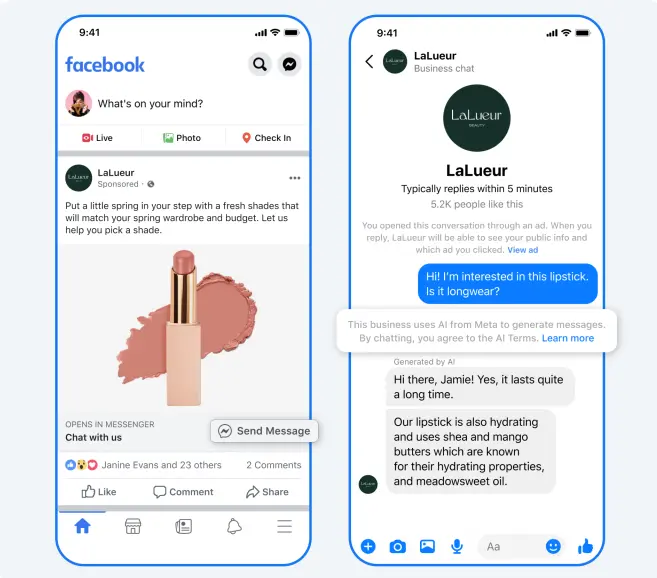
In markets like India, CTWA remains pivotal because many users still prefer conversational engagement over web forms. WhatsApp’s ubiquity makes it a preferred channel to begin a relationship—especially for discovery or product education.
Flows: When You Need Structure & Conversion
Use Flows when the objective demands precise data, validation, and handoff. Checkout, appointment scheduling, quoting, and service requests often require structured input (address, SKU, time slots), conditional branching (e.g., “if delivery outside service area, reject”), and native validations (postal codes, dropdowns).
Because a Flow lives inside chat, there’s no context switch or redirect. Inputs get validated and stored immediately, reducing abandonment—especially in low-bandwidth or mobile-first markets. Brands that deploy Flows can convert conversational intent into measurable outcomes without losing users mid-journey.
Hybrid Funnels: Combine CTWA → Flow
The strongest architecture is a hybrid funnel: CTWA serves to initiate chat, vet interest, and route users into the Flow when ready.
For example: a user sees a product ad, taps “Message to Buy” (CTWA), then within seconds is presented with “Select variant → Enter address → Confirm → Submit Payment” all via Flow logic.
This hybrid setup ensures:
- You don’t waste Flow “slots” on low-intent users.
- You qualify or segment users via chat before pushing them into structured tasks.
- Ad measurement and conversions stay unified under Meta’s Conversions API infrastructure.
Decision Logic (When to Choose Which)
| Scenario | Best Tool | Why |
|---|---|---|
| New product awareness, education | CTWA | Let the brand engage first |
| High-consideration purchases (insurance, B2B) | CTWA | Users often need Q&A |
| Want to capture structured data or complete a transaction | Flows | Precise forms inside chat |
| Mixture funnel (start chat → complete action) | CTWA → Flow | Efficient path balancing engagement + conversion |
In short, CTWA brings users in; Flows get them to finish. Use CTWA when you need engagement and education. Use a Flow when you need a reliable, structured, measurable outcome inside the chat environment.
Building a Multi-Step Checkout Flow
When you design a checkout flow within WhatsApp, the goal is to replicate the logic and validation of a web checkout—but inside a conversation. You guide the user through discrete steps (product selection, delivery info, confirmation) and integrate each input back into your backend. Below is a practical breakdown with design best practices and real-world precedent.
Breakdown of a Typical Checkout Flow
A well-designed multi-step WhatsApp checkout flow usually follows this structure:
| Step | Purpose | Key Considerations |
|---|---|---|
| Step 1: Product/variant selection | Let users choose what they want | Use quick reply buttons or dropdown lists. Offer images and short descriptions. |
| Step 2: Quantity/options | Capture numeric values or optional add-ons | Validate ranges (max/min), stock availability. |
| Step 3: Delivery/address capture | Collect location, address lines, pincode, landmark | Localize address fields by country, validate postal code. |
| Step 4: Payment/confirmation | Trigger payment or confirm order | Provide summary, “Confirm” button, and hand off to payment or internal system. |
Each step’s user input immediately feeds into your backend or middleware. You can then apply conditional logic (e.g., “if outside service area, reject or show alternative”), and dynamically adapt next questions.
Fashion brand Sefamerve adopted WhatsApp’s Flow features (catalog, add-to-cart, checkout) within their messaging channel. Over 4 months, they reportedly added 80,000 items available through WhatsApp, doubled (2.6×) revenue, and saw a 158% conversion lift.
Key Build Patterns & Best Practices
- Atomic Inputs over Free Text: Use buttons, radio, or dropdown selections whenever possible. Free-text fields (e.g., “Enter your address”) should be used carefully, ideally with validation and fallback if parsing fails.
- Conditional Branching: For example, if postal code is outside your delivery area, immediately display a “service not available” message and exit the flow, rather than letting the user proceed further.
- Summary & Confirmation Screen: Always show a final review of selected items, totals, delivery cost, and address, with “Edit” options for each line. This mirrors cart UX on web and reduces mistakes.
- Idempotence & Resume Logic: If a user exits mid-flow or session drops, allow them to resume where they left off. Persist state in your database or session store.
- Localization & Field Customization: Adapt the address form per market (e.g., for India include “State/District/PIN code”; for U.S. include ZIP + apartment; for Brazil include “bairro”). Format numeric inputs (e.g. phone) according to local norms.
- Fallbacks & Escalation: If validation fails (e.g. address cannot be parsed), provide fallback messaging (“Please re-enter suburb or landmark, or contact support”) or hand over to a human agent.
- Payment Handoff Integration: In many market contexts, brand flows end with a payment link, gateway redirect, or confirmation message that triggers a back-end API. In India’s UPI ecosystem, in-chat payments are feasible. Reuters reported WhatsApp adding in-app payment options (credit card, UPI gateways) to boost commerce usage.
Example Flow in Practice
Imagine a cosmetics brand running a WhatsApp ad with “Buy Now → Chat”. The flow might look like:
- Select Product (buttons: “Lipstick A/Lipstick B/Lip Crayon”)
- Select Shade and Quantity
- Enter Delivery [City / Pincode / Street / Landmark]
- Show Order Summary + Price + Delivery Fee with “Confirm”
- Launch Payment Link / Gateway
- Confirm Payment Receipt → Show Order ID / Thank You Message
In markets where in-chat payments are allowed (e.g., via UPI or card gateways inside the app), you can complete steps 5 & 6 without redirecting entirely.
Localization and Versioning for Global Campaigns
Scaling WhatsApp Flows across multiple markets demands more than translation—it requires re-engineering each step of the checkout experience to match how users actually transact in their region.
Language, currency, address formats, and even tone can influence whether someone completes a purchase or abandons the process. Meta’s rollout of Flows made global adoption feasible, but localization remains what separates high-performing chat commerce funnels from those that confuse users.
Why Localization Matters in Flows
Localization isn’t only about words; it’s about reflecting how people behave, pay, and trust brands in their local context. A checkout that feels natural in São Paulo can look alien in Jakarta or Berlin. These are the four most critical elements that brands must adapt for every market:
Language and Tone
Consumers overwhelmingly prefer interfaces in their native language, and subtle differences in phrasing can impact trust. For example, a 2023 CSA Research study found that 40% of online shoppers won't purchase from sites that provide information in other languages. In WhatsApp Flows, that extends to button labels, error messages, and confirmations—all of which need to use region-specific vocabulary and formality levels.
Address Formats and Validation
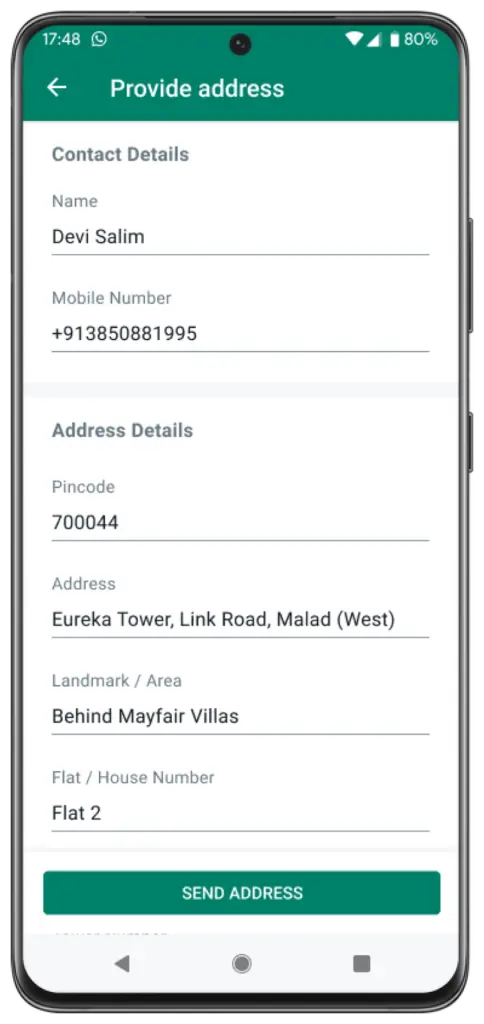
Address structures differ dramatically by geography. India’s PIN-code system includes “State/District/Taluka,” while Brazil uses CEP with distinct digit formatting, and Japan reverses the order entirely. A single generic “City/State/Postal” field leads to high validation failure and delivery errors. Successful implementations mirror local postal forms and perform real-time validation before submission.
Here's how WhatsApp flows should look like for countries like India with similar PIN-code systems:
Payment Methods and Currency Display
Payment preferences are among the most localized parts of commerce. In India, UPI and Paytm dominate; in Indonesia, users expect GoPay or DANA wallets; and in Europe, cards and Apple Pay remain standard.
Currency notation also varies—commas vs. periods, symbol placement, rounding—each of which must align with local UX expectations. WhatsApp’s own expansion of in-app payments in India, adding multiple credit-card and wallet options beyond UPI, demonstrates how tightly localization and conversion are linked.
Regulatory and Tax Differences
Compliance rules shift across borders: the EU’s GDPR affects consent messaging; India’s GST mandates displaying tax-inclusive pricing; and Brazil requires CPF numbers for invoice issuance. Flows must dynamically adjust form fields or disclosures to stay compliant—otherwise, transactions may be invalidated or flagged by payment providers.
Chat-Native Commerce Is Here to Stay
WhatsApp Flows mark a structural shift in how brands close the gap between conversation and conversion. By embedding checkout, address entry, and payment confirmation directly into chat, marketers finally have a commerce channel that feels as personal as messaging but as measurable as a website. From JioMart’s end-to-end grocery ordering to Kia India’s lead generation and AirAsia’s CRM automation, the results are consistent: faster journeys, fewer drop-offs, and data you can actually track.
As Meta continues expanding in-app payments, Conversions API integrations, and localized flow templates, WhatsApp is evolving into a fully fledged transactional environment—not just a lead funnel. For marketers, that means moving beyond “click-to-chat” toward chat-native checkout, where intent, form-fill, and purchase all happen in a single thread.
Done right, WhatsApp Flows don’t just simplify the user experience—they redefine how brands measure, optimize, and scale one-to-one commerce globally.
Frequently Asked Questions
How does WhatsApp fit into the broader social commerce ecosystem?
WhatsApp is now part of a fast-growing social commerce platform landscape where shopping happens inside apps rather than on websites, allowing users to discover, converse, and buy within one interface.
What distinguishes conversational commerce from traditional eCommerce?
Conversational commerce, or c-commerce, emphasizes two-way interactions through chat instead of one-way browsing, letting brands capture intent and close sales through messaging-based checkout experiences.
Which industries benefit most from chat-based checkout?
Retail, beauty, and quick-service brands see strong traction because they already use social shopping trends like influencer-led discovery and direct-to-chat conversion prompts that align naturally with WhatsApp Flows.
How can agencies support brands in deploying WhatsApp Flows?
Specialized social commerce agencies now design end-to-end chat funnels—connecting ads, flows, and conversion tracking—so that checkout feels native across messaging and web.
What strategy helps integrate WhatsApp into omnichannel commerce?
Successful marketers treat chat as another conversion surface within broader social commerce strategies, syncing product feeds, ad audiences, and CRM events for unified attribution.
Which tools help optimize WhatsApp-based checkout performance?
Workflow automation, message routing, and analytics are often handled through top eCommerce tools that integrate WhatsApp APIs with order management and customer data systems.
How does chat-native checkout enhance the buyer experience?
It reduces friction and mirrors the personalized service users already expect from customer experience platforms, turning routine transactions into conversational relationships.
How is the social commerce market evolving in 2025?
Brands are consolidating messaging, shopping, and fulfillment into unified systems, mirroring the integration patterns shaping today’s social commerce landscape across Meta, TikTok, and other platforms.