

- Influencer marketing connects brands with creators whose audiences already trust their opinions, helping drive awareness, credibility, engagement, and conversions across the customer journey.
- Effective strategies start with clear goals and KPIs, then match the right creators, platforms, and formats to the target audience. Audience fit and engagement matter more than follower count alone.
- Nano and micro influencers often provide stronger engagement and targeting, while macro and mega influencers offer greater reach. Many brands combine tiers to balance performance, scale, and cost.
- In 2026, influencer marketing is evolving into a full-funnel growth engine built around long-term partnerships, creator-led ads, social search, measurable ROI, and the reuse of creator content across paid and owned channels.
Influencer marketing has moved from an experimental channel to a core part of how brands drive awareness, trust, and revenue.
In 2026, it sits at the center of modern digital strategy, shaping how consumers discover products, evaluate options, and ultimately make purchasing decisions. This shift is backed by data. Our State of Influencer Marketing Benchmark Report shows that 85% of marketers now consider influencer marketing an effective channel for achieving their goals.
At its core, influencer marketing is a form of social media marketing where brands collaborate with creators to promote products or services to an engaged audience. These creators, often referred to as influencers, build trust within specific niches, allowing brands to reach consumers in a way that feels more authentic than traditional advertising.
But influencer marketing today is far more than sponsored posts. It spans short-form video, creator-led ads, affiliate partnerships, and even social commerce, where content and checkout increasingly happen in the same place.
As platforms like TikTok and Instagram double as search engines, influencer content is now a key entry point in the customer journey.
This guide breaks down everything you need to know about influencer marketing, including how it works, why it’s effective, how to build a strategy, how much it costs, and how to measure ROI.
Whether you're exploring influencer marketing for the first time or refining an existing program, you’ll find a clear, structured path to building campaigns that deliver measurable results.
- What Is Influencer Marketing?
- How Influencer Marketing Works
- Why Influencer Marketing Is Effective
- Types of Influencers Explained
- Popular Influencer Marketing Channels
- Influencer Marketing Content Types
- How to Build an Influencer Marketing Strategy
- How Much Does Influencer Marketing Cost?
- Advanced Influencer Marketing Strategies for 2026
- Influencer Marketing Trends in 2026
- Examples of Influencer Marketing Campaigns: Case Studies
- Explore Influencer Campaigns by Industry
- Influencer Marketing: From Channel to Growth Engine
- Frequently Asked Questions
What Is Influencer Marketing?
Influencer marketing is a marketing strategy where brands collaborate with creators to promote products or services to their audience. These creators have built trust and influence within a specific niche, allowing brands to reach potential customers in a more authentic and engaging way.
Unlike traditional advertising, influencer marketing relies on the relationship between the creator and their audience. When an influencer recommends a product, it often feels more like a trusted suggestion than a paid promotion, which can significantly impact purchasing decisions.
In fact, studies show that 72% of consumers trust recommendations from influencers—even those they don’t personally know—more than messaging that comes directly from brands or businesses.
In simple terms, influencer marketing is about partnering with people your audience already trusts to introduce your brand, build credibility, and drive action.
At a deeper level, influencer marketing sits at the intersection of content, distribution, and social proof. Brands are no longer just borrowing attention. They are leveraging creators to produce content, shape perception, and influence decisions across the entire customer journey.
How Influencer Marketing Works
At a high level, influencer marketing works by connecting brands with creators who already have the attention and trust of a specific audience. Instead of building that trust from scratch, brands tap into relationships that influencers have spent years developing.
The process typically starts with a brand identifying creators whose audience aligns with their target market. Once a partnership is established, the influencer creates content that features the brand’s product or service in a way that feels natural to their style and platform.
That content is then shared with the influencer’s audience, where it drives awareness, engagement, and often direct action. Depending on the campaign goals, this action could include visiting a website, using a discount code, signing up for a service, or making a purchase.
What makes this model effective is the combination of reach and trust. The influencer provides access to a relevant audience, while their credibility increases the likelihood that the message resonates.
In practice, influencer marketing is not a single interaction but part of a broader journey.
A user might discover a product through a TikTok video, research it through reviews or additional creator content, evaluate whether what the influencer has said is true, and complete the purchase later through a website or social commerce feature.
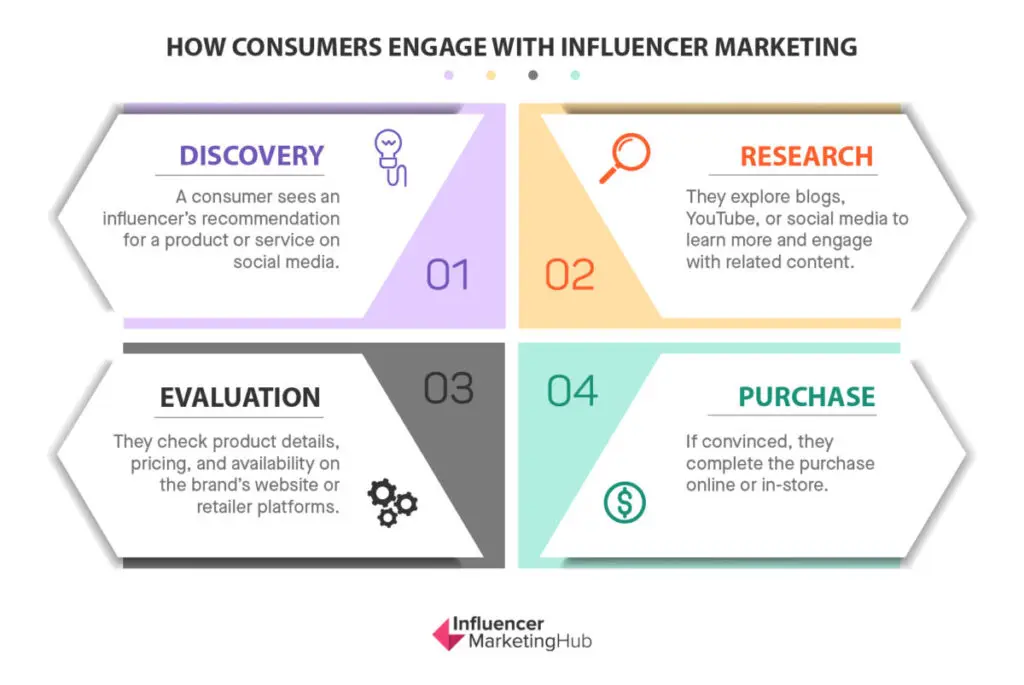
This multi-touch behavior is what allows influencer marketing to influence decisions across the entire funnel, from awareness to conversion.
Why Influencer Marketing Is Effective
Influencer marketing works because it aligns with how modern consumers discover and trust products. Instead of interrupting users with ads, it integrates into the content they already engage with, making brand messages feel more relevant, credible, and actionable.
At its core, influencer marketing is driven by a combination of trust, authenticity, and audience alignment. These factors allow brands to reach consumers in a way that traditional advertising often cannot replicate.
5 Reasons Why Influencer Marketing Is Effective
Authenticity and Trust
The foundation of influencer marketing is trust. Influencers build relationships with their audiences over time by consistently sharing opinions, experiences, and recommendations within a specific niche. As a result, their endorsements feel more like personal recommendations than paid promotions.
This trust directly impacts purchasing behavior. When a product is introduced through a creator’s content, it benefits from the credibility that the creator has already established.
A widely cited example is Dunkin’s collaboration with TikTok creator Charli D’Amelio. By launching “The Charli” drink and integrating it into native TikTok content, Dunkin’ saw a 60% increase in app downloads and a 45% boost in cold brew sales.
The campaign succeeded not because of reach alone, but because it felt authentic to Charli’s audience.
@dunkin Song is straight 🔥. Show us your moves to ‘The Charli’ while you drink ‘The Charli’- using #CharliRunsOnDunkin @charlidamelio #dunkin
Niche Targeting and Audience Relevance
Influencers operate within defined niches, from beauty and fitness to gaming and finance. This allows brands to reach highly specific audiences with content that feels tailored rather than generic.
Instead of broadcasting to a broad audience, influencer marketing enables precision targeting through creators who already speak directly to the communities brands want to reach.
For example, Moncler’s #MonclerBubbleUp campaign leveraged TikTok creators to produce visually engaging, trend-driven content. By aligning with platform behavior and creator style, the campaign generated billions of views and encouraged large-scale user participation, all while maintaining a strong sense of cultural relevance.
@moncler @ireneisgood have joined the #MONCLERBUBBLEUP challenge. 💭 Dive into your bubble. #Moncler
Content That Performs Natively
Influencers are content creators who understand what works on each platform.
Their ability to produce content that feels native to feeds, whether through short-form video, viral challenges, or lifestyle integrations, makes it significantly more engaging than traditional brand-created ads.
This is especially important in environments like TikTok and Instagram, where content that feels overly produced or promotional is often ignored. Influencer content blends into the user experience, increasing both attention and interaction.
Cost Efficiency and Performance
Influencer marketing also offers strong efficiency compared to traditional advertising, particularly when working with micro and nano influencers.
Smaller creators often deliver higher engagement rates and more targeted reach at a lower cost.
For example, nano-influencers average engagement rates of around 3.69%, which is more than double that of macro-influencers. This allows brands to distribute budgets across multiple creators, test different audience segments, and scale the partnerships that drive the strongest results.
Rather than relying on a single large campaign, brands can build a portfolio of creator partnerships that collectively drive stronger and more consistent performance.
A Model Built on Relationships
Ultimately, influencer marketing is effective because it is built on relationships rather than interruption.
It connects brands with consumers through voices they already trust, within environments they already engage with, using content that feels natural to the platform. This combination of trust, relevance, and creative execution is what allows influencer marketing to consistently outperform more traditional approaches.
Johnnie-O offers a long-term example of this approach. Its word-of-mouth strategy grew from golf-shop recommendations and community advocates into a creator network supporting a nearly $200 million lifestyle brand.
Types of Influencers Explained
Influencers are typically categorized based on the size of their audience. Each tier offers a different balance of reach, engagement, cost, and targeting, making it important for brands to choose the right mix depending on their goals.
Influencer Types by Follower Count
|
Influencer Type |
Follower Range |
Key Strength |
| Nano Influencers | 1,000 – 10,000 | High engagement and strong audience trust |
| Micro Influencers | 10,000 – 100,000 | Niche expertise and balanced reach |
| Macro Influencers | 100,000 – 1M | Scalable reach and established authority |
| Mega Influencers | 1M+ | Massive visibility and brand awareness |
Nano Influencers
Nano influencers have smaller, highly engaged audiences and often maintain close relationships with their followers. Their content tends to feel more personal and authentic, making them particularly effective for driving trust and conversions within niche communities.
For example, nano-influencers average engagement rates of around 3.69%, which is more than double that of macro-influencers.
Additionally, over 53.8% of brands now prioritize nano influencers as their preferred partners, reflecting a growing shift toward authenticity and community-driven marketing.
Nano influencers are best for:
- Small businesses and startups
- Local brands targeting specific communities
- DTC brands testing new products
- Brands prioritizing conversion and trust over reach
Micro Influencers
Micro influencers offer a balance between reach and engagement. They typically focus on specific niches and have built credibility within those communities, making them one of the most effective tiers for performance-driven campaigns.
Our data shows that 43% of marketers prefer working with micro and nano influencers, with many shifting budgets away from larger creators.
They also consistently outperform larger influencers in engagement, with micro influencers routinely pulling in engagement rates of 8.7% compared to 1.6% for celebrities.
Micro influencers are best for:
- E-commerce and DTC brands scaling acquisition
- SaaS and B2B brands targeting niche audiences
- Brands running performance or affiliate campaigns
- Companies looking for repeatable, scalable influencer programs
Macro Influencers
Macro influencers provide broader reach and are often recognized as established voices within their industry. They are well-suited for campaigns focused on visibility, brand positioning, and large-scale awareness.
While engagement rates tend to be lower than those of smaller creators, macro influencers play a critical role in scaling campaigns and reaching wider audiences.
Macro influencers are best for:
- Mid-sized to large brands
- Product launches requiring reach
- Brands entering new markets
- Campaigns focused on awareness over immediate conversion
Mega Influencers
Mega influencers include celebrities and high-profile creators with millions of followers. They offer massive exposure and cultural relevance, making them powerful for brand awareness at scale.
However, this reach often comes with higher costs and broader, less targeted audiences.
Mega influencers are best for:
- Enterprise brands with large budgets
- Global campaigns
- Mass-market product launches
- Brands focused on visibility, PR, and cultural impact
AI and Virtual Influencers
A newer category, AI or virtual influencers, are digitally created personas designed to represent specific brand identities. They offer complete control over messaging, consistency, and brand safety.
While they lack the lived authenticity of human creators, they are increasingly used in highly controlled campaigns and experimental brand activations.
AI and virtual influencers are best for:
- Tech-forward brands
- Gaming, fashion, and digital-first industries
- Brands prioritizing control and consistency
- Campaigns exploring emerging trends and formats
Choosing the Right Influencer Mix
The most effective influencer marketing strategies rarely rely on a single tier. Instead, brands combine different types of influencers to balance reach, engagement, and cost efficiency.
For example:
- Nano and micro influencers drive engagement and conversions
- Macro and mega influencers drive reach and awareness
The right mix depends on your campaign goals, budget, and target audience, but the trend is clear: brands are increasingly shifting toward smaller, more engaged creators to drive measurable performance.
Popular Influencer Marketing Channels
Influencer marketing takes place across a range of platforms, each with its own audience behavior, content dynamics, and strengths. Choosing the right channel is critical, as performance depends not just on the creator, but on how audiences interact with content within each environment.
TikTok
TikTok has become one of the most influential platforms for discovery, particularly among Gen Z and younger millennial audiences. Its algorithm prioritizes content relevance over follower count, allowing creators of all sizes to reach large audiences.
This shift is reflected in adoption data. According to our 2026 Influencer Marketing Benchmark Report, 32% of brands are increasing their investments in TikTok for influencer marketing.
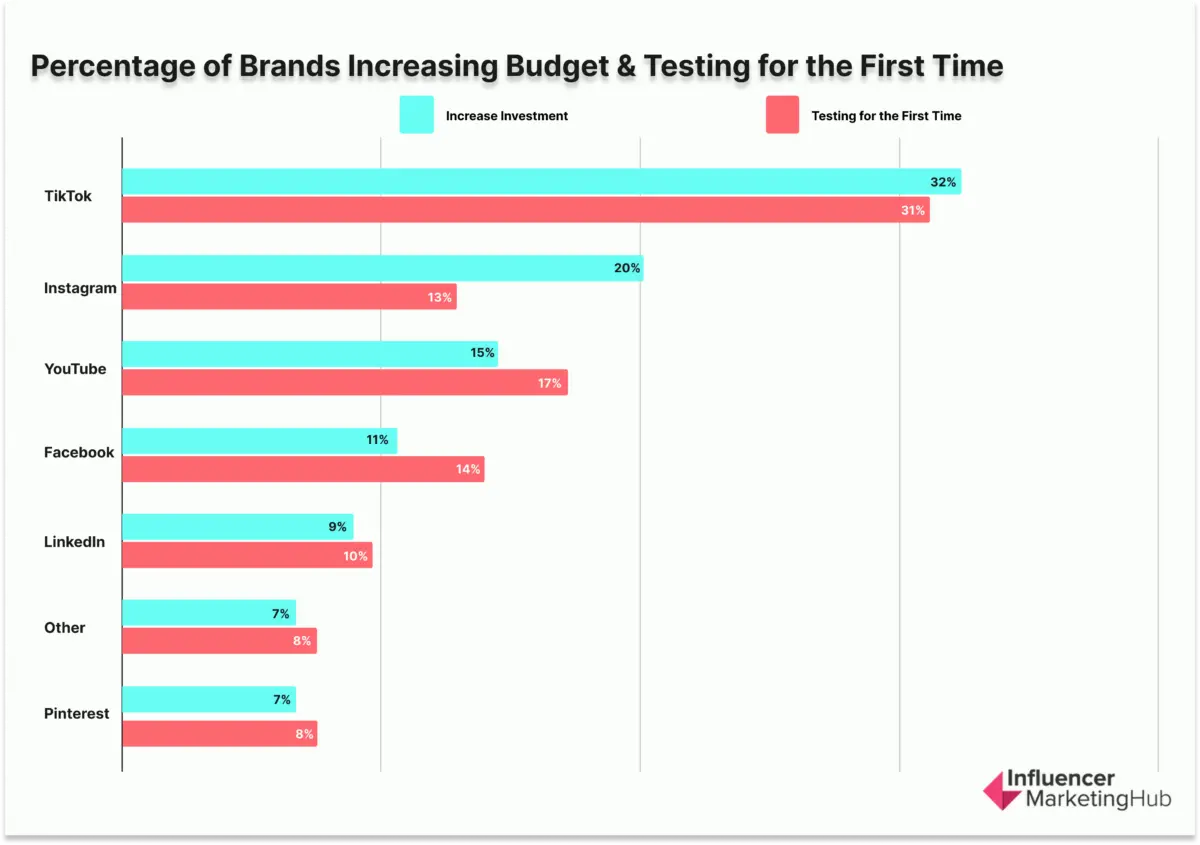
In addition, 68.8% of brands now use TikTok for influencer marketing, making it the most widely used platform in the space.
The platform plays a key role in product discovery, with users increasingly treating TikTok as a search engine for reviews, tutorials, and recommendations.
TikTok is best for:
- Consumer brands targeting Gen Z and millennials
- Product discovery and trend-driven campaigns
- Brands focused on reach and viral potential
Instagram remains a core channel for influencer marketing, particularly for lifestyle, fashion, beauty, and travel brands. Its ecosystem supports both discovery and relationship-building, making it one of the most versatile platforms.
While TikTok has taken the lead in recent years, Instagram continues to play a major role in influencer campaigns, especially when it comes to commerce and long-term brand building.
Platform usage trends also show that Instagram remains highly relevant, with 42% of users actively using the platform, maintaining its position as a key distribution channel for influencer content.
Instagram is best for:
- Lifestyle and visually driven brands
- E-commerce and DTC companies
- Brands building long-term creator partnerships
YouTube
YouTube is the leading platform for long-form, in-depth content. Unlike fast-scroll environments, it allows creators to provide detailed explanations, reviews, and comparisons that support more considered purchasing decisions.
Its search-driven nature also gives content a longer lifespan, making it particularly valuable for evergreen discovery.
This is reinforced by usage data, with 71% of U.S. adults using YouTube, making it one of the most widely adopted platforms for content consumption.
YouTube is best for:
- Tech, education, and product-heavy categories
- High-consideration purchases
- Brands focused on long-term visibility and SEO
LinkedIn is the primary platform for B2B influencer marketing. Instead of traditional influencers, it relies on industry experts, executives, and thought leaders who influence professional audiences.
Content on LinkedIn is typically insight-driven, making it effective for building credibility, trust, and authority within specific industries.
While smaller in scale compared to consumer platforms, LinkedIn plays a critical role in B2B strategies, where influence is driven more by expertise than reach.
LinkedIn is best for:
- B2B brands and professional services
- SaaS and enterprise companies
- Thought leadership and industry positioning
Communities and Niche Platforms
Beyond mainstream social media, influencer marketing also extends to niche communities such as forums, blogs, and platforms like Reddit or Substack. These environments often host highly engaged audiences with specific interests.
While they may not offer the same scale as major platforms, they can deliver strong credibility and targeted reach within tightly defined communities.
These are best for:
- Niche products and specialized industries
- Community-driven brands
- Brands prioritizing depth of engagement over scale
Choosing the Right Channel
The most effective influencer marketing strategies are not platform-exclusive. Instead, they align platform selection with audience behavior and campaign goals.
For example:
- Use TikTok for discovery and reach
- Use Instagram for engagement and conversion
- Use YouTube for depth and education
- Use LinkedIn for B2B influence
Selecting the right channel ensures that your influencer partnerships are not only visible but also effective within the context of how users engage on each platform.
Influencer Marketing Content Types
Influencer marketing is not defined by where content appears, but by the formats creators use to engage their audiences. The most effective campaigns align content type with platform behavior and audience expectations, ensuring that brand messaging feels natural rather than forced.
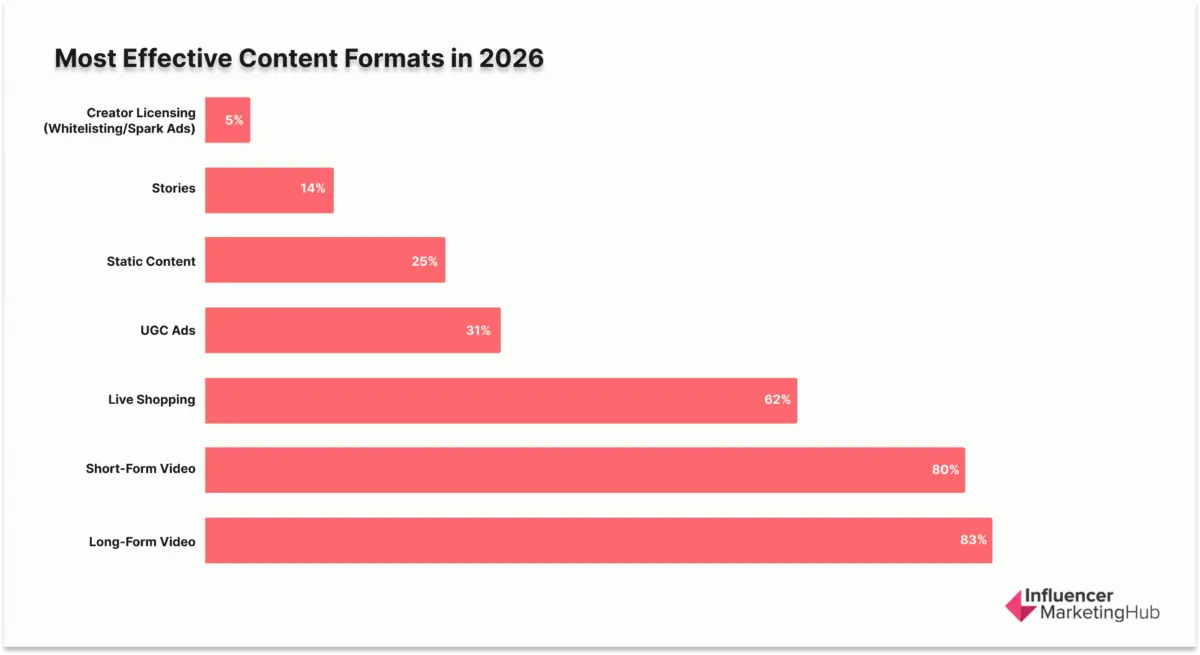
Our data reinforces this shift toward format-driven strategy. Video has become the dominant medium, with both short-form and long-form content consistently ranking among the most effective formats used by brands today.
Short-Form Video Content
Short-form video has become the default format for influencer marketing, driven by platforms like TikTok and Instagram Reels. These videos are designed for rapid consumption, making them highly effective for capturing attention and driving discovery.
As per our 2026 Benchmark Report, 80% of brands consider short-form video one of the most effective content formats, making it a core component of modern campaigns.
Short-form video is best for:
- Product discovery
- Viral campaigns and trends
- Top-of-funnel awareness
Long-Form Video Content
Long-form content, particularly on YouTube, plays a different role. It allows creators to provide deeper explanations, detailed reviews, and comparisons that support more informed purchasing decisions.
In fact, 83% of brands rank long-form content among their most effective formats, highlighting its importance in high-consideration journeys.
Long-form video is best for:
- Product reviews and tutorials
- High-consideration purchases
- Educational and in-depth storytelling
Product Reviews and Tutorials
Product-focused content remains one of the most influential formats in influencer marketing. Reviews, unboxings, and tutorials provide practical insights into how products work, helping consumers evaluate whether they meet their needs.
This type of content is particularly powerful because it combines education with social proof, making it easier for audiences to move from consideration to purchase.
Additional data support this behavior. Around 80% of users say they prefer how-to tutorials from influencers, reinforcing the role of instructional content in driving decisions.
Product reviews and tutorials are best for:
- Driving conversions
- Building product understanding
- Supporting mid- to bottom-funnel decisions
User-Generated Content (UGC)
User-generated content (UGC) refers to content created by UGC creators or customers that brands can reuse across their own channels. This includes testimonials, lifestyle integrations, and organic product mentions.
UGC has become a core output of influencer campaigns. According to our data, 56% of brands run influencer campaigns specifically to generate UGC, highlighting its importance beyond reach alone.
UGC is best for:
- Social proof
- Paid ads and repurposing
- E-commerce product pages
Live Content and Social Commerce
Live content, including live streams and shopping events, is emerging as a high-impact format that blends entertainment with real-time purchasing.
Our data shows that 62% of brands rank live shopping among their top three most effective content formats, signaling strong potential for conversion-driven campaigns.
This format shortens the path from discovery to purchase by allowing audiences to interact, ask questions, and buy within the same session.
Live content and social commerce are best for:
- Real-time engagement
- Product launches
- Conversion-focused campaigns
Matching Content Type to Campaign Goals
The most effective influencer marketing strategies do not rely on a single format. Instead, they combine multiple content types to support different stages of the customer journey.
For example:
- Short-form video drives discovery
- Long-form content supports consideration
- Reviews and tutorials drive conversion
- UGC extends campaign value across channels
- Live content accelerates purchase decisions
Choosing the right mix ensures that influencer marketing works not just as a visibility tool, but as a full-funnel growth engine.
How to Build an Influencer Marketing Strategy
Building an effective influencer marketing strategy requires more than simply partnering with creators. It involves aligning business goals with the right influencers, platforms, and content formats to drive measurable results.
Whether you're starting from scratch or refining an existing approach, the most successful strategies follow a structured process.
1. Define Your Goals and KPIs
The first step in building an influencer marketing strategy is identifying what you want to achieve. Clear goals will guide every decision that follows, from influencer selection to content creation and measurement.
Common objectives include:
- Increasing brand awareness
- Driving website traffic
- Generating sales or conversions
- Building social proof and credibility
Each goal should be tied to measurable KPIs, such as impressions, engagement rates, click-through rates, or revenue generated.
2. Identify Your Target Audience
Understanding your audience is critical to choosing the right influencers and platforms. This includes defining demographics, interests, behaviors, and the platforms they actively use.
The more clearly you define your audience, the easier it becomes to partner with influencers whose followers closely match your ideal customer profile.
3. Choose the Right Influencers
Selecting influencers is one of the most important steps in the process. Rather than focusing solely on follower count, brands should prioritize:
- Audience alignment
- Engagement rate
- Content quality
- Brand fit and authenticity
Many brands are now shifting toward micro and nano influencers, as they often deliver stronger engagement and more targeted reach.
4. Select the Right Platforms and Content Approach
At this stage, your strategy should align influencer selection with platform behavior and content formats.
For example:
- TikTok is ideal for discovery and reach
- Instagram supports engagement and conversion
- YouTube works well for in-depth product education
The goal is to ensure that both the platform and content style match how your audience consumes information.
5. Establish Clear Campaign Guidelines
A successful influencer marketing campaign requires clear communication between the brand and the creator. This includes outlining:
- Campaign objectives
- Deliverables (posts, videos, etc.)
- Messaging and key points
- Timeline and deadlines
- Content usage rights
While structure is important, it’s equally important to give influencers creative freedom so the content feels authentic to their audience.
6. Amplify High-Performing Content
Influencer content should not be treated as a one-time asset. Many brands now extend the value of creator content by repurposing it across:
- Paid social ads
- Website product pages
- Email marketing campaigns
This approach increases return on investment and allows brands to scale what is already working.
7. Track Performance and Optimize
No influencer marketing strategy is complete without measurement. Tracking performance helps you understand what’s working and where to improve.
Key metrics include:
- Engagement (likes, comments, shares)
- Reach and impressions
- Clicks and conversions
- Revenue and ROI
Brands that consistently analyze and optimize their campaigns are better positioned to scale successful partnerships over time.
Bringing It All Together
An effective influencer marketing strategy is not built on a single campaign, but on a repeatable system. By combining the right creators, platforms, and content with clear goals and ongoing optimization, brands can turn influencer marketing into a scalable growth channel.
How Much Does Influencer Marketing Cost?
The cost of influencer marketing can vary widely depending on the type of influencer, platform, campaign scope, and deliverables. There is no fixed pricing model, but understanding the key cost drivers can help brands plan budgets more effectively and set realistic expectations.
At a high level, influencer marketing costs are influenced by reach, engagement, content complexity, and usage rights. Larger creators typically charge more due to their audience size, while smaller influencers often offer more cost-efficient partnerships with higher engagement rates.
Average Influencer Marketing Costs by Tier
While rates can vary, here’s a general breakdown of what brands can expect to pay per post:
- Nano influencers (1K–10K followers): $10 to $100
- Micro influencers (10K–100K): $100 to $2,000
- Macro influencers (100K–1M): $1,000 to $10,000
- Mega influencers (1M+): $10,000+ per post
These ranges depend on factors like niche, audience quality, and content format. Video content, for example, often commands higher rates than static posts due to production effort.
We have calculator tools that help both brands and creators determine how much to pay/charge for collaborations. Brands can use them as rough estimates of how much creators charge, while creators can use them to estimate their potential earnings based on their following size, engagement rate, and platform.
What Influencer Marketing Budgets Look Like Today
Influencer marketing is no longer a small experimental spend. It is increasingly being treated as a core growth channel, with brands allocating larger and more intentional portions of their budgets to creator partnerships.
This shift is clearly reflected in our 2026 Influencer Marketing Benchmark Report, where 87.49% of marketers say they expect their influencer marketing budgets to increase, while only 5.55% anticipate a decrease.
Even more notably, 72.22% of respondents expect their budgets to grow by more than 50%, signaling a significant step-change in how brands are investing in the channel.
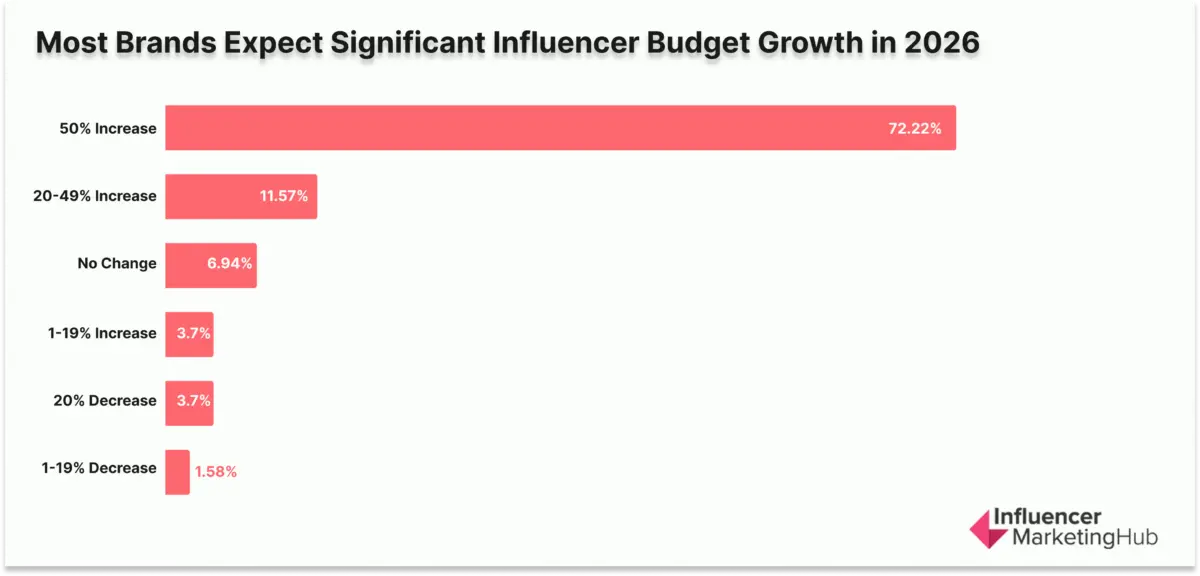
What this indicates is not just steady growth, but strong confidence in influencer marketing’s ability to scale. Brands are no longer testing the channel; they are expanding it.
At the same time, spending is becoming more strategic.
Rather than concentrating budgets on a small number of high-cost influencers, many brands are distributing investment across a broader mix of creators. This allows them to improve targeting, test performance across segments, and scale the partnerships that deliver the strongest results.
In practice, influencer marketing budgets are shifting from isolated campaigns to structured, repeatable programs designed to support long-term growth.
Common Influencer Payment Models
Influencer marketing pricing is not limited to flat fees. Brands typically structure partnerships using one or more of the following models:
- Pay per post: A fixed fee for each piece of content
- Pay per campaign: A bundled rate for multiple deliverables
- Affiliate or commission-based: Influencers earn a percentage of sales
- Product gifting: Free products or services in exchange for content
Each model has its advantages, and many brands combine them depending on campaign goals.
What Impacts Influencer Pricing?
Several factors influence how much brands pay for influencer marketing:
- Audience size and engagement rate
- Platform (TikTok, Instagram, YouTube, etc.)
- Content format and production complexity
- Campaign duration and deliverables
- Content usage rights and paid amplification
For example, campaigns that include content licensing or paid ad usage typically cost more than organic-only collaborations.
Cost vs. Return
While costs can vary, influencer marketing is often considered one of the most cost-effective digital channels, often returning $5.78 for every dollar spent. Many brands report strong returns, particularly when working with micro and nano influencers who deliver higher engagement and more targeted reach.
The key is not just how much you spend, but how efficiently that budget is allocated across creators, platforms, and content formats.
Budgeting for Success
Instead of asking “how much does influencer marketing cost,” brands should focus on building a budget that aligns with their goals.
For example:
- Smaller budgets can focus on nano and micro influencers for engagement and conversions
- Larger budgets can combine creator tiers to balance reach and performance
A well-structured budget allows brands to test, learn, and scale campaigns over time, turning influencer marketing into a predictable and repeatable growth channel.
Advanced Influencer Marketing Strategies for 2026
As influencer marketing matures, the most effective brands are moving beyond one-off collaborations and building integrated, performance-driven systems around creators. In 2026, success is no longer defined by who you partner with, but by how you activate, scale, and measure those partnerships.
The following strategies reflect how leading brands are evolving influencer marketing into a more structured and scalable growth channel.
Creator-Led Ads and Paid Amplification
One of the most significant shifts in influencer marketing is the move from organic-only collaborations to paid amplification.
Instead of treating influencer content as a single post, brands are increasingly repurposing high-performing creator content into paid ads. Formats like TikTok Spark Ads and Instagram Partnership Ads allow brands to promote creator content directly, combining authenticity with paid reach.
This approach consistently outperforms traditional brand-created ads because it maintains the native look and feel audiences expect, while benefiting from the scale of paid distribution.
Influencer Marketing vs Content Marketing vs Brand Ambassadors
While often grouped together, these approaches serve different roles within a broader marketing strategy.
- Content marketing focuses on owned media, such as blogs, videos, and email, designed to build long-term authority and capture demand.
- Influencer marketing leverages external creators to distribute content and generate trust at scale.
- Brand ambassadors represent long-term partnerships, providing a steady stream of content and ongoing audience engagement.
Zorka Agency's POV
Zorka.Agency, an influencer & performance marketing agency, draws a useful line between influencers (often short-term, campaign-level collaborations) and brand ambassadors (long-term representation with category or full-brand exclusivity).
Their guidance stresses choosing partners on engagement quality and audience fit (not just follower counts), tailoring briefs to enable creator originality, and accounting for cultural norms by market (e.g., how disclosure formats or integration styles affect perceived authenticity).
They also operate their own influencer discovery platform and emphasize reviewing comments and view-to-subscriber ratios as signals of real influence—“metrics define influence,” not the mere fact of having a channel.
In practice, the most effective brands integrate all three. Influencers drive discovery, content marketing supports consideration, and ambassadors sustain long-term brand presence.
The Multi-Touch Customer Journey
Influencer marketing no longer operates as a single-point interaction. Instead, it influences multiple stages of the customer journey.
A typical path might look like:
- Discovery through short-form content
- Validation through reviews or additional creator content
- Conversion through a website, social checkout, or retargeting
This multi-touch behavior means influencer marketing should be viewed as a full-funnel channel, not just a top-of-funnel awareness tactic.
Social Search and Discovery
Platforms like TikTok and Instagram are increasingly functioning as search engines, particularly for younger audiences. Users now actively search for product reviews, comparisons, and recommendations within these platforms.
This shift changes how influencer content is created. Captions, keywords, and content structure now play a role in discoverability, not just engagement.
Brands that align influencer content with search behavior can extend the lifespan and impact of each campaign beyond the initial post.
Content Rights, Licensing, and Governance
As influencer marketing becomes more integrated into broader campaigns, content ownership and usage rights are becoming critical considerations.
Brands are increasingly negotiating rights to:
- Repurpose influencer content across paid ads
- Use content on websites and product pages
- Adapt content for different formats and platforms
At the same time, clear disclosure and compliance remain essential. Regulatory bodies continue to emphasize transparency in influencer partnerships, making proper disclosure and contractual clarity a key part of campaign planning.
The Role of AI in Influencer Marketing
Artificial intelligence is playing a growing role in how influencer campaigns are planned and executed. From identifying creators to analyzing performance, AI is helping brands operate at greater scale and efficiency.
Common applications include:
- Creator discovery and audience analysis
- Content performance prediction
- Campaign optimization and reporting
According to our 2026 Influencer Marketing Benchmark Report, the most common use case is creator discovery, cited by 36.67% of marketers, reflecting the need to source creators faster, improve audience matching, and streamline vetting at scale.
AI is also supporting creative production. 21.11% of respondents use AI for content generation and 13.89% for brief development, meaning over 71% of AI applications are concentrated in early-stage and creative workflows.
Adoption is much lower in areas that require higher trust. Only 10.56% of marketers use AI for reporting and 7.22% for fraud detection, indicating that teams still rely on human oversight for accuracy and accountability as budgets grow.
AI is also not yet universal, with 10.56% of respondents not using it at all, highlighting uneven adoption across the market.
The takeaway for 2026 is clear: AI delivers the most value when applied to discovery, briefing, and content ideation, while measurement and validation still require structured human oversight to maintain trust and control.
Influencer Marketing Trends in 2026
Influencer marketing in 2026 is defined by scale, structure, and performance. What was once a channel driven by experimentation is now evolving into a core component of modern marketing strategies.
The following trends highlight how the industry is changing and where brands are focusing their efforts next.
Key Influencer Marketing Trends for 2026
Budgets Are Scaling Rapidly
Influencer marketing is entering a phase of aggressive investment. According to our 2026 Influencer Marketing Benchmark Report, 87.49% of marketers expect their budgets to increase, with 72.22% planning increases of more than 50%.
This aligns with broader industry growth. The influencer marketing market is now valued at over $32.55 billion globally and continues to grow at a double-digit rate.
The implication is clear: influencer marketing is no longer a test channel. It is being treated as a scalable acquisition and growth lever.
Micro and Nano Influencers Continue to Dominate
As budgets grow, strategy is shifting toward efficiency. Brands are increasingly prioritizing micro and nano influencers, who offer higher engagement rates and more targeted audience reach.
In fact, 75.9% of Instagram’s influencer base is made up of nano-influencers, while micro-influencers—those with between 10,000 and 50,000 followers—make up about 13.6% of Instagram’s influencer base.
Rather than relying on a small number of high-cost creators, brands are building diversified influencer portfolios that allow for testing, optimization, and more consistent performance.
Creator Content Is Becoming Paid Media
Influencer marketing is no longer limited to organic reach. High-performing creator content is increasingly being repurposed into paid campaigns, blurring the line between influencer marketing and digital advertising.
This shift turns influencer content into a scalable asset, allowing brands to extend reach, improve performance, and maximize return on investment beyond the initial post.
Social Search Is Reshaping Discovery
Platforms like TikTok and Instagram are rapidly becoming search engines, particularly for younger audiences. Users are actively searching for product recommendations, reviews, and comparisons within these platforms.
This behavior is already influencing purchase decisions. Studies show that 55.5% of consumers have purchased a product after seeing it promoted by an influencer. Luxury shopping is also a trend, with 27% of fashion and beauty shoppers who follow influencers having purchased luxury items directly through platforms like TikTok and Instagram.
As discovery becomes more intent-driven, influencer content is gaining longer-term value beyond the initial post.
AI Is Scaling Execution, Not Replacing Strategy
AI adoption is accelerating, but its role is becoming more clearly defined. As highlighted in our benchmark data, AI is primarily used to speed up creator discovery, content ideation, and campaign setup.
This aligns with broader operational trends. Influencer marketing is increasingly managed in-house, with 66.3% of teams running programs internally, signaling a shift toward structured, systemized execution.
AI is enabling this scale, but decision-making and strategy remain human-led.
Long-Term Partnerships Are Replacing One-Off Campaigns
Brands are moving away from one-off influencer activations and toward long-term partnerships. This includes ambassador programs, recurring collaborations, and always-on creator ecosystems.
This shift reflects how influencer marketing is being used across the funnel. In fact, 55.1% of marketers now prioritize brand awareness as a primary KPI, indicating a move toward sustained, long-term impact rather than short-term wins.
Long-term partnerships allow brands to build consistency, deepen audience trust, and generate ongoing content that compounds over time.
From Channel to Growth Engine
Taken together, these trends point to a broader shift. Influencer marketing is evolving from a tactical channel into a structured growth engine.
Brands that adapt to this shift by investing strategically, building systems, and prioritizing performance will be best positioned to scale influencer marketing in 2026 and beyond.
Examples of Influencer Marketing Campaigns: Case Studies
Understanding how influencer marketing works in practice is key to building effective campaigns. The examples below show how brands across industries use creators to drive awareness, engagement, and measurable business results.
Salesforce and MrBeast Super Bowl Campaign
Salesforce took an unconventional approach to influencer marketing by partnering with MrBeast during the Super Bowl to launch a large-scale, interactive viral challenge. Instead of a traditional ad, the campaign invited audiences to solve a multi-step riddle for a chance to win $1M, with clues distributed across MrBeast’s content ecosystem.
The campaign extended far beyond the Super Bowl broadcast. Within hours, the announcement video approached one million views, while related videos quickly accumulated over 10 million views, turning a one-time ad placement into an ongoing content experience.
@mrbeast How I Made a Super Bowl Ad w/ @Salesforce #ad
What made the campaign particularly effective was how Salesforce integrated its product into the experience. Participants were encouraged to use Slackbot, Salesforce’s AI assistant, to help solve the challenge, blending entertainment with product utility.
This campaign highlights a broader shift in influencer marketing: even B2B brands are adopting creator-led storytelling and platform-native formats to reach wider audiences and build relevance with future decision-makers.
Key takeaway: Influencer marketing is no longer limited to consumer brands. When executed correctly, creator partnerships can help B2B companies humanize their brand and extend engagement far beyond traditional advertising formats.
Gymshark and the 66-Day Challenge
Gymshark’s #Gymshark66 campaign is a standout example of how influencer marketing can evolve into a community-driven growth engine. Built around the idea that it takes 66 days to form a habit, the campaign encouraged users to document their fitness journeys while sharing progress across social platforms.
To kickstart momentum, Gymshark partnered with fitness influencers who shared their own routines and motivated followers to participate. From there, the campaign scaled through user-generated content, with participants posting before-and-after transformations and daily updates using the #Gymshark66 hashtag.
The results were significant. The campaign generated over 252 million views on TikTok and more than 785,000 posts on Instagram, demonstrating the power of combining influencer partnerships with large-scale community participation.
What made the campaign particularly effective was its integration with Gymshark’s Training App, where users tracked habits, received reminders, and stayed engaged throughout the 66-day journey. This created a feedback loop that not only drove awareness, but also improved retention and long-term brand loyalty.
Key takeaway: Influencer marketing is most powerful when it extends beyond content into participation. By combining creators, UGC, and product experience, brands can turn campaigns into lasting communities.
Explore Influencer Campaigns by Industry
If you’re looking for deeper insights, we’ve compiled detailed case studies across key industries. These examples highlight how influencer marketing strategies vary based on audience behavior, product type, and market dynamics.
Explore successful influencer campaigns in:
These industry-specific breakdowns show how brands structure campaigns, choose influencers, and measure performance across different sectors.
Influencer Marketing: From Channel to Growth Engine
Influencer marketing has evolved from a niche tactic into a core driver of modern marketing strategy. As budgets scale and platforms shift toward creator-led discovery, brands that treat influencer marketing as a structured, full-funnel system will see the strongest results.
Success no longer comes from one-off campaigns, but from building repeatable processes around creators, content, and distribution. From strategy and execution to measurement and optimization, every stage plays a role in turning influencer marketing into a scalable growth engine.
As the space continues to mature, the brands that win will be those that combine authenticity with performance, leveraging creators not just for reach, but for lasting impact.
Our guide has given you all the necessary information and tips to start your influencer marketing journey.
Frequently Asked Questions
What is influencer marketing?
Influencer marketing is a digital strategy where brands partner with individuals who have a dedicated and engaged following—often on social media—to promote products or services. By leveraging the trust and authenticity these influencers have built with their audiences, brands can increase awareness, drive engagement, and ultimately influence consumer behavior.
What are common challenges in influencer marketing?
Some of the key challenges include:
- Authenticity Concerns: Ensuring that the influencer’s endorsements feel genuine and are aligned with your brand’s values.
- ROI Measurement: Tracking the direct impact of campaigns on sales and brand engagement can be complex.
- Finding the Right Fit: Identifying influencers whose audience matches your target demographic while avoiding those whose promotions might seem solely money-driven.
- Budget Management: Balancing the cost of influencer partnerships with expected outcomes, especially as campaign strategies evolve with market trends.
How do you measure influencer marketing?
To measure the effect of influencer marketing, monitor engagement (likes, comments, shares), reach (impressions and views), and conversions (sales or leads using UTM codes or affiliate links). Additionally, calculating ROI by comparing campaign costs to generated revenue and assessing brand sentiment through surveys helps provide a complete picture of campaign effectiveness.
How do I run an influencer program?
The first step of any influencer program is to define your goals. Understand WHY you are carrying out an influencer campaign. Then define the target audience for your campaign, keeping your goal in mind. For influencer marketing to be successful, you need to work with influencers who influence your target audience.
From that, define the best type of influencer for your brand. Search for these influencers, either manually, with a platform, or with an agency. Make contact with these influencers and then contract them.
What platform is best for influencer marketing?
All major social media platforms, including Facebook, Instagram, TikTok, X, Snapchat, and Pinterest are suitable for influencer marketing. But the best platform for your campaign objectives will depend on where your audience is most active, and which platform's conventions best align with your brand.
What are the goals of influencer marketing?
The primary goals of influencer marketing include:
- Increasing Brand Awareness: Reaching a wider audience through an influencer’s established community.
- Driving Engagement: Encouraging likes, comments, and shares to build a relationship with potential customers.
- Boosting Sales and Conversions: Turning engagement into measurable sales by using authentic endorsements that resonate with the audience.
- Building Long-Term Relationships: Establishing ongoing collaborations that foster trust and loyalty over time.
What do social media influencers do?
Social media influencers promote the message, product, service, or event of a brand to their large or engaged social media following. They do this using sponsored posts, product reviews, shoutouts, or collaborations.
What are the four types of influencers?
There are four types of influencers based on follower count: nano, micro, macro, and mega. Nano influencers are the smallest creators, with less than 10,000 followers, while mega influencers have over a million followers. Micro-influencers have between 10,000 and 100,000 followers, while macro-influencers have between 100,000 and a million followers.
A fifth type of influencer has emerged in the last few years - AI/Virtual influencers. These are digital personas created using advanced AI and computer-generated imagery that interact with audiences on social media much like human influencers, offering brands greater control, consistency, and scalability in their campaigns.
What is the most preferred channel for influencer marketing?
While blogs and forums can be used for influencer marketing, social media is the most preferred channel. Not only is social media used by the majority of the world, but it's also a more visual platform that allows for more personal engagement with followers.
Social media platforms also have built-in analytics that help brands monitor the performance of their campaigns. More importantly, they offer a variety of formats for influencers to promote the brand, such as photos, videos, and live streams.
How much should I pay for influencer marketing?
Influencer marketing costs vary significantly depending on factors such as influencer tier, engagement rates, and content requirements, ranging from as little as $10 per post for nano-influencers to over $1 million per post for top-tier celebrities:
- Nano-influencers: 1,000–10,000 followers ($10-$100 per post)
- Micro-influencers: 10,000–50,000 followers ($100-&500 per post)
- Mid-tier influencers: 50,000–500,000 followers ($500-$5,000 per post)
- Macro-influencers: 500,000–1,000,000 followers ($5,000-$10,000 per post)
- Mega-influencers: 1,000,000+ followers($10,000+ per post)
- Celebrities: Varies, but $1+ million isn't unheard of
Rates vary based on factors such as the social media platform, influencer reach and engagement, industry specialization, content type, influencer demand, usage rights, and exclusivity.
How do I choose the right influencer for my brand?
Choosing the right influencer for a campaign involves several steps:
- Define Your Audience: Identify the demographics and interests of your target market.
- Evaluate Engagement: Look beyond follower counts and assess the influencer’s engagement rate and audience authenticity.
- Check Brand Alignment: Ensure that the influencer’s values and content style align with your brand identity.
- Review Past Collaborations: Analyze previous campaigns to gauge their effectiveness and relevance to your product or service.

SUGGESTED

What Is an Influencer? Definition, Types, and How Influencers Work
What is an influencer? Learn how influencers build trust grow audiences work with brands...
![How Global Consumer Brands Should Structure Influencer Marketing in 2026 [+ Free Checklist]](https://s.influencermarketinghub.com/imaginary/resize?width=400&height=200&type=webp&url=https://influencermarketinghub.com/wp-content/uploads/2026/07/27e78c49-chatgpt-image-jul-29-2026-02_47_11-pm.jpg)
How Global Consumer Brands Should Structure Influencer Marketing in 2026 [+ Free Checklist]
Structure global influencer campaigns across markets assign HQ and local ownership...

A Comprehensive Guide to the Future of Influencer Marketing 2025–2026
Influencer marketing is now a data-driven sales channel. Learn how AI ROI tracking and...