

A company built around listening eventually had to confront a new kind of speaker. Brand24 spent years monitoring what people say across social media, news sites, blogs, forums, reviews, podcasts, and other public sources. Then generative AI inserted itself between those conversations and the customer. People could ask an AI assistant which product to buy, which vendor to trust, or which solution best matched their requirements—and receive one synthesized answer instead of a page of links.
Chatbeat emerged from Brand24 in 2025 to monitor that synthetic layer. Brand24 captures the raw public conversation; Chatbeat measures how AI systems interpret and reproduce it. That distinction gives Chatbeat a particularly useful place in the AI marketing stack. Traditional social listening can show that a product is being discussed. SEO software can show where its pages rank. Web analytics can count the small percentage of visitors who click through from an AI answer. Chatbeat examines what happens between those points: whether AI recommends the brand, where it places the brand, which competitors it prefers, how it describes each company, and which sources support the answer.
That middle layer has become more important as search has shifted from retrieval to recommendation. A user searching Google can inspect ten results. A user asking ChatGPT for “the best CRM for a 30-person sales team” may accept a shortlist assembled before any company receives a website visit. The resulting marketing problem is less about ranking one URL for one keyword and more about influencing how a collection of probabilistic models reconstructs a category. Chatbeat responds by replacing the keyword rank tracker with a prompt-monitoring system and replacing the SERP with a dataset of repeatedly generated AI responses.
The platform’s biggest strength is its ability to make those responses measurable without pretending that generative output is perfectly stable. Chatbeat runs each monitored question roughly ten times per day, analyzes the resulting answers, and turns them into visibility, position, competitive, sentiment, and citation data. Marketers still need to determine why the numbers moved and execute the content, SEO, PR, and distribution work that changes them. Chatbeat gives them the observation layer for doing that with evidence.

Summary:
Pricing
Chatbeat prices access primarily around prompt capacity. A prompt is a complete question monitored across the supported AI systems, rather than one manual request or one generated response. The platform reruns those questions daily, which explains why a plan containing 30 prompts can analyze thousands of AI responses.
- Essential, $99 per month — 30 prompts, one project, two seats, eight AI platforms, approximately 7,400 AI responses analyzed during each daily refresh, prompt insights, visibility tracking, source analytics, and competitive benchmarks.
- Advanced, $249 per month — 100 prompts, unlimited projects, unlimited seats, access across the full model set, approximately 24,000 responses per daily refresh, exportable data, and Looker Studio integration.
- Business, $599 per month — 300 prompts, unlimited projects and seats, approximately 74,000 responses per daily refresh, exports, Looker Studio, beta-feature access, white-labeled client reporting, and a dedicated project manager.
- Enterprise, custom annual pricing — Unlimited prompts and users, custom response-analysis capacity, advanced exports, API access, Looker Studio, white-label reporting, GEO workshops, and dedicated project support.
The current pricing structure makes Essential suitable for one focused brand project. Thirty prompts can cover a tightly defined category or product line, especially when the team divides them between discovery, comparison, use-case, and branded questions. A company monitoring several product families, countries, languages, customer segments, or buying stages will reach that limit quickly.
Advanced is the practical entry point for an in-house team. Unlimited projects remove the one-brand restriction, and export plus Looker Studio access lets analysts combine Chatbeat data with traffic, conversion, PR, content-production, and conventional SEO reporting. Business has a clearer agency orientation, particularly through white-label reports and unlimited client projects. Enterprise opens the platform’s API and removes the prompt ceiling, which matters for teams building an AI-visibility warehouse or sending the data into an existing business-intelligence environment.
Trial terms currently require a quick check before signup: the pricing page presents a 10-day trial, while the homepage and help materials present 14 days. Each version waives the credit-card requirement. Monthly subscriptions can be canceled without overage charges; the system warns users as they approach their prompt allocation rather than billing automatically for excess usage.
The Details
Chatbeat launched as a new product inside Brand24, where it first appeared as an AI Listening area in the existing monitoring interface. It has since developed its own product identity, pricing, application, and GEO workflow. That heritage matters because the two products observe opposite ends of the same information chain. Brand24 tracks the public mentions that may contribute to a model’s understanding of a company. Chatbeat queries the models and measures the resulting answer. Together, they can connect potential inputs with observable outputs, although each platform remains useful independently.
The supported AI environments include ChatGPT, Gemini, Claude, Perplexity, DeepSeek, Grok, Copilot, and Google AI Overviews, with broader access to AI Mode and additional environments appearing in higher-level coverage. Model separation is essential here. A strong position in ChatGPT tells you very little about Gemini’s answer because each system uses different models, retrieval infrastructure, indexes, partnerships, ranking logic, and live sources.
Build a Prompt Map
A Chatbeat project begins with the brand, its category, important products, competitors, and the questions buyers could ask. The customer team can help assemble the first project by recommending keywords, identifying relevant questions, and prioritizing them using estimated search demand.
This assisted setup solves a real problem for marketers accustomed to keyword research. An AI prompt behaves more like a compressed brief than a search term. “CRM software” says very little about the user. “Which CRM is best for a European e-commerce company that needs order data and sales automation?” introduces geography, industry, integrations, organizational needs, and purchase intent in one query. Those extra conditions can produce a completely different list of recommended companies.
Chatbeat’s Suggested Prompts helps uncover these fuller questions and identify areas where competitors appear while the monitored brand remains absent. Search Volume then estimates the monthly demand associated with a question. The volume originates largely from conventional search behavior, and Chatbeat treats the transfer from search demand to LLM demand as a working assumption. That makes the metric valuable for prioritization rather than a direct count of how many people typed that precise sentence into an AI assistant.
An experienced team should therefore organize prompts into clusters rather than view them as isolated keywords. A useful project might contain:
- Category-discovery questions
- “Best software” and shortlist questions
- Competitor comparisons
- Problem-and-solution questions
- Feature-specific questions
- Industry and company-size variations
- Branded reputation questions
- Decision-stage questions involving price, security, implementation, or integrations
That structure also makes trends easier to interpret. A brand can perform well in general category prompts and disappear when security or enterprise implementation enters the conversation. The aggregate score alone would hide that strategic gap.
Turn Probabilistic Answers Into Data
Generative answers vary. Model updates, retrieval results, location, conversation history, personalization, and sampling parameters can all change the output. Chatbeat responds by running approximately 10 queries per monitored question each day, rather than treating one generated answer as the definitive result.
That repetition is central to the product. A marketer manually asking ChatGPT one question may see their brand in first place and assume the company owns the prompt. Ten independent runs could reveal that the brand appears three times, ranks first once, and disappears completely in the remaining responses. Chatbeat captures the distribution instead of preserving the most flattering screenshot.
Users can open an individual prompt to inspect the exact responses received from each AI system. This raw-response access is especially valuable for technical teams because every aggregate metric can be traced back to the language that produced it. Marketers can see whether a brand appeared as a recommendation, an incidental reference, a comparison point, a cited source, or part of a negative explanation.
The response-level view also helps diagnose entity confusion. An AI model may merge two similarly named companies, rely on an old product description, repeat information from before a rebrand, or continue associating a business with a market it has left. Chatbeat makes those narrative errors visible at scale.
Measure Brand Score and Position
Brand Score is Chatbeat’s top-line AI-visibility metric. It runs from 0% to 100% and combines how frequently a brand appears with how prominently it ranks across the monitored prompt set. A score of 100% represents a brand taking first position across every key query.
The platform attaches a Visibility Rating to make that number easier to interpret
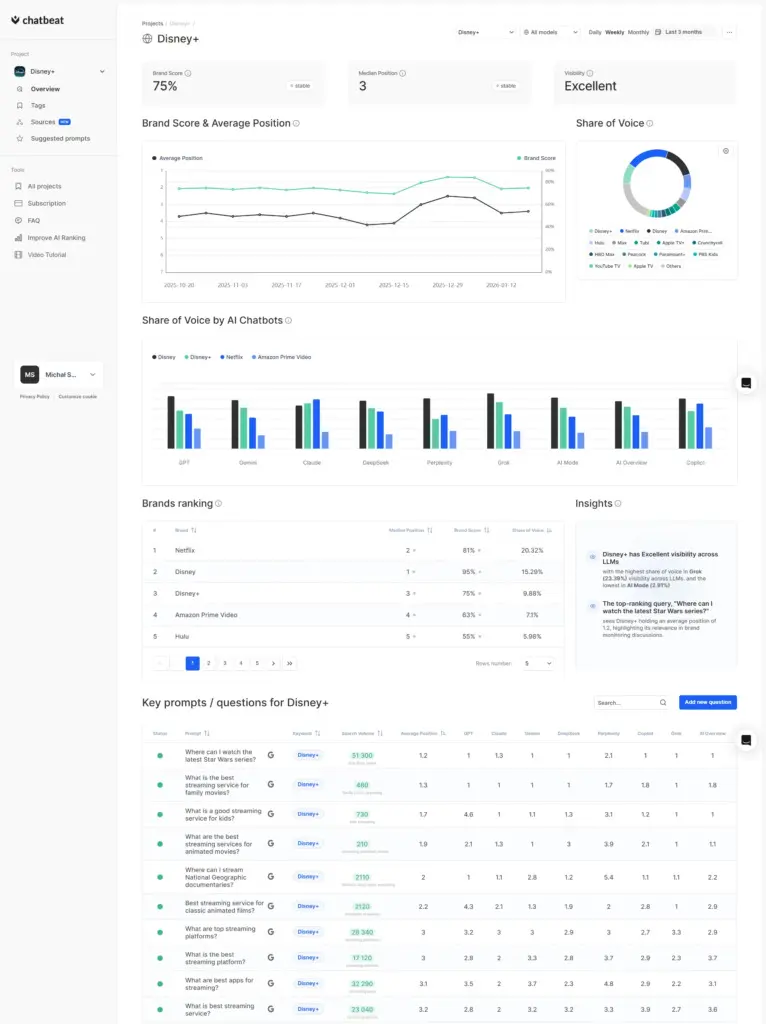
Median Position adds a more resistant measure of ranking performance. Median is useful because a few unusually high or low results exert less influence than they would on an average. Chatbeat also tracks average position and score movement over time, allowing marketers to see whether a new content program changed both appearance frequency and placement.
The full Brand Score formula remains undisclosed, so sophisticated teams should preserve prompt-level and model-level metrics alongside the headline score. Changes to the prompt set can alter the meaning of the aggregate. Adding twenty difficult prompts may lower the score even when the brand’s visibility in the original set remains stable. A clean reporting practice would freeze core prompt clusters, separate experimental prompts, and document every change to the monitored set.
Benchmark AI-Native Competitors
Chatbeat’s Share of Voice evaluates how often and how highly a brand is recommended relative to the other brands appearing in the same answers. Position receives explicit weighting: first place contributes roughly 40%, second around 20%, third around 10%, with diminishing weight further down the response. Share of Voice across all detected brands totals 100% for a query.
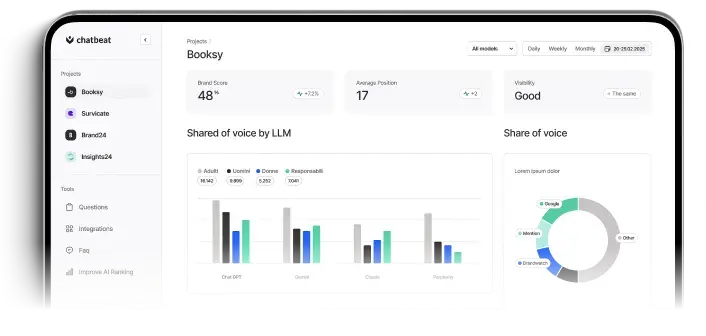
This approach gives ranking order more meaning than a simple mention count. A brand mentioned at the bottom of ten answers has a different competitive position from one repeatedly presented as the primary recommendation.
Competitors can also be detected automatically when they appear beside the monitored company. This creates an AI-native competitor set. It may reveal companies the marketing team rarely includes in conventional benchmarking, yet AI systems treat as close substitutes. That insight can expose a positioning problem, an emerging entrant, or a mismatch between the category the company claims and the category the models have inferred.
Teams can open a prompt and switch between their brand’s analysis and a competitor’s. From there, the workflow becomes diagnostic: identify the questions a competitor owns, inspect how the model characterizes that company, study the sources supporting it, and decide whether the gap belongs to content, authority, distribution, product positioning, or the prompt map itself.
Reverse-Engineer the Sources
Key Sources is Chatbeat’s strongest connection between measurement and action. The feature extracts the domains and individual URLs cited in raw AI responses, aggregates them, and ranks the sources that appear most frequently for a category or prompt set.
These are live citations used during answer generation, rather than a reconstruction of private model-training data. That distinction matters. Chatbeat can show which pages currently shape retrieval-assisted answers. It cannot reveal every document encoded inside a model’s parameters.
The resulting source map still gives marketers a highly practical view of the AI information environment. A frequently cited source might be:
- The company’s own product page
- A competitor comparison
- An industry publication
- A review or directory
- A Reddit discussion
- A YouTube page or transcript
- An affiliate article
- A Wikipedia entry
- A niche resource the marketing team had overlooked
Once a high-impact source is identified, the team can study what the model appears to retrieve from it. That could lead to updating an owned page, pitching an external publication, correcting outdated third-party information, strengthening a comparison page, contributing expert material, or developing a format that models already favor for the prompt.
This is the point at which Chatbeat becomes more useful than a visibility scoreboard. The source analysis turns “our score dropped” into “these three pages replaced our domain as the dominant citation for this prompt.” The second statement can produce an action plan.
Client programs demonstrate how the workflow operates in practice. Worksmile used prompt, narrative, and source data to move its AI positioning away from a legacy wellness identity and toward its broader HR and internal-communications offering. The company improved a selected prompt position by 27% and expanded from one owned URL in the top ten sources to three, including the first-ranked citation.
Base built a prompt map around product functions, then added deeper original pages, rankings, comparisons, FAQs, schema, trusted external references, and an llms.txt file. Its Brand Score moved from 50% to 65% in roughly two months, average position improved from eight to five, and overall AI referral traffic increased by 48.6% at its peak.
Rankomat used source inspection and volatility monitoring around Google AI Overviews. Its Brand Score rose ten percentage points, average position improved by 42%, and the number of search queries where its domain appeared in an AI Overview grew from about 47,000 to 100,000.
These results involved broader SEO, content, PR, and distribution programs. Chatbeat functioned as the diagnostic and validation system—the instrument panel, rather than the engine producing the movement.
Inspect Fan-Out Queries, Products, and Ads
Chatbeat’s newer prompt view moves deeper into the mechanics surrounding individual answers. Fan-out Queries reveals additional searches a model performs while constructing a response, while Top Phrases surfaces language repeated across those searches. This can show that a seemingly straightforward prompt triggered research around pricing, security, reviews, alternatives, integrations, or a specific use case.
For marketers, fan-out data provides an approximation of the hidden query expansion occurring inside AI search. It can uncover content requirements that the original prompt never stated explicitly. A page targeting “best email platform for creators,” for example, may also need clear material on subscriber limits, deliverability, automation, commerce, migration, and pricing if those themes consistently appear in the model’s supporting queries.
Product Cards extend the analysis for e-commerce. Chatbeat can detect product carousels within AI answers and capture which products appeared, how they were visually presented, and the listed price. This makes the platform relevant to product-feed quality, merchant visibility, and AI-assisted shopping as well as conventional brand mentions.
ChatGPT Ads tracking separates paid presence from organic recommendation. It flags when an ad appears beside an answer and records that event in both the prompt timeline and response details. As advertising becomes part of conversational search, this separation will be essential. Otherwise, a brand could misinterpret paid exposure as an improvement in organic AI authority.
Analyze Sentiment and Narrative Context
Frequency and rank explain whether a brand appears. Sentiment and context explain what the appearance means.
Chatbeat evaluates whether AI systems frame a brand positively, neutrally, or negatively and lets users inspect the surrounding response. This is useful for reputation management, product launches, rebrands, and categories where an outdated detail could influence a buying decision.
A positive mention can still be strategically wrong. An AI assistant may praise a company for an old service while ignoring its current product. It may consistently recommend the brand to small businesses when the company is pursuing enterprise customers. It may position the software as inexpensive when the marketing strategy emphasizes security and operational depth.
Context analysis helps identify these subtler gaps. Recommended Actions then translates visibility, sources, and positioning findings into suggested next steps. Experienced marketers will still want to validate those recommendations against the raw answers and their own market knowledge. The product works best as an intelligence system supporting expert judgment.
Report and Operationalize the Findings
Chatbeat’s main dashboard summarizes Brand Score, position, share of voice, competitor rankings, sources, and insights. Users can move from the aggregate view into a prompt and then down to individual model responses. The interface was intentionally designed to make a new and technically complicated category approachable, with Visux developing the product interface, design system, and website through an iterative beta process.
Advanced users can export data and connect Chatbeat to Looker Studio. Agencies receive white-label reporting at the Business level, while Enterprise customers gain API access. These divisions are reasonable commercially, although they leave Essential users largely inside Chatbeat’s native reporting environment.
Historical analysis starts on the day a project is created. A team preparing a rebrand, launch, or GEO campaign should establish the project before making changes so it can capture a useful baseline. Consistent prompt governance matters as much as timing. Comparisons lose validity when questions, models, countries, or languages change continuously.
Enterprise buyers should also note that Chatbeat stores data on servers in the United States and Poland. Its privacy framework describes SSL-protected transmission, 128-bit encryption, written data-processing agreements, and EU-approved contractual clauses for applicable international transfers.
Conclusion
Brand monitoring used to follow a relatively clean line: people discussed a company, search engines indexed those discussions, and analytics recorded whoever clicked. Generative AI folded that line into an answer. The customer can now receive a comparison, recommendation, reputation summary, and buying shortlist before visiting a single source.
Chatbeat unfolds that answer again. It shows which prompts triggered the brand, where the company appeared, which competitors surrounded it, how the model framed it, and which citations helped construct the response. Its repeated-query methodology also acknowledges the unstable nature of generative output and produces a more defensible dataset than occasional manual testing.
Key Sources is the platform’s most valuable capability because it connects observation with intervention. Prompt suggestions, competitive detection, raw-response access, fan-out queries, product cards, sentiment, and ad tracking deepen that workflow. The result sits somewhere between a rank tracker, brand-monitoring platform, competitive-intelligence system, and technical GEO audit tool.
The platform’s limits are equally clear. It begins collecting history at setup, traditional search data acts as a proxy for prompt demand, prompt capacity requires careful allocation, and the most open forms of data access sit in the Enterprise plan. Chatbeat measures the output of AI systems; the marketing team still has to change the inputs through better content, stronger entity signals, credible third-party mentions, technical accessibility, PR, partnerships, and distribution.
That division of labor makes sense. A thermometer never cures the patient, but marketing teams still need a reliable reading before choosing a treatment. Chatbeat gives AI visibility that reading—and then lets marketers open the answer, inspect the sources, and see where to operate.
Ratings
- Ease of Use:
- Features:
- Reporting:


