

- Poor contact data affects more than bounce rates. It can reduce deliverability, consume sales time, distort attribution, and prevent viable prospects from entering the pipeline.
- The problem is widespread: 37% of CRM users report losing revenue because of poor data quality, while 76% say less than half of their organization’s CRM data is accurate and complete.
- LinkedIn can improve contact discovery through Boolean search and detailed filters, but profile discovery should still be followed by role and email verification.
- Bounce rates below 2% are generally considered healthy, while rates below 1% indicate a particularly well-maintained database.
- The strongest contact databases verify records when they enter the system and review them again before they are reused, rather than waiting for campaign performance to reveal a problem.
Most B2B teams discover they have a contact database problem the same way. A campaign goes out, bounce rates are higher than expected, response rates are lower than projected, and the post-mortem eventually traces back to a list that was built months ago from sources that were already partially outdated at the time.
The fix applied is usually tactical: clean the list, remove the bounces, move on. The structural problem, that the process for building and maintaining contact data was inadequate from the start, stays in place until the same situation repeats.
What Bad Contact Data Actually Costs
The cost of poor contact database quality is consistently underestimated because it is distributed across multiple metrics rather than appearing as a single line item. Bounce rates are tracked. Response rates are tracked. But the aggregate cost of wasted sender reputation, misspent SDR time, distorted attribution data, and missed pipeline opportunities from contacts who were never actually reached rarely gets calculated together.
The scale of the problem becomes clearer when CRM data is considered alongside campaign performance. In Validity’s 2025 survey of 602 CRM users and stakeholders, 37% reported losing revenue as a direct consequence of poor data quality, while 76% said less than half of their organization’s CRM data was accurate and complete.
Understanding why your contact database is costing you more than you think covers the specific ways this cost compounds over time. The most significant component is sender domain reputation. When a campaign produces high bounce rates, the sending domain accumulates negative signals that affect every subsequent send, including messages to perfectly accurate contacts. Recovering a damaged domain reputation takes weeks and directly reduces pipeline during that recovery period.
The second most significant cost is SDR and recruiter time spent on manual verification after the fact. Sales representatives already spend 60% of their time on non-selling tasks, including CRM administration and searching for information. Correcting titles, replacing invalid addresses, and cleaning bounced contacts after a campaign adds to that existing administrative burden.
The third cost is invisible in most reporting: the deals and candidates that were never reached because the outreach never arrived. These do not appear as failures. They simply never appear at all.
What Good LinkedIn Search Practice Has to Do With Database Quality
LinkedIn is a common source for B2B contact discovery, but the quality of the resulting data depends heavily on how searches are structured. The typical workflow produces large result sets that require significant manual review to qualify, rather than small, precise sets of genuinely relevant contacts.
LinkedIn supports Boolean operators including AND, OR, and NOT, quotation marks for exact phrases, and parentheses for grouping search terms. Its people-search filters include location, current company, past company, industry, profile language, and keywords. LinkedIn also notes that adding details such as company, role, title, and location generally produces more relevant results.
The practical application for contact database quality is direct: a well-constructed LinkedIn search produces a shortlist of contacts worth verifying and adding to a maintained database. A broad keyword search produces a volume of results that degrades database quality because not all of them get properly verified before entering the pipeline.
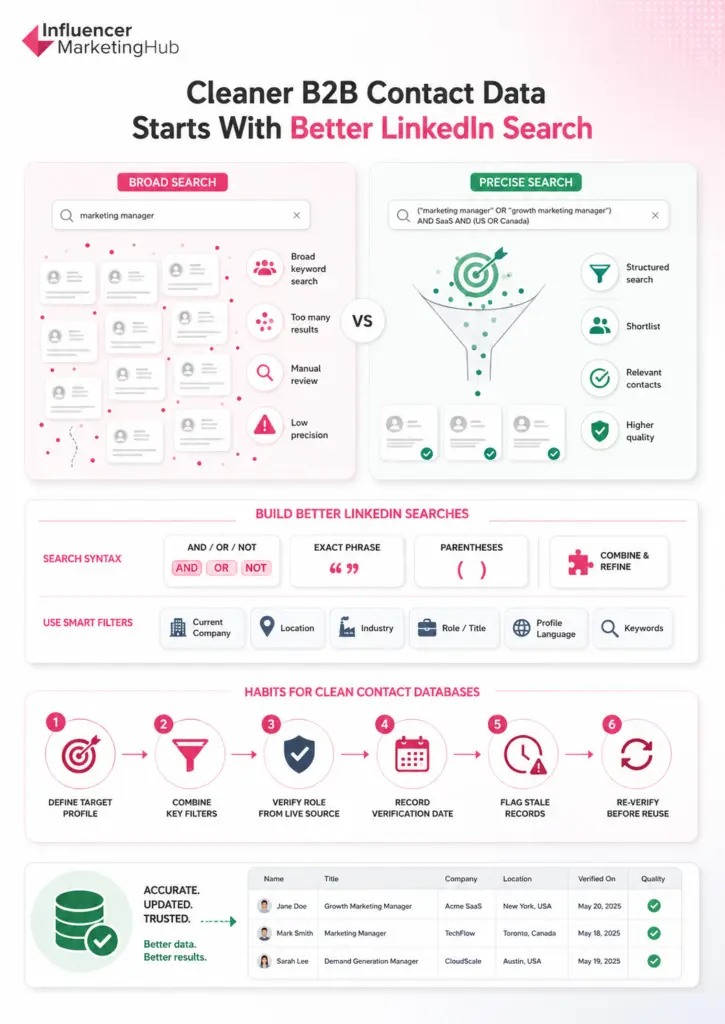
The habits that produce clean contact databases over time:
- Define the target profile precisely before any search is run.
- Combine the filters that materially define the audience, such as current company, location, industry, role, and keywords, rather than relying on a broad keyword search.
- Verify role accuracy against a live source before adding any contact to an active sequence.
- Record the verification date on every contact record.
- Set a maximum acceptable age for unverified contacts before they are flagged for review.
- Base the re-verification interval on how quickly roles and company information change within the target segment, and review older contacts before reusing them in a new campaign.
Building a Contact Database That Compounds Rather Than Decays
The contact databases that produce consistent outreach performance are not built once. They are maintained continuously through a process that treats data quality as an operational standard rather than a cleanup project triggered by poor campaign performance.
The structural difference between a database that compounds and one that decays is a verification cadence. Microsoft recommends keeping contact data current, removing old or invalid records that have hard bounced, and monitoring bounce and engagement rates for signs that list quality is deteriorating. (Microsoft, 2024)
| Database Management Approach | Verification Point | Maintenance Model | Performance Trend |
|---|---|---|---|
| Build once, use indefinitely | None | No ongoing maintenance | Declining as records age |
| Clean after poor results | After delivery problems appear | Reactive | Inconsistent |
| Verify before each campaign | Before contacts enter a sequence | Periodic | More stable |
| Continuous verification at lookup | When records enter the database and before reuse | Embedded | Improving |
Microsoft states that an acceptable email bounce rate generally should not exceed 2%. It also identifies old, invalid, inactive, and previously hard-bounced contacts as common causes of elevated bounce rates. The 2% figure should therefore be treated as a list-health benchmark rather than a guaranteed result of any specific database-management approach.
The investment required to move from reactive to embedded verification is a process decision, not necessarily a budget decision. It requires changing when verification happens in the workflow, not simply increasing how much is spent on contact data.