
Using competitive intelligence (CI) tools is an efficient way to gather information on your competitors. These tools give you insights into trends that you may have missed and how to further optimize your business.
With competitive intelligence tools, you get a curated overview of what your competitors may be doing. According to Gitnux’s data, 90% of businesses use competitive intelligence to enhance their market understanding, leading to better strategic decisions and improved product offerings. This enables you to monitor their product launches, pricing strategies, and marketing campaigns, allowing you to pinpoint their competitive advantages. This, in turn, gives you key insights into the trends and directions that your industry may be pivoting toward, allowing you to anticipate key market changes and come up with responses to seize opportunities and avoid risks. Here’s a guide on the competitive intelligence tools and techniques that you can use to give your organization a competitive edge.
- 11 Competitive Intelligence Tools and Techniques to Bring You Results
- 1. Semrush
- 2. SimilarWeb
- 3. SpyFu
- 4. Crayon
- 5. Contify
- 6. Monitor your industry via social media
- 7. Use scenario analysis for anticipatory actions
- 8. Conduct PEST analysis to account for outside disruptions
- 9. Do a SWOT/TOWS analysis for a more thorough understanding of your business
- 10. Funnel your findings among your collaborators and partners
- 11. Keep yourself updated with the latest trends in competitive intelligence
- 4 Core Essentials of Competitive Intelligence Tools and Techniques
- Wrapping Up
- Frequently Asked Questions
11 Competitive Intelligence Tools and Techniques to Bring You Results
Competitive intelligence as a field is still growing. Many of the tools and techniques available are relatively new compared to other marketing research, analysis, and reporting tools. Here are some of the most worthwhile CI tools to consider:
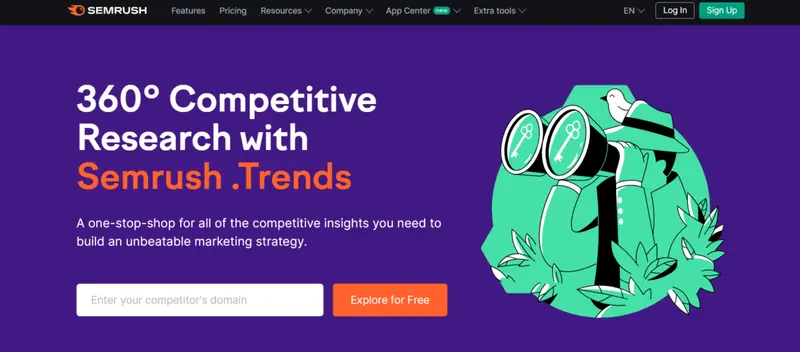
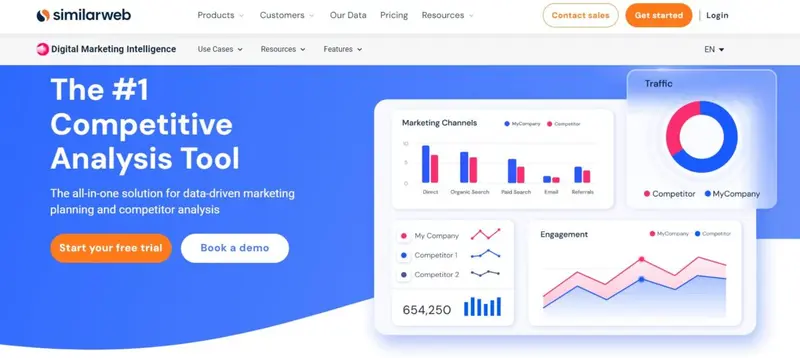
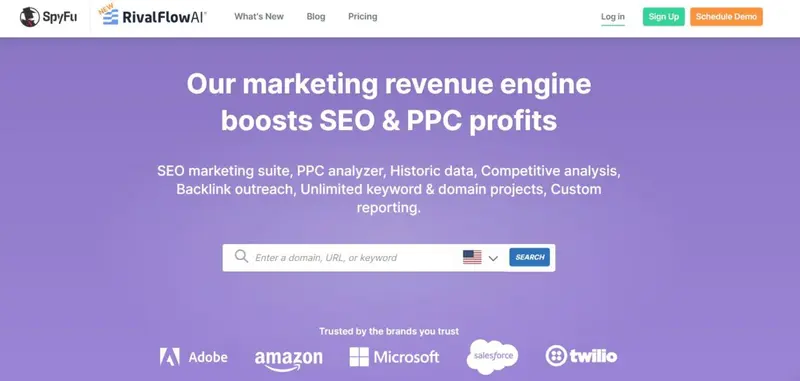
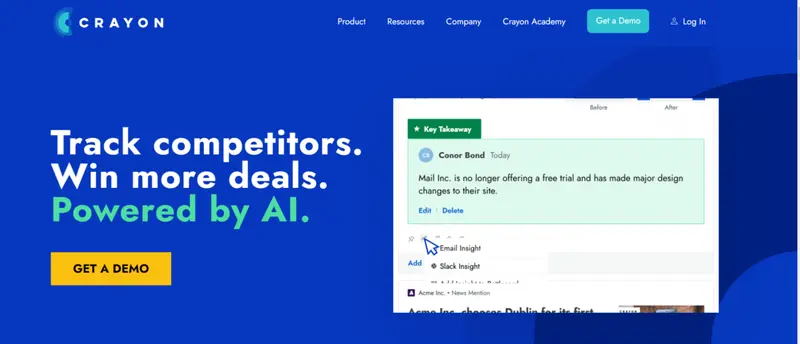
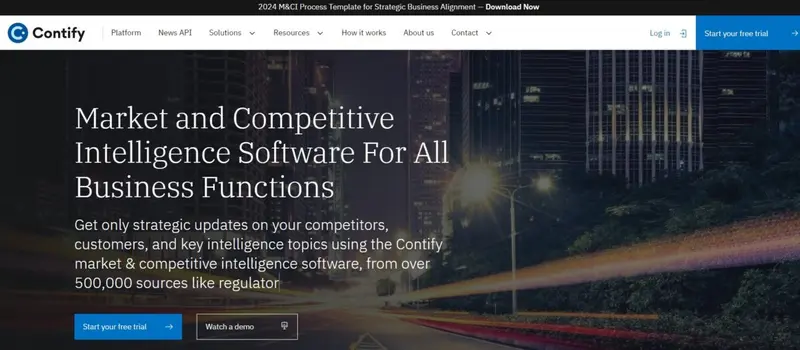
While SEMrush is primarily known for its SEO and keyword capabilities, you shouldn’t overlook its other features that can help you with CI. For competitive analysis and reporting, you can use SEMrush’s Organic Research feature to identify which of your competitors ranks highest in Google SERPs. Then, you can use Market Explorer to analyze the markets your competitors serve and generate comprehensive reports about your findings. SEMrush offers several other competitive intelligence features that you can leverage to make sure that you’re getting a clear picture of what you need to do to stay ahead: With SimilarWeb, you can directly compare and contrast your website with those of your competitors. You’ll be able to see the key metrics that affect your performance all within a few clicks and see what you can do to enhance your performance. Simply enter the URLs and the tool will do the rest. This tool has several features that can give you a closer look at what your competition is using to reach their audience, such as: If you’re looking to invest in competitive intelligence tools but are limited by budget, SpyFu can be a good alternative. This tool manages to strike a good balance between basic search analytics and the more robust data-gathering capabilities of dedicated CI tools. Its keyword feature (while strictly not a CI-centric capability) can offer you useful insights about the state of your SEO by comparing it against your competitors. Using SpyFu, you can see the common SEO keywords used by you and your competitors. With data presented this way, you can determine which keywords are most profitable for your business and which have the most impact in your field. Much of this data you can find in SpyFu’s SEO Overview: Crayon is a competitive intelligence tool that heavily leverages AI capabilities to drastically simplify the CI process. By doing this, it allows for seamless data gathering, analysis, and measurement on a single platform, which can improve your overall productivity and workflow. The Crayon AI helps you prioritize and filter the most essential areas to pay attention to in competitive analysis. Some of the features that can be useful for your SEO strategy include: Contify, an award-winning competitive intelligence platform, makes it easy for you to stay updated on your competitors. With this tool, you can monitor your competitors’ digital presence through battlecards, social media analysis, thematic tracking, and more. Contify takes its insights from over 500,000 different sources like company websites, social media, and other types of content for a comprehensive overview of your industry’s trends and other driving factors. It further enhances these insights with AI, with features like:1. Semrush
2. SimilarWeb
3. SpyFu
4. Crayon
5. Contify
6. Monitor your industry via social media
According to Statista, a little over 5 billion people today are on social media, whose insights can be useful for your competitive intelligence reports. Competitive intelligence analysis can help you see what those audiences are engaging with on social media. By monitoring how your audience engages with your competitors, you’ll be able to gain insights into engagement strategies that work for them—and how to improve on what they’re doing for your own social media efforts.
Social media monitoring identifies the posts of your competitors that gain the most traction, analyzes why they work, and keeps tabs on how it performs on social media. Not only will this allow you to get an overview of trends that your competitors may be following, but it also helps you monitor hashtags, specific mentions, and even engagement trends over time.
Some tools like SEMRush’s social media tracker can help you get started with social media monitoring and integrating the insights you get into your competitive intelligence strategy. But don’t think that a social media monitoring tool is needed for competitive intelligence analysis. Just keeping yourself updated with what your competitors are doing on social media can often give you a heads-up on trends that you may be missing out on.
7. Use scenario analysis for anticipatory actions
While scenario analysis is often used in the context of risk management and reduction, being selective about your data sources and analyzing them from a competitive intelligence perspective is a great way to generate CI-relevant data. By predicting the actions and trends of your competitors and industry based on available data, you’ll be much better equipped to take anticipatory actions and capitalize on any opportunities.
Keep in mind that scenario analysis becomes better the more data you have—which is an area where competitive intelligence tools can excel. You’re not just looking to avoid the worst-case scenario with this approach but also identifying any potential opportunities that you can take advantage of.
8. Conduct PEST analysis to account for outside disruptions
PEST analysis (political, economic, social, and technological) is a framework where you predict, analyze, and formulate responses to any major external factors that may affect your business’s performance. These factors don’t always have to be business-related or even caused by your competitors. They can be major shifts that can affect your business due to factors outside your industry’s control or influence. A reason why PEST analysis can be valuable is that the completed analysis can give you an idea of how your competition will react to these potential events, which you can then study further to inform your response.
9. Do a SWOT/TOWS analysis for a more thorough understanding of your business
SWOT (strengths, weaknesses, opportunities, and threats) and TOWS (threats, opportunities, weaknesses, and strengths) offer two perspectives on approaching competitors from the perspective of your company. While CI tools can give you a good overview of what others in your industry are doing, also studying your own business’s capabilities is crucial to creating an informed CI strategy.
By conducting these analyses, you’ll be in a far better position to formulate a concrete response to any outside factors, market changes, or competitor actions that could affect your business. By understanding the capabilities of your organization and operations, it will be easier for you to lay the foundations of a CI-led response.
10. Funnel your findings among your collaborators and partners
While the primary goal of competitive intelligence is to gain a better picture of how your competitors are performing, it’s also important to remember that CI data enables better teamwork. Most of the time, this will only apply within your company—but it’s also a possibility if you’re working with collaborators and partners.
Competitive intelligence tools have robust reporting features that allow for generating key insights or comprehensive overviews that are simple yet shareable with your collaborators. Don’t miss out on the opportunity to share information with the parties that need it. Not only does it put all of you on the same platform with the same insights, but it also improves further collaborations.
11. Keep yourself updated with the latest trends in competitive intelligence
Competitive intelligence is still a rapidly developing field, and there’s a lot of innovation that’s being done in response to growing trends, introduced technologies, and customer sentiment. If you’re planning on investing in competitive intelligence, you should make sure to stay up-to-date on the latest tools and techniques.
By doing this, you can ensure that you always have access to the best approaches available to understand your competitors within your industry. With the rapidly moving landscape of business today, even a head start of a few months with the right CI tools can spell the difference between success and underperformance.
4 Core Essentials of Competitive Intelligence Tools and Techniques
Before diving into the tools and techniques to use, it’s important to quickly go over the four essential steps in a competitive intelligence cycle. If your tool or technique fulfills one or more of these steps, you create a successful flow of information that can help your business succeed.
Gathering Information
There are two commonly used approaches to data gathering in competitive intelligence:
- Passive: Using competitive intelligence tools, platforms, or other third parties to gather data
- Active: Actively interacting with your competitors, like signing up for trials or viewing their published material
Data gathering is crucial for competitive intelligence because it forms the foundation of all the data that you’ll need to inform your own decisions in the future. You’ll get better insights by acquiring more information from a variety of sources.
Analyzing Data
Once you’ve gathered your data, it’s time to analyze it. While your general goal is to closely monitor your competitors, you should also keep an eye on important industry trends and developments. To delve deeper, employ specific analytical techniques such as cross-tabulation to compare competitors against various performance metrics, or use trend analysis to track changes in market share over time. Utilize predictive analytics to model and forecast future industry movements based on historical data, which can guide more informed strategic decision-making. The data you’ve gathered ensures not only an understanding of where your competitors and industry stand today but also where they are headed.
Reporting on Results
It’s important to collate all the data you’ve gathered and analyzed into a report, as it’s the best way to both share and organize your information. By organizing your data in a report, you’ll be able to reference it across different stakeholders, departments, and anyone involved in the decision-making process.
To enhance the depth of your reporting, include segmented analysis tailored to the specific interests of various stakeholders—for example, detailed competitor activity for marketing teams, or emerging market trends for strategic planning departments.
When it comes to reporting, competitive intelligence tools can provide you with a comprehensive overview of the data they gather. You can build an entirely new strategy or pick out the most useful insights for your business based on these automated reports.
Execute on Your Insights
Competitive intelligence helps you make informed decisions that benefit your business. Using the information you’ve gathered in the previous three steps, you should now have enough information to put together a winning strategy.
Even small improvements to your usual operations can be the result of competitive intelligence planning. These could include simple fixes, opening more communications channels, and even improved information-sharing across your organization.
Wrapping Up
The market for competitive intelligence tools is only poised to become bigger within the next few years. According to Electronic, roughly 88% of companies fail to analyze the data that they collect properly, missing out on key information and insights that could help them succeed. Competitive intelligence tools can effectively address this concern, giving you access to actionable data that can be included in your short and long-term marketing strategies.
And even in the absence of competitive intelligence tools, the methodologies and approaches used by those tools will always benefit any company that deploys them properly. Keeping a close eye on your competitors has always been the best practice for business, although doing so hasn’t always been easy. Now, the capabilities of competitive intelligence tools and techniques make this approach far more feasible for businesses.
Frequently Asked Questions
Are competitive intelligence tools necessary to succeed in business?
Competitive intelligence tools represent a promising future for the field of marketing research. With their capabilities to gather data from various sources, competitive intelligence tools have rapidly become popular among many large businesses seeking to stay ahead in their industry. In fact, around 68% of businesses use competitive intelligence to understand the marketplace, according to Gitnux.
Competitive intelligence tools are undoubtedly valuable to your business strategies and overall success, but it’s also crucial to be realistic in determining when making a decision about whether or not to invest heavily in these tools. In some cases (especially for small to medium enterprises), active competitive intelligence approaches can be sufficient to carry out your marketing efforts. With time, you should be able to utilize competitive intelligence tools as your business continues to grow.
Can using competitive intelligence tools be considered corporate espionage?
Because of the extensive information gathered by competitive intelligence tools, some users may be concerned about the possibility that these tools and platforms are sourcing their data illegally. However, competitive intelligence tools only gather information that isn’t protected by confidentiality or non-disclosure agreements. Their data-gathering processes comply with local and international regulations for acquiring data.
With competitive intelligence approaches, the sources are publicly available and published by your competitors. End-of-year reports, public quarterly earnings, and other public disclosures can all be used as sources for competitive intelligence gathering. This can yield even better insights the more advanced your tools are, as Forbes found in its report about AI-powered CI tools.
Where else can you gather competitive information?
Choosing where you get your sources is a crucial part of competitive intelligence. While most of your competitive intelligence research can be done online, there’s also some merit in looking at other areas where you can gather more information. Some of these include:
- Physical locations: If your competition has a brick-and-mortar establishment, taking a tour of their premises can be helpful for your data gathering. This is particularly useful if you’re researching events like activations or product launches.
- Checking press releases: Larger companies will often publish press releases ahead of major events in their company, product launches, or anything else that they want their customers to know. Consulting these releases can give you ideas on the potential direction that your competitors may be moving toward.
- Conferences and exhibitions: These events are some of the best opportunities you can have to gather data on both your competitors and your industry. Many of these events are forward-facing and showcase future trends, which can help you gauge your market’s potential and formulate your business strategy in response.
- Job postings: Looking at the job postings of your competitors can also give you a clue about their potential plans or indicate incoming market shifts that they want to act on. This can be useful if you think your industry is growing or expanding in new directions since new talent will often be needed by your competitors to address any challenges.


