
Great products don't automatically become great brands.
Customers make decisions based on perception as much as product quality. If they can't quickly understand who your brand is for, how it's different, or why it's the better choice, competitors with clearer messaging often win, even when their products aren't objectively better.
A brand positioning statement provides that clarity. It defines the audience you serve, the market you compete in, the value you deliver, and the unique advantage that separates your brand from alternatives.
While customers rarely see the statement itself, they experience its influence through your website, advertising, product messaging, sales conversations, and every other brand touchpoint.
The value of that clarity is measurable. Research highlighted by Adweek found that consistent and clear messaging can improve brand perception by 70%. A well-crafted brand positioning statement helps create that consistency by giving every team a shared strategic foundation for communicating what the brand stands for and why customers should choose it.
In this guide, you'll learn how to build a positioning statement using the IMH Brand Positioning Framework, explore real examples from leading brands across multiple industries, and download our free Brand Positioning Statement Builder to develop, refine, and validate your own.
- What Is a Brand Positioning Statement?
- Brand Positioning Statement vs. Mission Statement vs. Value Proposition
- The IMH Brand Positioning Framework
- Step 1: Know Your Audience
- Step 2: Define Your Market Category
- Step 3: Clarify Your Value Proposition
- Step 4: Prove Your Difference
- Step 5: Write and Refine Your Brand Positioning Statement
- 10 Brand Positioning Statement Examples (by Industry)
- Common Brand Positioning Statement Mistakes
- When Should You Update Your Brand Positioning Statement?
- Build a Positioning Statement That Guides Every Decision
- Frequently Asked Questions
🧱 Build Your Brand Positioning Statement in 30 Minutes
Writing a positioning statement is much easier when you have a structured process to follow.
The IMH Brand Positioning Statement Builder is a guided workbook that walks you through every stage of the process, from identifying your target audience and defining your market category to clarifying your value proposition, proving your differentiation, and refining your final statement.
Inside you'll find:
- A step-by-step positioning workbook.
- Multiple brand positioning statement templates.
- Industry-specific positioning frameworks.
- Competitive differentiation exercises.
- A refinement and validation checklist.
- An implementation checklist for rolling out your positioning across your business.
What Is a Brand Positioning Statement?
A brand positioning statement is an internal strategic document that defines how your brand should be perceived within a specific market. It identifies your target audience, the category you compete in, the value you provide, and the qualities that differentiate your brand from competing alternatives.
Unlike a slogan, tagline, or mission statement, a positioning statement isn't designed for public consumption. Its purpose is to align internal teams around a single strategic direction, ensuring marketing, sales, product development, customer success, and leadership communicate a consistent message at every stage of the customer journey.
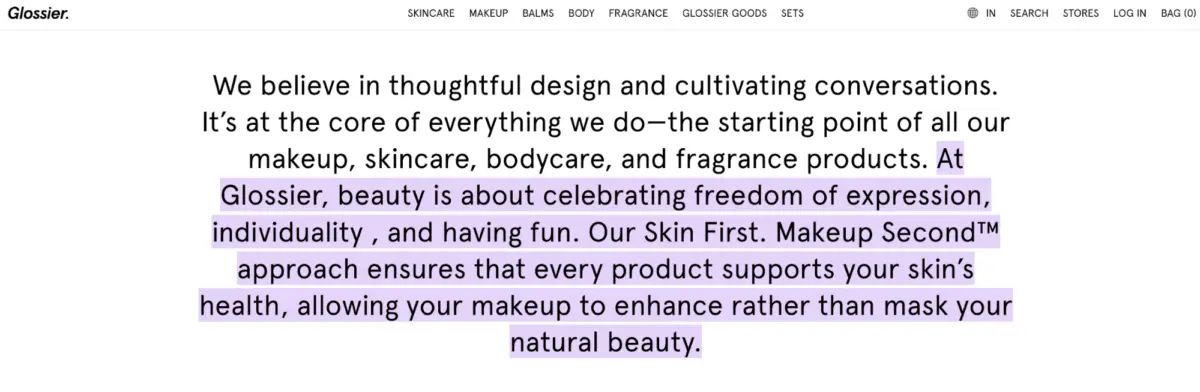
Glossier’s brand positioning statement clearly highlights how the brand celebrates freedom of expression and individuality. Customers can clearly see how the brand’s products support skin health and allow makeup to “enhance rather than mask your natural beauty.”
Most effective positioning statements answer four essential questions:
- Who are we trying to serve?
- Which market or category do we compete in?
- What primary value do we deliver?
- Why should customers choose us instead of competitors?
CEO at Rank Secure, Baruch Labunski, further expands on these questions, saying:
“Four elements are important to creating a strong brand positioning statement. They are: understanding your mission and committing to it, understanding who you are and your company's values, recognizing the past with honor, and having future goals. Being true to yourself and your company shows in your brand positioning statement.
People get that and relate to it."
He further says:
“Enforcing your mission and relating it to company values shows what you will do. Relating it to the past and demonstrating you have future goals will inspire potential customers.”
Once those answers are clearly defined, creating campaigns, landing pages, product messaging, sales enablement materials, and advertising becomes significantly easier because every team is working from the same strategic foundation.
Brand Positioning Statement vs. Mission Statement vs. Value Proposition
Although these terms are often used interchangeably, they each serve a distinct purpose within your brand strategy.
| Attribute | Brand Positioning Statement | Mission Statement | Value Proposition |
| Primary Purpose | Defines how your brand should compete and be perceived within the market. | Explains why your organization exists. | Explains the value customers receive from your products or services. |
| Primary Audience | Internal teams. | Employees, customers, investors, and the public. | Prospective and existing customers. |
| Visibility | Internal document. | Public-facing. | Public-facing. |
| Primary Focus | Target audience, market category, differentiation, and competitive positioning. | Company purpose, vision, and long-term direction. | Customer benefits and outcomes. |
| Typical Use | Guides marketing strategy, messaging, product positioning, and brand decisions. | Inspires stakeholders and communicates organizational purpose. | Supports marketing campaigns, landing pages, sales conversations, and product messaging. |
These documents complement one another rather than compete.
Your mission statement explains why your business exists. Your value proposition communicates what customers gain from choosing you. Your brand positioning statement defines how your brand should be positioned against competitors, serving as the strategic blueprint that informs virtually every external message your business creates.
The IMH Brand Positioning Framework
A strong brand positioning statement rarely appears after a single brainstorming session.
The best ones are built systematically, with each decision informing the next. Before you can write a compelling statement, you need to understand who you're serving, the market you compete in, the value you create, and the evidence that supports your claims.
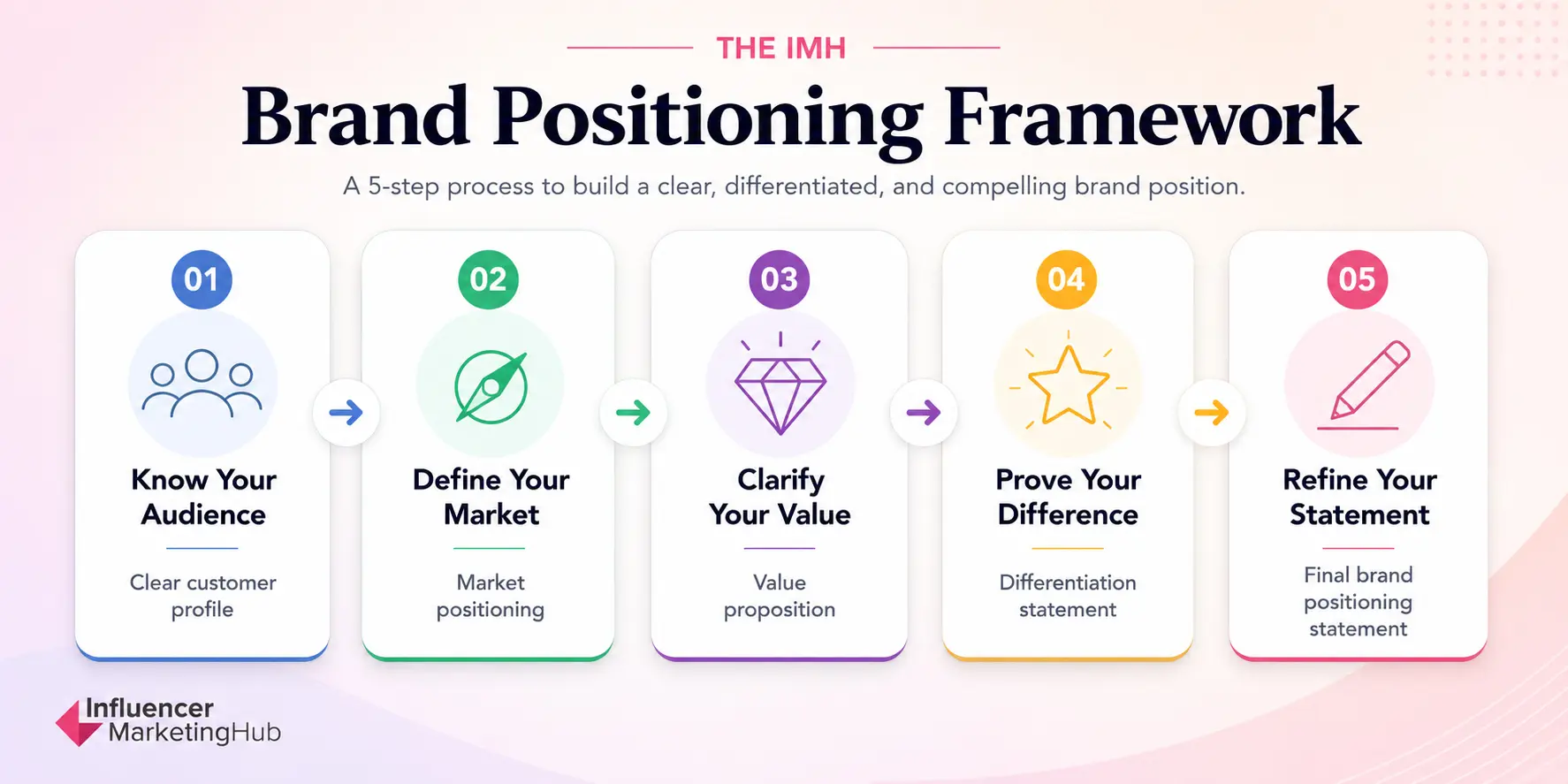
The IMH Brand Positioning Framework breaks that process into five practical stages. Each stage answers one strategic question and produces a clear outcome before moving to the next.
| Stage | Strategic Question | Outcome |
| Know Your Audience | Who are we trying to serve? | Clear customer profile |
| Define Your Market | Which category do we compete in? | Market positioning |
| Clarify Your Value | What core value do we deliver? | Value proposition |
| Prove Your Difference | Why should customers choose us? | Differentiation statement |
| Refine Your Statement | How do we communicate it clearly? | Final brand positioning statement |
Rather than treating positioning as a branding exercise, this framework helps you make a series of strategic decisions that ultimately shape your messaging, marketing campaigns, product positioning, and customer experience.
Step 1: Know Your Audience
Every positioning statement begins with the customer, not the product.
One of the biggest mistakes businesses make is writing positioning statements around what they sell instead of who they're helping. Customers don't buy products simply because they exist. They buy solutions to specific problems, aspirations, or goals.
That's why the first step is developing a clear understanding of your audience.
Go beyond basic demographics and consider questions such as:
- Who is our ideal customer?
- What challenges are they trying to solve?
- What outcomes are they hoping to achieve?
- Which alternatives are they using today?
- What influences their buying decisions?
- What objections might prevent them from choosing us?
The more specific your audience definition becomes, the easier it is to create messaging that feels relevant and differentiated.
For example, "small businesses" is a broad audience. "Growing eCommerce brands struggling to forecast inventory across multiple sales channels" is a positioning opportunity.
Focus on the Problem Before the Product
Many positioning statements fail because they describe features instead of customer needs.
Rather than asking:
What do we offer?
Start with:
What problem are we uniquely qualified to solve?
This shift naturally leads to stronger positioning because it frames your brand around customer outcomes instead of internal capabilities.
Outcome: A clearly defined audience profile that becomes the foundation for every decision that follows.
Step 2: Define Your Market Category
Customers understand new brands by comparing them to something they already know.
Your market category provides that mental reference point. It answers the question:
"What kind of company is this?"
Without a clear category, customers have to do the work of figuring it out themselves, and that uncertainty often slows buying decisions.
A strong positioning statement clearly identifies the market you compete in before explaining why you're different.
Choose the Right Competitive Frame
Your category should be broad enough to feel familiar but specific enough to communicate relevance.
For example:
| Weak Category | Stronger Category |
| Software | Marketing automation platform |
| Consulting | B2B growth consultancy |
| Clothing | Sustainable outdoor apparel brand |
| Coffee | Premium specialty coffee subscription |
| Banking | Digital banking platform for freelancers |
The stronger category immediately creates expectations while leaving room to communicate your unique value.
Define the Alternatives You're Replacing
Positioning is also about what customers would choose if your brand didn't exist.
Ask yourself:
- Which competitors are we replacing?
- What current solution are customers dissatisfied with?
- Why would someone switch to our brand?
- What expectations already exist within this category?
Understanding those alternatives helps you position your brand more clearly against competing options instead of describing it in isolation.
Outcome: A clearly defined market category that helps customers immediately understand where your brand fits and what alternatives it competes against.
Step 3: Clarify Your Value Proposition
Once you've identified your audience and defined your market category, the next step is answering a simple but critical question:
Why should customers choose your brand?
Many positioning statements fail because they describe what a company does rather than the value it creates. Listing features, services, or product capabilities doesn't explain why customers should care.
Your value proposition bridges that gap by translating what you offer into meaningful customer outcomes.
Focus on Outcomes, Not Features
Features describe your product.
Value explains the impact those features have on your customers.
For example:
| Feature | Customer Value |
| AI-powered analytics | Make faster, more confident business decisions. |
| Same-day delivery | Get products when you need them without waiting. |
| Automated workflows | Save time by eliminating repetitive manual tasks. |
| 24/7 customer support | Resolve issues quickly and reduce downtime. |
When drafting your positioning statement, ask yourself:
- What problem does our product solve?
- What outcome does the customer achieve?
- How does their situation improve after choosing us?
- Which benefit matters most to our ideal customer?
Focusing on outcomes creates positioning that's more persuasive because customers buy results—not features.
Identify Your Core Value
Every successful brand delivers multiple benefits, but your positioning statement should concentrate on the one that matters most.
Think about your value across three dimensions:
- Functional Value: What practical problem do you solve?
- Emotional Value: How do customers feel after choosing your brand?
- Business Value: What measurable impact do you create, such as saving time, reducing costs, or increasing revenue?
Trying to communicate every benefit often weakens positioning. Instead, identify the primary value customers associate with your brand and build your statement around that central promise.
For example:
- Slack focuses on making workplace communication faster and more organized.
- Airbnb emphasizes unique travel experiences over traditional accommodation.
- Canva positions itself around making professional design accessible to everyone.
Each brand delivers many benefits, but its positioning revolves around one clear value.
Outcome: A concise value proposition that explains the primary benefit your brand delivers and why customers should care.
Step 4: Prove Your Difference
Value attracts attention.
Differentiation gives customers a reason to choose you instead of someone else.
If competitors could copy your positioning statement and it would still make sense for their business, your positioning probably isn't distinctive enough.
Strong positioning identifies a competitive advantage that customers value and competitors struggle to replicate.
Find Your Competitive Advantage
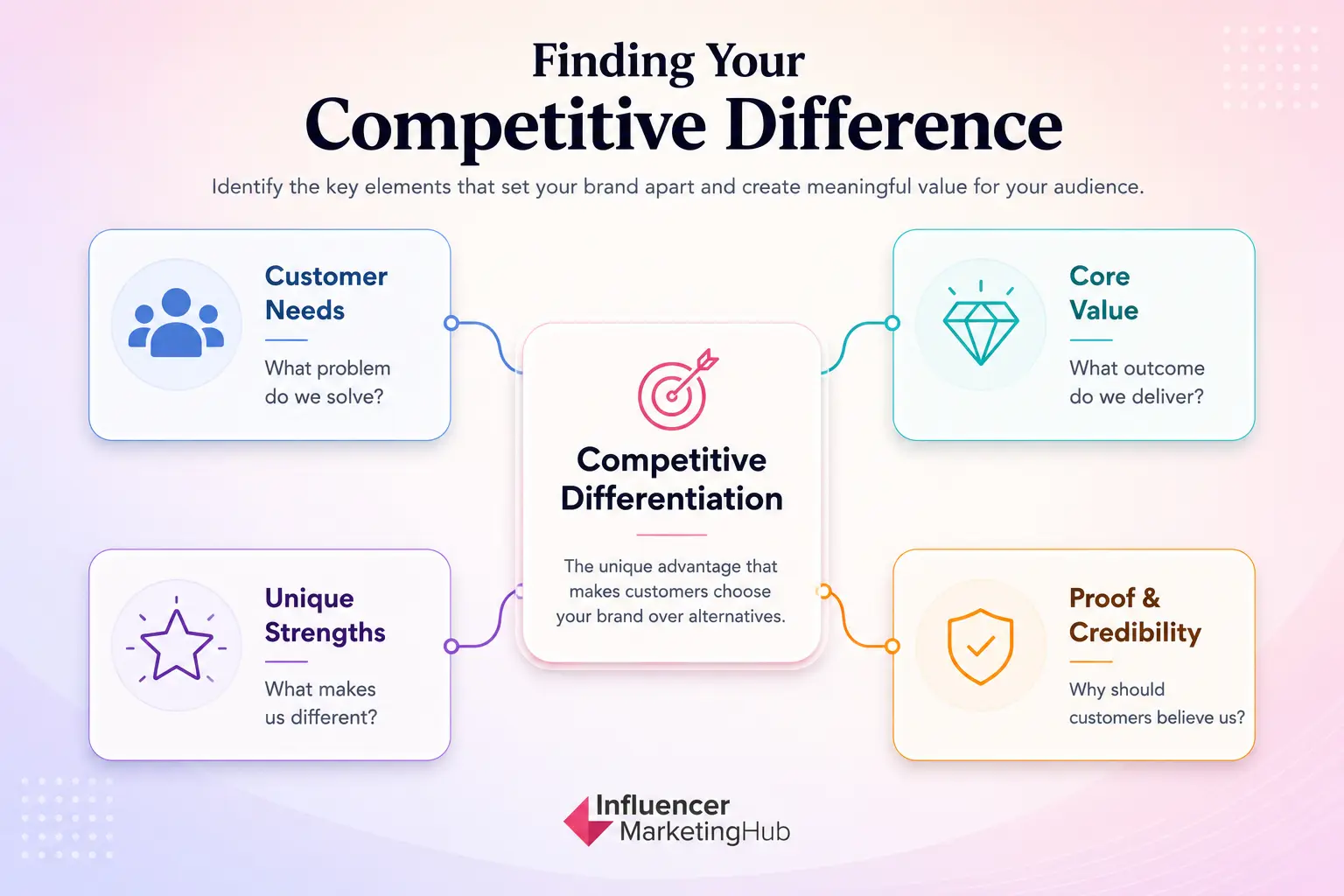
Differentiation isn't always about being completely unique.
It's about identifying an advantage that is meaningful within your market.
Consider questions such as:
- What do we consistently do better than competitors?
- What customer need is underserved today?
- What expertise, technology, or experience is difficult to replicate?
- Why do customers switch to us from competing brands?
- What proof supports our claims?
Your answers should move beyond marketing language and focus on tangible advantages.
For example, a software company might differentiate through ease of implementation rather than the number of features, while a consumer brand may compete on sustainability, customer experience, or product quality instead of price.
Support Your Positioning With Proof
Customers rarely believe positioning statements based on claims alone.
Where possible, reinforce your differentiation with credible evidence.
Examples include:
- Customer success stories
- Independent reviews
- Awards and certifications
- Proprietary technology
- Years of experience
- Measurable business results
- Industry expertise
The stronger your supporting proof, the more believable—and defensible—your positioning becomes.
Pressure-Test Your Statement
Before finalizing your positioning, ask these questions:
- Could our three biggest competitors make the same claim?
- Does this statement clearly communicate our unique advantage?
- Would our ideal customer immediately understand the value?
- Can we consistently deliver on this promise?
If the answer to any of these questions is "no," refine your positioning before moving forward.
Outcome: A differentiation statement supported by credible evidence that clearly explains why customers should choose your brand.
Step 5: Write and Refine Your Brand Positioning Statement
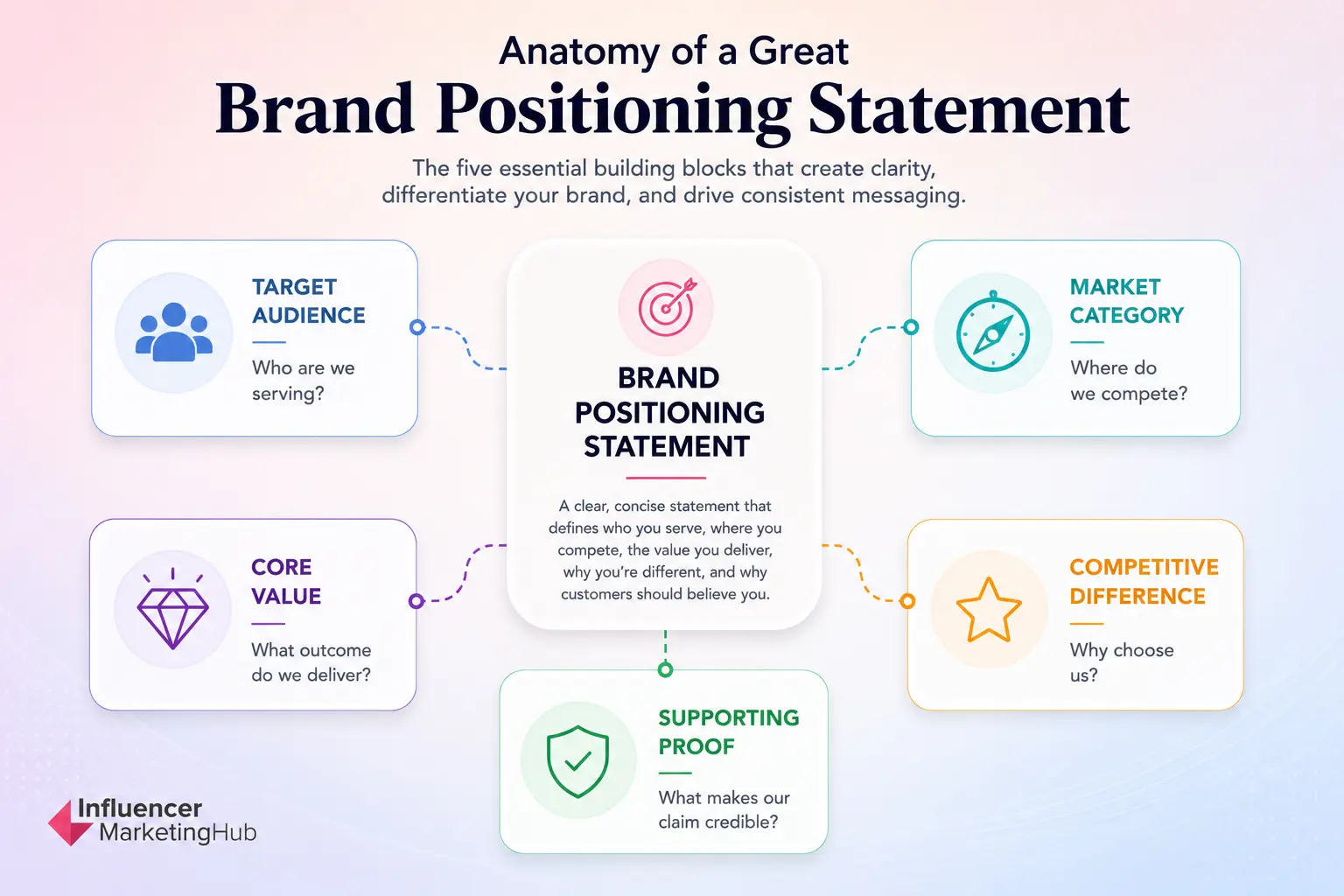
With your audience, market category, value proposition, and differentiation clearly defined, you now have everything you need to write your brand positioning statement.
Many businesses make the mistake of starting with a template and trying to fill in the blanks. A stronger approach is to complete the strategic thinking first and use the template to organize those decisions into a concise statement.
Your positioning statement should be clear enough to guide internal decision-making, yet flexible enough to evolve as your business grows.
Start With a Proven Framework
There isn't a single "correct" format for a positioning statement, but most successful examples follow a similar structure.
Classic Positioning Statement
For [target audience], our [brand] is the [market category] that [primary benefit] because [key differentiator].
Example
This framework works well because it clearly answers the four questions every positioning statement should address:
- Who is it for?
- What category do we compete in?
- What value do we deliver?
- Why are we different?
Adapt the Framework to Your Business
Different industries often require slightly different positioning approaches.
- SaaS
Focus on business outcomes, efficiency, scalability, or automation.
- Ecommerce
Highlight product quality, customer experience, convenience, or accessibility.
- Professional Services
Emphasize expertise, specialization, trust, and measurable results.
- Consumer Brands
Lead with emotional benefits, lifestyle alignment, or product innovation.
Regardless of industry, avoid trying to communicate every strength your business has. The most effective positioning statements focus on one primary promise rather than a long list of benefits.
Refine Before You Finalize
Your first draft is rarely your best draft.
Once you've written your positioning statement, review it critically.
Ask yourself:
- Is it customer-focused?
- Is it specific rather than generic?
- Could a competitor make the same claim?
- Does it clearly communicate our advantage?
- Is it easy for internal teams to understand?
- Can we consistently deliver on this promise?
If the answer to any of these questions is "no," simplify the wording and strengthen the differentiation until the statement feels both credible and distinctive.
Outcome: A clear, concise, and strategically aligned brand positioning statement that can guide every aspect of your marketing.
10 Brand Positioning Statement Examples (by Industry)
Studying successful positioning statements is one of the fastest ways to understand what makes them effective.
Notice that none of these examples attempt to communicate everything about the brand. Instead, each focuses on a specific audience, a clear market position, and a compelling reason to choose that brand over competing alternatives.
1. ShipBob
- Industry: Logistics and Fulfillment
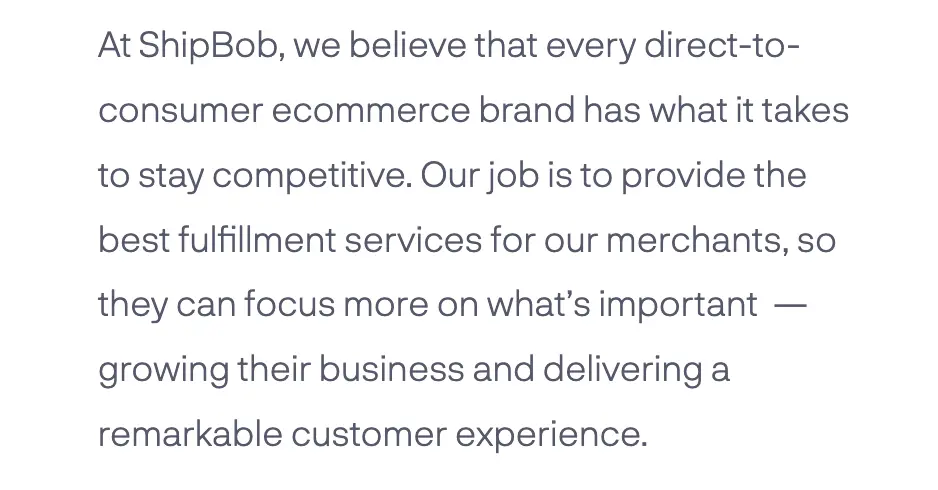
ShipBob is a third-party logistics company that ensures seamless fulfillment for direct-to-consumer ecommerce orders. Their services allow merchants to outsource their entire fulfillment process and free up time to focus on growing their business.
These elements are expertly and concisely conveyed in their brand positioning statement. The statement mentions the target audience (DTC ecommerce brands), the services they offer, and the benefits that businesses can get from partnering with them.
Why It Works
ShipBob’s brand positioning works because it’s simple and direct. It clearly mentions what they specialize in and who it’s for. The focus on value (allowing merchants to focus on what’s important) allows the target audience to understand why they should choose ShipBob.
2. CLEARSTEM
- Industry: Cosmetics and Personal Care
CLEARSTEM is a skincare brand with a focus on clean products that simultaneously target acne and aging. These benefits are clearly conveyed in their brand positioning statement, which also explains how their products are formulated to target these main concerns.

Why It Works
This brand positioning statement works because it’s heavily benefit-focused. While it doesn’t specifically mention their target audience, it’s clear that their products are for people who have concerns about acne and aging. They expertly highlight how their products are formulated to offer simultaneous benefits.
3. Quince
- Industry: Fashion
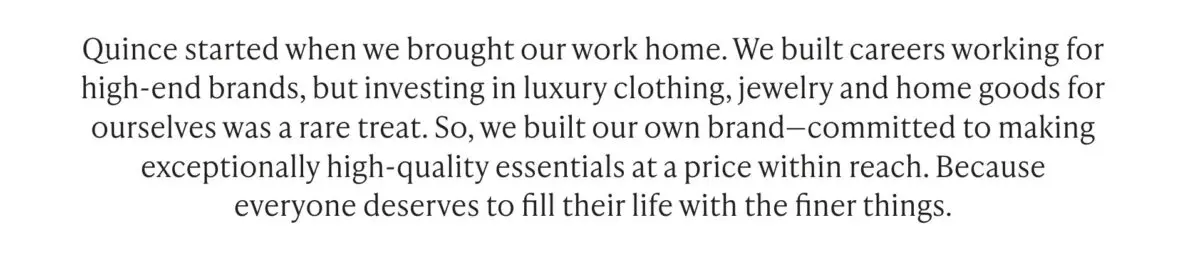
Quince is a sustainable fashion brand that produces high-quality luxury essentials at an affordable price. The brand’s focus on accessibility is visible across all their branding, including their brand positioning statement.
This statement highlights what the brand does (luxury products), what value they offer (high-quality essentials), and what makes them different from the competition (low prices).
Why It Works
This brand positioning statement works because it tells a story. It includes a story about why the brand was formed, which allows the audience to connect with the pain point — being unable to afford luxury products.
This effectively helps to establish the brand’s value, which is to make “exceptionally high-quality essentials at a price within reach” for everyone.
4. NutriPaw
- Industry: Pet Food
NutriPaw is a pet nutrition brand that sells 100% natural pet treats. Their products help maintain pet health by targeting common health problems in dogs. Their brand positioning statement makes these benefits clear and explains how their products are made with only the highest quality natural products.

Why It Works
The NutriPaw brand positioning heavily focuses on pain points. It lists some of the most common problem areas for dogs and mentions how their products address these issues. It also mentions another pain point, the complexity of keeping our dogs healthy, and how they address it.
5. Hungryroot
- Industry: Food
Hungryroot is a food subscription service that delivers groceries tailored to the dietary needs of each individual. This allows them to deliver personalized recipes that consider the preferences and dietary restrictions of each user. Their brand positioning statement reflects this and positions it as a key differentiator in the market.

Why It Works
This brand positioning statement relies on the company’s key differentiator. It starts off by mentioning what other companies in the same market are doing, then follows up by explaining how they do things differently.
This allows the audience to understand the unique value that Hungryroot brings to the table, helping them realize why they should choose their service over other options.
6. Mailchimp
- Industry: Tech
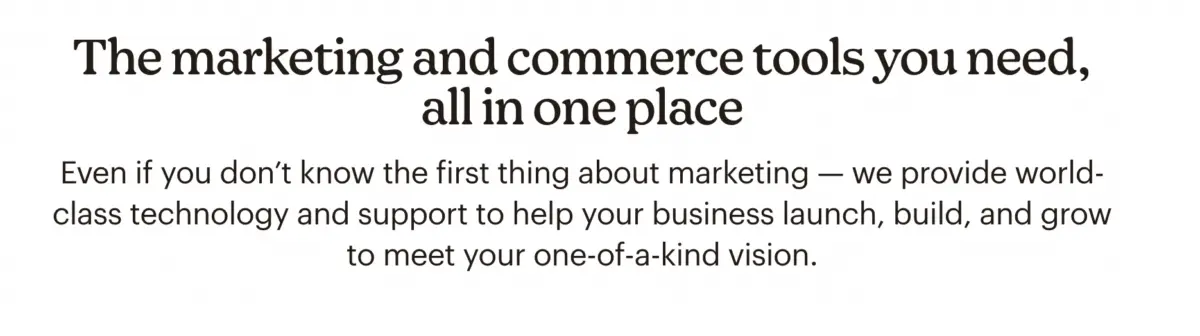
Mailchimp offers a range of technology solutions to help businesses with their marketing. Their brand positioning statement explains how they provide all kinds of marketing and commerce tools in one place. It also mentions how their technology can help businesses with launching, building, and growth.
Why It Works
This brand positioning statement is written in a way that highlights how Mailchimp’s technology can simplify marketing even for those who “don’t know the first thing about marketing.” It concisely sums up how the company can support businesses at every stage, from launch to growth.
7. Byredo
- Industry: Retail Luxury Goods and Jewelry
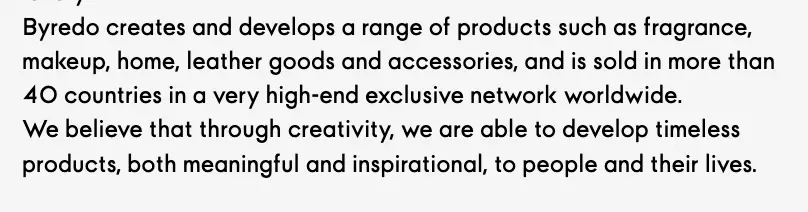
Byredo is a European luxury brand that’s known for their fragrance line but also develops other types of products like accessories, makeup, home, and leather goods. Their brand positioning statement lists all their product categories and mentions the different qualities that they stand for (timeless, meaningful, inspirational).
Why It Works
This brand positioning statement is clear about what the brand sells, leaving no room for ambiguity. So potential customers know exactly what to expect from the brand. It also highlights how their products are sold in a “very high-end exclusive network,” which appeals to customers who value exclusivity.
Moreover, the statement does a great job of emphasizing the timelessness of Byredo products.
8. Dove
- Industry: Personal Care
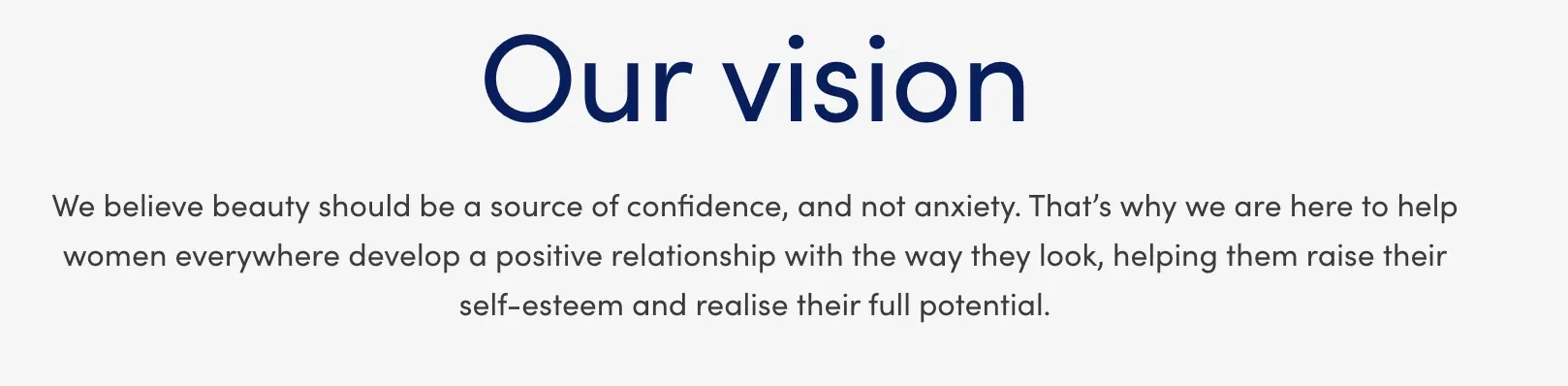
Dove’s branding has evolved from simply being a company that makes moisturizing soap to one that helps women embrace their real beauty. This is reflected in their brand statement, which explains the brand’s belief that beauty should be a source of confidence. Dove mentions their target audience (women everywhere) and states how they want to help them “develop a positive relationship with the way they look.”
Why It Works
This brand positioning statement may not specify what products they sell, but with Dove already being a household brand name, the shift to customer-centric positioning works. Instead of talking about their products, the statement focuses heavily on the customer, positioning the brand as one that can help them reveal their true beauty.
9. Wendy’s
- Industry: Fast Food
As one of the largest fast-food chains in the United States, Wendy’s is another major brand with a solid positioning statement. It starts by focusing on what they sell and what’s great about it — fresh food. It follows this with a key differentiator — making everyone feel at home.

Why It Works
The Wendy’s brand positioning statement focuses on what the brand does to offer unique value to their customers. It mentions that they go the extra mile to serve up fresh food. It also stresses making the customers feel like a part of the Wendy’s family, helping to build an emotional connection with them.
10. Fenty Hair
- Industry: Hair Care
Fenty Hair is a subset of the Fenty Beauty brand, with haircare products formulated to repair all types of hair. The brand positioning statement is short and simple, focusing on the different needs and preferences of their target audience.

Why It Works
The Fenty Hair brand positioning statement perfectly reflects the brand’s core values regarding diversity and inclusivity. It lists the common types of hair and concerns to highlight how the brand offers products to address all of them.
By focusing less on the products and more on the pain points, the statement clearly showcases the value that the brand offers.
Common Brand Positioning Statement Mistakes
Even businesses with great products can struggle to write an effective positioning statement. The problem, usually, is trying to communicate too much, sounding too generic, or focusing on the company instead of the customer.
Avoid these common mistakes when developing or refining your positioning.
Trying to Appeal to Everyone
The broader your audience becomes, the weaker your positioning usually gets.
A positioning statement should clearly identify the customers you're best equipped to serve rather than attempting to attract every possible buyer.
Instead of saying:
We help businesses grow.
Consider:
We help fast-growing eCommerce brands automate inventory forecasting.
Specific positioning makes your messaging more relevant and memorable.
Describing Features Instead of Outcomes
Customers rarely buy products because they have more features.
They buy the outcomes those features create.
Compare these examples:
Feature-focused
AI-powered analytics platform.
Outcome-focused
Helps marketing teams make faster, data-driven decisions.
Whenever possible, translate product capabilities into customer value.
Using Generic Marketing Language
Phrases like:
- Industry-leading
- Best-in-class
- Innovative
- World-class
- Customer-centric
appear in thousands of positioning statements.
Unless they're supported by meaningful evidence, they add very little strategic value.
Instead, explain how you're different and why customers should believe it.
Confusing a Positioning Statement With a Tagline
A tagline is designed to be memorable.
A positioning statement is designed to guide strategy.
For example:
Tagline
Just Do It.
Positioning Statement
Defines Nike's audience, market category, value proposition, and competitive differentiation.
One inspires customers.
The other aligns the business internally.
Forgetting to Differentiate
Perhaps the easiest way to test your positioning statement is to replace your company name with one of your competitors.
If the statement still makes sense, your positioning probably isn't distinctive enough.
Ask yourself:
- Could another company make the same claim?
- What makes our approach genuinely different?
- What proof supports our advantage?
If you can't answer those questions confidently, strengthen your differentiation before finalizing your statement.
When Should You Update Your Brand Positioning Statement?
A positioning statement shouldn't change every few months, but it shouldn't remain static forever either.
As markets evolve, customer expectations shift, and businesses expand into new categories, your positioning may need to evolve as well.
For example, Starbucks' target audience has evolved from working professionals with sleek, minimalist products in 2018 to vibrant, bold designs aimed at capturing the attention of teenage girls nowadays, and here’s the breakdown:
@alyssainchicago #greenscreen @Starbucks #brandstrategy #starbucksmarketing #marketing #brand
Review your positioning statement when:
- You launch a significantly different product or service.
- Your target audience changes.
- You enter a new market or industry.
- Competitors reshape customer expectations.
- Your business undergoes a major rebrand.
- Customer research reveals changing priorities or buying behavior.
Even if your positioning doesn't require major changes, reviewing it annually helps ensure it still reflects your business strategy and competitive landscape.
Build a Positioning Statement That Guides Every Decision
A strong brand positioning statement isn't just another marketing document—it's the strategic foundation that shapes how customers perceive your business and how your teams communicate its value.
By following the IMH Brand Positioning Framework, you can move beyond vague messaging and develop a positioning statement built around a clear audience, a defined market, meaningful customer value, and credible differentiation.
If you're ready to put the framework into practice, download the IMH Brand Positioning Statement Builder. The guided workbook walks you through every stage of the process, helping you draft, refine, validate, and implement a positioning statement that supports your marketing, sales, and long-term brand strategy.
Frequently Asked Questions
What is a brand positioning statement?
A brand positioning statement is an internal strategic document that defines your target audience, market category, customer value, and competitive differentiation. It guides how your brand should be positioned across marketing, sales, and product communications.
What should a brand positioning statement include?
An effective positioning statement should identify your target audience, define the market you compete in, explain the value you deliver, and clearly communicate why customers should choose your brand over competitors.
Is a brand positioning statement the same as a value proposition?
No. A value proposition explains the primary benefit customers receive, while a brand positioning statement provides a broader strategic framework that includes your audience, market category, differentiation, and value.
Is a brand positioning statement public?
Typically, no. Positioning statements are internal documents used to align teams and guide strategic decisions. Customers usually experience the positioning through your messaging, campaigns, and brand experience rather than seeing the statement itself.
How long should a brand positioning statement be?
Most positioning statements are one or two sentences long. The goal is clarity rather than length, making it easy for internal teams to reference and apply consistently.
How often should I update my brand positioning statement?
Review your positioning statement at least once a year or whenever your business undergoes significant changes, such as entering a new market, launching a new product, or completing a rebrand.
Can small businesses benefit from a brand positioning statement?
Absolutely. Clear positioning helps businesses of every size communicate their value consistently, differentiate themselves from competitors, and make better marketing decisions.


