
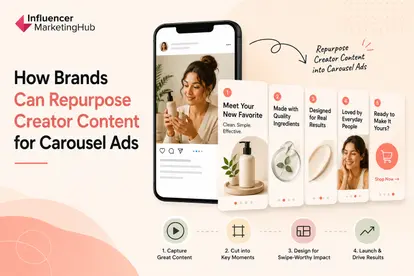
Creator partnerships can produce far more than a single sponsored post.
A campaign may leave the brand with product demonstrations, lifestyle images, testimonials, tutorials, unboxings, and other assets that could support paid media. The opportunity is becoming more valuable as creator advertising grows. According to the latest influencer marketing insights, US creator ad spend to reach $44 billion in 2026, while identifying measurement, standards, and operational tools as leading areas for improvement.
Repurposing creator content can extend the useful life of those assets, but placing several images inside a carousel is not enough. Brands need the appropriate rights, a clear narrative, platform-ready creative, and a logical path from each card to the next action.
- Secure Paid Usage Rights Before Repurposing Content
- Use the Carousel as a Story Rather Than a Gallery
- Audit Creator Assets Before Building the Carousel
- Give Every Carousel Card a Specific Job
- Choose a Sequence That Matches the Campaign Objective
- Adapt Creator Carousels for Different Advertising Environments
- Connect Each Card With the Right Destination
- Test the Sequence as Well as the Individual Assets
- Treat Creator Content as a Reusable Media Asset
Secure Paid Usage Rights Before Repurposing Content
Paying a creator to publish content does not automatically give the brand unlimited ownership of that content.
The US Copyright Office states that the person who creates an original visual work is generally its initial copyright owner. Exceptions can apply when the work qualifies as work made for hire or when ownership is transferred through an agreement.
It also confirms that brands need permission from the owner to reproduce, adapt, distribute, or publicly display protected work.
Before turning creator assets into carousel ads, the agreement should define:
- Which assets the brand may use
- Whether paid advertising is included
- Which platforms and placements are covered
- How long the license lasts
- Which countries or regions are included
- Whether the brand may crop, resize, or edit the content
- Whether the creator’s name, image, voice, or handle may be used
- Whether the content can be transferred to agencies or media partners
- What happens when the usage period expires
Brands also need to preserve required advertising disclosures. The FTC states that material connections between advertisers and endorsers must be clearly disclosed. Its native-advertising guidance also requires commercial content to be readily identifiable as advertising when the format could otherwise mislead consumers.
Read more about separating licenses by channel, duration, and purpose in our guide to organic and paid creator-content usage rights.
Use the Carousel as a Story Rather Than a Gallery
Carousel ads give marketers room to combine several images or messages within one interactive format.
That space can be used to showcase several products, explain a process, present different use cases, or build a narrative across cards. Spotify, for example, supports product showcases and sequential storytelling within its carousel format. Each ad can include two to six cards.
The value comes from the relationship between those cards.
A collection of attractive creator images may look polished, but the audience still needs a reason to continue exploring. Each card should add information, answer a question, or move the viewer closer to the intended action.
Creator content is particularly adaptable because one campaign can generate assets with different functions:
- Lifestyle images establish context.
- Product demonstrations show how something works.
- Close-up images highlight details.
- Tutorials explain usage.
- Testimonials provide an endorsement.
- Before-and-after content can illustrate a supported product outcome.
- Product collections introduce several options.
Not every asset belongs in the same carousel. The objective should determine which combination makes sense.
Read more about extending creator assets beyond their original posts in our influencer marketing and paid media guide.
Audit Creator Assets Before Building the Carousel
Content created for an Instagram post, TikTok video, or creator portfolio may need adjustments before it can work as a paid carousel ad.
The original post may have depended on a caption, voiceover, trending sound, or surrounding comments for context. Once an image is removed from that environment, the message may no longer be clear.
Review each asset before placing it into the sequence.
| Asset check | What to confirm |
| Usage rights | The paid placement, platform, territory, and campaign period are covered |
| Standalone clarity | The image remains understandable without the creator’s original caption or voiceover |
| Product visibility | The product can be identified at the size used in the ad |
| Format compatibility | The image can be adapted to the required dimensions without losing important details |
| Claims and endorsements | Product statements remain accurate, supported, and consistent with the creator’s experience |
| Disclosure | The paid relationship remains clear where disclosure is required |
| Visual consistency | Color, lighting, cropping, and typography work across the complete sequence |
| Landing-page fit | The product, offer, or message matches the destination attached to the card |
The review should include the creator team, paid-media team, legal or compliance stakeholders where required, and whoever owns the destination pages.
Read more about reviewing creator assets before paid distribution in our guide to UGC content moderation.
Give Every Carousel Card a Specific Job
A carousel becomes easier to structure when every card has one purpose.
A six-card sequence might look like this:
- Capture attention: Open with the strongest creator image or most relevant consumer situation.
- Establish the need: Introduce the problem, goal, or use case connected with the product.
- Present the product: Show what the creator is using or recommending.
- Demonstrate the benefit: Use a tutorial, product detail, or creator experience to explain the value.
- Provide supporting proof: Add an accurate testimonial, feature, comparison, or supported result.
- Invite action: Connect the final message with the most relevant destination and CTA.
This is a framework rather than a fixed rule. Some carousels may need only two or three cards. Others may use the available space to present a complete collection.
The important part is removing repetition. If several cards communicate exactly the same idea, they are using additional space without advancing the story.
Choose a Sequence That Matches the Campaign Objective
Different campaign goals require different carousel structures.
| Campaign objective | Possible card sequence |
| Introduce a product | Consumer situation → product reveal → main benefit → demonstration → CTA |
| Explain how something works | Desired outcome → first step → product in use → final result → learn more |
| Showcase a collection | Collection introduction → hero product → supporting products → use cases → shop collection |
| Build consideration | Lifestyle image → product detail → creator experience → feature or supported proof → product page |
| Promote an offer | Attention hook → eligible product → offer details → creator recommendation → purchase CTA |
A beauty brand could use one card to introduce the creator’s routine, another to show product application, and a third to present the finished look.
A homeware brand could open with a styled room, move into individual product details, and link each product card to the corresponding page.
These sequences give the audience a clearer path than placing several unrelated creator images next to one another.
Adapt Creator Carousels for Different Advertising Environments
Carousel advertising is no longer limited to traditional social feeds.
Spotify’s carousel ads appear in the Now Playing view on desktop and mobile. The format supports two to six square image cards, and each card can include its own destination URL, tagline, and optional price overlay.
This creates another environment in which brands can use creator photography for product discovery or sequential storytelling. However, the listening context changes how the assets should be prepared.
The image should communicate quickly without relying on a long social caption. Text should remain readable at a smaller size. The opening card should identify the idea or product clearly, while the destination attached to each card should match what the listener sees.
Spotify requires carousel images to use a 1:1 aspect ratio with a minimum resolution of 600 by 600 pixels. Its specifications also limit carousel and card-level taglines to 40 characters. Those constraints make early asset planning useful, particularly when the brand intends to reuse content across several advertising platforms.
Platform-specific permission systems should also be considered. TikTok, for example, requires creator authorization before organic creator videos can be promoted through Spark Ads. TikTok One’s Content Suite allows advertisers to request this permission directly from creators before syncing authorized videos with Ads Manager.
Read more about the permissions involved in creator-led paid advertising in our guide to whitelisting and Spark Ads.
Connect Each Card With the Right Destination
A carousel can introduce several products or ideas, but the landing experience needs to continue the same journey.
A product-specific card should normally connect with the relevant product page. A collection card may lead to a category or campaign page. A tutorial card could link to a more detailed explanation.
Sending every card to a generic homepage creates additional work for the visitor, especially when the card promoted a particular product or offer.
Tracking should also be prepared before launch. UTM parameters can identify the source, medium, and campaign that referred traffic.
Brands can use distinct parameters to compare:
- Creator assets
- Card positions
- Products
- Offers
- Calls to action
- Advertising platforms
- Audience segments
Tracking should follow a consistent naming convention so results from different carousel versions can be compared reliably.
Test the Sequence as Well as the Individual Assets
Carousel testing should examine more than the image used on each card.
Brands can test:
- The opening card
- Card order
- Number of cards
- Creator
- Product arrangement
- Headline or tagline
- Price presentation
- Call to action
- Landing page
- Audience segment
- Platform placement
Where reporting supports card-level analysis, marketers can compare which cards attract interaction and which destinations generate useful actions. Campaign-level metrics can then show how the complete carousel contributes to reach, traffic, conversions, or another defined objective.
Testing also helps determine whether a creator asset performs best as the opening hook, supporting demonstration, testimonial, or final action card.
The goal is to learn which role each asset can play, rather than simply identifying one winning image.
Treat Creator Content as a Reusable Media Asset
Repurposing creator content for carousel ads begins long before the cards are assembled.
Brands need to secure the correct rights, review every asset, define the story, adapt the creative for the placement, connect cards with relevant destinations, and measure the sequence.
When those pieces are in place, a creator campaign can produce more than a temporary social post. It can provide a rights-approved collection of assets that supports paid storytelling across multiple advertising environments.

SUGGESTED

What Is an Influencer? Definition, Types, and How Influencers Work
What is an influencer? Learn how influencers build trust grow audiences work with brands...

What are Carousel ads ?
Carousel ads are a unique advertising format that combines multiple videos or images into...
![How to Create an Influencer Campaign Brief in 10 Steps [+ Free Builder]](https://s.influencermarketinghub.com/imaginary/resize?width=400&height=200&type=webp&url=https://influencermarketinghub.com/wp-content/uploads/2025/05/755652e4-how-to-create-an-influencer-campaign-brief-in-10-steps-free-builder.jpg)
How to Create an Influencer Campaign Brief in 10 Steps [+ Free Builder]
Learn how to create an influencer campaign brief covering goals creator roles messaging...