
Instagram advertising can deliver strong results, but simply getting an ad onto the platform is only part of the equation. How the creative is built for the placement can affect how well it performs.
Meta found that, across 15 Reels-only split tests, campaigns using 9:16 video with audio and key creative elements positioned inside the safe zone achieved a 34.5% lower cost per result than campaigns using image ads.
The finding, although specific to the Reels format, illustrates a broader point for Instagram advertisers: creative performs best when it is designed for the environment in which people will actually see it.
That starts with using the right dimensions and aspect ratio.
Instagram Feed, Stories, Reels, carousels, and Explore do not all use the same ideal canvas. Using the appropriate Instagram ad size helps you make better use of the available screen space, protect important text and products from awkward cropping or interface overlays, and give your creative the best chance of appearing as intended.
This guide breaks down the recommended Instagram ad sizes and specifications for 2026, along with safe zones, placement-specific considerations, and a downloadable cheat sheet your team can keep on hand.
📥Download the Instagram Ad Sizes & Specs Cheat Sheet
Keep the key Instagram ad dimensions on hand while you design.
The free IMH Instagram Ad Sizes & Specs Cheat Sheet includes:
- Recommended dimensions and aspect ratios for major Instagram ad placements
- Feed, Stories, Reels, carousel, and Explore specifications
- Stories and Reels safe-zone diagrams
- Three core creative canvases for simplifying production
- A pre-upload checklist for catching sizing, cropping, and placement issues
- Instagram Ad Sizes at a Glance
- What Is the Best Instagram Ad Size?
- Instagram Feed Ad Sizes Specification
- Instagram Stories Ad Sizes Specification
- Instagram Reels Ad Sizes
- Instagram Carousel Ad Sizes
- Instagram Explore Ad Sizes
- Instagram Stories and Reels Safe Zones
- How to Prepare Instagram Ads for Multiple Placements
- Conclusion
- Frequently Asked Questions
Instagram Ad Sizes at a Glance
If you only need the dimensions, start here. The table below gives you the recommended working size for each major Instagram ad format rather than every size or aspect ratio Meta may technically accept.
| Instagram ad format | Recommended size | Aspect ratio | Creative type |
| Feed image | 1440 × 1800 px | 4:5 | Image |
| Feed video | 1080 × 1920 px* | 9:16* | Video |
| Stories | 1440 × 2560 px | 9:16 | Image or video |
| Reels | 1440 × 2560 px | 9:16 | Video primarily |
| Image-only carousel | 1440 × 1800 px | 4:5 | Images |
| Mixed-media carousel | 1080 × 1080 px or higher | 1:1 | Images and video |
| Explore | 1440 × 1800 px | 4:5 | Feed-compatible creative |
*Meta's current guidance around Instagram Feed video is less consistent than its guidance for Feed images, Stories, and Reels. We recommend starting with vertical video and checking the final Feed preview in Ads Manager before publishing.
These dimensions are production recommendations, rather than hard boundaries around what Instagram will accept. Meta supports additional aspect ratios for some placements, while tools such as placement asset customization and automated creative adjustments can adapt assets for different surfaces.
For most campaigns, however, designing for the placement from the beginning gives you much more control over what people actually see.
What Is the Best Instagram Ad Size?
There is no single best Instagram ad size for every placement.
- For Feed image ads, a 4:5 portrait format is the strongest default because it uses more vertical screen space than a square image while fitting naturally within the Instagram Feed.
- For Stories and Reels, use 9:16 vertical creative. Both placements are built around full-screen mobile viewing, so a 9:16 asset fills the available canvas and gives you more control over where products, text, subtitles, and branding appear.
- Carousel ads need a little more planning. An image-only carousel can use a 4:5 portrait layout, while 1:1 remains the safest production standard for a carousel that mixes images and video.
If You Only Create a Few Instagram Ad Sizes
Teams running ads across several placements do not necessarily need a completely different master file for every ad.
A practical production setup starts with three core canvases:
| Master asset | Size | Ratio | Best used for |
| Feed portrait | 1440 × 1800 px | 4:5 | Feed images, image carousels, Explore-compatible creative |
| Full-screen vertical | 1440 × 2560 px | 9:16 | Stories and Reels |
| Square mixed-media | 1080 × 1080 px+ | 1:1 | Carousels containing video |
Feed video may warrant an additional 9:16 vertical master, particularly when video is an important part of the campaign rather than a secondary placement.
Creating these core assets gives the creative team enough flexibility to design around how Instagram actually displays ads without producing dozens of unnecessary variations.
It also provides a better starting point than uploading one square asset everywhere and relying on Meta to make the creative fit.
Automated resizing can adjust an asset's dimensions. It cannot reliably determine whether the product, headline, logo, subtitle, or offer that gets cropped was the most important part of the ad.
We will now break down the specifications and creative considerations for each placement individually.
Preview Your Instagram Ad Before You Build Every Placement
Once you know which canvas you need, it helps to see how the creative will actually look inside an Instagram-style interface before you start producing multiple versions.
Use the IMH Instagram Ads Mockup Generator to preview your ad concept, test different creative formats, and see how the visual, advertiser information, copy, and CTA work together.
The tool supports image, video, carousel, and Instagram Stories-style mockups, making it useful for early creative reviews, internal approvals, and client presentations before the final assets are built.
Instagram Feed Ad Sizes Specification
Instagram Feed ads appear within the normal scrolling experience, so they do not need to fill the entire phone screen. For static creative, that makes 4:5 portrait the strongest default: it uses considerably more vertical space than a square image while still fitting naturally within the Feed.
Video is a little different. Instagram has increasingly shifted video toward vertical viewing, and current Meta guidance favors 9:16 for Feed video. Because Meta's documentation is less consistent for Feed video than for static images, it is especially important to check the placement preview before publishing.
Instagram Feed Image Ad Size
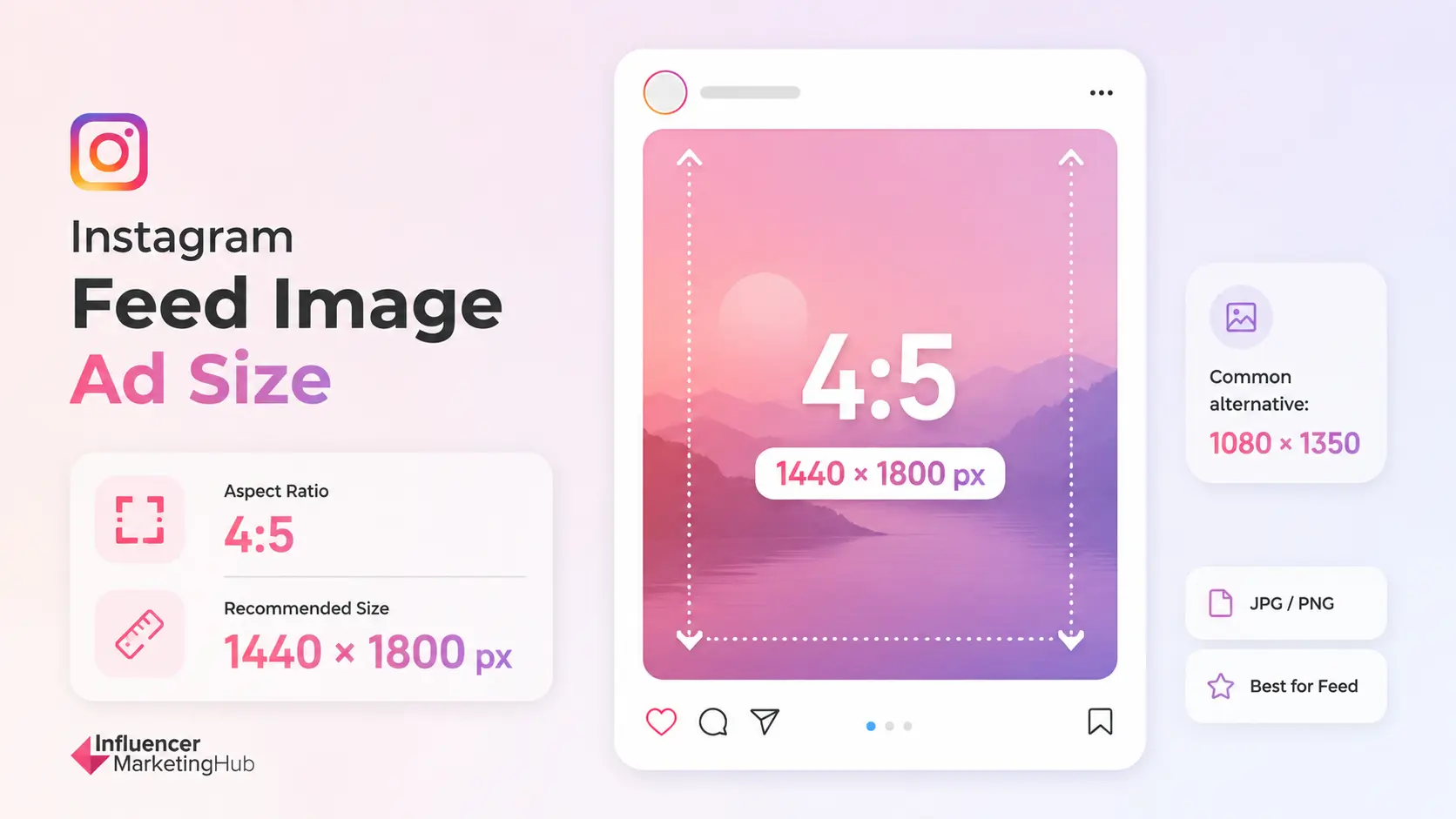
For most Feed image campaigns, start with a 1440 × 1800 px canvas at a 4:5 aspect ratio. Meta also supports square and landscape ratios, but 4:5 is its current recommended Feed image format. Current Meta Ads Guide-based documentation lists JPG and PNG files up to 30 MB.
| Specification | Instagram Feed image |
| Recommended size | 1440 × 1800 px |
| Aspect ratio | 4:5 |
| Common alternative | 1080 × 1350 px |
| Other supported ratios | 1:1 and 1.91:1 |
| File types | JPG, PNG |
| Maximum file size | 30 MB |
The familiar 1080 × 1350 px portrait canvas has the same 4:5 aspect ratio and remains a practical alternative. The difference is resolution rather than shape. For new creative, however, working from Meta's higher-resolution 1440 × 1800 recommendation gives the platform more image data to work with.
Square creative still has a role, particularly when an existing campaign is built around 1:1 assets. Landscape can also make sense when the composition genuinely depends on width. Neither should be the automatic starting point simply because Instagram accepts them.
- Influencer Marketing Hub Recommendation: Use 1440 × 1800 px at 4:5 as the default canvas for Instagram Feed image ads. Move to square or landscape only when the creative concept gives you a reason to.
Instagram Feed Video Ad Size
Feed video requires more care because current Meta documentation is not as tidy as its static-image guidance.
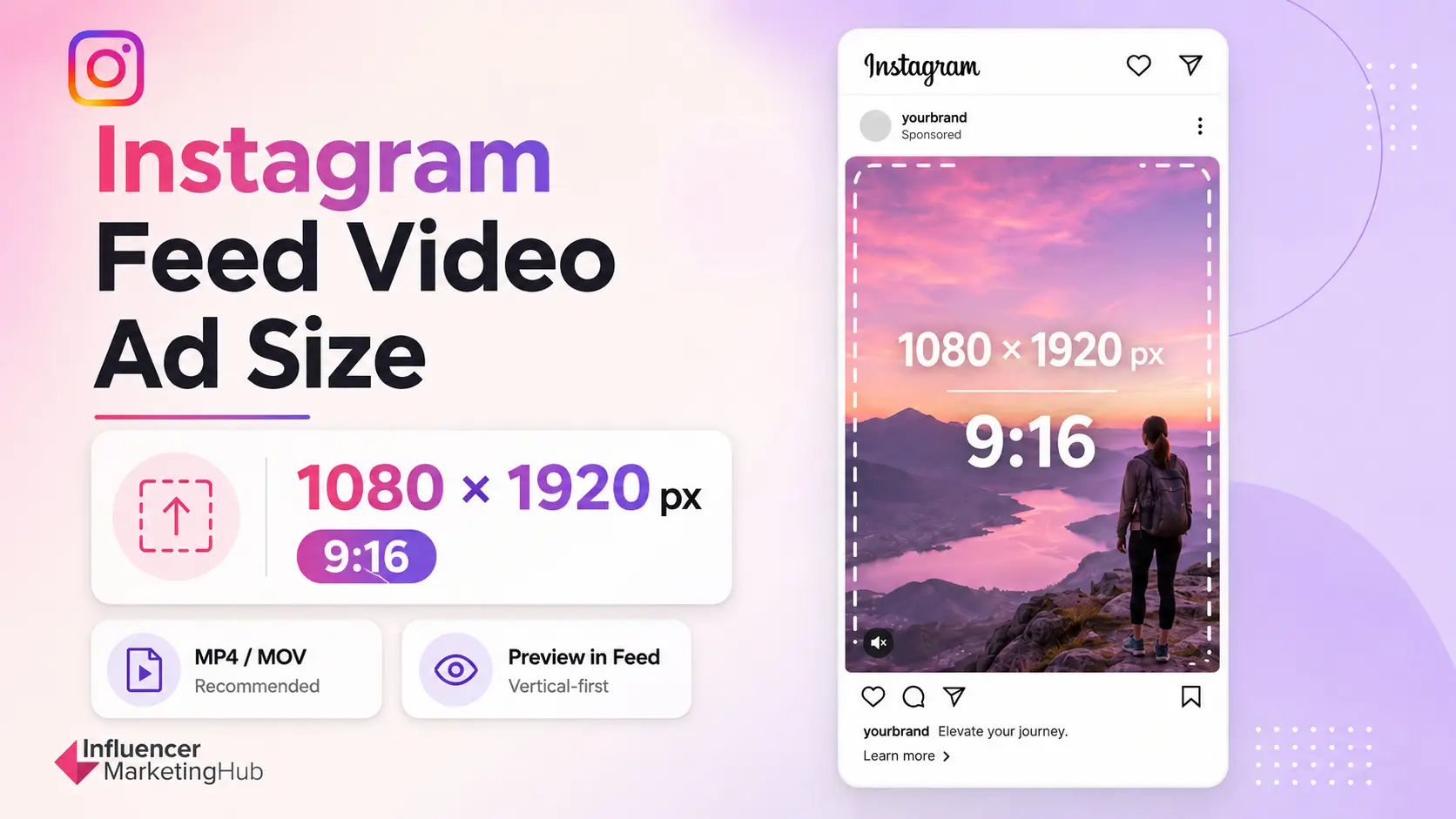
Current references based on Meta's Ads Guide recommend 9:16 vertical video, with 1080 × 1920 px as a practical production canvas for Instagram Feed video. Feed can also support other ratios, including 4:5 and 1:1, depending on the creative and campaign setup.
| Specification | Instagram Feed video |
| Recommended working size | 1080 × 1920 px |
| Recommended aspect ratio | 9:16 |
| Other supported Feed ratios | 4:5, 1:1; wider formats may also be supported |
| Recommended file types | MP4, MOV |
| Maximum Meta file size | 4 GB |
| Final duration limit | Confirm in Ads Manager |
The move toward vertical video makes sense in the context of how Instagram now distributes and consumes video. But a 9:16 Feed video should still be reviewed as a Feed placement, rather than assumed to appear exactly as it does inside Stories or Reels.
Meta can crop or adapt creative for different surfaces, particularly when automated creative options or multiple placements are enabled. A technically valid file can therefore still produce a poor composition if a headline, product, or important visual sits too close to the edge.
- Influencer Marketing Hub Recommendation: Start with vertical video, but check the actual Instagram Feed preview before launch. If Feed is a priority placement, treat its crop and composition as part of creative approval rather than relying entirely on automatic adaptation.
Note: We are deliberately not giving Feed video a universal maximum duration here. Meta's current Ads Guide and other Meta requirements documentation have published conflicting limits, so the value shown for your selected campaign setup in Ads Manager should take precedence. Current documentation reviews have identified the same discrepancy.
Instagram Stories Ad Sizes Specification
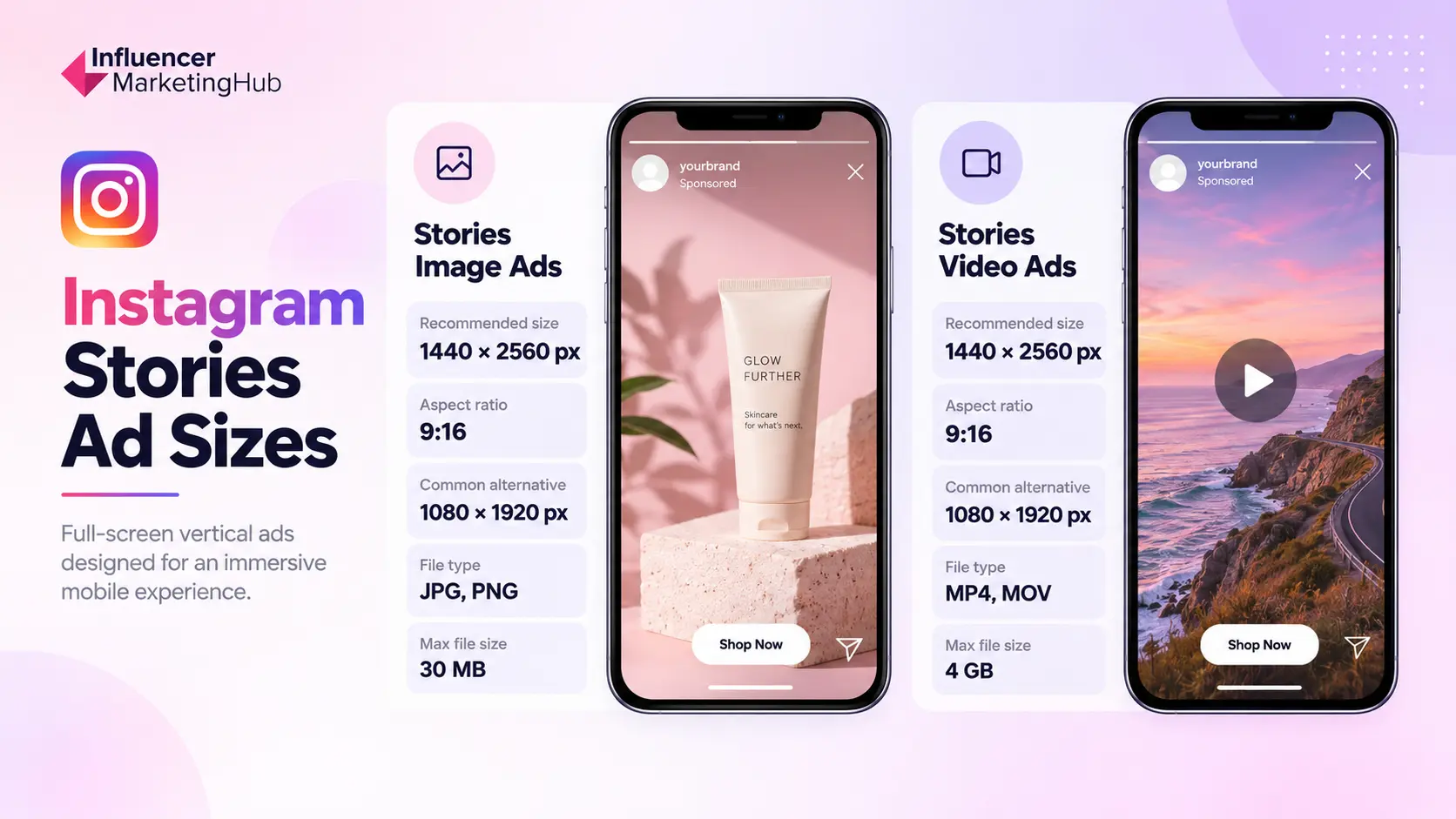
Instagram Stories are built around a completely different viewing environment from the Feed. Stories occupy the full vertical screen, making 9:16 the natural creative ratio for both static images and video.
Meta's current Ads Guide recommends 1440 × 2560 px at 9:16 for Instagram Stories. The widely used 1080 × 1920 px canvas has the same aspect ratio and remains a practical alternative, but Meta's current placement documentation has moved to the higher-resolution recommendation.
Rather than designing a Feed ad first and stretching or cropping it into Stories later, build important Stories creative on a full-screen vertical canvas from the beginning.
| Specification | Stories image | Stories video |
| Recommended size | 1440 × 2560 px | 1440 × 2560 px |
| Aspect ratio | 9:16 | 9:16 |
| Common alternative | 1080 × 1920 px | 1080 × 1920 px |
| File type | JPG, PNG | MP4, MOV |
| Maximum file size | 30 MB | 4 GB |
| Safe-zone design | Recommended | Recommended |
The higher resolution does not change the composition. Both 1440 × 2560 and 1080 × 1920 use the same 9:16 shape. If a team already has high-quality 1080 × 1920 templates, there is no reason to assume those assets have suddenly become unusable. For new templates and master files, however, we recommend using the current 1440 × 2560 specification.
Why Stories Need Their Own Creative
Dropping a Feed asset into Stories might save production time, but it gives away much of the full-screen canvas or forces Meta to adapt the creative.
A Feed-first composition can also put text, logos, products, or offers in areas occupied by Instagram's own interface. That's particularly important in Stories because profile information appears toward the top while interactive and call-to-action elements occupy the lower portion of the screen.
The better approach is to preserve the idea behind the campaign while recomposing it for 9:16. A product that sits correctly in a 4:5 Feed image may need to move upward or inward in Stories. Likewise, a headline that works near the bottom of a Feed creative can end up competing with interface elements on a full-screen placement.
- Influencer Marketing Hub Recommendation: Build Instagram Stories at 1440 × 2560 px / 9:16, keeping the important message, product, branding, and CTA-related creative well inside the usable area of the screen.
Note: We will break down the exact Stories and Reels safe zones later in the guide. As a general rule, correct dimensions tell you how large the canvas should be; safe zones tell you where the important parts of the ad should sit inside it. Current Meta-derived Stories guidance specifically reserves substantial space around the top, bottom, and sides for interface elements.
Instagram Reels Ad Sizes
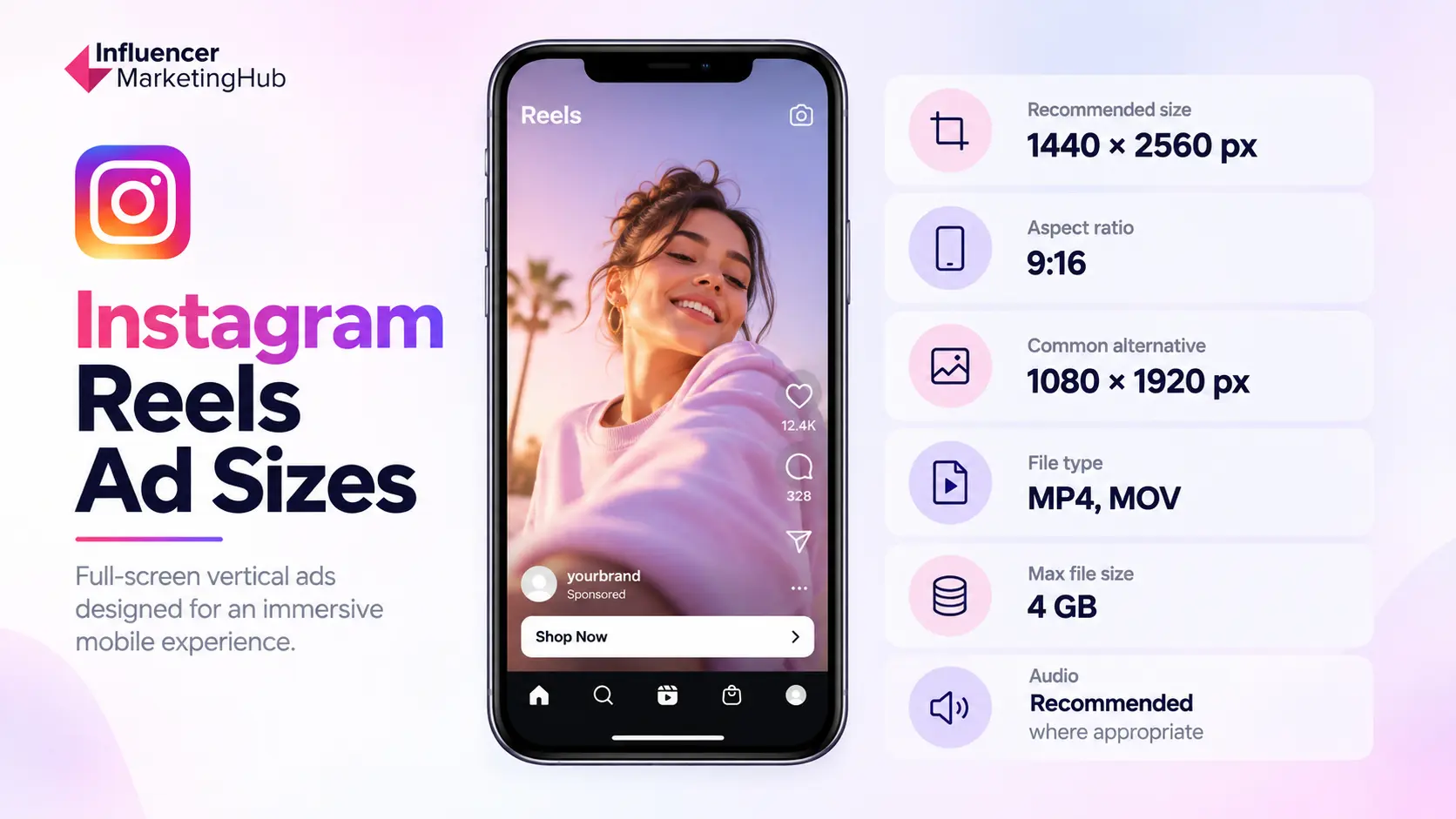
Instagram Reels are built for full-screen vertical viewing, so 9:16 should be the starting point for Reels creative. Unlike Feed ads, where Instagram's interface surrounds the creative, Reels occupy most of the screen and compete directly with organic vertical video.
Meta recommends creating Reels ads in 9:16, using audio where appropriate and keeping important creative elements inside the safe zone. Meta's own testing has also found better performance when Reels creative follows those native conventions rather than simply repurposing assets built for other placements.
| Specification | Instagram Reels ad |
| Recommended size | 1440 × 2560 px |
| Aspect ratio | 9:16 |
| Common alternative | 1080 × 1920 px |
| Recommended file types | MP4, MOV |
| Maximum file size | 4 GB |
| Creative format | Video-first |
| Audio | Recommended where appropriate |
| Safe-zone design | Recommended |
Both 1440 × 2560 and 1080 × 1920 use the same 9:16 aspect ratio. If your team already produces high-quality 1080 × 1920 vertical video, the important point is that the composition is correct for a vertical canvas. For new master files, we recommend working from the higher-resolution canvas used throughout this guide.
Design Reels as Reels, Not Cropped Feed Ads
A Feed video can technically be adapted into a Reel, but that does not mean the result will feel native to the placement.
Reels add interface elements around the creative, including account information, captions, engagement controls, and calls to action. Important elements positioned near the edges can therefore become harder to see or compete with Instagram's interface.
The same applies to captions and subtitles. Placing them too low on the canvas can leave them fighting with the lower interface area, while placing a product or logo too far to the right can push it behind engagement controls.
- Influencer Marketing Hub Recommendation: Build Reels at 1440 × 2560 px / 9:16 and position the product, headline, subtitles, branding, and important offer information inside the central safe area.
We will map those safe zones in detail later in the guide.
Instagram Carousel Ad Sizes
Instagram carousel ads allow advertisers to combine multiple cards in a single ad, making them useful for product ranges, sequential storytelling, feature breakdowns, or showing different views of the same product.
The important sizing consideration is that a carousel should be treated as one consistent creative unit. Switching dimensions or aspect ratios between cards can lead to inconsistent cropping and a disjointed experience.
For production, we recommend separating image-only carousels from carousels that combine images and video.
Image-Only Instagram Carousel Ad Size
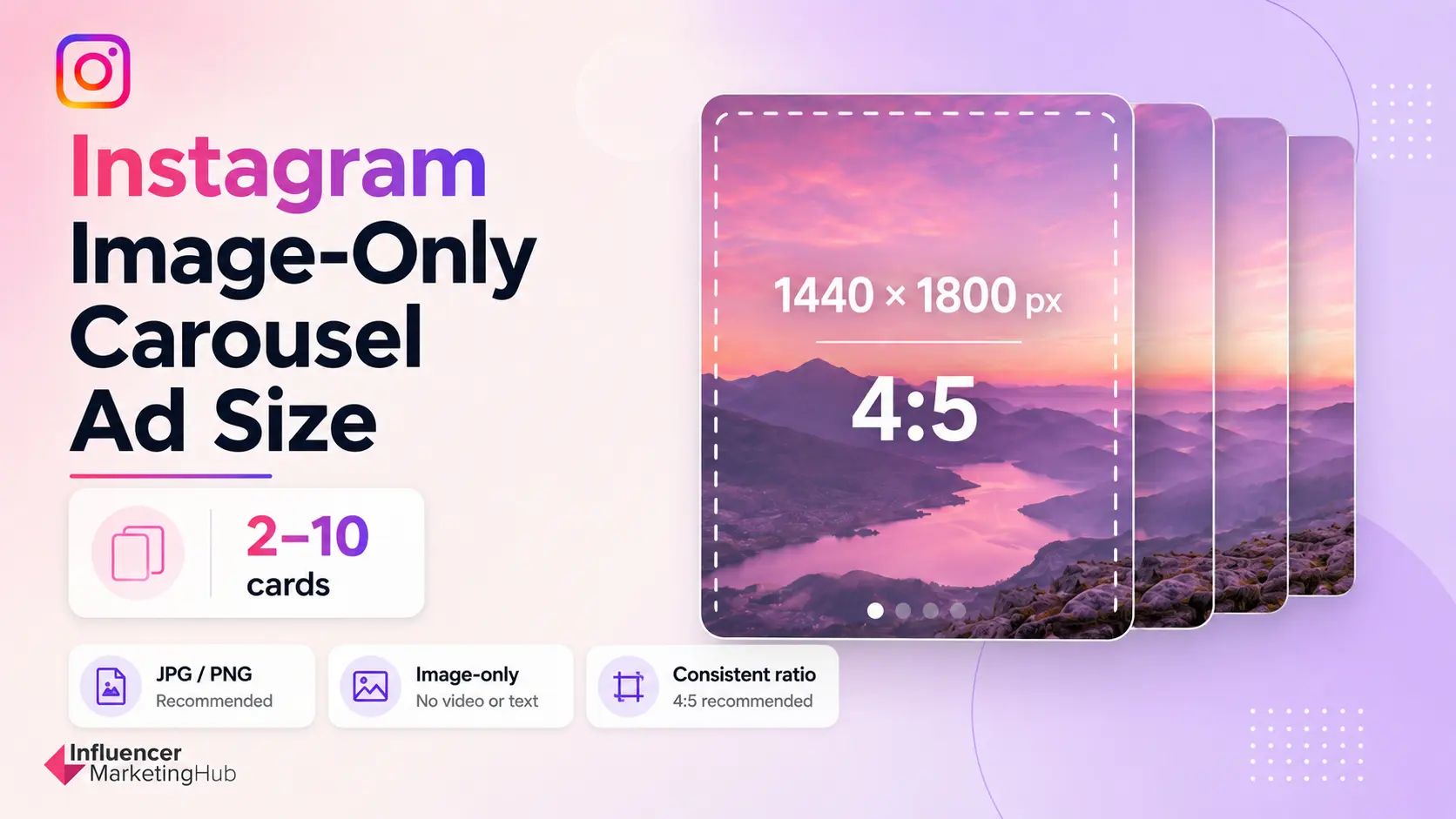
For an image-only carousel, 4:5 portrait creative is our preferred starting point because it takes advantage of more vertical Feed space than the traditional square format.
| Specification | Image-only carousel |
| Recommended size | 1440 × 1800 px |
| Aspect ratio | 4:5 |
| Number of cards | 2–10 |
| File types | JPG, PNG |
| Maximum image file size | 30 MB per image |
| Creative consistency | Use the same dimensions across all cards |
The older version of this article recommended 1080 × 1080 / 1:1 as the standard carousel format. Square carousels remain useful, but they no longer need to be the automatic production choice when an image-only carousel can make better use of portrait Feed space.
- Influencer Marketing Hub Recommendation: Use 1440 × 1800 px / 4:5 for image-only carousels and build every card using the same master dimensions.
The first card deserves particular attention because it establishes both the visual framing and the expectation for the slides that follow. If the opening card is designed around a centered product, for example, later cards should not unexpectedly move critical information into areas that feel cropped or visually unbalanced.
Instagram Carousel Ads With Video
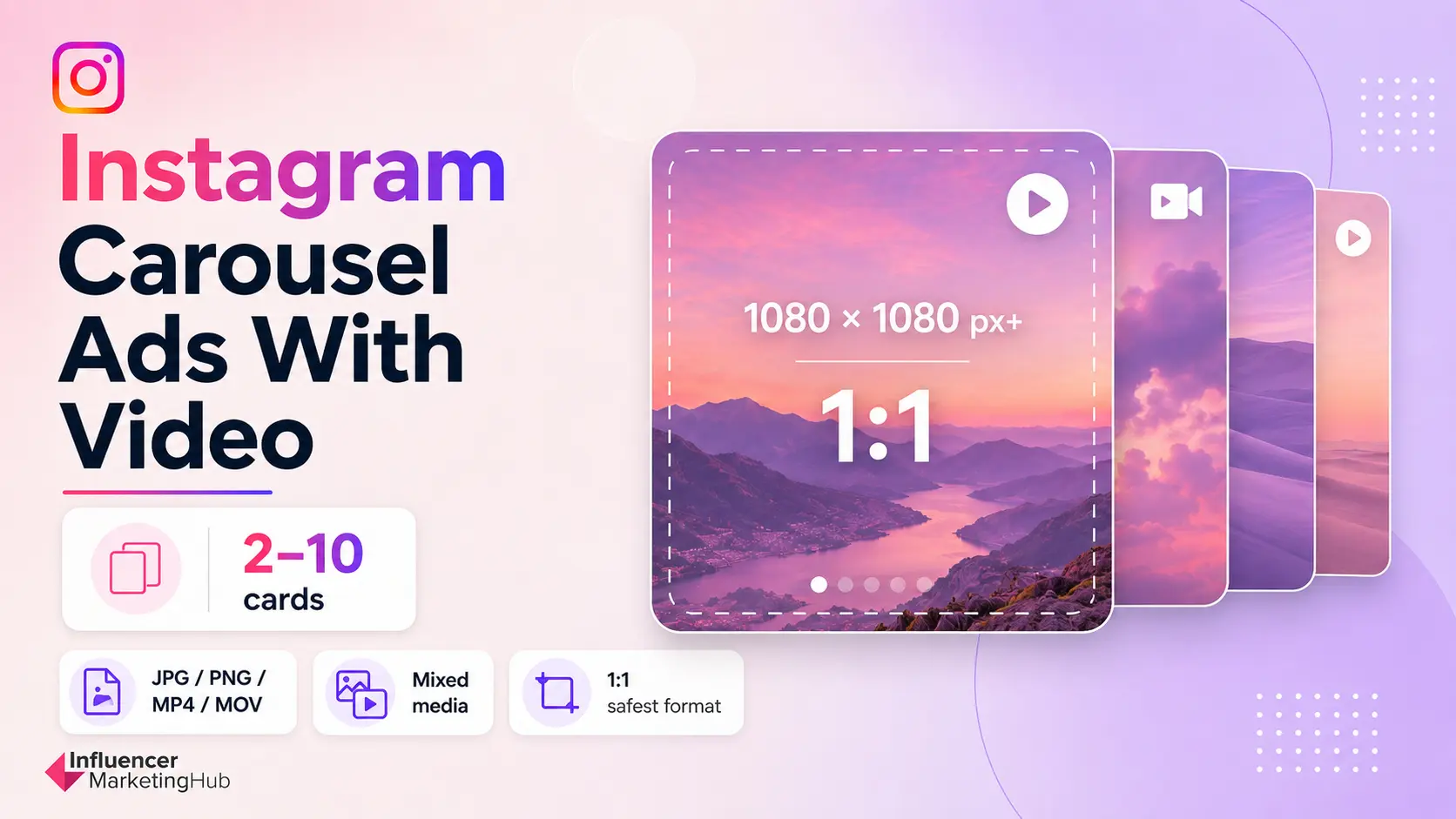
Mixed-media carousels need a slightly more conservative workflow.
When images and video appear together, 1:1 square creative is the safest production standard for maintaining consistency across the carousel.
| Specification | Mixed-media carousel |
| Recommended working size | 1080 × 1080 px or higher |
| Working aspect ratio | 1:1 |
| Number of cards | 2–10 |
| Image file types | JPG, PNG |
| Video file types | MP4, MOV |
| Maximum image file size | 30 MB |
| Maximum video file size | 4 GB |
Meta's carousel requirements can vary according to the media combination, placement, and campaign setup. For that reason, we would not treat 1:1 as the only ratio Instagram could ever accept. Instead, it is the safest production baseline when video enters the carousel.
Influencer Marketing Hub Recommendation: Decide whether a carousel will contain video before creative production begins. If it will, start from a square master and verify the final carousel in Ads Manager rather than converting a finished 4:5 image carousel at the last minute.
That planning decision can save a surprising amount of redesign. A headline, product crop, or sequence built around a 4:5 frame may need substantial repositioning when moved into 1:1.
Instagram Explore Ad Sizes
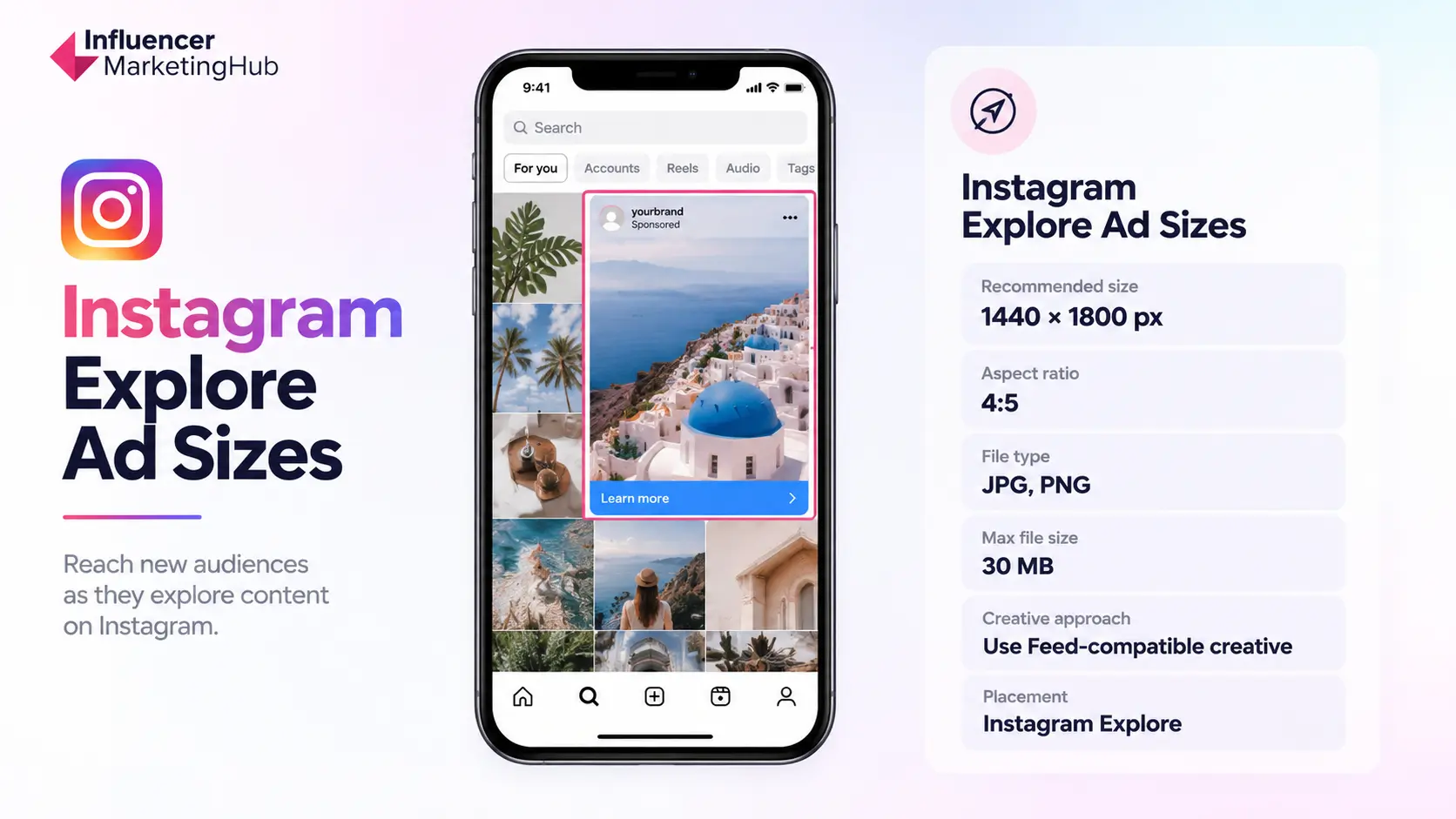
Instagram Explore gives advertisers another way to reach people as they browse content outside their main Feed. From a creative-production perspective, however, most teams do not need to build an entirely separate Explore master.
For Explore-compatible creative, we recommend starting with the same 4:5 portrait asset used for Instagram Feed images.
| Specification | Instagram Explore ad |
| Recommended working size | 1440 × 1800 px |
| Aspect ratio | 4:5 |
| Creative approach | Feed-compatible |
| Image file types | JPG, PNG |
| Video | Preview according to the selected placement |
| Final check | Ads Manager preview |
The current article treats Explore image and video ads as separate formats with their own large specification blocks. For most advertisers, that adds complexity without improving the production workflow.
A better approach is to create strong Feed-compatible creative and use Meta's placement preview to confirm how it appears within Explore.
- Influencer Marketing Hub Recommendation: Use 1440 × 1800 px / 4:5 Feed-compatible creative as the starting point for Explore, then check the Explore preview before publishing.
This is especially important when the creative contains text close to the edges or depends on a specific crop. A technically compatible asset can still look weaker if the placement changes how the composition is presented.
With the major placement dimensions covered, the next question is where those important elements should sit inside the canvas. That matters most for full-screen Stories and Reels, where Instagram's own interface occupies a meaningful part of the screen.
Instagram Stories and Reels Safe Zones
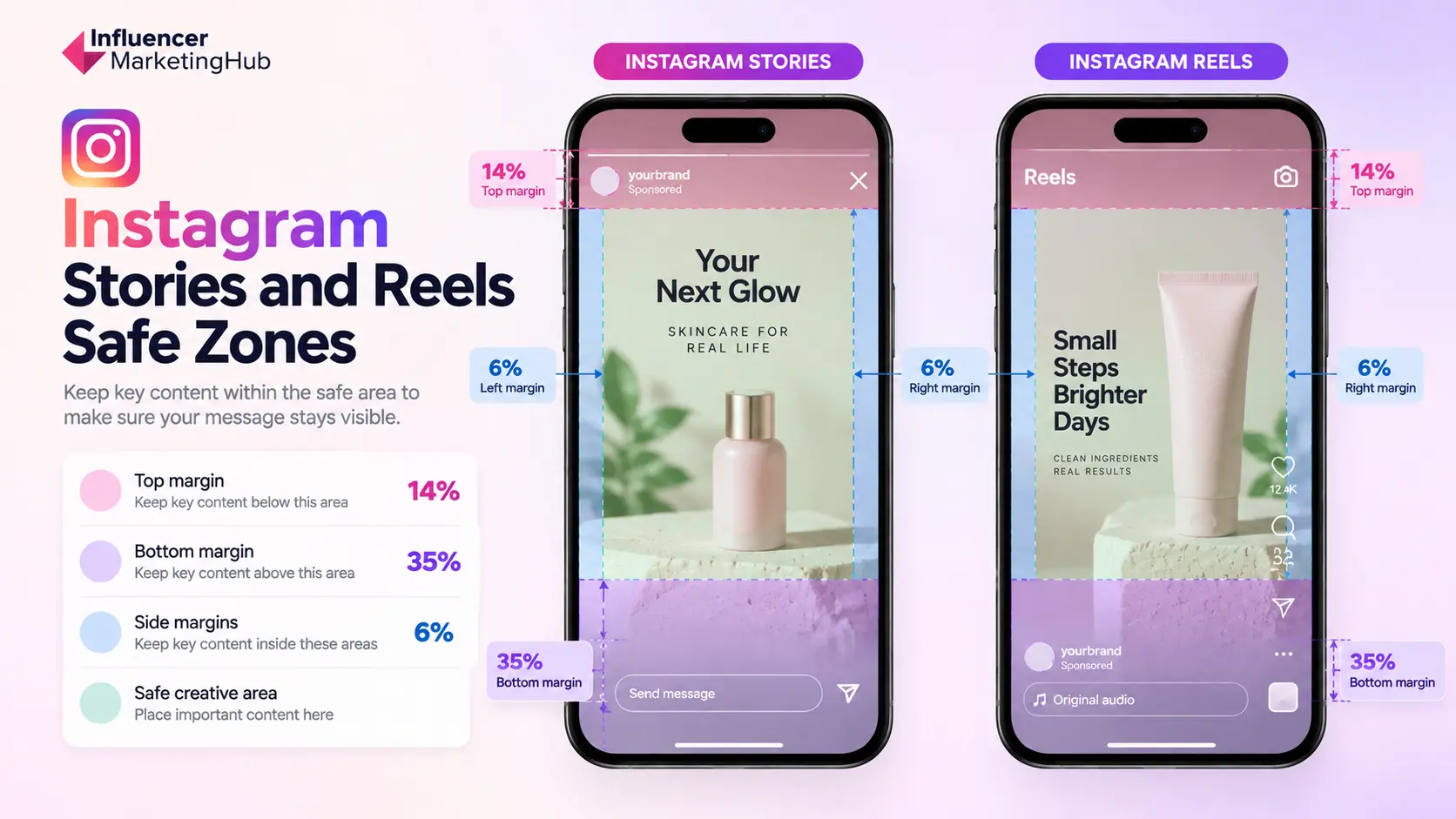
Using the correct 9:16 dimensions gives Stories and Reels the right canvas, but it does not guarantee that every part of the creative will remain visible.
Instagram places its own interface over full-screen ads. Profile information appears near the top, while captions, engagement controls, audio information, and calls to action occupy much of the lower and side areas. A headline or product can therefore sit inside a technically correct 9:16 file and still end up competing with Instagram's UI.
Meta's published Ads Guide recommends keeping key creative elements away from roughly 14% of the top, 35% of the bottom, and 6% of each side for Instagram Reels and Stories ads. Meta describes these as design recommendations rather than upload requirements.
Recommended Instagram Safe Zones
| Area of the creative | Keep key content away from | On 1440 × 2560 | On 1080 × 1920 |
| Top | Approx. 14% | Approx. 358 px | Approx. 269 px |
| Bottom | Approx. 35% | Approx. 896 px | Approx. 672 px |
| Left | Approx. 6% | Approx. 86 px | Approx. 65 px |
| Right | Approx. 6% | Approx. 86 px | Approx. 65 px |
The pixel measurements above are calculated from Meta's percentage guidance. If you work at another resolution, use the percentages rather than the fixed pixel values.
The generous bottom margin is especially important for Reels. Captions, audio information, calls to action, and Instagram's engagement interface all compete for space in the lower part of the screen.
Meta specifically recommends keeping key Reels creative elements within the safe zone. Its own testing also found that Reels ads built as 9:16 video with audio and key messages inside the safe zone achieved a 34.5% lower cost per result than image ads in its analysis of Reels-only campaigns.
What Should Stay Inside the Safe Area?
Treat the central safe area as the part of the canvas reserved for anything the viewer needs to see or understand.
That includes:
- Headline or primary message
- Product or main subject
- Brand logo
- Price or promotional offer
- Discount or promo code
- Subtitles
- Important supporting copy
- CTA-related messaging
Background imagery, textures, decorative shapes, and other non-essential visual elements can extend beyond the safe area because losing part of them to Instagram's interface will not change the meaning of the ad.
A useful design test is simple:
If Instagram covered this element, would the ad still communicate the same message?
If the answer is no, move it further inside the safe area.
Stories and Reels Do Not Need Identical Compositions
Stories and Reels may share the same 9:16 canvas, but that does not mean the exact same layout is always ideal.
Reels have a prominent engagement rail and caption area, while Stories have their own profile, progress, and CTA interface. Meta's published safe-zone recommendations provide a conservative shared starting point, but the interface displayed in Ads Manager can vary somewhat between placements. Current comparisons of Meta's published guidance and its live Ads Manager guardrails have found some differences, particularly for Stories.
For that reason, use the safe zone to create the layout, then use the actual placement preview as the final check.
- Influencer Marketing Hub Recommendation: Keep critical creative inside the central 9:16 safe area, but always preview Stories and Reels separately before launch. A shared master file is useful; a shared master file should not replace placement QA.
⭐Keep Every Instagram Ad Size and Safe Zone on Hand
You do not need to remember which canvas goes with Feed, Stories, Reels, carousels, and Explore every time your team starts a campaign.
Download the IMH Instagram Ad Sizes & Specs Cheat Sheet for the recommended dimensions, aspect ratios, Stories and Reels safe-zone diagrams, full placement specifications, and pre-upload checklist.
How to Prepare Instagram Ads for Multiple Placements
Creating a separate master file for every possible Instagram placement can quickly make creative production inefficient. At the same time, uploading one asset everywhere and allowing Meta to adapt it can produce crops and layouts that your designer never intended.
The practical approach sits between those two extremes.
For most campaigns, teams can cover the major Instagram placements with a small set of core creative canvases and then create additional placement-specific variants where the campaign justifies them.
Start With Three Core Instagram Ad Canvases
A streamlined creative system can begin with these three masters:
| Master asset | Recommended size | Ratio | Main uses |
| Feed portrait | 1440 × 1800 px | 4:5 | Feed images, image-only carousel, Explore-compatible creative |
| Full-screen vertical | 1440 × 2560 px | 9:16 | Stories and Reels |
| Square mixed-media | 1080 × 1080 px+ | 1:1 | Carousels containing video |
Feed video can warrant an additional 9:16 video master, especially when Feed video represents an important placement rather than simply additional inventory.
This system gives the creative team a practical starting point without requiring every campaign concept to be rebuilt six or seven times.
It also forces an important distinction early in production:
Feed creative is portrait. Full-screen creative is vertical. Mixed-media carousel creative may need to be square.
Those decisions are much easier to make before design begins than after the campaign has already been approved.
When to Create Placement-Specific Instagram Ads
Creating separate placement variants becomes more valuable as the importance of the campaign and the sensitivity of the composition increase.
A dedicated Stories or Reels version is particularly useful when the ad contains subtitles, large headlines, promotional codes, prices, product close-ups, or other elements that need precise positioning.
The same applies when Stories or Reels account for a meaningful share of planned spend. If a placement is strategically important, it makes little sense to treat its creative as an automatic crop of something designed somewhere else.
Consider a Feed ad built around a product on the right and a headline on the left. Simply expanding that canvas to 9:16 may technically produce a valid Reel, but it can leave the product behind the engagement rail or create large areas of visually empty space.
Placement-specific design allows you to preserve the idea while changing the composition.
When Meta Can Adapt the Creative
There are also cases where producing several manual variants adds more work than value.
Meta provides placement asset customization, allowing advertisers to supply different assets for specific placements while keeping them within the same campaign. Meta's Advantage+ creative tools can also adjust aspect ratios and, for Reels, use image expansion to extend creative into a 9:16 format.
Automated adaptation can make sense when:
- You are running fast creative tests
- Campaign budgets are relatively small
- The composition has plenty of whitespace
- The main subject sits comfortably toward the center
- Cropping does not remove important information
- The placement previews already look correct
The important distinction is between technical adaptation and creative judgment.
Meta can extend an image or adjust an aspect ratio. It cannot know that the small product benefit in the bottom corner is the reason the creative converted in the first place.
- Influencer Marketing Hub Recommendation: Use Meta's adaptation tools to reduce unnecessary production work, not to avoid designing for placements that matter to the campaign.
Build Safe Zones Into the Master Files
Safe-zone QA is easier when designers do not have to remember it every time.
For teams producing Instagram ads regularly, create reusable templates with the Stories and Reels safe areas already marked as non-exporting guides.
That gives designers a visible boundary while working and reduces the chance that a headline, logo, subtitle, or product drifts into the interface area during revisions.
The same template system can include:
- 4:5 Feed master
- 9:16 Stories/Reels master with safe-zone guides
- 1:1 mixed carousel master
The dimensions then become part of the creative system rather than something marketers have to look up at the end of every campaign.
Always Review the Placement Preview
The final creative approval should happen after the asset has been placed into Ads Manager, not when the designer exports the file.
Meta itself recommends using placement customization and provides tools for optimizing Reels assets across placements. That flexibility also means the final presentation can differ from the raw file sitting in your design folder.
Before publishing, check how the creative appears in every Instagram placement included in the ad set.
Look specifically for:
- Cropping: Has part of the product, person, or visual focal point disappeared?
- Text: Is every important line visible and readable?
- Safe zones: Are the headline, logo, subtitles, and offer clear of Instagram's interface?
- CTA: Does the creative leave enough room for the platform CTA rather than competing with it?
- Composition: Does the ad still look intentionally designed at the displayed ratio?
A file passing Meta's technical upload requirements only tells you that the platform can display it. The preview tells you whether it displays the way your campaign team intended.
Need to Resize an Existing Instagram Ad?
Already have the creative but need it in a different size? You do not necessarily need to rebuild the asset from scratch.
Use the IMH Free Social Media Image Resizer to resize existing images for Instagram and other major social platforms.
It is particularly useful when you need to turn an existing asset into a different canvas for Feed, Stories, Reels, or another placement.
Conclusion
There is no single Instagram ad size that works best across every placement.
For Feed images, 4:5 portrait creative gives advertisers a strong balance between screen coverage and natural Feed presentation. Stories and Reels should be designed around a 9:16 full-screen canvas, while mixed-media carousels may require a 1:1 square format for the most reliable production workflow.
The dimensions are only part of the job. Safe zones, cropping, interface overlays, and placement previews all influence how the final ad appears to users.
Build a small set of placement-appropriate master assets, keep important creative inside the safe areas, and review every selected placement in Ads Manager before launch.
For an easy reference, download the IMH Instagram Ad Sizes & Specs Cheat Sheet and keep the dimensions, safe zones, and pre-upload checks with your creative workflow.
If you found this article helpful, check out other similar articles we have on:
Frequently Asked Questions
What size should an Instagram ad be?
The best Instagram ad size depends on the placement. For Feed image ads, we recommend 1440 × 1800 px at 4:5. Stories and Reels should use a 9:16 vertical canvas, with 1440 × 2560 px as our recommended working size. Carousel requirements can differ depending on whether you are using images only or combining images and video.
What is the best aspect ratio for Instagram ads?
There is no single best ratio for every Instagram placement. 4:5 is the strongest default for Feed image ads because it uses more vertical screen space than a square asset. 9:16 is the natural format for Stories and Reels because those placements are designed for full-screen vertical viewing. Mixed-media carousels are safest when produced at 1:1.
What size are Instagram Feed ads?
For Instagram Feed image ads, we recommend 1440 × 1800 px at a 4:5 aspect ratio. The familiar 1080 × 1350 px size uses the same ratio and remains a practical alternative. Feed video is more vertical-first, so we recommend starting with a 9:16 video canvas and checking the final Feed preview in Ads Manager before publishing.
What size are Instagram Story ads?
Instagram Stories should be designed at a 9:16 aspect ratio. Our recommended working canvas is 1440 × 2560 px, while 1080 × 1920 px remains a common alternative. The same canvas can be used for both Story images and videos, but key text, logos, products, and offers should remain inside the safe area so Instagram's interface does not cover them.
What size are Instagram Reels ads?
We recommend creating Instagram Reels ads at 1440 × 2560 px with a 9:16 aspect ratio. A 1080 × 1920 px video uses the same ratio and remains a common production size. Reels should be treated as full-screen vertical creative, with important elements positioned inside the safe zone rather than close to Instagram's caption, engagement, and CTA areas.
What size should Instagram carousel ads be?
For an image-only Instagram carousel, we recommend 1440 × 1800 px at 4:5 so the creative can make better use of Feed space. If the carousel combines images and video, 1080 × 1080 px or higher at 1:1 is the safest production baseline. Use consistent dimensions across all cards and check the final carousel preview before publishing.
Is 1080 × 1080 still a good size for Instagram ads?
Yes. 1080 × 1080 px is still a useful square format, particularly for mixed-media carousels and creative that has already been designed around 1:1. However, it should not automatically be the default for every Instagram ad. A 4:5 Feed image or 9:16 Stories/Reels asset generally makes better use of the space available in those placements.
Can I use the same ad size for Instagram Feed, Stories, and Reels?
You can reuse the same campaign concept, but using one identical canvas across Feed, Stories, and Reels is rarely the best approach. Feed images work well at 4:5, while Stories and Reels are designed around 9:16. If you reuse creative, adapt the composition so important products, headlines, subtitles, and branding remain visible in each placement.

![Instagram Ad Sizes for All Post Formats [2026 Cheat Sheet]](https://s.influencermarketinghub.com/imaginary/resize?width=400&height=200&type=webp&url=https://influencermarketinghub.com/wp-content/uploads/2020/01/58e98fbd-instagram-ad-sizes-for-all-post-formats-2026-cheat-sheet.jpg)