
Posting regularly does not automatically mean you have a social media marketing plan.
Many brands maintain active accounts, publish content, and track engagement without clearly defining what social media should achieve for the business. Platform choices are often inherited, content is created reactively, and performance is judged through whichever metrics are easiest to access.
Yet, the performance gap between purely active brands and truly strategic ones is staggering: companies with a documented strategy are 3.5 times more successful than those operating without one.
A documented plan replaces that activity-first approach with a coordinated system.
It connects business objectives to specific audiences, platform roles, content priorities, budgets, responsibilities, publishing workflows, and measurable outcomes. Instead of asking what to post next, your team can make decisions based on what the plan is designed to accomplish.
This guide covers key building blocks, including goal setting, audience research, competitive analysis, content creation, scheduling, promotion, and performance measurement. We've also brought those elements together as one repeatable planning process.
In this guide, you will work through the IMH 9-Step Social Media Marketing Plan, moving from your current position to a complete execution and measurement system.
Use the free template alongside the guide to document each decision as you build your plan.
📥 Build Your Social Media Marketing Plan as You Read
A strong plan should connect strategy with execution.
Get the IMH Social Media Marketing Plan Template to organize your objectives, audience insights, competitor research, platform choices, content direction, publishing activity, and performance measurement in one structured workspace.
Complete the relevant section as you move through each step of this guide, then use the finished document to align your team and guide ongoing execution.
- What Is a Social Media Marketing Plan?
- Social Media Marketing Plan vs. Strategy, Campaign, and Calendar
- What Should a Social Media Marketing Plan Include?
- The IMH 9-Step Social Media Marketing Plan
- Step 1: Audit Your Current Social Media Position
- Step 2: Align Social Media With Business Goals
- Step 3: Define Your Priority Audiences
- Step 4: Analyze Competitors and Market Opportunities
- Step 5: Assign a Clear Role to Each Social Platform
- Step 6: Architect Your Social Media Content System
- Build Social Media Campaigns Around One Clear Objective
- Step 7: Allocate Budget, Tools, and Responsibilities
- Step 8: Activate the Plan
- Step 9: Assess, Report, and Optimize
- Turn Social Media Activity Into a Measurable Plan
- Frequently Asked Questions
What Is a Social Media Marketing Plan?
A social media marketing plan is a documented roadmap explaining how a business will use social platforms to achieve specific marketing and business objectives.
It defines:
- What social media should accomplish
- Who the brand needs to reach
- Which platforms deserve investment
- What content and campaigns will be created
- What resources are required
- Who owns each activity
- How the work will be executed
- Which metrics will determine success
A useful plan should be specific enough to guide day-to-day decisions while remaining flexible enough to respond to platform changes, audience behavior, and performance results.
It should also explain the reasoning behind the activity.
For example, stating that the team will publish four LinkedIn posts per week is not a complete plan. The document should clarify why LinkedIn matters, who the posts are intended to reach, what role the content plays, and which business outcome the team expects it to influence.
For example, Wendy's has effectively used its social media marketing plan by engaging with its audience through humorous interactions on X, which has significantly boosted its brand visibility and customer engagement.
real recognize real pic.twitter.com/n1nq8VDPHn
— Wendy’s (@Wendys) July 10, 2026
In fact, 73% of marketers believe that their efforts through social media marketing have been "somewhat effective" or "very effective" for their business, highlighting the importance of a well-structured plan in achieving marketing success.
Social Media Marketing Plan vs. Strategy, Campaign, and Calendar
These documents are closely connected, but each one answers a different planning question.
| Document | Main Question | Typical Output |
| Social media strategy | Why will we use social media, and where will we compete? | Audience, positioning, platform direction, strategic choices |
| Social media marketing plan | What will we do, with which resources, and how will we measure it? | Goals, channels, content, campaigns, budgets, owners, KPIs |
| Social media campaign plan | How will we execute one defined initiative? | Campaign objective, message, assets, channels, timeline |
| Social media calendar | What will be published and when? | Posts, formats, dates, owners, approval and publishing status |
Your strategy informs the plan. The plan then guides individual campaigns and the publishing calendar used to execute them.
For example, your strategy may identify LinkedIn as the strongest channel for reaching B2B decision-makers. Your marketing plan would define its role, objectives, budget, content pillars, ownership, and KPIs.
A campaign plan would organize one LinkedIn lead-generation initiative, while the calendar would schedule its individual posts.
What Should a Social Media Marketing Plan Include?
A complete social media marketing plan should cover both strategic decisions and the operational requirements needed to execute them.
At minimum, include:
| Planning Area | What It Should Define |
| Current position | Existing accounts, performance, resources, strengths, and weaknesses |
| Business alignment | The business objective social media must support |
| Goals and KPIs | The result you want and how it will be measured |
| Audience | Priority segments, needs, behaviors, and platform preferences |
| Competitors | Market benchmarks, content patterns, and positioning opportunities |
| Platform roles | Why each channel is used and what it should contribute |
| Content system | Pillars, formats, campaigns, CTAs, and publishing cadence |
| Resources | Budget, people, tools, creators, and production requirements |
| Execution | Calendar, workflow, approvals, community management, and escalation |
| Measurement | Reporting cadence, targets, insights, and optimization decisions |
However, not every business requires the same level of detail.
A small company managing two platforms may need a concise plan covering a single quarter. A larger organization may need channel-specific budgets, separate campaign workflows, approval processes, regional responsibilities, and detailed performance reporting.
The structure should reflect the complexity of the operation.
The IMH 9-Step Social Media Marketing Plan
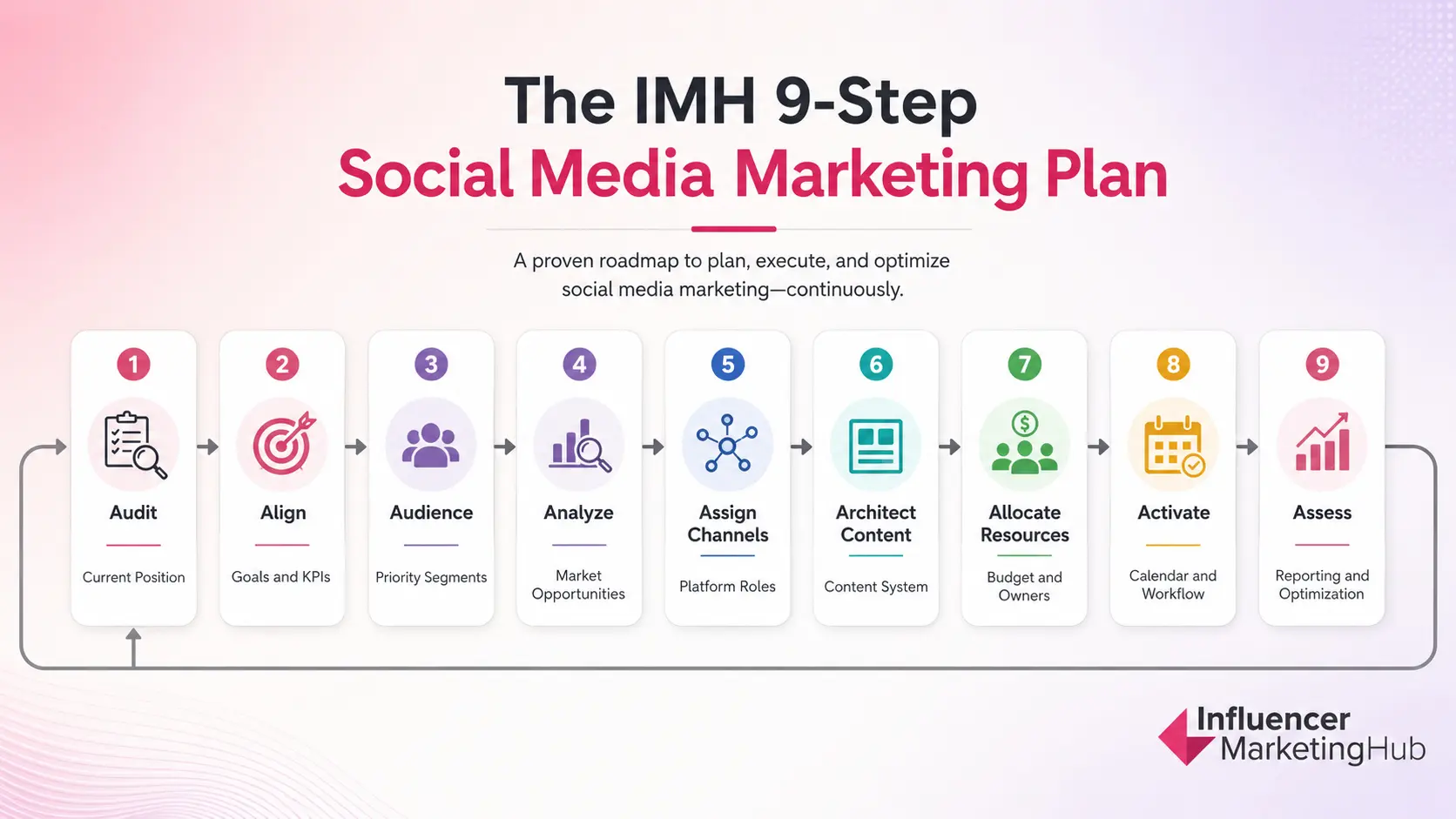
Building the plan in stages makes it easier to connect strategic decisions with execution.
The IMH 9-Step Social Media Marketing Plan moves from diagnosis to planning, activation, and continuous improvement.
| Stage | Business Question | Plan Output |
| 1. Audit | Where do we stand today? | Current-state assessment |
| 2. Align | What business result should social support? | Goals and KPIs |
| 3. Audience | Who are we trying to reach and influence? | Priority audience profiles |
| 4. Analyze | What can we learn from competitors and the market? | Competitive opportunities |
| 5. Assign Channels | What role should each platform play? | Platform role map |
| 6. Architect Content | What will we create, and how will it support the customer journey? | Content pillars, formats, campaigns, and cadence |
| 7. Allocate Resources | What budget, tools, and people are required? | Resource and ownership plan |
| 8. Activate | How will the plan be executed consistently? | Calendar and operating workflow |
| 9. Assess | How will we measure and improve performance? | Reporting and optimization system |
Each stage should produce a practical planning output.
That prevents the document from becoming a collection of broad aspirations. By the end of the process, you should have clear decisions about where to invest, what to create, who is responsible, and how results will be evaluated.
1. Audit
Establish the starting position by reviewing accounts, profiles, content, performance, audience growth, and current resource use.
2. Align
Translate business priorities into clear social media objectives, KPIs, benchmarks, and targets.
3. Audience
Identify the audience segments the plan must reach, the problems they are trying to solve, and how they behave across social platforms.
4. Analyze
Compare competitors, category leaders, and audience conversations to uncover gaps and positioning opportunities.
5. Assign Channels
Decide which platforms deserve investment and give each one a defined role in the wider plan.
6. Architect Content
Build the content system by defining pillars, formats, campaigns, funnel roles, CTAs, repurposing opportunities, and publishing cadence.
7. Allocate Resources
Determine the budget, team, tools, production capacity, paid distribution, external partners, and ownership required.
8. Activate
Convert the plan into a practical calendar, production workflow, approval process, community-management routine, and escalation system.
9. Assess
Measure performance against targets, document insights, reallocate resources, and refine the plan based on results.
The stages are connected.
An audience insight may influence platform selection. Platform roles will shape content formats. Content requirements affect the budget. Available resources determine publishing cadence. Measurement then reveals which parts of the plan should be expanded, refined, or removed.
Step 1: Audit Your Current Social Media Position
A strong social media marketing plan starts with an honest assessment of what already exists.
Without an audit, teams often build new goals, campaigns, and publishing schedules on top of outdated assumptions. They may continue investing in underperforming platforms, repeat content that no longer resonates, or overlook accounts that already contribute meaningful traffic, engagement, or conversions.
The audit establishes your baseline. It shows where social media stands today so the rest of the plan can focus on improving the right areas.
Inventory Every Social Media Account
Begin by creating a complete list of the accounts associated with your business.
This should include active brand accounts, regional or local pages, product-specific profiles, employer-brand accounts, customer-support channels, campaign pages, inactive profiles, and any accounts created by former employees.
For each account, record the core details in one place:
| Field | What to Document |
| Platform | Facebook, Instagram, LinkedIn, TikTok, YouTube, or another network |
| Profile URL | Direct link to the account |
| Username | Current account handle |
| Owner | Person or team responsible |
| Status | Active, inactive, archived, or under review |
| Primary purpose | Awareness, support, recruitment, sales, or another role |
| Access status | Whether login and administrative access are confirmed |
This process often reveals outdated accounts, inconsistent handles, duplicate profiles, or pages that nobody actively manages.
Review Profile Health
Once you know which accounts exist, evaluate whether each active profile accurately represents the business.
Check that the business name, username, visual identity, bio, website link, contact information, calls to action, pinned content, and profile imagery are all current and consistent.
Pay particular attention to broken links, outdated campaign references, old visual assets, and incomplete profile information. These may appear minor, but they shape how people understand and trust the brand before engaging with any content.
Evaluate Account and Content Performance
Review performance over a consistent period, such as the previous three, six, or 12 months. The appropriate timeframe will depend on your publishing frequency, campaign cycles, and seasonality.
Relevant metrics may include audience growth, reach, impressions, engagement rate, website traffic, conversions, revenue, response time, posting frequency, video views, and watch time.
Avoid evaluating every platform using the same standard.
A customer-support account may create value through faster response times and issue resolution. LinkedIn may contribute qualified website traffic and leads. TikTok may primarily support discovery, reach, and video engagement.
Each account should be judged according to the role it currently plays—or the role it is expected to play in the new plan.
Identify Your Strongest Content Patterns
Review your top-performing posts and look for recurring patterns across topics, formats, creative styles, hooks, calls to action, campaigns, and publishing times.
The objective is not simply to identify the posts with the highest numbers. You need to understand why they performed well.
A strong post may have solved a specific audience problem, simplified a complex idea, used a format suited to the platform, featured credible proof, or encouraged meaningful participation. In other cases, paid distribution may have contributed significantly to the result.
These observations should become repeatable planning insights rather than isolated examples of past success.
Examine Underperforming Activity
Weak results can be equally useful.
Look for platforms that consume significant resources without contributing measurable value, content formats that repeatedly underperform, campaigns that generate attention but little action, and accounts where publishing or community management is inconsistent.
Not every weak result means the channel should be abandoned. Poor performance may reflect weak execution, insufficient consistency, limited distribution, or a mismatch between the content and platform.
The audit should help distinguish between problems worth fixing and activity worth stopping.
Assess Resource Efficiency
Performance should also be considered alongside the resources required to produce it.
Review internal staff time, freelance or agency costs, production expenses, paid media spend, software subscriptions, creator fees, community-management workload, and approval requirements.
A channel generating modest results with very little effort may still be efficient. Another may appear successful until the team accounts for the production costs and paid support required to maintain it.
Summarize the Audit
Finish with a concise assessment of strengths, weaknesses, opportunities, and risks.
| Area | Example Finding |
| Strength | LinkedIn generates high-quality website traffic |
| Weakness | Instagram publishing is inconsistent |
| Opportunity | Educational short-form video performs well in the category |
| Risk | Customer-service escalation has no clear owner |
Then assign a recommended action to each major account or activity:
Keep, improve, expand, test, consolidate, pause, or exit.
This ensures the audit produces decisions rather than becoming a report that nobody acts on.
Outcome: A current-state assessment showing which accounts, content, channels, and resources are contributing value—and which areas require change.
🔍 Audit Before You Plan A marketing plan is only as reliable as the baseline behind it. Use the IMH Social Media Audit Template to document account health, content performance, audience growth, platform contribution, and improvement opportunities before setting new priorities. The audit will help you decide which channels to maintain, expand, test, consolidate, or remove from your plan. Get the Free Social Media Audit Template
Step 2: Align Social Media With Business Goals
Social media goals should not exist separately from the goals of the business.
Posting more frequently, gaining followers, or increasing engagement may sound positive, but these outcomes only matter when they contribute to something the organization is trying to achieve.
Start with the business priority, then define the role social media will play in supporting it.
In the case of The NOBO, their Instagram ads made use of carousel posts featuring specific products. The caption included a promo code to encourage the target audience to make a purchase.
This type of ad campaign would help to achieve the goal of driving brand awareness and boosting sales.

Begin With the Business Objective
Common priorities include increasing awareness, entering a new market, generating demand, acquiring leads, driving sales, supporting a product launch, improving retention, strengthening employer branding, or building industry authority.
Select the objectives that matter most during the planning period.
A quarterly plan may focus on one or two major priorities. An annual plan may include several, but each should still have a clear hierarchy. Treating every objective as equally important usually produces unfocused content and unclear reporting.
Translate Business Objectives Into Social Media Goals
A social media goal should describe the contribution the channel is expected to make.
| Business Objective | Social Media Goal |
| Increase awareness | Expand qualified reach among priority audiences |
| Enter a new market | Build visibility and engagement within the target region |
| Generate demand | Drive relevant audiences to educational resources |
| Acquire leads | Increase social-attributed form submissions |
| Drive sales | Generate purchases and attributable revenue |
| Improve retention | Increase customer education and proactive engagement |
| Strengthen authority | Grow engagement with expert-led content |
| Improve service | Reduce response time and resolve more issues through social channels |
This distinction prevents the plan from confusing tactics with outcomes.
“Publish five posts per week” is a tactic.
“Increase qualified website visits from LinkedIn by 25% during Q3” is a measurable goal.
Set Clear, Measurable Targets
Goals should define the platform, metric, baseline, target, and timeframe.
For example:
Increase the average LinkedIn engagement rate from 2.4% to 3% by the end of Q4 while maintaining qualified website traffic.
This is more useful than simply stating that the team wants to improve engagement. It also includes a quality safeguard, ensuring that higher engagement does not come at the expense of attracting relevant audiences.
Choose KPIs That Match the Goal
The metrics you select should follow directly from the business objective.
| Business Objective | Social Media Goal | Primary KPIs | Supporting Metrics |
| Brand awareness | Reach more priority users | Qualified reach, impressions, share of voice | Follower growth, video views |
| Demand generation | Drive interest in the category | Engaged visits, content downloads | CTR, landing-page sessions |
| Lead generation | Increase qualified inquiries | Leads, conversion rate, cost per lead | Clicks, form starts |
| Sales | Generate attributable purchases | Revenue, purchases, ROAS | Product-page visits, add-to-cart rate |
| Community building | Strengthen participation | Meaningful comments, recurring engagement | Shares, mentions, community growth |
| Customer care | Improve service through social | Response time, resolution rate | Message volume, sentiment |
| Retention | Educate and engage customers | Product engagement, retention indicators | Content saves, support-content clicks |
Primary KPIs determine whether the plan is succeeding. Supporting metrics explain why performance changed.
Establish Baselines Before Setting Targets
A target needs a starting point.
Use historical data to document current reach, engagement, traffic, leads, conversion rate, revenue, cost per result, response time, and posting cadence.
When no reliable history exists, use the first month of execution as a benchmarking period.
Targets should reflect previous performance, available budget, team capacity, market demand, planned campaigns, and the maturity of each platform. A plan that expects output to double without additional production resources is unlikely to be sustainable.
Define the Measurement Source
Every KPI should have an agreed source of truth.
Depending on the metric, this may be native platform analytics, web analytics, a CRM, an eCommerce platform, social listening software, an advertising platform, or a customer-service system.
Defining this before execution prevents different teams from calculating or reporting the same metric in conflicting ways.
Assign Accountability
Each major goal should have one accountable owner responsible for monitoring progress, coordinating contributors, identifying risks, reporting results, and recommending changes.
That person does not need to execute every activity, but they should ensure the work remains connected to the intended outcome.
Goal-Setting Example
Consider a B2B software company preparing its Q3 social media marketing plan.
| Planning Element | Example |
| Business objective | Increase qualified product adoption |
| Social media goal | Generate 300 qualified product trials by the end of Q3 |
| Primary KPI | Qualified trials attributed to social media |
| Supporting KPIs | Landing-page sessions, conversion rate, cost per trial, social-attributed pipeline |
| Baseline | 180 qualified trials in Q2 |
| Owner | Demand generation manager |
This provides much stronger direction than simply aiming to increase LinkedIn engagement.
Outcome: A set of goals, KPIs, baselines, targets, deadlines, and owners directly connected to business priorities.
Step 3: Define Your Priority Audiences
A social media marketing plan should not target “everyone interested in the product.”
Broad audience definitions make it difficult to choose platforms, messaging, formats, campaigns, and calls to action. The plan becomes more useful when it identifies the specific segments social media needs to reach and influence.
Move Beyond Basic Demographics
Age, location, income, and job title provide useful context, but they do not explain why someone would engage with your content or take action.
More useful audience insights include what people are trying to achieve, which problems they need to solve, what prevents them from acting, what information they trust, where they research solutions, and what would motivate them to engage, subscribe, inquire, or purchase.
These insights directly influence channel selection, content planning, messaging, and campaign design.
Prioritize the Audiences That Matter Most
Most businesses serve more than one audience, but not every segment deserves equal attention during every planning period.
Classify audiences as primary, secondary, or supporting.
For a B2B software company, that might look like:
| Priority | Audience |
| Primary | Marketing managers evaluating social media tools |
| Secondary | Agency leaders influencing software selection |
| Supporting | Practitioners who may advocate for the tool internally |
This hierarchy helps prevent the plan from becoming too broad.
Build Actionable Audience Profiles
Each priority audience profile should answer a focused set of questions.
| Field | Question |
| Segment | Who are they? |
| Goal | What are they trying to achieve? |
| Pain point | What is making that difficult? |
| Barrier | Why might they delay taking action? |
| Platform behavior | Where and how do they use social media? |
| Content preference | What information and formats do they value? |
| Trust signal | What evidence influences them? |
| Desired action | What should they do next? |
| Messaging implication | How should the brand communicate with them? |
The profile should be concise enough for writers, designers, and campaign managers to use without consulting a long persona document.
Start With First-Party Evidence
Audience research should begin with the information the business already owns.
Customer interviews, sales conversations, support tickets, CRM data, website analytics, email performance, search queries, reviews, and existing social analytics can all reveal recurring needs, objections, language, and use cases.
Sales and customer-service teams are especially valuable because they hear directly from potential and existing customers.
Use Social Listening to Add Context
Social listening reveals what audiences discuss when they are not speaking directly to the brand.
Monitoring category terms, competitor mentions, complaints, emerging needs, industry debates, and frequently asked questions can uncover the language people use to describe their problems and the concerns shaping their decisions.
These insights can then inform content topics, campaign messaging, FAQs, community engagement, and customer-service priorities.
Map Audience Behavior to Platforms
The same audience may use several platforms for different reasons.
A marketing manager might use LinkedIn for professional insights, YouTube for tutorials, Instagram for creative inspiration, Reddit for peer discussion, and TikTok for discovery.
The plan should identify both where the audience is active and what role each platform plays in their behavior.
| Platform Behavior | Planning Implication |
| Researching solutions | Publish educational and comparison content |
| Discovering trends | Use timely, accessible formats |
| Seeking peer opinions | Prioritize community and proof |
| Building professional knowledge | Share expert analysis and frameworks |
| Looking for entertainment | Use lighter, platform-native creative |
| Asking for support | Establish response and escalation processes |
Presence alone does not justify investment. The platform must support relevant audience behavior and business objective.
Translate Audience Insights Into Messaging
Each segment should have a clear message angle, supporting proof, objections to address, and desired action.
For example:
| Planning Element | Example |
| Audience | Small-business owner managing social media alone |
| Problem | Lacks time and a repeatable process |
| Message angle | Simplify planning and reduce reactive work |
| Evidence | Practical templates and step-by-step examples |
| CTA | Download the marketing plan template |
This gives content creators clear direction without scripting every post.
Avoid Fictional Persona Details
Audience profiles should be based on evidence.
Details such as a persona’s favorite coffee, car, or television series rarely improve social media planning unless they directly influence purchase behavior or platform use.
Focus on information that changes decisions about channels, content, messaging, campaigns, offers, calls to action, and community management.
Audience Profile Example
| Area | Example |
| Segment | Marketing managers at 20–200-person B2B companies |
| Goal | Build a measurable social media program |
| Pain point | Limited team capacity and unclear attribution |
| Barrier | Concern that new activity will increase workload without proving ROI |
| Primary platforms | LinkedIn and YouTube |
| Preferred content | Frameworks, benchmarks, templates, and case studies |
| Trust signals | Data, expert guidance, and customer proof |
| Desired action | Start a product trial |
| Messaging implication | Emphasize implementation, efficiency, and measurable outcomes |
Outcome: Prioritized audience profiles documenting needs, behaviors, platform preferences, trust signals, messaging implications, and desired actions.
🧭 Connect Audience Insights to Your Content Plan Knowing who you want to reach is only the beginning. Use the IMH Content Planning Matrix to connect audience needs with customer journey stages, keywords, content formats, distribution channels, and calls to action. For a broader strategic foundation, use the IMH Social Media Strategy Template to define your audience, positioning, channel direction, and content priorities before moving into execution.
Step 4: Analyze Competitors and Market Opportunities
Competitor analysis helps you understand the social media environment your plan will enter.
The goal is not to copy high-performing brands or recreate their most popular posts but to identify how competitors position themselves, which audiences they prioritize, what content they rely on, and where opportunities remain open.
A useful analysis should show both what is working in the category and where your brand can take a more distinctive approach.
If you’re starting from scratch, you may not have enough audience insights on the native analytics dashboard of your social media channels.
Make use of third-party audience research software to uncover practical insights about your target audience. Platforms like Brandwatch can provide you with in-depth market insights so you can gain a better understanding of your audience and the conversations that matter.

- Source: brandwatch.com
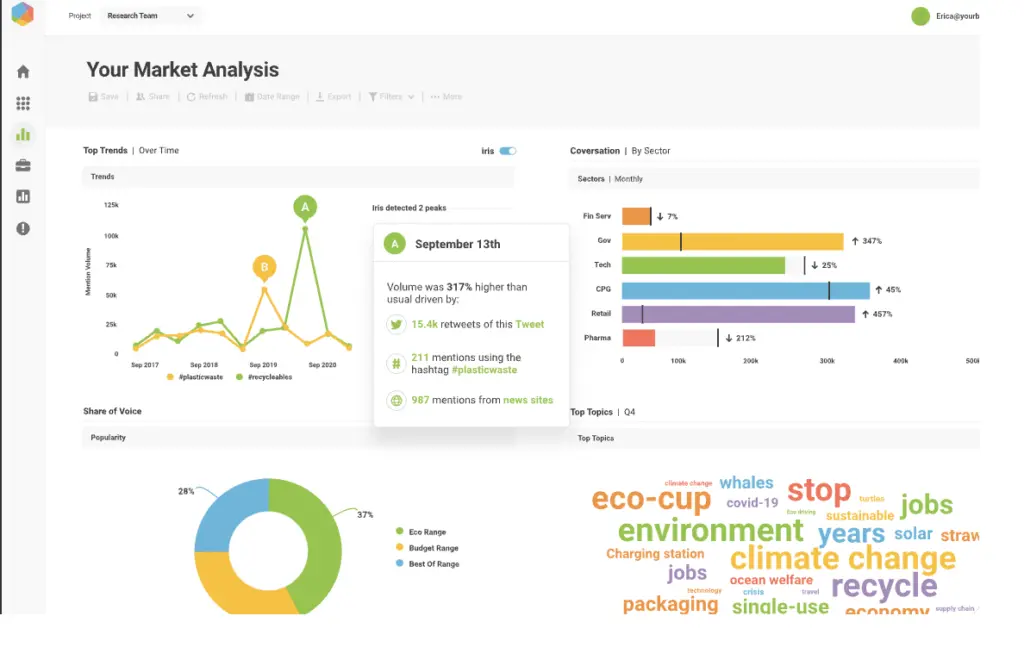
To get a deeper understanding of how to appeal to your target audience, go beyond quantitative insights. Look for qualitative information using social listening to get a better idea of the conversations they’re engaging in, the issues they’re expressing, and the solutions they’re looking for.
Select the Right Competitors
Start with three to five brands that offer meaningful comparison.
Include a mix of direct competitors, category leaders, and emerging brands gaining attention. Direct competitors help you evaluate realistic market expectations, while category leaders can reveal stronger creative, community, or campaign practices.
Avoid benchmarking your entire plan against global brands with much larger teams and budgets. Their content may offer inspiration, but it may not provide a realistic operating standard.
For example, Rolex and Daniel Wellington both sell watches, of course.
However, their social media strategies are completely different. Take a look at the posts below. Just like in the picture, most of the photos on Rolex’s Instagram page showcase their watches. Their captions detail the features of the watch.
In contrast, Daniel Wellington takes a very different approach. Their Instagram feed features user-generated content, influencer-generated content, and in-house promotional content.
That’s not to say that one of them is better than the other. But it should be noted that each brand has set itself apart from its competitors in its own way.
Rolex’s social media marketing efforts stay true to the brand’s personality of sophistication and reliability. Meanwhile, Daniel Wellington tries to maintain a brand personality that’s more relatable and accessible to the general public, which shows in the way they make use of content generated by influencers and customers.
Compare Their Platform Presence
Record where each competitor is active and how seriously they appear to invest in every channel.
| Competitor | Main Platforms | Publishing Cadence | Apparent Platform Role |
| Competitor A | LinkedIn, YouTube | Four posts and one video weekly | Education and demand generation |
| Competitor B | Instagram, TikTok | Daily | Awareness and community |
| Competitor C | LinkedIn, Instagram | Three posts weekly | Authority and brand visibility |
This comparison can reveal where competitors concentrate their efforts and which channels may be underserved.
A platform where no competitor performs well may represent an opportunity. It may also indicate that the audience or format is poorly suited to the category, so treat absence as a signal to investigate rather than automatic proof of potential.
Review Content Pillars and Formats
Look beyond individual posts and identify recurring themes.
A competitor may consistently publish educational explainers, product demonstrations, founder commentary, customer stories, industry news, or employee content. These patterns reveal what the brand wants to be known for and how it is trying to influence its audience.
Also compare the formats used to deliver those themes.
| Area | What to Examine |
| Content pillars | The themes competitors return to consistently |
| Formats | Video, carousels, text posts, livestreams, polls, or Stories |
| Campaigns | Launches, events, reports, partnerships, or promotions |
| Creative approach | Visual style, hooks, editing, tone, and presentation |
| Calls to action | The next steps competitors encourage |
| Proof | Testimonials, experts, data, creators, or customer examples |
The objective is to understand the category’s content patterns without assuming that popular tactics will automatically work for your brand.
Examine Audience Response
Public engagement provides useful qualitative information even when you cannot access a competitor’s internal analytics.
Review comments, shares, audience questions, complaints, brand responses, and recurring discussion themes. Pay attention to the difference between visible engagement and meaningful engagement.
A post with many generic reactions may be less strategically useful than one attracting detailed questions from prospective customers.
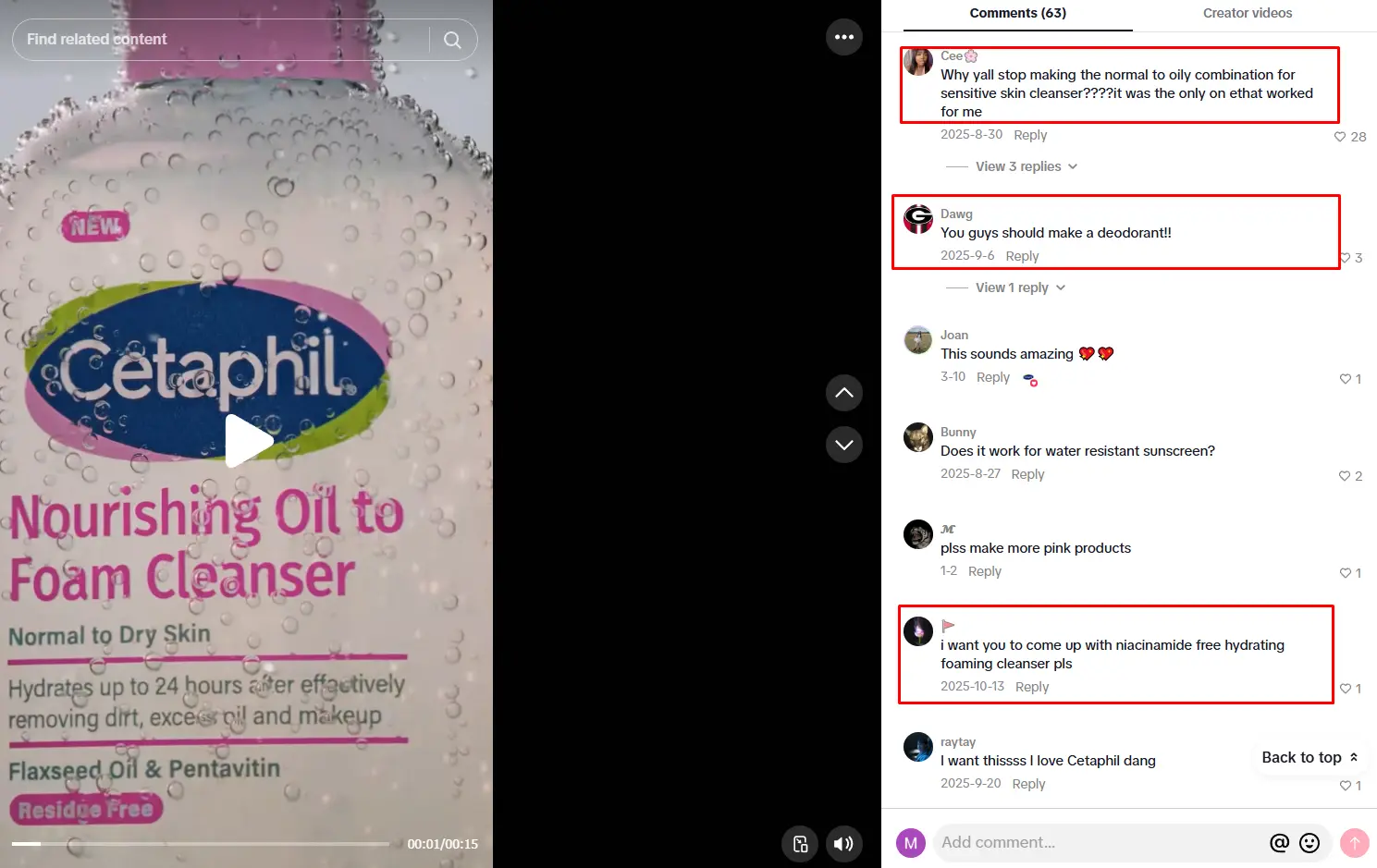
Comments can reveal what audiences value, what they misunderstand, what they dislike, and which needs competitors have not fully addressed.
Estimate Relative Performance Carefully
Follower counts and visible interactions can provide context, but they should not be treated as complete performance data.
A competitor may support posts with paid media, creator partnerships, employee amplification, or a much larger existing audience. Public data also cannot show lead quality, revenue, retention, or profitability.
Use observable metrics to identify patterns rather than declare winners.
Useful comparisons may include average visible engagement, posting consistency, video views, audience growth over time, response activity, content variety, and the proportion of posts generating meaningful discussion.
Identify Strategic Gaps
The most useful output is a list of opportunities your own plan can act on.
Potential gaps may include:
- Important audience questions competitors rarely answer
- A lack of practical implementation content
- Weak community engagement
- Overreliance on promotional posts
- Limited customer proof
- Poor platform-native creative
- Little content for a specific buyer stage
- An underserved audience segment
- Inconsistent brand positioning
For example, competitors may publish broad thought leadership but provide little practical guidance. Your brand could differentiate through frameworks, templates, walkthroughs, and evidence-led examples.
Alternatively, a category may be saturated with educational content but lack strong customer stories. In that case, proof and implementation could become more valuable than publishing more advice.
Decide What to Adapt, Avoid, and Own
Conclude the analysis with three decisions.
| Decision | Meaning |
| Adapt | A proven practice worth applying in a way that fits your brand |
| Avoid | A common category habit that creates weak or repetitive content |
| Own | A gap or positioning opportunity your brand can consistently lead |
This moves the analysis beyond observation and turns it into direction for channel selection, content architecture, and messaging.
Outcome: A competitor benchmark identifying category standards, audience expectations, content gaps, and opportunities your brand can own.
📊 Go Deeper Than a Surface-Level Competitor Review Use the IMH Social Media Competitor Analysis Template to compare competitors across platforms, content pillars, publishing cadence, engagement, campaign activity, positioning, and audience response. The structured benchmark can help you turn competitor observations into practical opportunities for your own marketing plan. A common planning mistake is treating every platform as another place to publish the same content. Different networks attract different behaviors, support different formats, and contribute to different stages of the customer journey. Your marketing plan should therefore define a specific role for every platform receiving time or budget. If a channel has no clear audience, purpose, or measurable contribution, it may not belong in the plan. Start with the audience research completed in Step 3. The question is not simply whether your audience uses a platform but whether they use it in a way that supports your objective. A decision-maker may use LinkedIn to discover professional insights, YouTube to evaluate solutions, Reddit to seek candid peer opinions, and Instagram to understand a company’s culture. Each behavior creates a different marketing opportunity. Assign each channel one primary role and, where necessary, one supporting role. Possible roles include awareness, education, community building, demand generation, conversion, customer support, advocacy, recruitment, or retention. Giving a platform too many equally important roles usually makes its content unfocused. Define the primary contribution first. Each platform rewards different forms of communication. LinkedIn may support expert commentary, document posts, customer stories, and B2B video. TikTok may favor accessible short-form storytelling and discovery-led creative. YouTube is better suited to tutorials, demonstrations, interviews, and deeper education. Duolingo nails this on TikTok with unhinged and hilarious videos that are on-trend with the latest topics and viral memes. The brand manages to stay in the conversation with creative TikToks that cover everything from the F1 races to the “looking for a man in finance” viral trend. Choose platforms where the formats your team can realistically produce align with audience expectations. A channel may look attractive in theory but become unsustainable if it requires a level of video production, publishing frequency, or community management the team cannot support. Some channels may play a strong organic role, while others become more valuable through paid distribution. Evaluate whether the platform offers: The plan should state whether the platform will be used primarily for organic content, paid activity, or a coordinated mix of both. A platform’s value depends partly on how easily audience attention can become meaningful action. Ask what happens after someone engages with the content. Can they visit a landing page, start a trial, register for an event, message the business, purchase a product, or access support without unnecessary friction? If the path from content to action is weak, the platform may be better suited to awareness or education than direct conversion. Channel selection should reflect the people, skills, and budget available. Estimate the effort required for content creation, design, video production, approvals, publishing, community management, paid media, and reporting. A small team is often better served by executing strongly on two or three platforms than maintaining a weak presence across six. The right platform mix balances market opportunity with the organization’s ability to participate consistently. Document the purpose and expectations of each selected channel. This map prevents the team from evaluating every platform using follower growth or engagement alone. Assign one clear decision to every current or potential channel: Maintain, improve, expand, test, reduce, or exit. A mature channel with strong results may need to be maintained or expanded. A promising platform with limited evidence may deserve a structured test. An inactive channel with no audience fit or measurable contribution may need to be removed. For test platforms, define the duration, resources, publishing commitment, and success threshold in advance. For example: This creates a real experiment rather than an open-ended commitment. Repurposing is efficient, but copying the same asset and caption across every channel ignores platform behavior. One core idea can be adapted into: The message remains connected, while the presentation changes to fit how audiences consume content on each platform. Outcome: A platform role map defining each channel’s audience, purpose, formats, cadence, resources, and success metrics. 🧭 Build the Supporting System Around Each Platform Once every channel has a clear role, use these IMH resources to turn the decision into a practical publishing system:
Once your platforms have defined roles, the next step is deciding what each one will publish and how those content choices will support the broader marketing plan. A strong content system should prevent two common problems: publishing random ideas with no strategic connection and producing the same promotional message in several different formats. The goal is to create a repeatable structure that connects audience needs, business priorities, platform behavior, and measurable outcomes. Content pillars are the recurring themes your brand will return to across campaigns and channels. They give the plan consistency without forcing every post to look or sound the same. Most teams only need three to five pillars. More than that can make the strategy difficult to recognize and harder to maintain. Each pillar should answer a meaningful audience need while supporting a business objective. A pillar should be broad enough to generate many ideas but specific enough to shape clear decisions. “Helpful content” is too vague. “Practical social media implementation” is more useful because it guides the team toward tutorials, templates, workflows, and examples. The audience profiles developed earlier should influence the content system directly. For each pillar, document the audience problem, the message angle, and the action you want the audience to take. This keeps the calendar from filling with content that is relevant to the category but disconnected from the audience’s actual decision process. Not every post should aim for immediate conversion. A balanced social media marketing plan should support different stages of the audience journey. The exact balance will depend on the business objective. A new brand may invest more heavily in awareness and education. A mature product with strong demand may need more proof, conversion, and customer-success content. A content idea should not begin with the assumption that every platform receives the same asset. The format should reflect what the audience is trying to do and how the platform is designed to support that behavior. One core idea can still be repurposed. A research report might become a LinkedIn document post, a short video, a data-led carousel, a newsletter section, and a webinar discussion. The central insight remains the same, while the presentation changes to suit each channel. Many social media plans fail because content becomes either too promotional or so educational that the audience never understands what the business actually offers. The right balance depends on the brand, category, and customer journey. Rather than following a universal percentage rule, classify each planned item by function. A practical mix may include: The monthly calendar should make the balance visible. If nearly every post asks for a sale or demo, the plan may create fatigue. If none of the content presents the product, offer, or next step, the plan may generate attention without business impact. Every piece of content does not need a hard conversion CTA, but it should still have a purpose. Possible actions include reading, saving, sharing, commenting, visiting a page, downloading a resource, registering for an event, starting a trial, making a purchase, or contacting the business. Match the CTA to the audience’s level of readiness. An awareness post may encourage someone to save or follow. An implementation guide may promote a template. A customer story may invite a demo or product trial. The CTA should feel like the logical next step rather than an unrelated promotional addition. Cadence should be based on audience behavior, platform expectations, production capacity, and the role assigned to each channel. A higher posting frequency is not automatically better if quality, approval, or community management suffers. Document the expected cadence by platform and format. These should be treated as planning examples, not universal benchmarks. Your own audience data and production capacity should determine the final schedule. Repurposing should be planned before production rather than added as an afterthought. For every major asset, decide which smaller pieces can be created from it. For example: This improves efficiency while helping the same core idea reach audiences in different formats. Ongoing content maintains visibility, but campaigns concentrate effort around a specific objective. A campaign should define the audience, message, offer, channels, assets, timeline, budget, CTA, and KPI. This makes it easier to see how individual posts contribute to one coordinated initiative. Bring the decisions together in one planning table. This table becomes the strategic bridge between the marketing plan and the publishing calendar. Outcome: A defined content system covering pillars, audience needs, journey stages, formats, campaigns, cadence, CTAs, and performance measures. 📅 Turn Your Content System Into a Publishing Plan Once your pillars, formats, campaigns, and calls to action are defined, use these IMH resources to organize execution:
[image] Social media campaign planning should translate the broader social media marketing plan into a defined period of coordinated activity. Each campaign may involve several channels and assets, but it should still support one primary outcome. When a campaign tries to generate awareness, leads, sales, community growth, and customer retention equally, its message and measurement often become unclear. A practical campaign brief should state the objective, audience, offer, central message, channels, timeline, budget, and main KPI. For example: This creates one shared reference point for everyone involved. A campaign should have a progression rather than a single launch post. A simple structure might include: Each phase should move the audience toward the desired action. Campaign assets should reinforce one another rather than operate as unrelated posts. A guide can provide the central educational resource. LinkedIn posts can introduce key ideas. Short video can simplify individual steps. Email can nurture existing subscribers. Paid social can amplify the strongest creative. The landing page can convert attention into the campaign’s main action. According to a WebFX survey, the cost per action on Facebook ads ranges between $0.26 and $8, while Instagram ads cost between $0 and $5 per action. Meanwhile, LinkedIn ads will cost you at least $2 per click or $5 per impression. This creates a connected campaign system instead of a collection of isolated promotions. Select the primary and supporting metrics before production begins. For a lead-generation campaign, the main KPI may be qualified downloads or form submissions. Supporting metrics might include reach, CTR, landing-page sessions, conversion rate, and cost per lead. This prevents the team from judging success based on whichever metric looks strongest after the campaign ends. The final campaign plan should show when each asset will be produced, approved, published, promoted, and reviewed. The calendar should include enough detail to coordinate dependencies without duplicating the full production workflow. For example, an announcement post should not be scheduled before the landing page is complete. A paid campaign should not launch before tracking has been tested. A customer story should not be published before approval is confirmed. Outcome: A campaign structure connecting one objective to a defined audience, message, asset plan, timeline, CTA, budget, and measurement system. A social media marketing plan only works when the resources behind it are realistic. It is easy to build an ambitious channel mix, publishing schedule, and campaign roadmap on paper. The harder question is whether the team has enough budget, time, skills, and production capacity to execute it consistently. This step turns the plan into a resource model. Start by estimating what the plan will require across people, production, distribution, technology, partnerships, and testing. The budget should reflect the role assigned to each platform. A channel used mainly for awareness may require heavier creative and paid distribution. A customer-service channel may require more staffing and response coverage. A video-led channel may need production resources that a text-led channel does not. Technology should support the workflow rather than define it. The plan may require tools for scheduling, analytics, social listening, asset management, collaboration, paid media, and reporting. The specific mix depends on the team’s scale and complexity. A small team may work effectively with native analytics, a calendar, and a scheduling platform. A larger organization may need approval workflows, role-based access, cross-channel reporting, listening, and customer-care integrations. Avoid adding tools simply because they offer more features. Every platform should solve a recurring problem, reduce manual work, or improve decision-making. Routine content should not require the same process as a sensitive announcement or crisis response. Create separate approval paths for: The plan should also state who has authority to pause scheduled content, respond publicly, escalate an issue, or approve urgent messaging. This is particularly important when social media is managed across several teams, regions, or external partners. It can help to model the plan under more than one budget condition. For example: This gives decision-makers a clearer view of what different investment levels can realistically support. Consider a B2B software company with a quarterly social media budget of $80,000. The exact percentages will vary, but the structure makes the tradeoffs visible. Outcome: A realistic resource plan covering budget, tools, production capacity, responsibilities, approvals, and escalation. 💰 Turn Strategy Into a Realistic Budget Use the IMH Social Media Budget Planner to estimate spending across people, content production, paid promotion, software, partnerships, and testing. For deeper guidance on allocation decisions and trade-offs, explore the IMH Social Media Budget Toolkit.
A completed strategy document has little value until it becomes a repeatable operating process. Activation translates goals, audiences, platforms, content, budgets, and responsibilities into actual work. This is where the plan becomes a calendar, production workflow, publishing routine, and review rhythm. Separate the work into two categories: Always-on content may include recurring educational posts, community prompts, customer stories, and product guidance. Campaign content may support a report launch, webinar, seasonal promotion, product update, or lead-generation initiative. This distinction helps the team balance consistency with focused bursts of activity. The calendar should connect each planned item to the broader marketing plan. Useful fields include the campaign, content pillar, audience, platform, format, owner, due date, publish date, CTA, status, and asset link. The calendar should show what will be published. The project workflow should manage the tasks required to produce it. A clear workflow reduces missed deadlines and inconsistent approvals. A simple process might be: Planned → Briefed → In Production → Review → Approved → Scheduled → Published More complex teams may need additional stages for design, legal review, localization, or stakeholder approval. Use only the stages that affect delivery. Too many statuses create administrative work, while too few hide where content is getting stuck. Publishing is only one part of execution. Define how the team will manage comments, messages, mentions, complaints, and customer-service questions. The plan should state: Community management should support the role assigned to each platform. A channel positioned around community or customer service will require more active response coverage than a purely awareness-led channel. The operating plan should include a clear response process for sensitive situations. Define who should be contacted when the team encounters misinformation, legal concerns, customer complaints, executive issues, safety concerns, or a potential crisis. Also clarify who can pause scheduled content and who has authority to approve a public response. This reduces delays when speed and accuracy matter most. Organic and paid social should reinforce the same plan. High-performing organic content can inform paid creative. Paid campaigns can extend the reach of priority launches, reports, or offers. Retargeting can move engaged audiences toward stronger actions. The calendar should identify which content will receive paid support and what outcome the promotion is expected to drive. A social media marketing plan should define how decisions will be made after execution begins. Reporting is not only about documenting results. It should explain whether the plan is moving the business toward its goals, why performance changed, and what the team should do next. This final stage turns measurement into an ongoing optimization process. Start with the objectives established in Step 2. Every report should compare actual performance against a defined baseline and target. This provides more context than reporting raw numbers alone. For example, 268 leads may look positive until compared with a target of 300. At the same time, the plan may have exceeded its pipeline target because the leads generated were more valuable than expected. Once you know whether performance improved or declined, investigate the reasons. Look at the relationship between audience, platform, content, distribution, and conversion. A drop in leads may be caused by weaker reach, lower click-through rates, landing-page friction, poor audience targeting, or limited follow-up. Strong reach with weak conversions suggests a different problem from low reach with strong conversion intent. The report should therefore connect metrics rather than evaluate them in isolation. Different decisions require different review intervals. Weekly reports should support execution. Monthly reports should explain performance. Quarterly reviews should decide where the plan needs to change. Do not expect every platform to produce the same outcome. A platform assigned to awareness should be evaluated through qualified reach, video consumption, visibility, or audience growth. A demand-generation channel should be assessed through engaged visits, leads, pipeline, and acquisition efficiency. The role map from Step 5 should act as the basis for reporting. This keeps teams from abandoning a useful awareness channel because it generates fewer direct sales than a conversion-focused one. Individual post performance can be volatile. Instead of drawing conclusions from one unusually successful or weak post, compare patterns across content pillars, formats, campaigns, CTAs, and audience segments. Questions to consider include whether tutorials consistently outperform opinion posts, whether customer proof generates higher-quality traffic than educational content, and whether short video produces reach without moving users toward the next step. The goal is to identify repeatable strengths and persistent weaknesses. A strong social media marketing plan gives every channel, campaign, and content decision a clear purpose. The IMH 9-Step Social Media Marketing Plan helps you move from auditing your current position to setting goals, defining audiences, choosing platforms, building content, allocating resources, activating campaigns, and improving performance. The finished document should be practical enough to guide weekly execution and structured enough to support budget and strategy decisions. Use the free template to record each stage, assign ownership, and keep your plan connected to measurable business outcomes as priorities and platform performance evolve. A social media marketing plan is a documented roadmap explaining how a business will use social platforms to achieve specific objectives. It typically defines goals, audiences, channels, content, campaigns, resources, responsibilities, and performance metrics. A complete plan should include a current-state audit, business objectives, social media goals, audience profiles, competitor research, platform roles, content pillars, campaigns, budget, responsibilities, execution workflow, KPIs, and a review schedule. Begin by auditing your current performance. Then define goals, audiences, competitive opportunities, platform roles, content priorities, resources, ownership, and execution processes. Finish by establishing benchmarks, targets, reporting frequency, and optimization rules. A social media strategy defines the broader choices behind your activity, including audience, positioning, objectives, and platform direction. A marketing plan converts those choices into campaigns, content, timelines, budgets, responsibilities, and measurable actions. A plan might define LinkedIn as a demand-generation channel, YouTube as an educational channel, and Instagram as an awareness channel. It would then document each platform’s content formats, cadence, budget, owner, campaigns, and success metrics. The appropriate budget depends on goals, channels, content requirements, paid distribution, team size, software, and external support. The budget should cover the entire operating system rather than paid advertising alone. Review execution weekly, performance monthly, and strategy quarterly. Conduct a full audit and plan rebuild annually or whenever major business, audience, budget, or platform changes occur.
Step 5: Assign a Clear Role to Each Social Platform
Evaluate Audience Fit
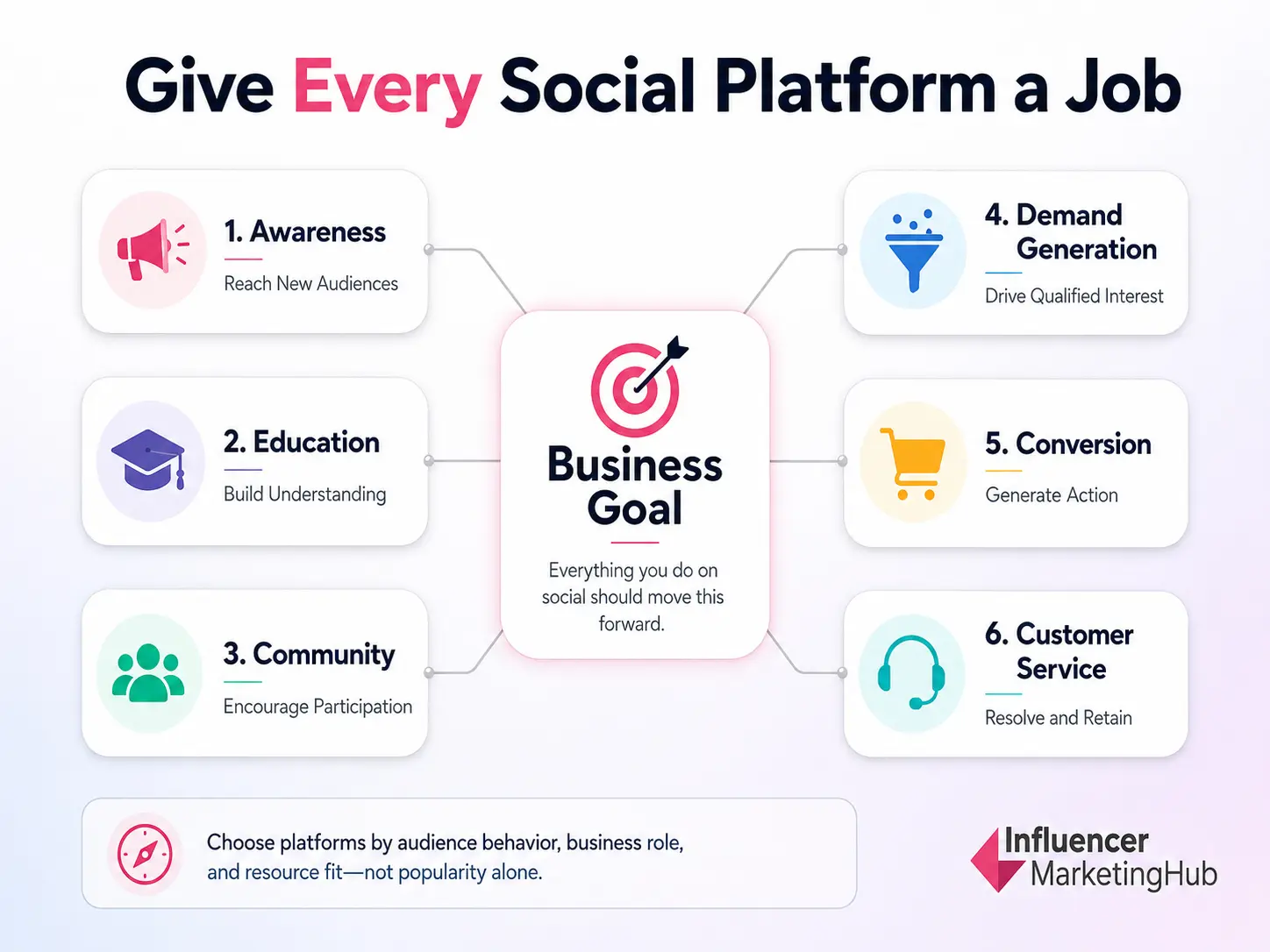
Connect Platforms to Business Objectives
Platform Role
What the Channel Should Contribute
Awareness
Reach relevant new audiences
Education
Help audiences understand a problem or solution
Community
Encourage interaction and recurring participation
Demand generation
Drive qualified interest and website visits
Conversion
Support purchases, registrations, or inquiries
Customer service
Answer questions and resolve issues
Advocacy
Encourage customers and partners to share experiences
Recruitment
Attract candidates and communicate employer value
Assess Content-Format Fit
Review Organic and Paid Potential
Consider the Conversion Path
Account for Resource Requirements
Build a Platform Role Map
Platform
Priority Audience
Primary Role
Core Formats
Cadence
Main KPI
LinkedIn
B2B decision-makers
Demand generation
Expert posts, documents, video
Four times weekly
Qualified visits and leads
YouTube
Research-oriented prospects
Education
Tutorials, interviews, demonstrations
Twice monthly
Watch time and conversions
Instagram
Customers and potential hires
Awareness and brand connection
Reels, carousels, Stories
Five times weekly
Qualified reach and engagement
TikTok
Discovery-led younger audiences
Awareness
Short-form video
Four times weekly
Views and completion rate
Classify Each Platform Decision
Avoid Cross-Posting Without Adaptation
Step 6: Architect Your Social Media Content System
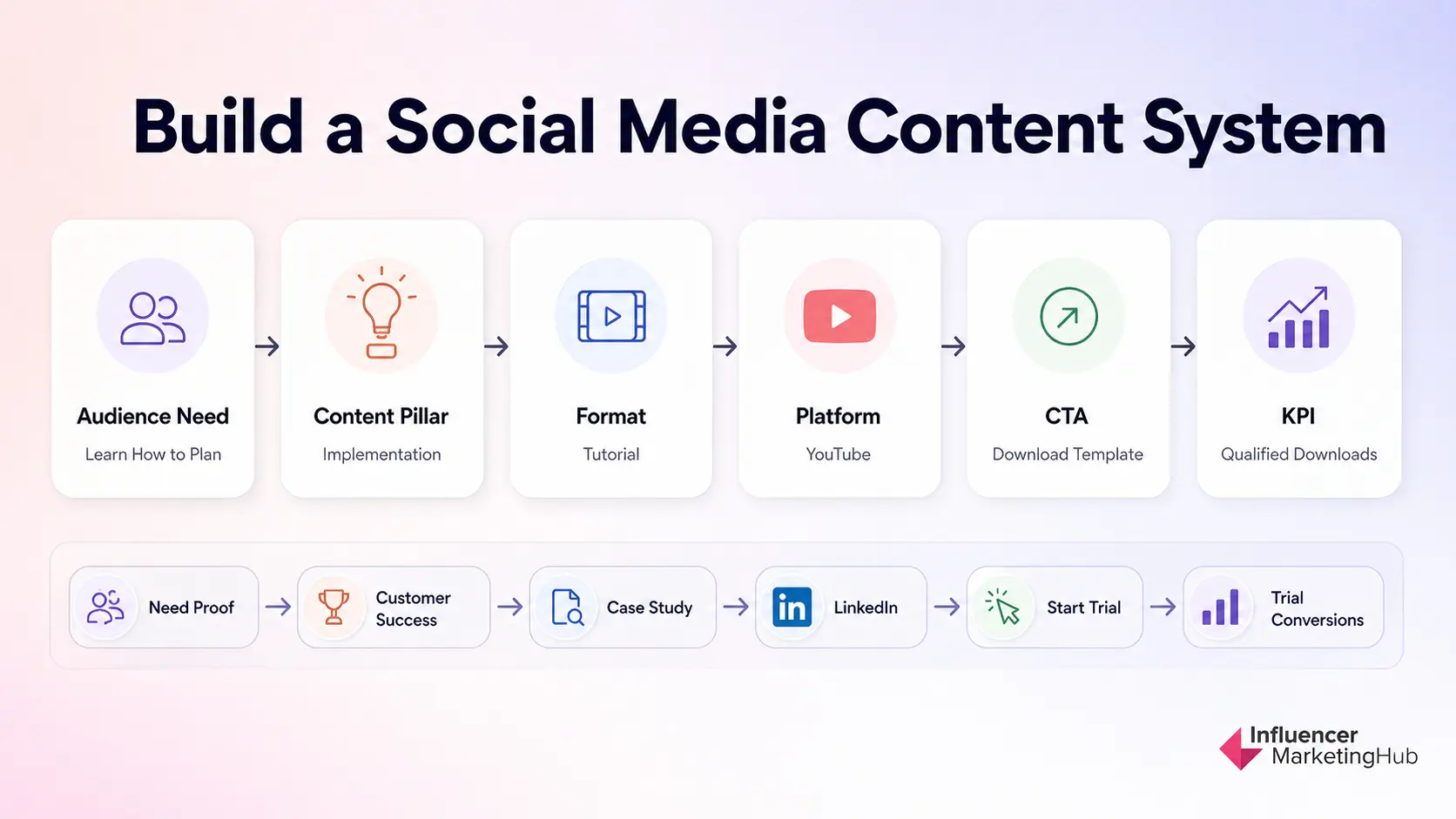
Define Your Core Content Pillars
Content Pillar
Audience Need
Business Role
Education
Understand the problem or category
Build awareness and authority
Implementation
Put ideas into practice
Increase consideration and product relevance
Proof
Reduce uncertainty and evaluate credibility
Support conversion
Community
Participate, contribute, and connect
Strengthen engagement and loyalty
Product Value
Understand how the offer solves the problem
Support adoption and sales
Connect Pillars to Audience Needs
Audience Need
Content Angle
Desired Action
Understand a complex topic
Explain it simply
Read, watch, or save
Compare potential solutions
Show differences and tradeoffs
Visit a product or comparison page
Reduce implementation risk
Provide frameworks and examples
Download a template
Build confidence
Share evidence and customer outcomes
Start a trial or make an inquiry
Feel involved
Invite contribution and discussion
Comment, respond, or share
Map Content Across the Customer Journey
Journey Stage
Audience Question
Useful Content
Awareness
Why should I care about this problem?
Trends, insights, short explainers
Consideration
What are my options?
Tutorials, frameworks, comparisons
Evaluation
Can I trust this brand or solution?
Case studies, testimonials, expert proof
Conversion
Why should I act now?
Product demonstrations, offers, direct CTAs
Retention
How do I get more value?
Education, support content, feature guidance
Advocacy
How can I share my experience?
UGC prompts, community features, customer stories
Choose Formats Based on Platform and Purpose
Purpose
Possible Formats
Explain
Carousel, tutorial, long-form video, thread
Demonstrate
Product walkthrough, screen recording, live session
Prove
Case study, testimonial, creator review, customer quote
Engage
Poll, question, challenge, community prompt
Humanize
Behind-the-scenes content, employee story, founder commentary
Convert
Offer post, demo invitation, lead magnet, shoppable content
Define the Promotional Balance
Build Clear Calls to Action
Establish a Realistic Publishing Cadence
Platform
Core Content
Example Cadence
LinkedIn
Expert posts, carousels, customer proof
Three to five times per week
Instagram
Reels, carousels, Stories
Four to six feed posts plus Stories
TikTok
Short-form educational and trend-led video
Three to five times per week
YouTube
Tutorials, interviews, demonstrations
Two to four times per month
Facebook
Community, links, video, campaign posts
Three to five times per week
Create Repurposing Pathways
Original Asset
Repurposed Content
Research report
Data posts, carousel, webinar, short videos
Long-form guide
Checklist, thread, infographic, email series
Webinar
Clips, quotes, Q&A posts, recap article
Customer interview
Testimonial, case study, social clips
Product demonstration
Tutorial, FAQ, comparison post
Organize Content Into Campaigns
Campaign Element
Example
Objective
Generate qualified leads
Audience
Social media managers at mid-sized brands
Offer
Free planning toolkit
Main message
Replace reactive posting with a structured plan
Channels
LinkedIn, Instagram, email, paid social
Assets
Guide, carousel, video, landing page, email
CTA
Download the toolkit
KPI
Qualified downloads and follow-up conversions
Build the Content Architecture
Content Pillar
Audience Need
Format
Platform
Funnel Role
CTA
KPI
Education
Understand planning fundamentals
Carousel
LinkedIn
Awareness
Save the post
Qualified reach
Implementation
Build a practical plan
Tutorial video
YouTube
Consideration
Download template
Downloads
Proof
See measurable outcomes
Case study
LinkedIn
Evaluation
Read case study
Engaged visits
Product Value
Understand the solution
Demo video
Instagram
Conversion
Start a trial
Trials
Community
Share challenges and experiences
Poll
LinkedIn
Retention
Comment
Meaningful responses
Build Social Media Campaigns Around One Clear Objective
Define the Campaign Brief
Campaign Area
Example
Objective
Generate 500 qualified template downloads
Audience
Marketing managers at growing B2B companies
Offer
Free social media marketing plan template
Message
Build a plan that connects content to business goals
Channels
LinkedIn, YouTube, Instagram, email, paid social
Duration
Six weeks
Primary KPI
Qualified downloads
Supporting KPI
Landing-page conversion rate
Owner
Demand generation manager
Plan Campaign Phases
Phase
Purpose
Content
Introduce
Establish the problem
Insight posts, polls, short videos
Educate
Explain the solution
Guides, tutorials, carousels
Prove
Build confidence
Case studies, testimonials, expert commentary
Convert
Encourage action
Demo, offer, template, landing page
Extend
Capture additional value
Retargeting, recap, follow-up content
Connect Assets Across Channels
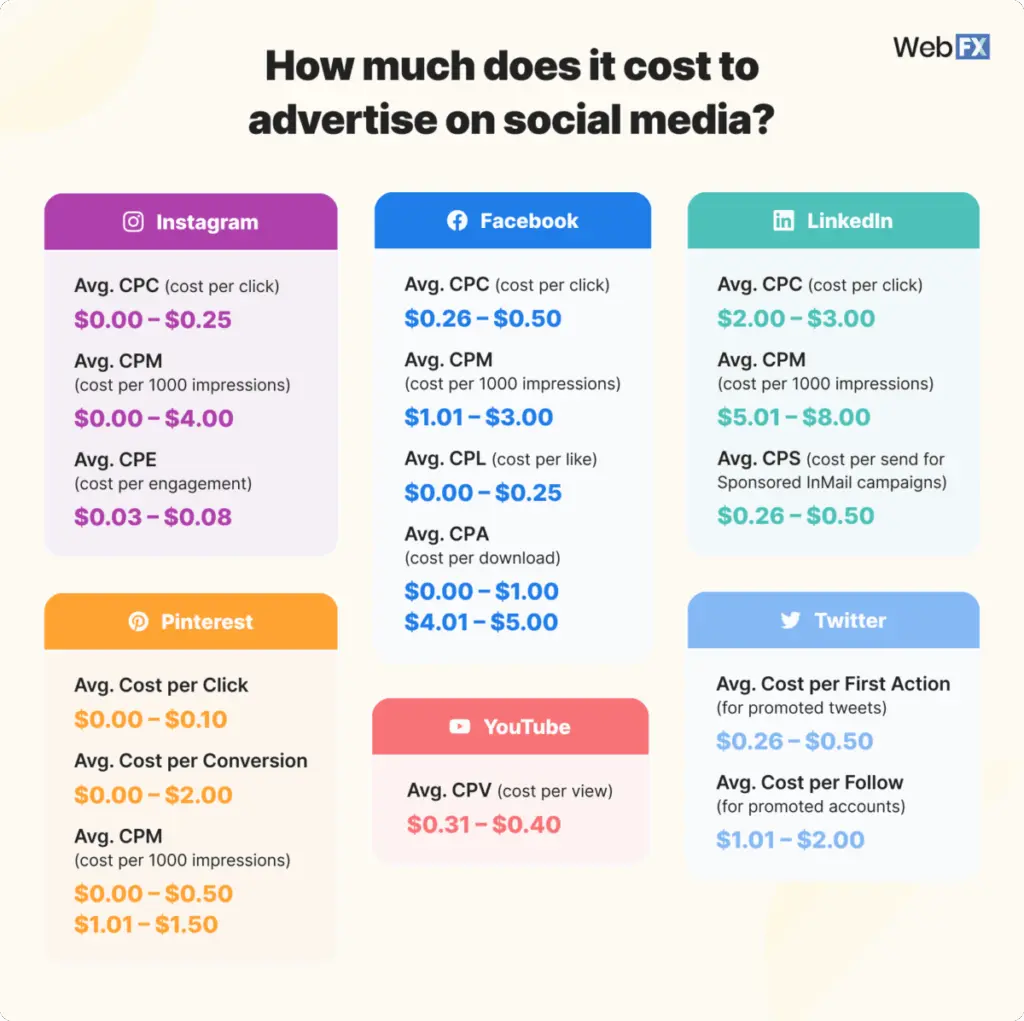
Define Measurement Before Launch
Create a Campaign Calendar
Step 7: Allocate Budget, Tools, and Responsibilities
Build the Budget Around the Work
Budget Category
What It Covers
Planning Question
People
Internal staff, freelancers, agencies
Who will complete the work?
Production
Copy, design, video, photography
What will content cost to create?
Distribution
Paid social, boosting, retargeting
How will priority content reach more people?
Technology
Scheduling, analytics, listening, reporting
Which systems are necessary?
Partnerships
Creators, influencers, experts, collaborators
Where will external reach or credibility come from?
Community
Moderation, customer care, escalation
Who will manage ongoing interaction?
Testing
New formats, channels, audiences, and creative
How much can be invested in learning?
Contingency
Unexpected opportunities or changes
What flexibility does the plan need?
Choose Tools Based on the Process
Define Approval and Escalation Rules
Create a Resource Scenario
Scenario
Approach
Minimum viable plan
Focus on two priority channels and one core campaign
Recommended plan
Maintain three channels with paid support and regular video
Growth plan
Expand production, creators, paid media, and testing
Resource Allocation Example
Category
Allocation
Purpose
Content production
30%
Video, design, copy, and case studies
Paid distribution
35%
LinkedIn and retargeting campaigns
Internal and external support
15%
Freelance production and specialist help
Software and analytics
10%
Scheduling, listening, and reporting
Testing
5%
New formats and audience experiments
Contingency
5%
Timely opportunities and campaign adjustments
Step 8: Activate the Plan
Convert the Plan Into Campaigns and Recurring Activity
Activity Type
Purpose
Always-on activity
Maintains regular visibility, education, engagement, and support
Campaign activity
Concentrates effort around a launch, offer, event, or defined objective
Build the Publishing Calendar
Date
Platform
Content
Campaign
Owner
Status
August 5
LinkedIn
Planning framework carousel
Q3 toolkit
Social lead
Scheduled
August 7
YouTube
Marketing plan walkthrough
Q3 toolkit
Video team
Editing
August 8
Instagram
Common planning mistakes
Always-on education
Social team
In review
August 12
LinkedIn
Customer planning example
Q3 toolkit
Content team
Drafting
Define the Production Workflow
Establish Community-Management Expectations
Prepare for Escalation and Risk
Coordinate Organic and Paid Activity
Step 9: Assess, Report, and Optimize
Revisit the Goals and Benchmarks
KPI
Baseline
Target
Actual
Variance
Qualified social leads
180
300
268
-32
Landing-page conversion rate
4.2%
5.5%
5.1%
-0.4 pp
Cost per lead
$72
$60
$64
+$4
Social-attributed pipeline
$140,000
$220,000
$236,000
+$16,000
Diagnose Why Performance Changed
Report at the Right Frequency
Frequency
What to Review
Weekly
Publishing status, campaign risks, community activity, and immediate performance signals
Monthly
Channel contribution, content performance, leads, conversions, and budget use
Quarterly
Platform priorities, content pillars, investment, targets, and resource allocation
Annually
Full strategy, audience priorities, channel mix, and planning framework
Compare Platforms According to Their Assigned Roles
Platform
Assigned Role
Main KPI
LinkedIn
Demand generation
Qualified leads
YouTube
Education
Watch time and assisted conversions
Instagram
Awareness and brand connection
Qualified reach and engagement
TikTok
Discovery
Views, completion rate, and audience growth
Facebook
Community and service
Responses, participation, and resolution
Review Content at the Pattern Level
Turn Social Media Activity Into a Measurable Plan
Frequently Asked Questions
What is a social media marketing plan?
What should a social media marketing plan include?
How do you create a social media marketing plan?
What is the difference between a social media strategy and a social media marketing plan?
What is an example of a social media marketing plan?
How much should a business budget for social media marketing?
How often should a social media marketing plan be updated?


