
Building a business around content does not have to mean filling a spare room with products.
Creators can earn from product recommendations, brand campaigns, UGC, and affiliate promotions without purchasing stock or processing a single order. The content creates attention and demand, while the brand, retailer, or platform manages the physical product.
For most creators, that separation matters. Only 34% describe themselves as full-time creators, while 63% spend no more than ten hours per week creating content, according to Stan’s State of the Creator Economy 2026. The majority are fitting content around employment, education, family responsibilities, or another business.
Their monetization model needs to respect those limits.
Side-hustle creator monetization works best when the earning model fits the creator’s available time, capital, and operational capacity.
Running a complete e-commerce operation can turn a manageable side hustle into a second full-time job. Zero-inventory social selling offers a lighter alternative, especially when AI matching helps creators find products and campaigns that fit their content and audience.
CPM “paid for every view” campaigns add a performance-based route that rewards qualified attention. Creators can then stack revenue in two ways: by combining UGC fees, view-based earnings, and affiliate commissions, and by participating repeatedly in relevant, high-frequency campaigns when suitable opportunities are available.
Why Traditional E-commerce Can Be Too Heavy for a Side Hustle
Selling an owned product can give creators more control over pricing, branding, and the customer relationship. It also gives them responsibility for almost everything that happens before and after the sale.
Products need to be developed or sourced. Suppliers may impose minimum order quantities. Inventory must be financed, stored, counted, packaged, shipped, and replenished. Someone also needs to handle customer questions, delayed deliveries, refunds, and returns.
Each task introduces another demand on the creator’s time and cash flow:
- Upfront product or manufacturing costs
- Supplier and sample coordination
- Inventory storage
- Storefront maintenance
- Payment processing
- Packaging and shipping
- Customer support
- Returns and refunds
- Unsold stock
- Tax and compliance administration
These responsibilities are manageable for a properly resourced retail business. They can become disproportionate for someone producing content during evenings, weekends, or a few available hours between other commitments.
The financial exposure arrives before the creator knows whether the audience will buy. Stock may need to be purchased before demand has been tested. Packaging and software subscriptions create recurring expenses. A product that performs well in content may still produce weak margins once fulfillment and return costs are included.
Removing inventory does not remove the need for effort. Creators still have to assess products, understand campaign requirements, produce credible content, meet deadlines, disclose commercial relationships, and protect audience trust.
What changes is the type of work they take on. Instead of building a supply chain around their content, creators can focus on the part of the process where they offer the most value: explaining, demonstrating, recommending, and generating interest.
Zero-Inventory Social Selling Changes the Creator’s Role
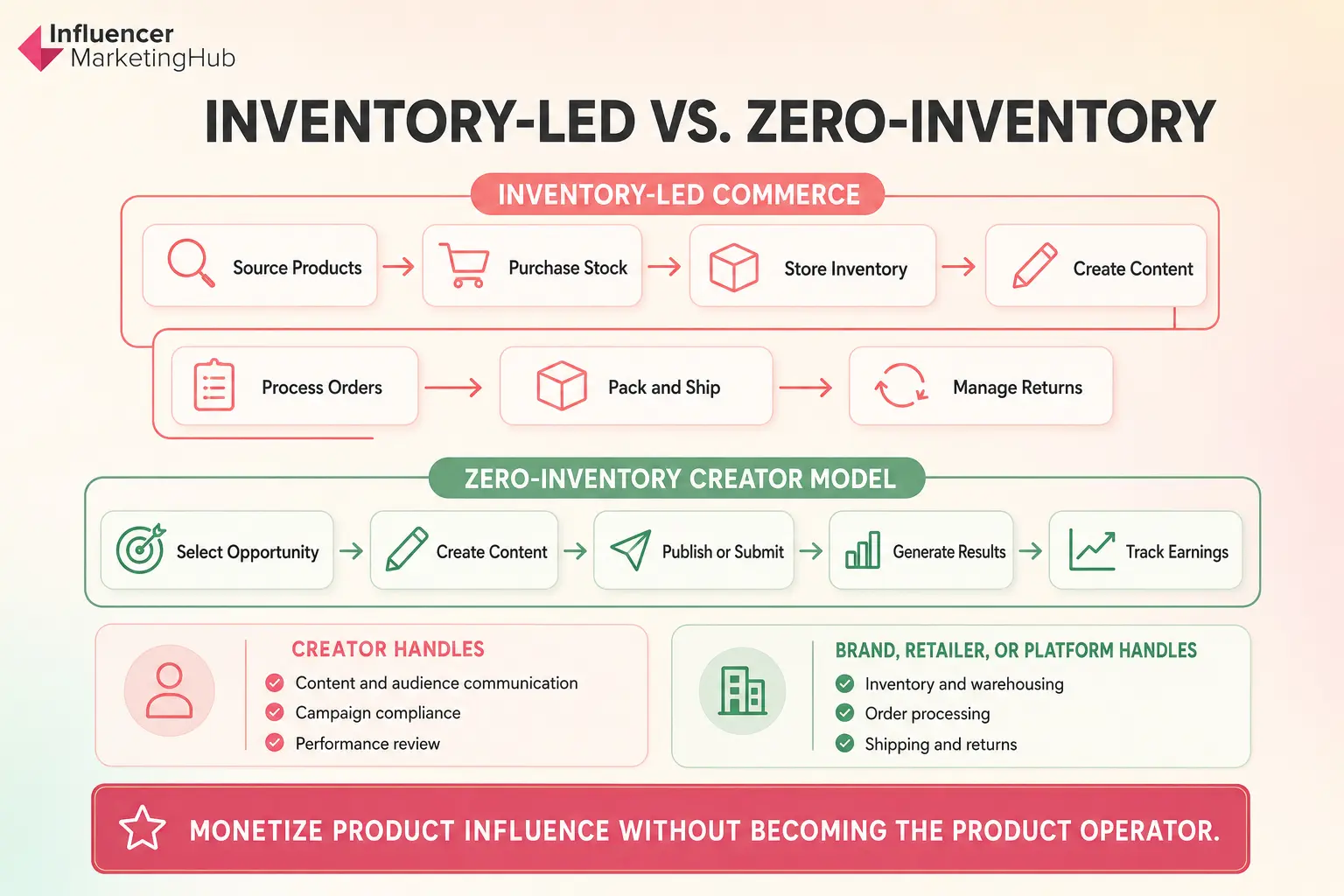
Zero-inventory social selling separates product influence from product ownership.
The creator does not purchase or warehouse the item being promoted. Their role is to choose a relevant opportunity, develop the content, introduce the product to an audience, and generate the outcome defined by the campaign. That outcome might be an approved asset, published post, qualified view, referral, or sale.
The brand, retailer, or platform remains responsible for the commercial infrastructure surrounding the product.
| Creator manages | Brand, retailer, or platform manages |
| Content concept | Inventory |
| Filming and editing | Warehousing |
| Publishing or submission | Order processing |
| Audience communication | Shipping and fulfillment |
| Campaign compliance | Product returns |
| Performance review | Retail operations |
Exact responsibilities depend on the campaign. A paid UGC campaign may require the creator to produce and submit an asset without publishing it. A promotion campaign may involve posting to the creator’s account. An affiliate opportunity connects compensation to tracked sales.
MyyShop reflects this separation between content and logistics. Its AI matching system helps surface products and opportunities that align with a creator’s content style, audience, and commercial positioning. Creators can then pursue CPM “paid for every view” campaigns, UGC assignments, affiliate promotions, and other opportunities without purchasing or storing inventory themselves.
Behind those opportunities, MyyShop operates as a wider creator business ecosystem connecting marketing, merchandise, logistics support, and monetization. The creator can remain focused on content and audience development without needing to operate the entire commercial funnel alone.
@callmetishanae so I just discovered MyyShop & the MyyFinds feature and it actually makes finding content ideas and brand collaborations way easier 👀✨ you can literally save products, plan your content, and connect with brands all in one place… I’m lowkey mad I didn’t know about this sooner 😭 if you’re a creator you should definitely check it out!! link in bio 🔗 @myyshopcreators ffypmmyyshopcreatorsmmyyshopuugcvideou#ugccontent
Those different models also give creators more than one way to earn. Creative production can generate a fixed content fee. An approved CPM campaign video can earn from qualified views. Purchase intent can generate affiliate commissions, while other paid campaigns may compensate creators for publishing or completing defined deliverables.
The creator is still running a business. It is simply a business built around content and audience relevance rather than boxes, warehouses, and shipping labels.
AI Matching Can Connect Creators With Relevant CPM Opportunities
Campaign work begins before a creator films anything.
Finding opportunities takes time. Creators need to search campaign listings, compare requirements, review products, check eligibility, and decide whether the compensation justifies the workload. Many applications will never progress because the creator, audience, or content style does not fit what the brand needs.
For someone running a side hustle, those unsuccessful searches carry a real cost. An hour spent reviewing irrelevant campaigns is an hour unavailable for creating content, completing paid work, or managing another responsibility.
AI tools for micro-entrepreneurs can reduce some of that administrative work by helping creators filter, compare, and prioritize more relevant opportunities.
Brands face the same matching problem from the other direction. IAB’s 2025 Creator Economy Ad Spend & Strategy Report found that identifying the right creators was brands’ leading creator-marketing challenge. Three in four brands were already using or planning to use AI for creator-marketing tasks.
AI-driven creator tools can narrow the opportunity pool by analyzing signals such as:
- Content category and niche
- Audience characteristics
- Follower count and engagement
- Platform activity
- Previous content performance
- Product category
- Brand requirements
- Creator eligibility
- Historical campaign results
MyyShop's AI matching system draws on data from more than 1.66 million creators and 33 million SKUs. For brands, the system helps identify creators whose content, audience, and previous performance indicate a stronger ability to generate product sales or build brand awareness. For creators, it surfaces products and opportunities that more closely match their content style, audience interests, and commercial positioning.
That matching can be especially useful for CPM campaigns. A paid-for-view opportunity still needs a creator who can present the product credibly and attract relevant, genuine attention. Better alignment does not guarantee approval, views, or earnings, but it can give both sides a stronger starting point.
It can also make repeated campaign participation more practical. Instead of repeatedly searching through unrelated listings, creators can concentrate on suitable opportunities that appear frequently enough to support a workable production cadence. Each relevant campaign can create another earning event without requiring the creator to build or fulfill a product business.
AI recommendations still require human judgment. Before accepting a recommended opportunity, the creator should ask:
- Would I discuss this product without a campaign?
- Does it solve a recognizable audience problem?
- Can I create something useful rather than merely promotional?
- Is the compensation appropriate for the work?
- Are the usage rights and settlement terms acceptable?
- Will this opportunity strengthen or dilute my positioning?
AI can reduce search friction. The creator remains responsible for deciding whether an opportunity belongs in the business.
Revenue Stacking Is More Than Joining More Campaigns
Revenue stacking has two dimensions.
The first is model stacking. Creators combine opportunities that compensate different contributions, such as UGC production fees, CPM or view-based earnings, and affiliate commissions.
The second is campaign stacking. Creators participate repeatedly in relevant, high-frequency campaigns, creating a series of earning opportunities instead of waiting for one occasional collaboration.
Both dimensions matter. A creator with five active campaigns does not have a resilient revenue stack if every campaign depends on the same purchase outcome. At the same time, having several compensation models will not create much momentum if suitable opportunities appear too infrequently to support a workable cadence.
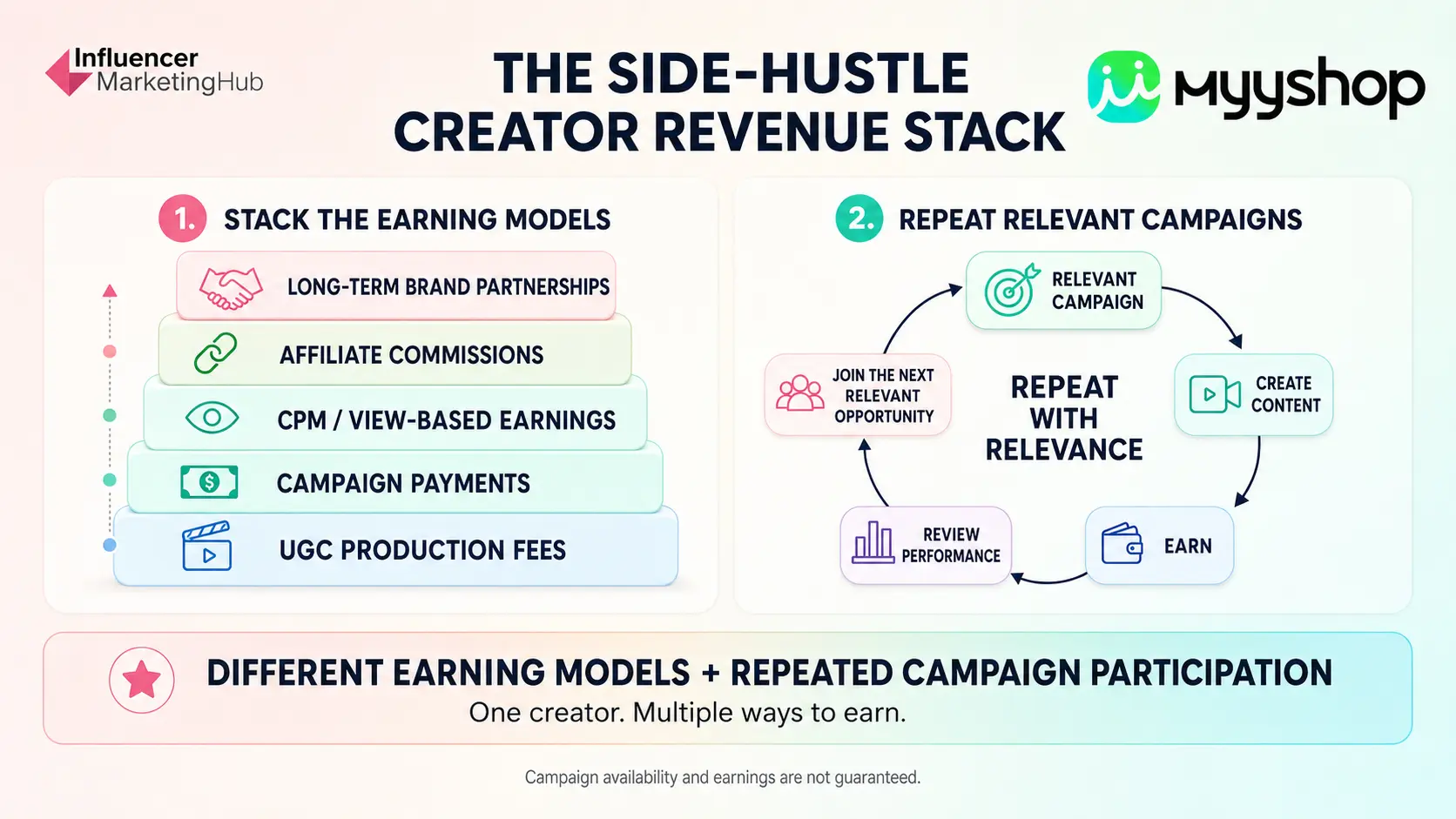
Model stacking can include:
| Creator contribution | Possible revenue model |
| Producing a content asset | UGC or production fee |
| Publishing approved content | Campaign payment |
| Generating product interest | View-based earnings |
| Driving tracked purchases | Affiliate commission |
| Referring other creators | Referral reward |
| Building sustained audience trust | Long-term brand partnership |
Each model captures a different part of the creator’s work.
A UGC fee compensates the creator for developing an asset. The brand receives the content regardless of how it performs on the creator’s account. A publishing fee recognizes access to the creator’s platform or audience.
CPM earnings reward qualified attention generated by an approved campaign video during the campaign period. Affiliate commission recognizes a tracked purchase or action. MyyFinds provides a separate view-based route by connecting earnings to valid product views on a creator’s personalized page.
Campaign stacking adds frequency to that mix. A creator might complete a UGC assignment, join a suitable CPM campaign the following week, and participate in another relevant opportunity when it becomes available. Repeated participation creates more earning events without requiring every campaign to use the same compensation model.
These opportunities can support one another. A paid UGC assignment may reveal which hook makes people stop scrolling. The creator can apply that lesson to a product-promotion campaign. View data can show which products attract interest, while affiliate results reveal which recommendations move people from consideration to purchase.
Consistent performance can then support stronger applications, repeat campaign participation, and longer-term brand partnerships.
Repeated participation should not become indiscriminate campaign collecting. Accepting too many disconnected opportunities can leave creators producing rushed content for products that do not fit their audience. It can also make deadlines, approval requirements, and expected payments difficult to track.
Before adding an opportunity to the stack, creators should consider:
- How closely the product fits their audience
- What work the campaign requires
- How compensation is calculated
- When earnings become available
- Whether the brand receives usage rights
- How long the content must remain live
- Whether the opportunity can be repeated
- Whether it adds a distinct earning model or duplicates an existing one
- Whether the opportunity could lead to repeat work
The goal is to combine compatible earning models and build a manageable cadence of relevant opportunities. More campaigns create activity. A deliberate revenue stack creates resilience.
Sustainable creator income is more likely to come from several compatible earning routes and repeated access to suitable campaigns than from depending on one isolated deal or outcome.
Faster Settlement Can Make a Small Creator Business Healthier
Campaign value is usually discussed in terms of the total payment. For side-hustle creators, the timing of that payment can be just as important.
Creator estimated earning potential
Amount of followers across social media
Engagement (%)
Conversion (%)


Content production often creates immediate costs. Creators may pay for editing software, recording equipment, internet access, props, transportation, or freelance support before receiving campaign earnings. Their time also carries a cost, particularly when content is produced around another job or source of income.
A profitable collaboration can still strain cash flow when payment arrives several weeks or months after the work is completed.
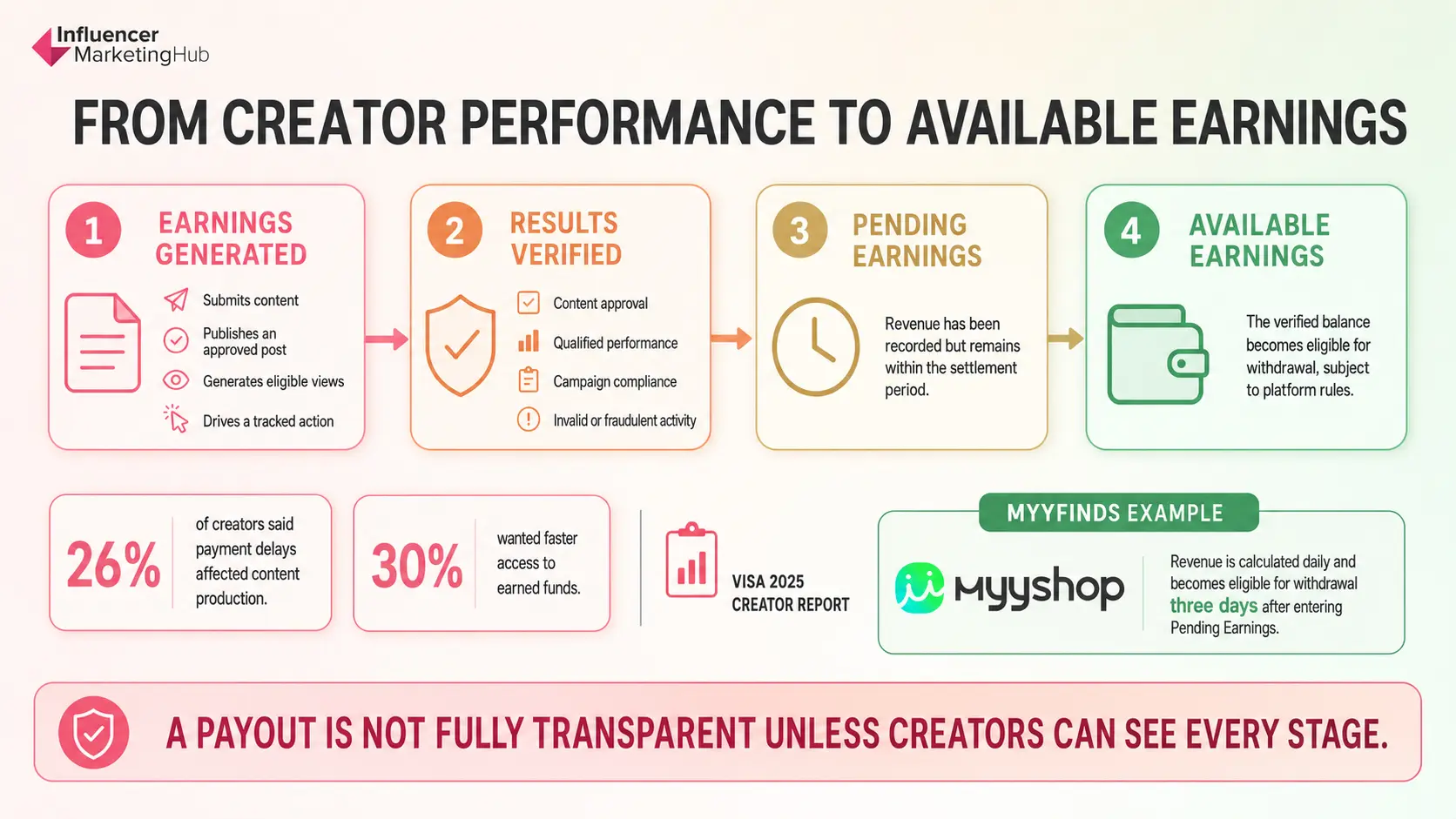
Visa’s 2025 creator research found that 26% of creators had experienced payment delays that affected their ability to produce content. Another 30% wanted financial features that would give them faster access to money they had already earned.
Those findings connect settlement directly with production capacity. A delayed payment may prevent a creator from replacing equipment, purchasing software, or setting aside enough time for the next assignment.
Creators should distinguish between three stages of campaign income:
- Earnings generated: The creator has completed the activity that produces revenue.
- Earnings approved: The platform or advertiser has verified the content or performance.
- Earnings available: The creator can withdraw or receive the money.
Transparent creator payouts depend on showing where earnings sit within that progression. Creators should also be able to see the verification period, minimum withdrawal balance, available payment methods, and any circumstances that could delay settlement.
For MyyShop CPM opportunities, creators upload published campaign videos for advertiser review. Once a submission is approved, eligible views generated during the campaign’s validity period can contribute to earnings. Approved creators can review the relevant performance and earnings data through the submission details, while the campaign’s own rules determine approval and settlement timing.
That three-day period applies specifically to MyyFinds view revenue. Paid content, affiliate earnings, and other campaign types may follow different approval and settlement schedules.
Faster settlement does not increase the amount earned from a campaign. It reduces the time during which the creator has completed the work but cannot use the resulting income.
For a one-person operation with limited working capital, shortening that gap can make it easier to keep producing without funding every new opportunity entirely out of pocket.
Run the Side Hustle Like a One-Person Business
Treating content as a business does not require employees, an office, or a warehouse. One-person business monetization depends on making careful choices about where limited time and resources can produce the strongest return.
Visa found that 68% of surveyed creators already consider themselves small business owners. Their operations may be built around a phone, a laptop, and a few weekly hours, but they still make decisions about revenue, expenses, workload, positioning, and customer relationships.
The one-person business model extends far beyond content creation. US Census Bureau data identified 29.8 million nonemployer businesses generating approximately $1.7 trillion in economic activity. These businesses operate without paid employees and depend heavily on the skills, time, and judgment of one individual.
That makes operational discipline particularly important. When one person handles strategy, production, communication, and finances, small inefficiencies multiply quickly.
A simple campaign system can keep the side hustle manageable.
Evaluate the opportunity before applying
Review the audience fit, deliverables, deadline, payment model, settlement schedule, and usage rights. A large headline payment may become less attractive once production hours and content-licensing terms are considered.
Batch similar production tasks
Creators can plan several concepts together, record multiple videos during one setup, and reserve a separate session for editing. Batching reduces the time lost changing locations, lighting, equipment, and production modes.
Track every deliverable and payment
A basic spreadsheet or project board should record:
- Campaign and advertiser
- Required content
- Submission deadline
- Approval status
- Publishing requirements
- Expected earnings
- Settlement date
- Withdrawal status
- Usage-rights period
Calculate the effective hourly return
A $150 campaign requiring twelve hours of work produces a different business result from a $90 campaign completed in three hours. The payment alone does not show which opportunity uses the creator’s limited time more effectively.
Review campaign cadence, not only individual payments
A relevant campaign that appears regularly can be more useful than a larger one-off opportunity if it fits the creator’s production capacity and produces a stronger effective return over time. Creators should compare earnings, time invested, approval rates, and repeat availability across several campaigns before deciding which opportunities deserve a regular place in the business.
Reuse lessons without reusing restricted assets
A successful hook, production process, or storytelling structure can inform future work. Contracted footage, brand-owned assets, and content covered by exclusivity terms require separate treatment.
Creators do not need complex operating systems at the beginning. They need enough structure to see where time goes, which opportunities produce value, and when earnings should arrive.
That visibility turns a collection of occasional campaigns into a one-person business that can make deliberate decisions about what to accept, repeat, or leave behind.
How MyyShop Supports Lower-Barrier Creator Monetization
A lower-barrier platform should remove unnecessary operational work without hiding the rules creators need to make informed decisions.
A trusted influencer platform needs more than searchable profiles and messaging features. Published earning rules, visible settlement stages, active creator participation, and a connected collaboration process matter more than broad promises about earning potential.
Creators still need to produce quality content, meet campaign requirements, and generate genuine audience interest. What they should not need is a warehouse, a fulfillment system, or a large upfront investment before they can begin exploring monetization.
MyyShop is not structured as a conventional influencer SaaS tool that gives brands access to scraped creator profiles and leaves both sides to manage outreach, negotiation, and campaign execution independently.
Its creators are registered participants within an active business ecosystem, with MyyShop reporting a daily creator activity rate of 70-80%. That active network allows brands and creators to move from opportunity matching into campaign execution through a more connected workflow.
MyyShop’s AI matching and influencer positioning tools support the first part of that process. Its commercial value report examines niche positioning, audience characteristics, commercial adaptability, comparable creators, and potential brand alignment, while its Find Your Lane experience helps creators identify strengths that could translate into different earning paths.
The matching layer can help creators find relevant CPM and other campaign opportunities without manually sorting through a broad database. When suitable campaigns appear regularly, creators can participate repeatedly and build a steadier production cadence around opportunities that fit their audience.
Several earning routes are available through the platform:
- CPM opportunities: Through “paid for every view” commercial orders in the Opportunities section, creators can earn according to the eligible views generated by approved campaign videos. Advertisers set the available CPM, with example rates ranging from $4 to $12 per 1,000 views.
- Paid content creation: Creators produce assets according to a brand brief and receive a defined payment. Some assignments do not require publishing to the creator’s own audience.
- Affiliate campaigns: Creators receive commissions when their content or links generate tracked sales.
- Product promotion: Creators publish approved content through their social accounts and earn according to the opportunity’s completion rules.
- MyyFinds earnings: Creators select products for a personalized page and earn when visitors generate valid product views.
- Brand collaborations: Eligible creators can apply for partnerships matching their content and audience.
- Campaign and referral rewards: Creators can access additional earning opportunities through selected challenges, incentives, and referrals.
@myyshopcreators At MyyShop, we’re all about the vibe check! ✅ From beauty must-haves to high-tech gadgets and cute mom-finds, our creators are spilling the tea on their dream collabs. ☕️ We’re constantly bringing in more brands based on your needs. What’s the ONE product you’re dying to review next? Let us know in the comments! 👇 #myyshop #myyshopcreators #createwithmyyshop
The variety matters because each opportunity compensates a different contribution. A creator can combine production fees, qualified-view earnings, and affiliate commissions, then add frequency by participating in further relevant campaigns when they become available.
MyyFinds remains a separate product-view model. MyyShop reports average earnings of $0.025 per valid product view, although rates may vary. Qualifying revenue is calculated daily, enters Pending Earnings, and becomes eligible for withdrawal three days later. CPM commercial orders and other opportunities follow their own campaign, approval, and settlement rules.
According to MyyShop’s no-commission policy, creators keep 100% of the earnings they generate through brand deals, affiliate promotions, MyyFinds rewards, and referrals. A withdrawal can be requested once the total account balance reaches $50.
The platform also keeps the initial entry barrier relatively low. Creators can register with zero followers, although specific campaigns may apply separate requirements based on location, audience size, platform activity, content category, or previous performance.
AI matching cannot decide which products a creator should genuinely recommend. It can, however, make the search and evaluation process more manageable for someone operating with limited time and no dedicated team.
Build Around Flexibility, Not Endless Hustle
Revenue stacking should make creator income more resilient. It should not turn every available hour into another campaign deadline.
A side-hustle creator has limited production capacity. Adding an opportunity makes sense only when it contributes enough value to justify the time, audience attention, and creative energy it requires.
Before accepting a campaign, creators should ask five questions:
- Does the product or brief fit my audience?
- Can I complete the work within the time available?
- Is the compensation method clearly explained?
- Does the settlement schedule work for my cash flow?
- Does the opportunity add something useful to my current revenue mix?
A paid UGC assignment can compensate the work of producing an asset. A CPM opportunity can reward qualified views. An affiliate campaign can capture purchasing intent. Repeated participation in suitable campaigns can create additional earning events across the month, while a longer-term partnership can provide continuity over a wider period.
Each model serves a different purpose, and campaign frequency adds another layer. Together, they reduce the amount of income resting on one brand, one campaign type, one isolated collaboration, or one customer action.
Creators still need to protect their time. More opportunities are valuable only when they remain operationally manageable and credible to the audience.
A side-hustle creator does not need to become a retailer to build a business around content. The more practical model is to use AI matching to find relevant opportunities, combine transparent earning routes, participate repeatedly when the fit is right, and leave inventory and fulfillment to the businesses already equipped to manage them.

SUGGESTED
![How Creators Make Money Online in 2026 [Business Models]](https://s.influencermarketinghub.com/imaginary/resize?width=400&height=200&type=webp&url=https://influencermarketinghub.com/wp-content/uploads/2026/05/59402c44-chatgpt-image-may-20-2026-02_08_51-pm.jpg)
How Creators Make Money Online in 2026 [Business Models]
Discover how creators actually make money in 2026 through brand deals subscriptions UGC...

47 Side Hustle Tools to Help Creators Make More Money in 2025
Discover lucrative side hustle ideas to boost your income grow skills and achieve...

Creator Earnings Report 2025
Over half of creators earn under $15K annually even as the creator economy surges to...