
Most B2B outreach fails before it even starts. Not because the product is wrong or the pitch is weak. It fails because the process is broken.
Salespeople waste hours hunting for contact info. They send emails to outdated addresses. They follow up at the wrong time. And when a lead finally responds, the reply has no real system for moving them forward.
According to Salesforce's State of Sales report, only 28% of salespeople expect to hit quota this year. That's not a motivation problem. It's a workflow problem.
Without a clear process, outreach can feel like guesswork. A structured outreach workflow changes that. You know exactly who to contact, where to find their information, and what to say to increase your chances of getting a response.
Let’s check each step of that process from setting your target audience to closing cold calls into signed contracts. This is the playbook for every SDR, whether you're a one-man team or a sales team; this is what you can implement now.
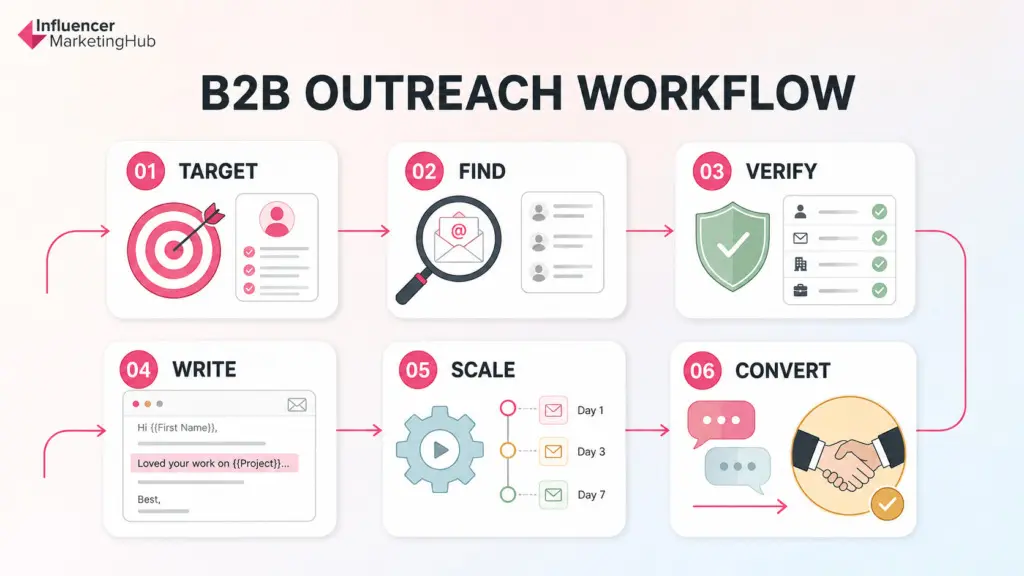
- Step 1: Defining Your Ideal B2B Customer
- Step 2: Finding Verified Business Emails
- Step 3: Verifying and Cleaning Prospect Data
- Step 4: Creating High-Converting Outreach Campaigns
- Step 5: Automating and Scaling Outreach
- Step 6: Make Conversations Sales Opportunities
- Common B2B Outreach Mistakes to Avoid
- Conclusion
Step 1: Defining Your Ideal B2B Customer
Before you send any emails or look up any contact, you must have complete clarity as to who you are trying to reach. The most common cause of outreach failure is vague targeting.
The first step is to create your Ideal Customer Profile (ICP). This is different from a buyer persona. An ICP defines the type of company most likely to benefit from your product. A buyer persona describes the individual within that company who makes the decision.
Your ICP should include:
- Company size (employee count and revenue range)
- Industry or vertical
- Geography (if relevant to your offering)
- Tech stack they currently use
- Pain points your product directly solves
- Signs they are ready to buy (funding rounds, recent headcount growth, new leadership, etc.)
Once you have your ICP mapped out, layer in your buyer personas. Think about the specific titles you need to reach. Is it the VP of Marketing? The Director of Operations? The founder of a 20-person SaaS company?
A practical example:
Suppose you sell an employee scheduling tool. Your ICP might be US-based restaurants with 50 to 200 employees. Your buyer persona would be the Operations Manager or General Manager who deals with shift scheduling every day.
The more specific you get, the better your results will be. Narrow targeting feels counterintuitive, but it consistently outperforms broad spray-and-pray approaches.
Use LinkedIn Sales Navigator or your CRM data to analyze your top 10 existing customers. What do they have in common? That pattern becomes the foundation of your ICP.
Step 2: Finding Verified Business Emails
You have your list of target companies and decision makers. Now comes the part that trips up most teams: actually finding the right email addresses at scale.
Manual prospecting works at low volume, but it breaks down fast. Searching LinkedIn, guessing email formats, and hoping for the best is not a repeatable process. You need something built for scale.
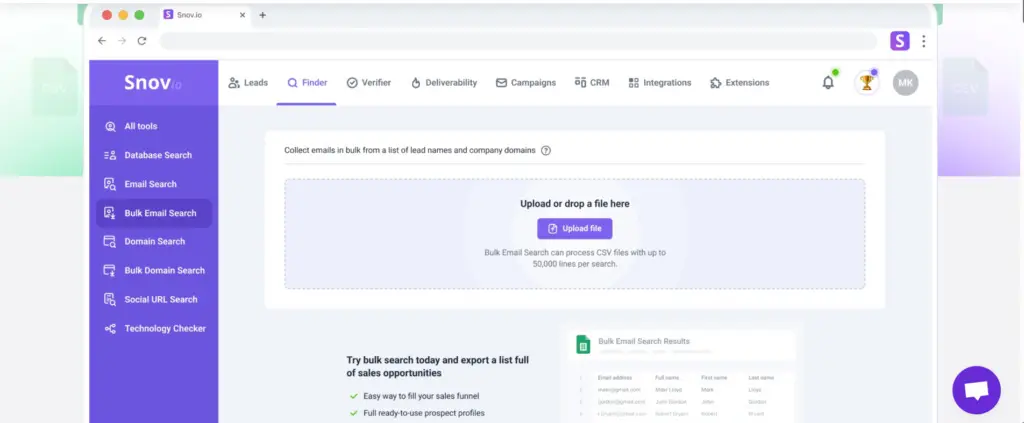
This is where a Snov.io bulk email finder will help a lot. You can upload a list of names and company domains and get verified emails in minutes, rather than looking them up one by one. This will save your team hours per week and allow them to get back to selling. Start with a small batch so you can check the accuracy of the results before processing your entire prospect list.
Here are some key factors to consider when compiling your prospect list:
- Focus on quantity over quality. 200 verified targeted contacts will be more effective than 2000 random contacts.
- Look at several sources: LinkedIn company websites, job postings and industry directories.
- Be sure to check emails before sending (to be covered in the next step).
- Record the source of each contact in order to determine which sources are getting you the best conversions.
A practical way to do this:
export a CSV file containing your filtered prospects list from LinkedIn Sales Navigator. Add first name + last name + company domain. Feed that into your email finder, and you'll have a pristine list of actions to do.
A compliance issue: Remember to adhere to CAN-SPAM for American contacts and GDPR if you are contacting European contacts. Ensure that there is an unsubscribe link on all emails and that unsubscribe requests are honored in a timely fashion. Ethical Outreach is Good Outreach.
Step 3: Verifying and Cleaning Prospect Data
Raw contact lists are always unclean. Job titles change. People leave companies. Domains expire. Poor data equals poor sender reputation and stymies deliverability.
B2B data decays at a rate of about 22.5% per year. That equates to almost 25% of the contacts on a 1-year-old list being old.
Email verification tools will verify the existence of an email address without sending a real email.
Beyond email verification, clean your list by removing:
- Duplicate entries
- Contacts who previously unsubscribed
- Catch-all email addresses (high risk of bounce)
- Role-based addresses like info@ or support@, which rarely convert
- Contacts outside your ICP criteria
Also, standardize your data. When you begin drafting emails, you'll find it easier to personalize if you have the same formatting throughout the fields, such as first name and job title.
A two percent or less bounce rate, 0.1% or less spam complaint rate is a good benchmark to aim for. These are the limits for most email service providers to flag or suspend accounts.
Data cleanliness is more than a technical matter. It's the first step in your outreach workflow!
Step 4: Creating High-Converting Outreach Campaigns
Once the verified list is clean, it's time to craft a compelling email that will get them to respond. This is where most outreach gets derailed.
Research by the Radicati Group reports that the average business user gets approximately 121 e-mails each day. Your email should attract attention in a busy email inbox. This begins with the subject line.
Subject line principles that work:
- Keep it under 50 characters
- Avoid spam trigger words like free guaranteed, or limited time
- Make it specific to the recipient's situation
- Lead with curiosity or a relevant insight rather than a product pitch
Examples that work: 'Quick question about [Company]'s hiring plan' or 'Noticed you just expanded to Chicago.' These feel like real messages not mass emails.
For the email body, follow this structure:
- Opening line: Personalized and relevant. Reference something specific about their company or a recent event.
- Bridge: Connect their situation to the problem you solve.
- Value statement: 1-2 sentences about what you do and who you help.
- Social proof: Quick reference to some of your relevant achievements with a similar company.
- Call to action: Ask for something small. A 15-minute call is not a contract.
Here's a simple example for that scheduling software company:
Subject: Shift scheduling at Riverfront Grill
Hi Marcus,
Saw that Riverfront recently added two new locations. Managing schedules across multiple sites usually gets chaotic fast.
We help restaurant groups reduce scheduling time by around 60%. One of the clients in a similar situation managed to reduce their manager's overtime by 30% within the first month.
Worth a half-hour discussion to find out if it can fit in your team?
Notice what this email lacks: ‘I hope this email finds you well. No lengthy company history. No hard sell. Short, specific and focused on the prospect's world.
Step 5: Automating and Scaling Outreach
Writing great emails is one thing. Sending them consistently at scale while managing follow-up replies and timing is another challenge entirely. That's where automation pays off.
Yesware research indicates that 70% of email threads end after the initial email. However, the majority of the answers are from follow-ups. Sending just one email is giving up the majority of your potential responses.
A good outreach sequence usually proceeds in this manner:
Day 1: Initial email
Day 3: First follow-up (introduce a new angle, or something of value).
Day 7: Second follow-up – ask a yes/no question.
Day 14: Breakup e-mail (funny last shot)
Each follow-up should add something new. Don't just resend the same email with 'following up on this.' Reference a relevant article. Share a quick case study. Ask about a specific challenge you noticed on their website.
When automating outreach, watch these guardrails:
- Cap your daily send volume, especially on new domains (start at 30 to 50 and scale slowly)
- Warm up new email accounts before sending cold outreach
- Pause sequences automatically when someone replies
- Monitor open reply and bounce rates weekly
Consider multi-channel outreach strategies too. Although it is possible to send emails to increase response rates, combining touchpoints on LinkedIn can make a big difference. When the prospect sees your connection request and then gets a thoughtful email, they will most likely respond.
Automation is meant to enhance what you do best. Do not use it to cover up poor messaging or to omit research in the process. Computer-generated junk remains junk.
Step 6: Make Conversations Sales Opportunities
A response is not the end of the road. It's the starting gun. How you handle the first response often determines whether a lead converts or disappears.
Reply within the hour whenever possible. Speed matters enormously in B2B sales.
According to a Harvard Business Review study, leads contacted within 5 minutes of engaging are 100 times more likely to convert than those contacted after 30 minutes.
When you get a positive reply your goal is to qualify fast:
- Do they have a real problem your product solves?
- Do they have the budget or authority to move forward?
- What is their timeline?
- Is there a specific trigger that made them open to a conversation now?
For more complex enterprise deals, employ a lightweight framework such as BANT (Budget, Authority, Need, Timing) or MEDDIC for complex ones. The objective is not to ask the prospect questions. To determine if there's a real match before spending hours in demos and proposals. The goal isn't to interrogate the prospect. It's to understand whether there's a genuine fit before investing hours in demos and proposals.
For your discovery call preparation is everything:
- Research the company in the 24 hours before the call
- Know their recent news funding announcements or product launches
- Have 3 to 5 open-ended questions ready
- Understand 2 or 3 ways your solution could specifically help them based on what you know
After every call, send a recap email within 24 hours. Summarize what was discussed and what the next step is. This keeps momentum going and positions you as organized and reliable.
Track every conversation in your CRM. Record what led them to be interested, what questions they had, and their current level. This data can be used to show trends over time and improve your outreach for future campaigns.
Common B2B Outreach Mistakes to Avoid
Despite having the proper workflow, there are patterns that subtly kill outreach results. These are the most harmful and how to avoid them.
-
Talking about yourself too much
People don't care about features of your product. They care about their problems. Every sentence in your email should connect back to something relevant to them. Run this test: count how many times your email says 'I' or 'we' versus 'you.' The ratio tells you a lot.
-
Skipping research to save time
Templated outreach is obvious. There are hundreds of cold emails received by decision makers. Anything that is tailored to you makes your message unique (even if it is something simple, like a recent article in the press about a challenge they are facing in their industry, or a mutual connection) Research for 5 minutes prior to each outreach. It builds up with time.
-
Giving up after one follow-up
Most positive responses come from the third or fourth touch. Reps who stop at one follow-up leave a significant amount of pipeline behind. Persistence with value is not spam. It's good sales.
-
Using a weak call to action
'Let me know if you're interested' is not a call to action. It puts all the work on the prospect. Instead propose something specific: 'Are you free Tuesday or Wednesday at 2 PM for a quick chat?' A clear ask gets a clear answer.
-
Sending from a cold domain
New domains with no sending history land in spam. Warm up your email account over 2 to 4 weeks by sending a gradual increase of emails and engaging with replies before launching a full outreach campaign.
-
Not testing anything
What works today may not work next quarter. Subject lines open rates, reply rates and conversion rates all shift. Run A/B tests on subject lines, email length and CTAs. Let data drive iteration not gut instinct.
Conclusion
B2B outreach is not about volume. It's about precision timing and consistency. The reps and teams who close deals reliably are not necessarily the most talented writers or the most charismatic on calls. They're the ones who follow a system.
The first step in streamlining is to understand how things are done today.
Start by auditing your current process. Where does it break down? Is your targeting too broad? Is your data messy? Are your follow-up sequences too short? Fix the weakest link first.
Then build from there. Apply one step from this workflow each week. Within a month you'll have a repeatable process that generates consistent results. Within a quarter you'll have the data to optimize every stage of it.
The best time to fix your outreach workflow was six months ago. The second best time is right now.