

In 2005, John O’Donnell started selling four-button polos with a pocket and a thoughtful surfer logo. The first run contained roughly 120 shirts. Some went into golf shops. Others travelled to home trunk shows and school holiday boutiques, often in the back of O’Donnell’s car.
Two decades later, Johnnie-O is approaching $200 million in annual revenue. Its path from one polo to a full line of men’s, women’s, and boys’ clothing ran through a series of trusted communities. Golf professionals came first. Retailers, licensing partners, creators, athletes, and stores followed.
The faces and platforms have changed, but the principle remains remarkably consistent. Johnnie-O grows by placing its clothing with people and organizations that already have credibility with the customers it wants to reach.
This Brand Story examines how Johnnie-O turned golf-shop word of mouth into a nearly $200 million lifestyle business and how its product, retail, licensing, creator, and ambassador strategies reinforce one another.
- How Johnnie-O Found a Gap Between East Coast Prep and West Coast Casual
- How Golf Shops and Community Influencers Created Johnnie-O’s Early Demand
- Why Conservative Growth Helped Johnnie-O Build a Durable Brand
- How Johnnie-O Expanded From One Polo Into a Full-Closet Brand
- How Retail and Sports Licensing Introduced Johnnie-O to New Communities
- How Johnnie-O Built Its Creator and Ambassador Strategy
- What Our Analysis Reveals About Johnnie-O’s Influencer Network
- Why Johnnie-O’s Word-of-Mouth Strategy Worked
How Johnnie-O Found a Gap Between East Coast Prep and West Coast Casual
Johnnie-O began with an observation about two different wardrobes. O’Donnell grew up around the blue blazers, khakis, and penny loafers of Chicago’s North Shore before attending UCLA and later returning to Los Angeles.
East Coast and Midwestern prep felt familiar. Southern California offered a more relaxed surf culture. O’Donnell saw space for clothing that could carry both identities.
A friend’s beach house and surf-themed merchandise supplied the initial spark. O’Donnell later photographed an image of a surfer standing beside a board and asked his brother-in-law to turn it into a logo. The mark went onto a traditional polo rather than a T-shirt or board short.
That contrast gave an otherwise familiar product an immediate point of difference. Johnnie-O eventually named the position “West Coast Prep,” combining East Coast tradition with West Coast comfort and casual styling.
The first product reinforced it. The Original Polo had four buttons, a chest pocket, and a logo that felt at home in a golf shop without resembling the animal marks already dominating the category.
How Golf Shops and Community Influencers Created Johnnie-O’s Early Demand
O’Donnell had no apparel background, but he understood sales and golf. His career had included radio, regional sports media, the Golf Channel, and financial services. Those experiences gave him relationships and a practical way to test the idea.
Golf professionals he knew agreed to stock small orders. Their shops gave Johnnie-O trusted placement and exposed the brand to customers already comfortable buying premium apparel.
O’Donnell also organized hundreds of trunk shows in friends’ homes and at school holiday boutiques. He deliberately sought hosts with influence in their communities, believing that other customers would follow when they saw the right people wearing the shirts.
This was influencer marketing in its earlier, offline form. Authority came from social position, personal relationships, and professional expertise rather than audience size.
O’Donnell retained his corporate job for roughly the first two and a half years. When eCommerce orders arrived, he added handwritten notes that referenced a customer’s hometown or college team. He continued until the volume reached approximately 50 to 100 orders a day.
Those gestures helped an unfamiliar label feel personal. More importantly, they turned early buyers into participants in a growing brand rather than anonymous transactions.
Why Conservative Growth Helped Johnnie-O Build a Durable Brand
Demand gave O’Donnell enough confidence to raise approximately $600,000 from friends and family. He reportedly paid himself nothing during the company’s first two years and operated as though every dollar could be the last.
That discipline continued through seven or eight funding rounds, with institutional investors arriving later. Johnnie-O could add people, products, and channels without requiring an overnight jump into mass distribution.
The early Rain Shorts experiment showed why that restraint mattered. O’Donnell ordered approximately 2,500 units while the business had around 80 customers. The distinctive product attracted attention and eventually sold, but the inventory was far ahead of the company’s distribution.
How Johnnie-O Expanded From One Polo Into a Full-Closet Brand
A polo can introduce a brand, but it cannot fill a wardrobe. Johnnie-O’s next stage depended on giving customers more reasons to return.
Chief Merchandising Officer Chris Knott and his team expanded the assortment into woven shirts, pants, outerwear, sport coats, swimwear, footwear, accessories, and women’s clothing. They also reduced “logo fatigue” by keeping prominent chest placement for selected products and moving the mark to the neck or shirt tail elsewhere.
But the product still needed recognizable Johnnie-O details. The patented Tweener Button® sits between the second and third buttons to control how open a shirt appears.
@standregolf Unleash the perfect amount of wolf with the @Johnnie-O Tweener Button
Hangin’ Out shirts are cut for untucked wear. Performance pieces use four-way stretch and dull-finish yarns that resemble cotton rather than shiny technical fabric.
These features give retailers and content creators concrete material to discuss. A creator can show how a dress moves through a golf swing, compare a soft fabric with a familiar product, or style one piece for the course and dinner. A store lets customers feel benefits that remain difficult to communicate through a screen.
Women’s apparel formally launched in spring 2024 after Johnnie-O had concentrated on men’s and boys’ clothing. Seasonal colours, additional categories, licensed teams, and holiday gifting now create a repeat-purchase cycle without relying on subscriptions or consumables.
How Retail and Sports Licensing Introduced Johnnie-O to New Communities
Johnnie-O’s channels increasingly reinforce one another. Golf shops and menswear retailers provide discovery. Ecommerce captures demand beyond their geographic reach. Freestanding stores present the complete assortment in one place.
O’Donnell reported approximately 16 stores in September 2025, with additional locations subsequently announced in Virginia Beach, Tysons Corner, Westport, and his hometown area of Wilmette. The company has also hired for retail marketing, inventory, analytics, store leadership, and clienteling, indicating a more centralized retail operation.
Sports licensing applies the same trusted-distribution logic to existing fandoms. Johnnie-O holds licenses covering MLB, NHL, and more than 200 colleges and universities. Its August 2025 NFL agreement extended the collection across all 32 teams.
The Nashville Predators partnership puts Johnnie-O travel wear on players and coaches while offering selected items to fans. At the Genesis Invitational, Jake Knapp wore UCLA branding one day and Anaheim Ducks branding the next.
One ambassador appearance connected Johnnie-O with college golf, professional hockey, and Knapp’s Southern California identity.
Matthew Ferrer helped expand the wholesale, retail, and licensed businesses after joining in 2015. Now President, he oversees the commercial organization across brand, marketing, product, wholesale, retail, and ecommerce.
How Johnnie-O Built Its Creator and Ambassador Strategy
Johnnie-O’s formal creator program arrived much later than its community-led beginnings. David Neville joined as Senior Vice President of Marketing with deep golf-industry experience and began strengthening social media, brand storytelling, and customer acquisition.
At the 2025 PGA Show, Neville announced partnerships with St. André Golf, Peter Finch, and Danny Maude. The official creator roster now also includes Parker McLachlin, known as the Short Game Chef, and Blair Wheeler.
These partnerships place Johnnie-O inside content golfers already seek out. Finch, Maude, and McLachlin build authority through instruction. St. André and Wheeler lean further into entertainment, commentary, and golf culture. The clothing can remain visible throughout a lesson or comedy video without forcing every post to become a direct product demonstration.
That creates repeated exposure in a credible setting. Creators can discuss performance fabrics, fit, or styling when relevant, while their regular programming keeps Johnnie-O associated with the wider experience of playing and enjoying golf.
The company separates these content creators from its brand ambassadors. Jake Knapp represents the relaxed California side of Johnnie-O, while J.T. Poston brings North Carolina roots and a polished East Coast style. Together, they turn “East Coast Meets West Coast” into two recognizable people with genuine connections to each region.
Other ambassadors extend the brand into additional sporting communities.
The roster includes Aaron Boone and Mason Miller from baseball, Adam Porzak and Jim “Bones” Mackay from golf, Hannah Blatt and Tom DeCaprio from pickleball, and equestrian Ansgar Holtgers Jr. Their credibility helps Johnnie-O appear naturally within several active lifestyles rather than depending on golf alone.
Matthew Stafford takes that expansion further. Johnnie-O introduced him as its first NFL ambassador, while the campaign presents him as a quarterback, father, spouse, businessperson, and golfer. Those overlapping identities support the company’s full-closet ambition by showing that the customer’s life extends well beyond one sport or occasion.
Ritual developed and captured the Stafford campaign. Its creative focused on the complete person behind the athlete, giving Johnnie-O more emotional and lifestyle material than a conventional endorsement built around performance credentials.
The resulting system has three layers. Content creators earn attention through education and entertainment. Ambassadors translate Johnnie-O’s identity across sports and lifestyles. Publishers, teams, and retailers then extend that content into larger communities and purchase environments.
This structure modernizes the same principle behind O’Donnell’s original trunk shows. Johnnie-O puts its clothing on trusted people, allows those people to introduce it in context, and uses repeated visibility to turn familiarity into consideration. The remaining challenge is proving how consistently that attention produces sales.
What Our Analysis Reveals About Johnnie-O’s Influencer Network
Johnnie-O’s official creator roster shows only the most visible part of its influence strategy. To examine the wider network forming around the brand, we turned to HypeAuditor to analyze Johnnie-O’s mentions.
The resulting feed would look less like a conventional influencer campaign than a cross-section of golf culture. Across 400 mentions from 160 accounts, Johnnie-O appeared in instructional videos, comedy, sports media, team content, retailer posts, and everyday outfit recommendations.
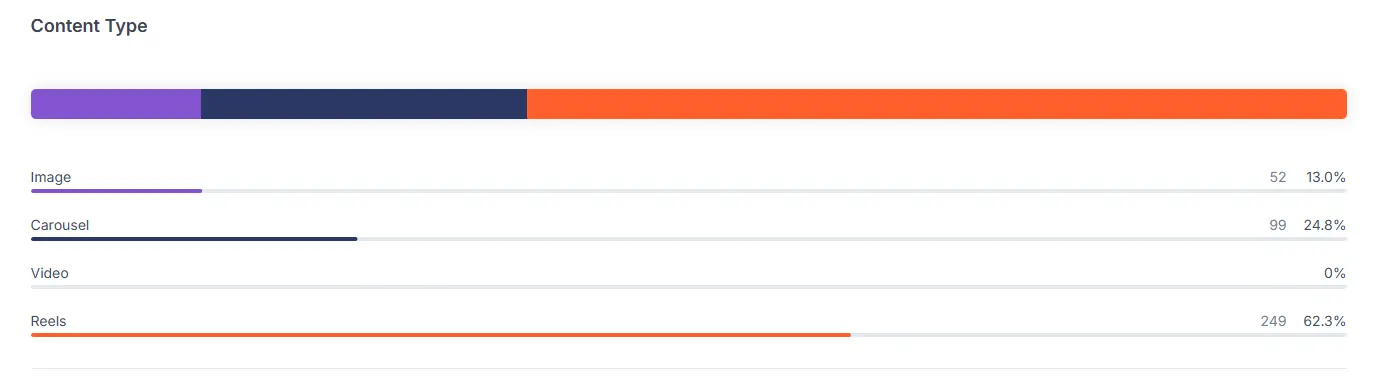
Most of that activity came from smaller voices. Nano and micro accounts represented 82.4% of the network, while Reels accounted for 62.3% of mentions. This gives Johnnie-O frequent, personality-led exposure within niche communities, complementing the larger audiences supplied by Golf Digest, ZIRE Golf, Skratch, GOLF.com, and the Anaheim Ducks.
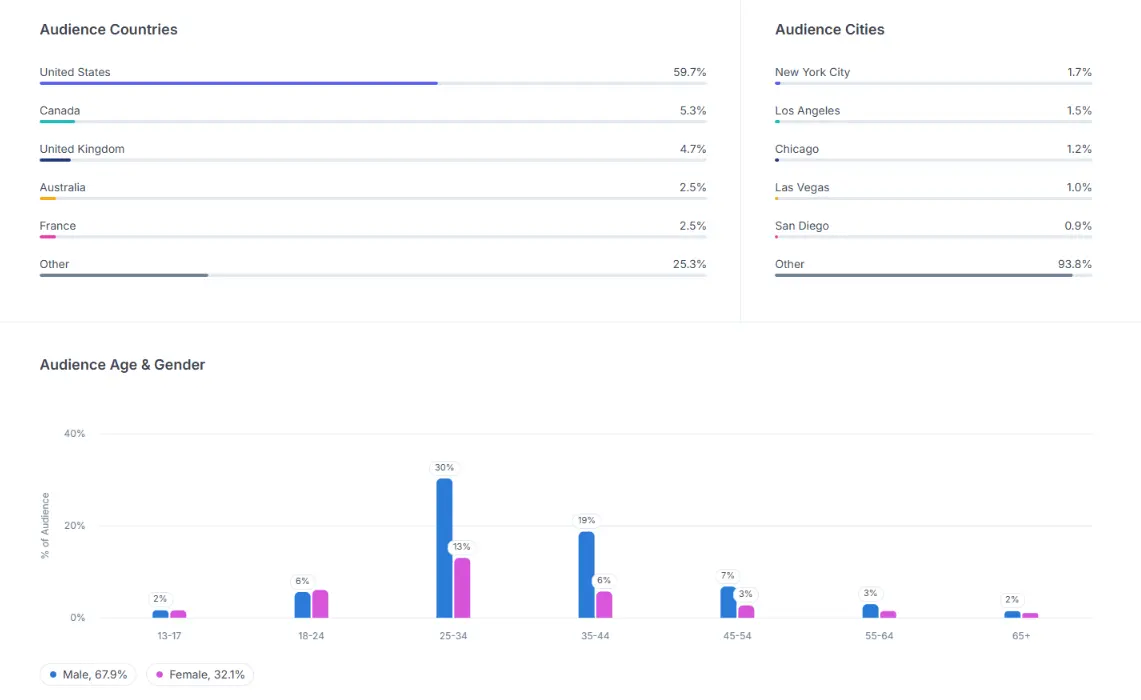
The audience also remains closely aligned with the company’s origins. HypeAuditor estimated that 59.7% was US-based and 67.9% was male, with golf, clothing, and retail forming the three largest account categories.
Some relationships generated far more content than others. Golf instructor Adam Porzak produced 88 mentions, while Josh Snider and Aaron Puzey contributed another 58 between them. Rather than relying entirely on isolated creator activations, Johnnie-O’s visibility appears to be supported by a smaller group of recurring advocates surrounded by a broader long tail of accounts.
HypeAuditor classified 235 mentions as organic, 164 as likely sponsored, and one as sponsored. These are modeled classifications, not confirmation that payment changed hands. The activity could include gifting, formal ambassador agreements, licensing partnerships, retailer promotion, or unsolicited posts.
Performance presents a more complicated picture. The average campaign engagement rate was a low 0.62%, although 52.72% of posts matched or exceeded the publishing account’s usual performance. Johnnie-O has built considerable contextual visibility, but Instagram data alone cannot reveal how often that attention turns into a purchase.
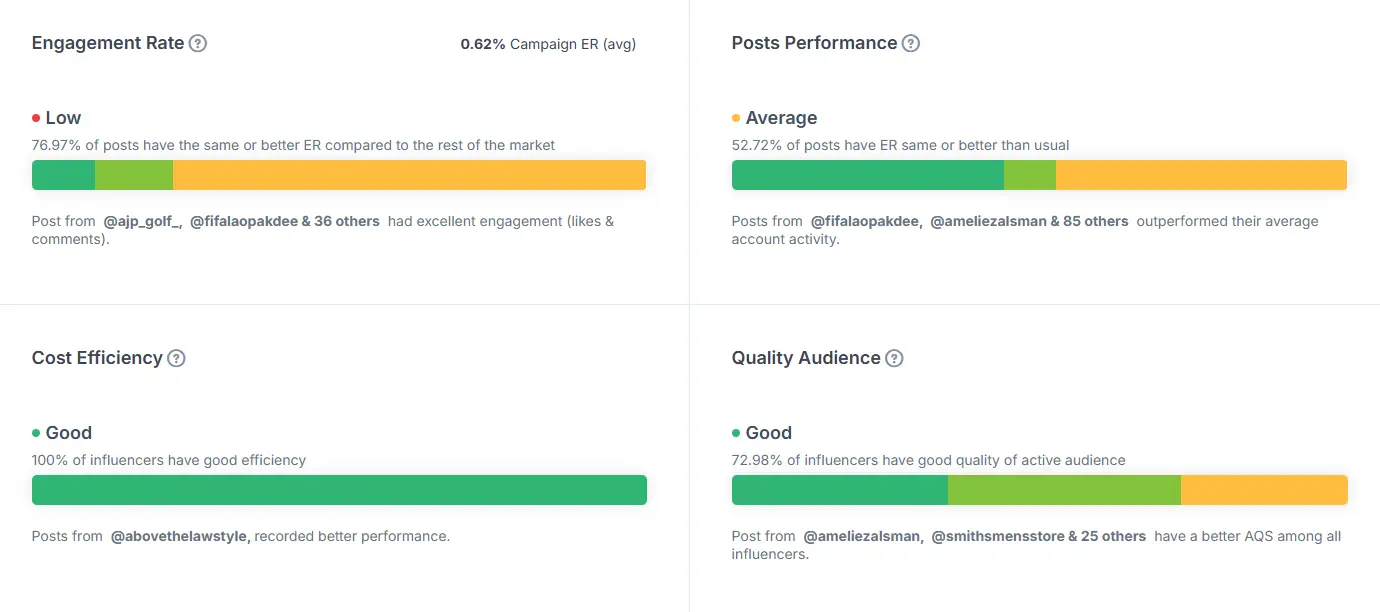
That is the measurement question now facing the company. O’Donnell has challenged the marketing team to move beyond views and determine whether creator activity “rings the cash register.” HypeAuditor helps reveal the scale and structure of the network. Connecting that network to customer acquisition and sales will show which relationships are producing business value.
Why Johnnie-O’s Word-of-Mouth Strategy Worked
Johnnie-O’s growth began when a distinctive polo entered golf shops and living rooms through people customers trusted. Product improvements gave those advocates better stories to tell. Additional categories turned first-time buyers into repeat customers. Licensing brought the clothing into new communities, while ecommerce and stores converted recognition into a wider wardrobe.
Creators and ambassadors now carry that system across digital platforms and professional sports. Their value comes from translating Johnnie-O into situations their audiences already understand, whether that is a golf lesson, a team allegiance, a family story, or an outfit worn from the