

Bug repellent has a content problem. A creator can show someone applying a spray, lighting an incense stick, or placing a device on a patio, but the protection itself remains invisible.
Murphy’s Naturals works around that limitation by focusing on what happens before people go outside. Its products appear while parents prepare children for camp, hikers pack their gear, families plan lake weekends, and Costco shoppers stock up for summer. The routine shows audiences when the product fits, while the creator’s experience supplies the recommendation.
That content sits inside a wider growth system. Murphy’s built its retail presence, brought most manufacturing in-house, expanded into new product formats, and developed campaigns that position the company around enjoying nature rather than fighting it.
This Brand Story examines how Murphy’s Naturals grew from a garage-based operation into a nationally distributed brand, how different creators support its influencer strategy, and how outdoor routines connect social discovery with retail availability and repeat purchases.
- How Murphy’s Naturals Started With a Family Mosquito Problem
- Murphy’s Naturals Expanded Through National Retail and In-House Manufacturing
- Why Outdoor Routines Drive Murphy’s Naturals’ Influencer Marketing
- How Murphy’s Naturals Uses Family, Outdoor, and Retail Influencers
- What Our HypeAuditor Analysis Reveals About Murphy’s Naturals’ Instagram Strategy
- The “We Love Bugs” Campaign Expanded Murphy’s Naturals’ Brand Positioning
- Murphy’s Naturals’ Product Strategy Creates Repeat-Purchase Opportunities
- Why Murphy’s Naturals’ Influencer Marketing Strategy Works
How Murphy’s Naturals Started With a Family Mosquito Problem
Murphy’s Naturals began with a problem inside founder Philip Freeman’s own family. His wife, Pam, attracted mosquitoes but struggled to find an effective plant-based repellent that suited their preferences.
Freeman brought an unusual combination of experiences to the problem. He grew up on a farm in the Blue Ridge Mountains, served in the Navy as a deep-sea diver, and spent more than two decades working in packaging. He was also influenced by The Body Shop's late founder Anita Roddick’s belief that a company could connect commercial growth with a broader mission.
He began developing Murphy’s around 2013 and 2014. The company was named after the family dog and initially operated from Freeman’s garage.
For more than two years, Freeman developed the business alongside a demanding packaging career. The first customers arrived through independent retailers and trade shows rather than a large launch campaign.
The origin of the business still shapes its marketing. Murphy’s started with a recognizable family use case and an emotional objective: helping people spend more time outside without worrying about mosquitoes and ticks.
Murphy’s Naturals Expanded Through National Retail and In-House Manufacturing
Independent stores gave Murphy’s an entry into the category, while Whole Foods and Sprouts helped establish credibility among shoppers already looking for plant-based products. Target became an early national breakthrough, followed by distribution through Costco, Walmart, Lowe’s, Home Depot, and other major retailers.
Growth also exposed the limits of outsourced manufacturing. Insect repellent is highly seasonal, which creates a compressed cycle of production, inventory, retail delivery, and cash flow. Murphy’s responded by bringing much of its production under its own control.
That decision gave the company greater flexibility. During the pandemic, Murphy’s was able to respond quickly when the US Navy needed sanitizer. The pivot disrupted regular production, but it demonstrated the operational value of manufacturing capability inside the business.
Freeman says the brand placed around 80% to 85% of production in-house and nearly 90% in the United States. The company now operates from a 140,000-square-foot facility in Raleigh and employs close to 50 people.
A Costco-exclusive three-spray kit followed in 2023. In 2024, Murphy’s raised an $8 million Series B led by Point King Capital to expand national retail distribution and support research and development across the outdoor-lifestyle category.
Retail gave Murphy’s the possibility to place the product in familiar shopping environments that creators could turn into discovery content.
Why Outdoor Routines Drive Murphy’s Naturals’ Influencer Marketing
Murphy’s products frequently appear at the preparation stage of an outdoor activity. Creators spray children before they enter the woods, place tick repellent in travel baskets, light incense around a backyard, or add a bottle to the gear packed for a family trip.
These actions help viewers understand the product without requiring a lengthy explanation. The routine answers three questions quickly: when to use it, where it belongs, and who it is for.
One Instagram creator included Murphy’s tick repellent among the items prepared for a family mountain getaway, alongside binoculars, nature books, cameras, and craft supplies. The product becomes part of creating the experience rather than the central subject of the post.
This approach also associates Murphy’s with the activity that follows the application. Audiences see hiking, camping, lake trips, gardening, and outdoor play. Protection becomes the practical step that makes those experiences easier to enjoy.
Creator experience can build confidence, but it cannot independently establish efficacy. Claims concerning protection periods, age guidance, coverage areas, and safety still need to follow the company’s approved product language.
How Murphy’s Naturals Uses Family, Outdoor, and Retail Influencers
The consistency of the outdoor setting allows Murphy’s to work across several creator categories without making the influencer strategy feel fragmented.
Family creators make the products part of parental preparation. Sasha Dubè places Murphy’s within motherhood and outdoor family life, while Mountain Mothering connects it with nature-led childhood and family adventures. Ordinary Papa introduces the product through modern fatherhood.
Their content performs several jobs at once. It introduces the brand, explains how a family uses the product, and places the recommendation inside an established relationship between creator and audience.
Outdoor and travel creators provide a different form of credibility. Bee Corrado’s hiking and camping content gives mosquito and tick protection an obvious reason to appear. Nomad Maddie can place the same products within van life, travel, and time on the trail. Their usual environments supply the context that a direct product demonstration cannot.
Low-tox and wellness creators position Murphy’s as an alternative within an existing category. Posts commonly include the spray among summer essentials or compare it with conventional products. This format supports consideration because viewers already understand the need and are being offered a different way to meet it.
Creator wording still requires caution. Phrases such as “non-toxic,” “chemical-free,” and “all natural” may extend beyond the language Murphy’s can substantiate. The stronger editorial description is the company’s plant-based positioning and the specific active ingredients listed for each product.
Retail creators bring the recommendation closer to purchase. Costco-focused accounts show audiences where the product is available, how it is bundled, and how it compares with familiar alternatives.
A Costco home-products video placed Murphy’s beside household brands across several categories and invited viewers to request a shopping list. It became the most-engaged Murphy’s social post as per our HypeAuditor analysis.
Family creators build trust, outdoor creators establish situational credibility, low-tox creators frame the alternative, and retail creators reduce purchase friction. Each group supports a different stage of the customer journey while returning to the same outdoor use case.
What Our HypeAuditor Analysis Reveals About Murphy’s Naturals’ Instagram Strategy
To examine how far Murphy’s visibility extends beyond the creators identified in public campaign examples, we used HypeAuditor to analyze Instagram mentions from the past six months.
The resulting network is broader than a conventional sponsored roster. Family and outdoor creators form its center, surrounded by travel, lifestyle, low-tox, retail, and American-made content.
HypeAuditor detected 53 mentions from 33 accounts during the six-month period. Five posts from three creators were classified as sponsored, giving paid content a 9.4% share of tracked mentions. Those sponsored creators were all classified as mid-tier family accounts.
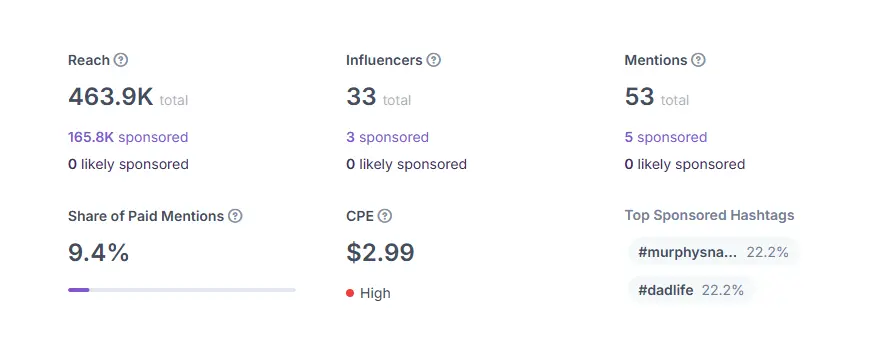
The wider network ranged from nano to macro influencers. It suggests that Murphy’s uses a relatively focused paid group inside a larger mixture of seeded, earned, retail-led, and potentially independent recommendations. HypeAuditor’s classifications are modeled, so an “organic” label cannot rule out gifting or another commercial connection.
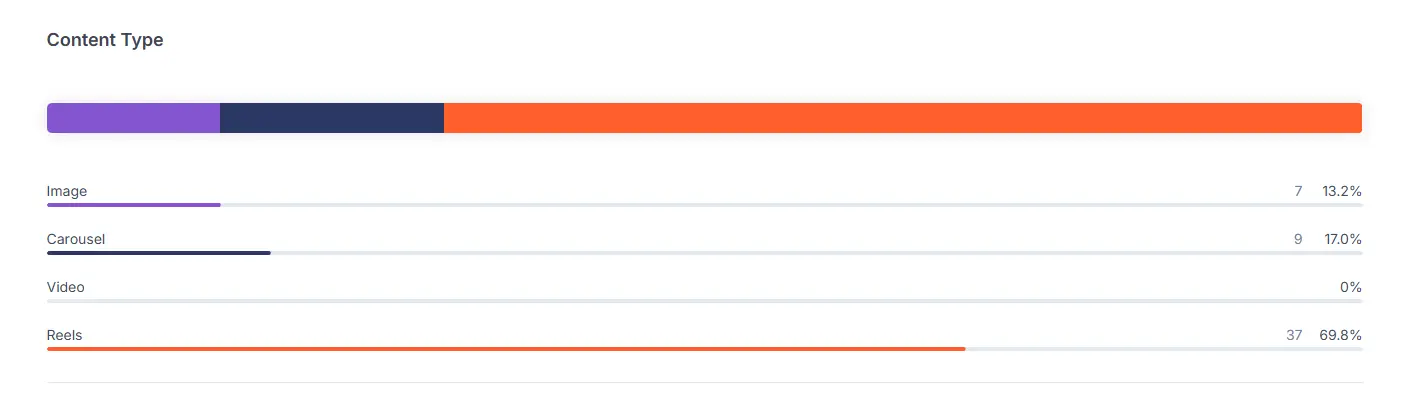
Reels represented 69.8% of the content. The format suits Murphy’s because creators can establish an outdoor problem, show the application, and move into the activity within a short sequence.
The audience was predominantly female and US-based, which aligns with the family, household, and summer-preparation content found throughout the dataset. HypeAuditor also estimated 463,900 total reach, with 165,800 associated with sponsored posts.
Performance was uneven. The Costco comparison alone generated 56,700 likes and 2,800 comments, accounting for more than half of the engagement across the analysis. It demonstrates the reach potential of retailer-led discovery while also making a poor benchmark for typical content.
The analysis reveals the shape of Murphy’s creator visibility, but it cannot connect that activity to customer acquisition costs, attributable retail sales, or repeat purchases. Those commercial measures remain the missing link.
The “We Love Bugs” Campaign Expanded Murphy’s Naturals’ Brand Positioning
Murphy’s initially differentiated itself through plant-based products. “We Love Bugs” gave the company a more memorable position within the category.
Rather than presenting mosquitoes as enemies to destroy, the campaign argues that insects play an essential role in nature and need healthy boundaries from people. Skeeter, a mosquito mascot, makes the idea playful enough for family audiences.
The campaign, launched by advertising agency Fitzco, extended across social media, digital video, influencers, retail media, earned coverage, and weather-triggered programmatic advertising. The weather component allowed Murphy’s to increase relevance when local humidity made mosquito activity more likely.
Murphy’s internal marketing and analytics team worked with Fitzco, production company Chomp, and digital growth partner Voyageur Group. Brand specialist Genevieve Guenther attended campaign production, while Julia Bethune and Jennings Ridout were credited through marketing leadership and analytics.
“We Love Bugs” won Best in Show at the AAF Atlanta ADDYs and Bronze in the Best Challenger Brand category at the 2026 ANA REGGIE Awards. The campaign’s award submission also reported lifts in awareness and product usage, although its performance figures remain self-reported.
“Outervention” developed the same position around a wider behavior. Its invitation to trade screen time for green time presents Murphy’s products as one way to remove barriers to outdoor activity.
The campaigns give creators a shared worldview to express. Product features still matter, but the content can now advocate for outdoor participation, family time, and respect for nature.
Murphy’s Naturals’ Product Strategy Creates Repeat-Purchase Opportunities
Murphy’s has expanded from personal sprays into mists, wipes, balms, candles, incense, zone repellents, and refills. Each format solves the same underlying problem in a different setting.
The Mosquito Dodger, for example, moves the product from personal application to protecting a defined outdoor area. Guenther reveals how its launch moved across email, social media, and the DTC product page.
The expanding assortment gives creators fresh situations to demonstrate and gives existing customers reasons to return. Consumable sprays, incense, candles, and refills also support replenishment, especially when summer weather reactivates demand.
Free shipping on relatively small orders, a first-purchase newsletter discount, and a reported subscriber list of more than 100,000 help Murphy’s turn seasonal traffic into an owned customer relationship. The available evidence does not provide retention rates, but the product structure creates several clear paths to another purchase.
Why Murphy’s Naturals’ Influencer Marketing Strategy Works
Murphy’s influencer strategy works because it begins with situations audiences recognize. Creators show the preparation that makes outdoor activities more comfortable, while their different content categories support awareness, credibility, consideration, and retail discovery.
Manufacturing gives the company the capacity to supply that demand. National retailers make recommendations easier to act on. New formats create more creator briefs and purchase occasions. “We Love Bugs” and “Outervention” connect those activities to a consistent position about helping people enjoy nature.
The remaining opportunity is measurement. Connecting individual creators and content formats with ecommerce acquisition, retail movement, and replenishment would show which parts of the network contribute most directly to growth.
Even without that attribution, the wider method is visible: Murphy’s makes the use case recognizable, surrounds it with trusted voices, and ensures the product is available when customers decide to go outside.

SUGGESTED


What is Influencer Marketing? The Ultimate Strategy Guide for 2026
Learn how influencer marketing drives brand awareness engagement and sales with our...

Is Influencer Marketing Still Just a Channel Or Has It Become the System?
Creator-led marketing goes beyond social. See how brands in Dubai and Saudi Arabia use...