
Parents rarely begin with a toy brand in mind. They are more likely to wonder what will hold their baby’s attention, whether a toddler is ready for a new activity, or how to make playtime feel less like guesswork. Lovevery built its business around those questions.
Its stage-based Play Kits give families activities matched to a child’s age, along with guidance for using them. That combination has a useful quality for marketing: parents and creators can show a child trying an activity, then explain why they chose it. The product becomes easier to understand through a moment of play than through a list of features.
The audience for that guidance extends beyond customers.
In 2025, Lovevery had approximately 650,000 customers and a broader audience of more than five million across social and other channels. That distance between following the brand and buying from it is central to the story.
Here is how Lovevery developed its products, built a network of parent creators and educators, and created more ways for interested families to make a first or repeat purchase.
- How Lovevery Built Play Kits Around Parents’ Development Questions
- Why Lovevery Play Kits Work in Creator Demonstrations
- How Lovevery’s Influencer Marketing Strategy Builds Product Understanding
- How Books, Retail, and Pre-Loved Expand Lovevery’s Purchase Options
- What Our HypeAuditor Analysis Reveals About Lovevery’s Instagram Creator Network
- What Lovevery’s Content Strategy Shows Marketers
How Lovevery Built Play Kits Around Parents’ Development Questions
Jessica Rolph felt confident about what she fed her first baby. She had cofounded the organic baby-food company Happy Family and spent years thinking about early nutrition. Play raised another question: what experiences would support her child’s learning, and how could she choose among the toys available?
She began reading child-development research and making activities herself. One early frustration was an electronic toy that responded to a button press with flashing lights and music. Rolph wanted more opportunities to connect with her son and understand what he was learning as they played.
Rolph and Roderick Morris began building Lovevery around 2015. They tested early concepts with families, watched parents and children use them, and worked on turning developmental research into activities that could fit into daily life. Lovevery launched the Play Gym in 2017, followed by its stage-based Play Kits subscription in 2018.
The Play Kits addressed two people at once. Children received objects they could explore; parents received guidance on what to offer and how to play together.
@ariellebrimhall LOVEVERY LINK IN BIO 💜💙💛💚 #lovevery #loveverygift #fyp #sensoryplay #Montessori #newmomtips #toddlersoftiktok #montessorimom #montessoritoddler #toyrotation @lovevery
♬ Monkeys Spinning Monkeys - Kevin MacLeod & Kevin The Monkey
That parent-facing explanation became as important to Lovevery’s growth strategy as the toys themselves.
Why Lovevery Play Kits Work in Creator Demonstrations
A Play Kit gives a creator a simple story to show. They can identify their child’s age, open the box, introduce an activity, and film what happens. A viewer can see a child posting an object, solving a puzzle, or returning to a favorite book. The parent supplies the context that connects the behavior to a buying decision.
One mother asks whether other parents feel their children’s toys serve little purpose or hold attention for only a few minutes. She then shows her two-year-old playing with the Helper Kit and explains why its activities suit his stage. Her question catches parents facing the same problem; the demonstration gives them something concrete to consider.
@kiraalvarez0414 @Lovevery is truly a brand of products we absolutely love in our home 💕🫶🏻 check out their products 🔗’d on my page! #lovevery #loveverygift #montessoritoys #montessoritoddler #toddlermom #momsoftiktok #toddlertoys #CapCut
♬ Positive background music such as play and games(1251730) - earbrojp
The guide inside each kit adds another layer to these demonstrations. It suggests ways to begin playing, which helps parents who like the idea of an open-ended toy but still want somewhere to start. Creators can show the activity and explain how they introduced it at home.
The next developmental stage brings a new kit and a new reason to engage. About 85% of Lovevery’s 2023 revenue came from repeat customers. That does not measure the contribution of any particular video, but it shows the commercial importance of helping families find value beyond their first purchase.
For marketers working with products people can demonstrate, our UGC campaign framework shows how questions, demonstrations, and testimonials can become a repeatable content process.
How Lovevery’s Influencer Marketing Strategy Builds Product Understanding
Lovevery’s creators help with different parts of the buying decision. Parents show how a kit fits into family life. Educators explain how to use a learning activity. Gifted and affiliate partners can introduce products to their audiences and offer a route to purchase. The content works best when it answers a question the creator’s followers already bring to them.
Parent Creators Address Price, Attention, and Longevity
One mother begins with a question she says new parents ask her: is the Lovevery subscription worth it? She answers through her family’s experience subscribing since her daughter was three months old. The value of that format lies in its specificity. A prospective buyer hears how long another family has used the kits and can weigh that account against the price.
@lizreices #lovevery #loveverygift #toddler #toys
♬ Positive background music such as play and games(1251730) - earbrojp
The relationships behind these recommendations vary. One creator discloses a commission link, while another says her video is unsponsored. A longtime subscriber describes Lovevery contacting her about a partnership and offering to send a kit.
Because she already subscribed to the Play Kits, she chose a Block Set to introduce to her audience instead. Her familiarity gives the collaboration a different foundation from a first-time unboxing, though this single example cannot establish how Lovevery recruits partners more broadly.
@kenya_may_ Lovevery will forever have my heart 💗 #lovevery #loveverygift #loveveryunboxing #momsoftiktok #firsttimemom
Educators Make Learning Products Easier to Use
Spencer Russell, founder of Toddlers CAN Read, is a Lovevery Literacy Partner for the Reading Skill Set. His usual work helps parents approach early reading, making him a fit for explaining the program’s games, phonics activities, and gradual progression.
An educator and a parent reviewer contribute different kinds of proof. Russell can show a parent how to guide the activity. A family creator can show where it fits into an ordinary afternoon.
Together, those explanations make a learning product less intimidating before purchase and more usable afterward.
The Collab Program Supports Partnerships Across Markets
Lovevery invites creators and social partners to apply to its Collab Program, which provides approved participants with access to campaigns, branded assets, and performance tracking. It has separate partnership routes for businesses and for education, healthcare, and childcare professionals.
The work also extends beyond the US. When Senior Influencer Marketing Specialist Kylie McGinniss announced her Amsterdam role, she described building on influencer partnerships across the EU, UK, and APAC. Her post indicates the regional scope of the team’s work, without disclosing campaign performance.
The visible strategy combines lived parent experience, specialist instruction, and a formal way to manage creator campaigns.
We can see how those roles support product understanding and discovery. The available evidence does not show creator spend, affiliate sales, or customer acquisition by partner. Our creator affiliate program guide covers the activation and tracking needed to answer those commercial questions.
Lovevery’s Instagram Strategy Gives In-House Content and Creators Different Roles
Lovevery has also developed parenting content for the accounts it controls. By 2024, it had shifted much of its Instagram production toward a small in-house social team, including employees who are parents. Influencers continued to publish Lovevery content on their own channels.
The arrangement lets Lovevery develop a consistent voice around topics such as tummy time, toddler meals, and emotional regulation. Creators bring those ideas into family routines their followers already recognize. Lovevery also invites contributions from enthusiastic customers and films activities in real homes with child-development expertise on set.
Across five localized Instagram accounts, Lovevery reached a combined 2.3 million followers in 2024. Local accounts allow the brand to adapt advice for different markets while returning to the same central idea: give parents something practical to try. A useful activity post may introduce Lovevery to a family long before that family considers a Play Kit.
Our Instagram content playbook looks more closely at how brands can assign different formats to discovery and ongoing audience engagement.
How Books, Retail, and Pre-Loved Expand Lovevery’s Purchase Options
As children grow, Lovevery has extended its approach beyond baby and toddler Play Kits. The Reading Skill Set brought hands-on activities into early literacy, while the Early Reader Club added recurring books and guidance. The Math Skill Set later applied the same approach to another school skill and is sold in individual parts rather than as a subscription.
@thebabygearconsultant We were gifted the @Lovevery Reading Skills Set and my wife was SO excited to review it. If you don’t know, my wife is a Elementary Teacher as well as a Reading Specialist! She gives the Lovevery Reading Set (Skills 1) a 5 star raving review! We’ve been having so much fun with it and love the diverse way you can play the games and use all the tools and books included in the kit. She thinks it would be a great supplement for home use or a really great tool for homeschooling families. #gifted #loveverygift #playtoreador #lovevery #loveverytoysl #scienceofreading #toddlertoys #besttoys #toyreview #readingspecialist
Each product gives Lovevery and its partners another parent question to address. A family that first encountered a baby activity may return years later for reading support. A creator known for early literacy can introduce the brand to parents who never shopped for its infant kits.
Lovevery has also widened the ways families can buy. Retail placement makes products available for physical discovery and product gifting. Its Pre-Loved marketplace, launched in 2025, gives secondhand buyers an official route into a market where families were already trading used Lovevery toys. It can serve parents interested in the brand who prefer a lower-priced first purchase.
These options connect audience growth to commerce without requiring every interested parent to begin with a Play Kits subscription. They also create different points of discovery, from an educator’s explanation to a store shelf or a secondhand listing.
What Our HypeAuditor Analysis Reveals About Lovevery’s Instagram Creator Network
Does Lovevery’s visibility depend on a few prominent partners, or does it extend through a wider parenting community? To examine that network, we used HypeAuditor to analyze Instagram activity from the past six months.
HypeAuditor tracked 766 posts from 570 accounts. Family was the largest account category, with lifestyle and children’s toy accounts also represented. Of the 560 accounts assigned a size tier, 415 were nano or micro creators.
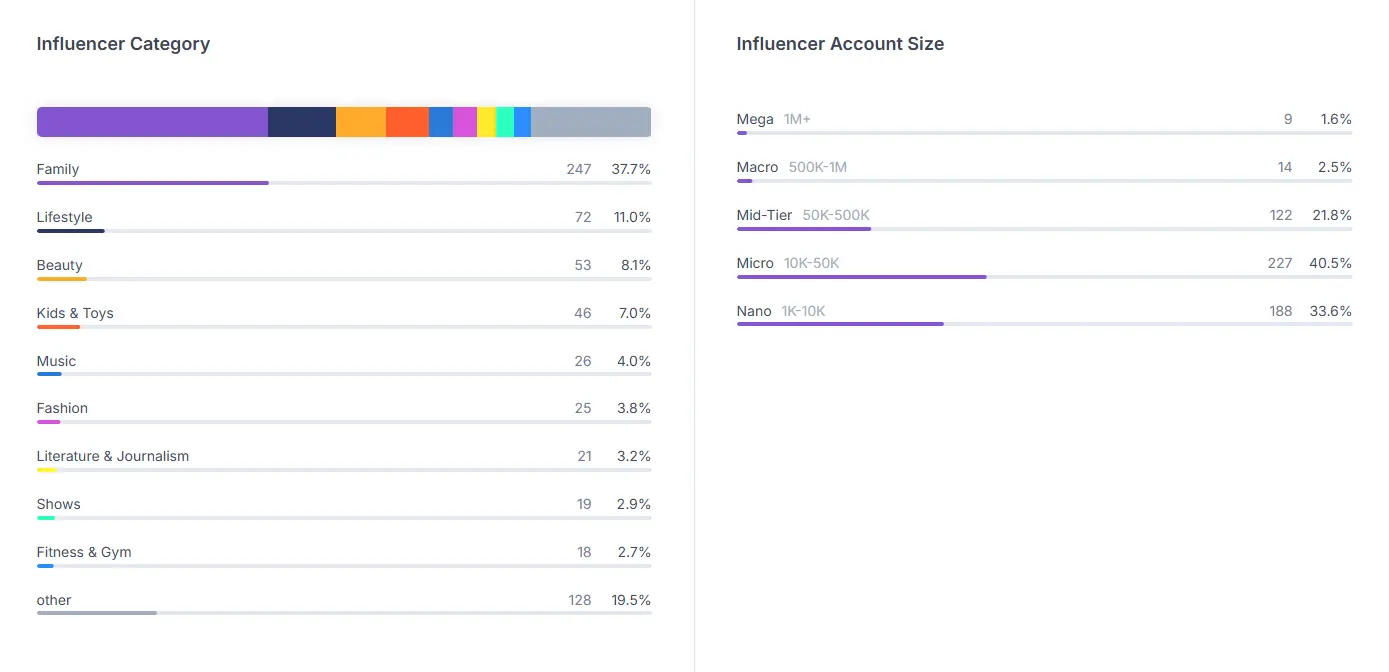
Even the most active account appeared in only 10 tracked posts. The pattern points to many smaller voices placing Lovevery in parents’ feeds, with some recurring contributors rather than a network dominated by one personality.
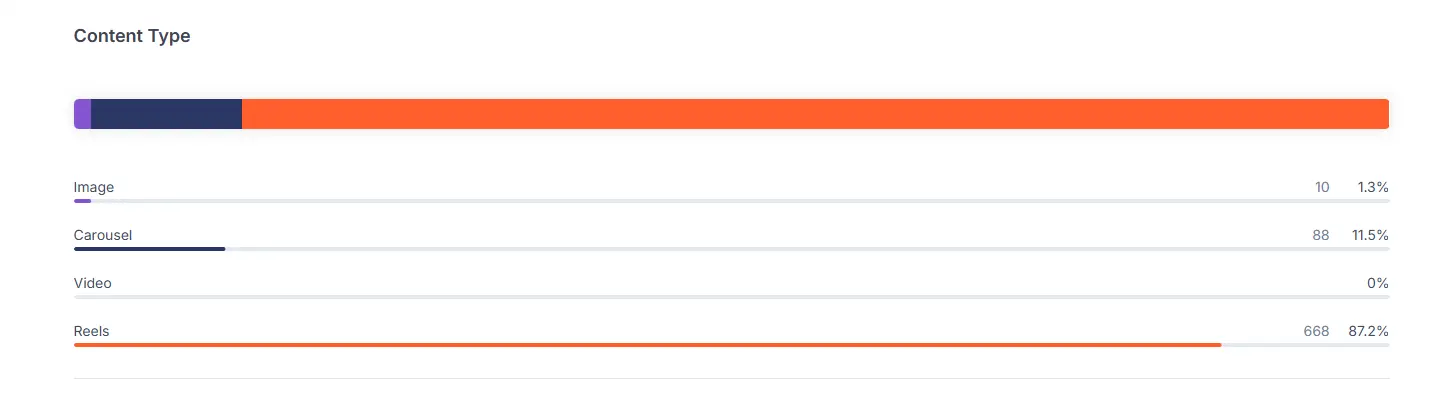
The content format suits the product. Reels accounted for 668 posts, giving creators room to show a child trying an activity, returning to a toy, or interacting with a parent. Product-related hashtags also show several conversations happening at once.
#loveverygift appeared in 263 tracked posts, #loveverypartner in 69, and #loveverymath in 33 as the brand introduced its math program. A hashtag indicates how a post was labeled or discussed; it does not establish what a creator was paid.
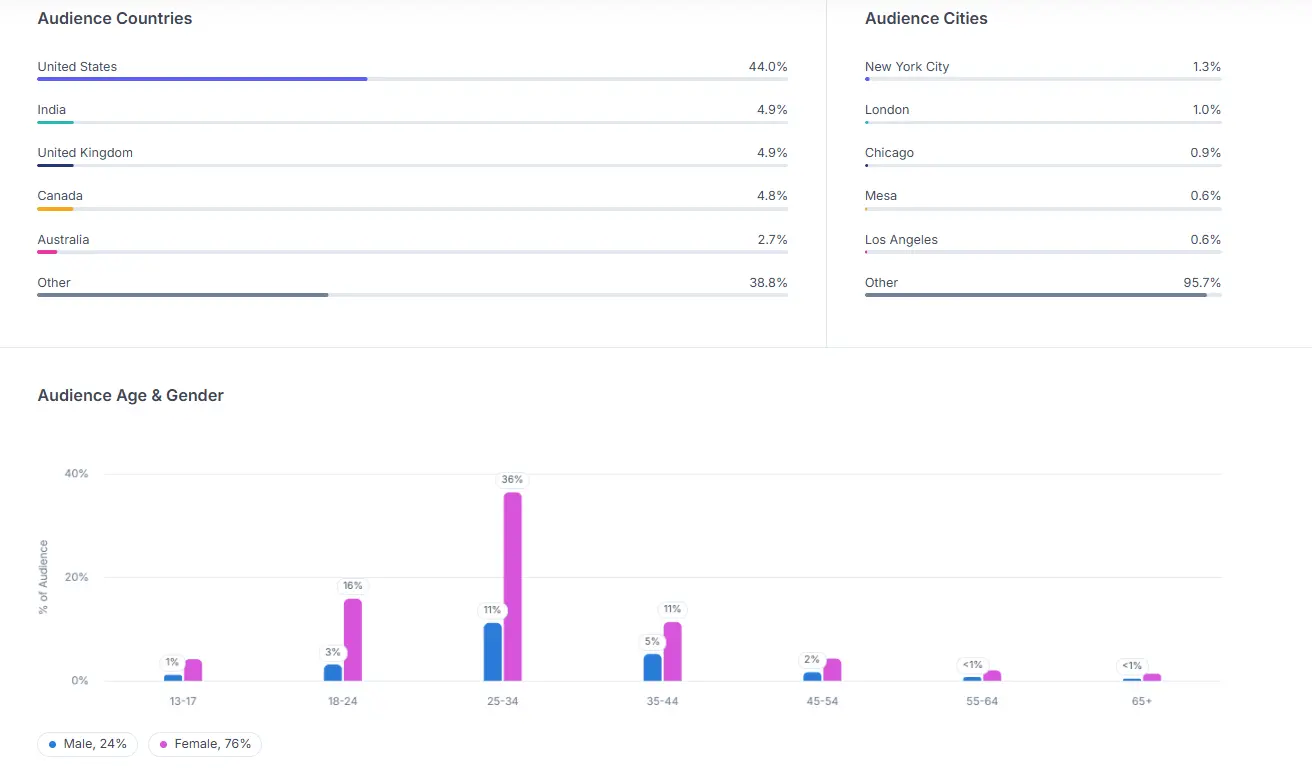
HypeAuditor’s audience model estimated that 76% of the accounts’ audience was female and 44% was in the US. That is consistent with Lovevery reaching a substantial audience in its home market, though audience demographics cannot tell us which viewers are parents or buyers.
The report classified 32 posts as sponsored, 281 as likely sponsored, and 453 as organic. These are modeled classifications, not confirmed partnership records. Together, the findings show broad creator visibility around a product made for demonstration.
The commercial question remains open: which of those encounters introduced a new customer, supported a later purchase, or kept an existing family engaged?
What Lovevery’s Content Strategy Shows Marketers
Lovevery gives parents an activity they can try, an explanation of how to use it, and examples of other families doing the same. Creators make the product visible in daily life; the brand’s own channels keep answering questions as children grow. New learning products, retail, and resale provide ways to act on that interest.
That sequence explains why parenting content is central to Lovevery’s product discovery. The advice earns attention, the demonstration makes the product understandable, and the next suitable offering gives the family a reason to return. The remaining measurement challenge is to identify which of those encounters leads to a purchase.

SUGGESTED

Best Social Media Marketing Strategies For Baby & Kids’ Products
Boost your brand with proven social media strategies from top Baby & Kids’ Product...

Top Baby & Kids’ Products Social Media Marketing Campaigns
Explore top baby and kids’ social media marketing campaigns and see how brands use...

Top Social Media Trends Every Baby & Kids’ Products Brand Needs to Know
Discover top trends like personalized baby gifts smart tech integration and early...