

In categories where products can appear interchangeable, creator marketing can make small differences impossible to miss. A hair tie, brush, or claw clip might look familiar on a retail shelf. On camera, its stretch, hold, comfort, and suitability for a specific hair type become visible proof.
GIMME Beauty has built its growth strategy around that opportunity. The company develops hair accessories for different hair types, then works with creators who can demonstrate why those distinctions matter in everyday routines.
The broader marketing lesson is that an effective creator strategy can begin with product design. When a product gives creators something clear to test, compare, or reveal, brands gain a repeatable content format instead of relying on scripted endorsements.
To understand how GIMME has applied that principle, we looked at past creator campaigns, creator content, and employee commentary on said campaigns and content. We also used HypeAuditor to examine the structure and performance of the brand’s social creator network.
The result is a brand story about more than influencer reach. It shows how GIMME combines product demonstrations, smaller creators, high-reach accounts, experiential campaigns, and national retail availability to turn visible proof into a wider growth system.
- GIMME Beauty’s Growth Began With Hair-Type-Specific Products
- Retail Setbacks Turned Creator Marketing Into a Growth Channel
- Hair Accessories Gave Creators Visible Product Proof
- Inside GIMME Beauty’s Social Creator Network
- Dream Curls Connected Creator Content to a National Target Launch
- Community Campaigns Expanded GIMME Beauty’s Creator System
- Creator Visibility and Retail Distribution Reinforce Each Other
GIMME Beauty’s Growth Began With Hair-Type-Specific Products
GIMME’s origins sit within a family manufacturing and distribution business. According to co-founder and CEO Jeff Durham, the initial idea emerged when his sister used materials from the family’s scrapbooking business to create hair clips for her daughters.
Those experiments developed into GIMME Clips, a children’s accessories business that eventually expanded into products for women. Its defining idea became what Durham calls the “science of hair type.”
Instead of treating hair accessories as universal products, GIMME developed different options for fine, medium, thick, long, curly, and textured hair. That approach now extends across hair bands, brushes, claw clips, heatless curlers, bonnets, towels, and other styling tools.
The product differences are practical and easy to explain. GIMME brushes use shorter, softer bristles for fine hair and longer, stiffer bristles for thick hair. Its claw clips vary in size and structure, with patented double-teeth designs among the features the company promotes. Its hair bands are woven in a continuous circle to remove the glued seam that often becomes a breaking point in traditional ties.
GIMME says some of its bands can withstand more than 70 pounds of pressure, with later campaign materials citing up to 80 pounds. These are company testing and marketing claims, but they illustrate how GIMME turns an inexpensive, familiar accessory into a differentiated product.
They also give creators something concrete to show.
Retail Setbacks Turned Creator Marketing Into a Growth Channel
GIMME entered retail before developing a substantial direct-to-consumer operation.
Walgreens became an important early customer, according to Durham. An initial opportunity with Target was less successful. GIMME created a roughly 40-product children’s collection under the Lily Jane private-label name, but the range disappeared after a change in Target’s buying team.
The experience exposed a weakness in the retail-first model. GIMME could manufacture products and win shelf space, but it had limited direct access to the customer.
Around 2018 and 2019, the company began investing more seriously in its website, social channels, ambassadors, and influencer relationships. Creators could introduce the products before shoppers encountered them in stores, while direct sales gave GIMME more immediate feedback about which messages and products resonated.
In an interview, Durham recalled an early influencer initiative in which approximately $40,000 in spending generated about $500,000 in sales. That result helps explain why creator marketing became central to GIMME’s growth model.
The company increased its digital and influencer investment during the pandemic. GIMME later reported that the business doubled during that period and gained distribution at Ulta Beauty.
Hair Accessories Gave Creators Visible Product Proof
The strongest GIMME creator content rarely requires an elaborate explanation. The product becomes the content.
TikTok creators test how many times a band can wrap around thick or loc’d hair. They compare claw clips with products that previously slipped or failed to contain their hair. Others sleep in heatless curlers and reveal the result the following morning.
@bre_shopfinds @gimme beauty I'm in love with how perfect these hair ties are! 🩷 #thicklocs #thickhair #4chaircare #naturalhairtiktok #womenwithlocs
Brush demonstrations make the logic equally clear. A creator can show how the bristles move through tangled hair, how a curved brush follows the scalp, or how a version designed for one hair type differs from another.
Some tests produce uneven curls, require a second attempt, or reveal that wrapping a band too tightly can still cause discomfort. Those imperfect moments can make the content more credible because the creator is documenting an experience rather than reciting polished claims.
@sleepytani trying @gimme beauty overnight heatless flex rods (+ results!!) 🫣 #hair #hairstyle #fail #heatlesshair #overnightblowout
This creates a reusable format.
A creator identifies a familiar hair problem, selects the GIMME product intended for that hair type, demonstrates it, and shows the result. The hair type, styling goal, personality, and outcome can change while the underlying story remains consistent.
Inside GIMME Beauty’s Social Creator Network
We used HypeAuditor to examine worldwide social mentions of GIMME Beauty in the past six months. The analysis was conducted to understand the structure of the network, the formats creators used, and the audience those mentions could reach.
HypeAuditor identified 388 mentions from 221 influencer accounts and estimated their total reach at 4.7 million.
Nano and Micro Creators Build Repetition
GIMME’s social footprint was weighted toward smaller accounts. HypeAuditor classified 113 participating accounts as nano creators and another 44 as micro creators. Together, they represented approximately 71% of the analyzed network.
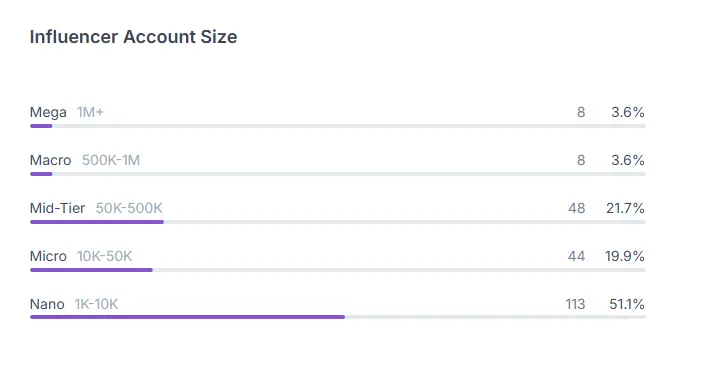
This structure allows products to appear across many routines, hair types, households, and styling situations. Some of the most active accounts mentioned GIMME between five and 22 times during the reporting period, indicating recurring participation alongside one-time posts.
One UGC creator, Briana Gallardo, thanked GIMME’s Brand and Influencer Partnerships Manager Lauren Shlee for repeatedly trusting her to produce content for the company. The exchange gives the wider pattern a human example: at least some creator relationships extend beyond a single deliverable.
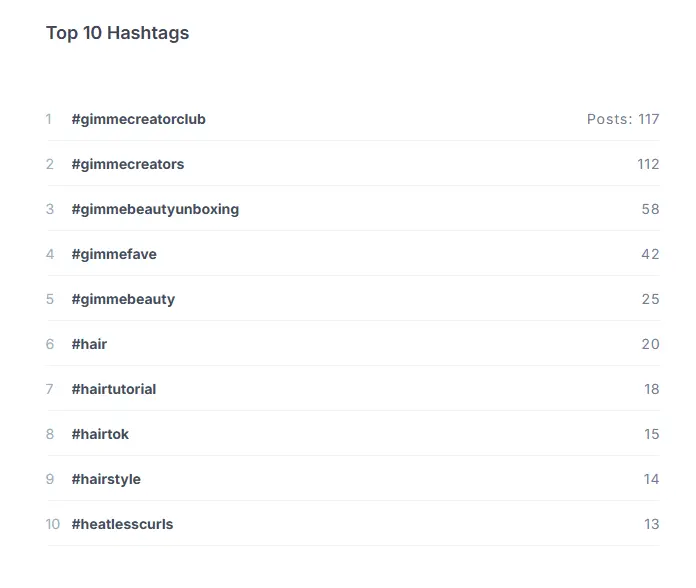
The hashtags reinforce that structure. HypeAuditor found #gimmecreatorclub in 117 posts and #gimmecreators in 112. #gimmebeautyunboxing appeared in 58 posts, while #gimmefave appeared in 42.
HypeAuditor classified 324 mentions as organic, 54 as likely sponsored, and 10 as sponsored. These are modeled classifications. They do not confirm payment, gifting, affiliate participation, or independent posting.
Reels Make Product Differences Easy to See
Reels accounted for 283 of the 388 mentions, or 72.9%. Carousels represented 18.3%, while images accounted for 8.8%.
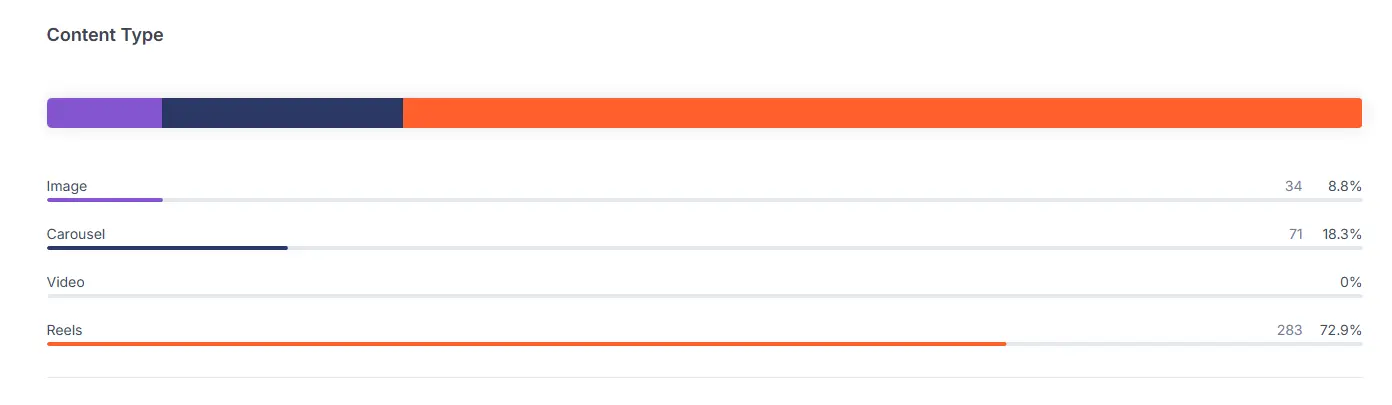
That format mix closely matches the products’ demonstrable qualities. Movement helps viewers see whether a clip stays in place, whether a brush catches, how a band stretches, and what a heatless styling product produces after several hours.
GIMME does not need every creator to follow the same script. It needs the product difference to remain recognizable across many individual experiences. That interpretation is supported by the combination of Reels, tutorial hashtags, recurring Creator Club participation, and hair-type-specific products.
Larger Creators Supply Additional Reach
The network also included a smaller layer of high-reach accounts. HypeAuditor identified mentions from LaurDIY, Nichole Ciotti, Matt Newman of MattLovesHair, Eman, BeautyyBird, Natalie Zacek, and Cassidy Michelle Bogan. Eight analyzed accounts had more than one million followers, with another eight between 500,000 and one million.
Smaller creators give GIMME frequency and variation. Larger creators extend its potential audience. A mention, however, does not automatically represent a dedicated endorsement, and the analytics report cannot establish the commercial relationship behind each post.
The Engagement Data Shows Scale, Not Universal Virality
HypeAuditor measured an average campaign engagement rate of 0.91%, which it rated as low. It also found that 68.75% of classified sponsored posts performed below the creators’ usual engagement levels. With that said, data shows a 100% creator efficiency, which HypeAuditor scores as "Good," and average quality audience.
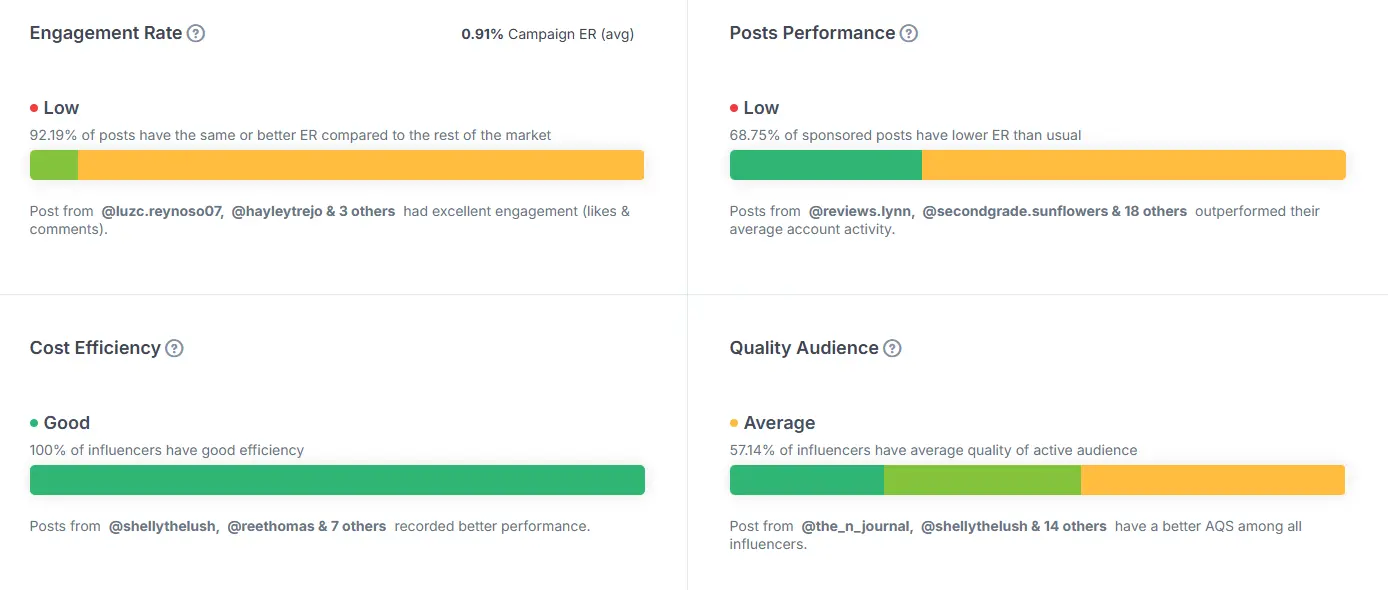
GIMME’s apparent advantage therefore comes from cumulative exposure, network breadth, and repeated product demonstrations rather than consistently exceptional performance from every post.
The audience fit remains notable. Women accounted for an estimated 81.7% of the combined audience, and the United States was its largest market at 49.8%. Beauty was the largest creator category, followed by lifestyle and family.
Dream Curls Connected Creator Content to a National Target Launch
The Dream Curls launch shows how GIMME can connect its creator network to a larger retail campaign.
The 12-product Heatless Curl Collection launched nationwide at Target. GIMME supported it with its first commercial produced specifically for television, outdoor advertising in New York, Los Angeles, and Salt Lake City, creator partnerships, and UGC.
Senior Art Director Janie George described the three-day production as a collaborative project, including an unscripted intervention from Brand Marketing Manager Taylor Santo Tomas when the team decided the original voiceover was missing something.
GIMME and its partners also transformed the Toasty Badger diner in Austin into a Dream Curls experience. Visitors received live demonstrations, styling education, samples, discounts, and opportunities to create content. The first 75 attendees received products matched to their hair type.
The campaign connected several layers of proof. Creators demonstrated the styling process, customers experienced it in person, and Target gave interested audiences an immediate purchase destination.
GIMME has also used entertainment to carry product education. Its Science Fair campaign borrowed from 1990s and Y2K teen films while explaining bristle lengths, hair types, ergonomic grips, and band strength.
Community Campaigns Expanded GIMME Beauty’s Creator System
GIMME’s creator system extends beyond conventional beauty partnerships. Customers, teachers, employees, athletes, and founders all appear within its wider content ecosystem.
GIMME Gives Back began after teachers repeatedly contacted the brand for products and essential supplies for students. The resulting campaign attracted 2,300 nominations and selected ten teachers for Target shopping experiences.
Agency partner VO|US reported that the campaign involved more than 80 influencer partners and 200 PR boxes, generated 32 million views, and doubled weekly online and in-store revenue during the campaign month. These are agency-reported outcomes rather than independently verified results.
A second season shifted the focus to women founders. GIMME received 500 nominations, brought four finalists to Los Angeles for a six-part series, and awarded a $40,000 grant.
Other activations have placed products at the Super Girl Pro surf competition, the Los Angeles Marathon, and community hikes held across ten cities. Each setting gives participants an opportunity to test the accessory while placing the product inside an experience that naturally generates content.
Creator Visibility and Retail Distribution Reinforce Each Other
Social demonstrations can make GIMME’s hair-type distinctions familiar before shoppers encounter the products at Ulta, Target, Walmart, CVS, Walgreens, Amazon, or a grocery retailer.
Physical availability then gives creator-generated interest somewhere to convert. Company updates show the footprint expanding from approximately 15,000 retail locations in 2022 to 23,000 by the next year. More recent founder commentary places the brand in roughly 25,000 stores. These remain company-reported figures.
Durham has framed the retail proposition around simplicity: one accessible price, three clearly color-coded hair types, and a decision shoppers can make within seconds. The same clarity that helps a retail customer select a product also helps a creator explain it.
The reinforcing system begins with product design. Smaller creators repeat the proof across different hair types. Larger accounts add reach. Campaigns concentrate attention, and broad retail distribution captures the resulting demand.
GIMME’s HypeAuditor results add an important qualification. The network is broad and highly visual, but its value appears to come from cumulative product proof rather than consistently exceptional engagement.
That is the larger lesson for marketers. Creator strategy becomes more scalable when a product provides its own content mechanism and when every demonstration helps the customer make a clearer buying decision.

SUGGESTED

Influencer Marketing Hub | Influencer Marketing Hub
Stay Ahead of the Influencer Marketing Movement The latest benchmarks brand stories and...