
When brands complain about influencer platforms, they rarely say, “I need more charts.” What you see instead, is a pattern of dashboards that are too powerful, too expensive, and still not answering the question the CMO actually asks:
“Which creators drove revenue, and can we prove it?”
Advanced analytics has become both the key differentiator and the biggest source of friction. Smaller teams feel priced out of enterprise stacks that promise AI-driven ROI but bury them in features they’ll never use, while global brands wrestle with data that doesn’t quite match native social metrics, inconsistent EMV formulas, and gaps wherever creators refuse to authenticate their accounts.
This article is for marketers who are done buying vanity dashboards. You’ll see each platform evaluated through the lens of real pain points: data accuracy and coverage, how well analytics connect to ecommerce and CRM revenue, whether the UI is usable for lean teams, and how easily insights can be exported into the way your organization already reports performance.
The goal isn’t just to find “the most advanced” tool—it’s to find the platform whose analytics will actually change how you brief creators, allocate budget, and justify influencer spend to the rest of the business.
1. Brandwatch Influencer Marketing Software
Key Features: Global Influencer Payment, Influencer Discovery, Influencer directory management, Creation of private influencer network, Campaign management and reporting, Broad platform coverage, Automated reporting,
Channels: YouTube, Facebook, Instagram, Twitter, Twitch, TikTok, Shopify
2. Upfluence
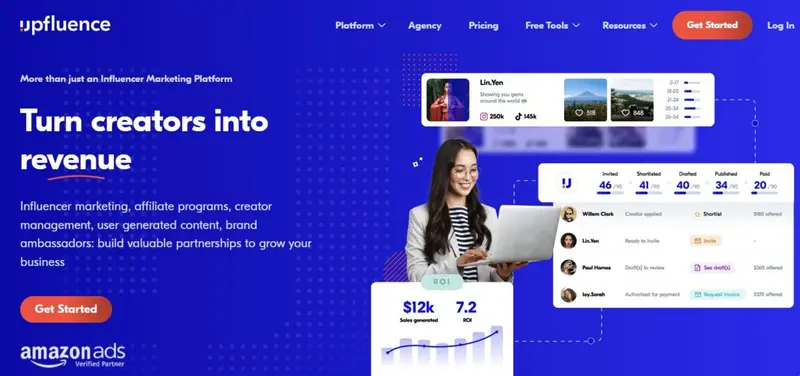
Best for: Ecommerce and DTC brands, and agencies that need hard revenue attribution and scalable affiliate/creator programs.
Notable clients: Amazon, Marriott, Asics, Universal Pictures, OMEGA, Mercedes-Benz, HP, Shiseido, Herman Miller and more.
Locations: New York (HQ), Los Angeles, Lyon, Mexico City.
Upfluence is built around one idea: influencer and affiliate campaigns should be measured like performance marketing, not PR. The platform combines influencer discovery, campaign workflow, and payments with a revenue-first analytics layer that ties every creator and piece of content back to sales.
Read More
Key Features: Influencer Search & Discovery, Relationship Management, Campaign Management, Third Party Analytics, Automated Recruiting, Influencer Lifecycle Management, Team Collaboration Tools, Content Review, Campaign Reporting, Audience Analysis, E-commerce Tools, Product/Gifting Tools, Payment Processing, Social Listening, Affiliate Management, Affiliate Campaigns,
Channels: Instagram, Youtube, Facebook, Twitch, Tiktok, Twitter, Pinterest, Blogs
Conclusion
The real differentiators show up in the frustrations brands mention last: analytics that break down in niche or local-language markets, dashboards you can’t customize to match internal KPIs, and “advanced” exports that still require rebuilding every slide manually.
Add the friction of creators refusing authentication, data silos across TikTok–Instagram–YouTube, and attribution models that collapse into last-click, and it’s clear why teams feel trapped between feature bloat and limited real-world visibility. The strongest platforms are the ones that solve these gaps, not the ones promising the most metrics.


