

According to our TikTok marketing report, 71% of TikTok users decide whether to keep watching a video within the first three seconds. Those three seconds are the hook, and they decide whether anyone sees the rest of what you made.
A good hook does two jobs in that window: it tells viewers what the post is about, and it gives them a reason to stay. That sounds simple, but plenty of big brands with big budgets still miss it, and their engagement numbers show it.
Below are 10 rules for writing hooks that hold attention, each shown on real brand videos and slideshows that either follow it or break it.
What a TikTok Hook Is Made Of
A hook is everything viewers take in before they decide to stay: roughly the first three seconds of a video, or the first slide of a slideshow. It's rarely a single line. Most hooks have up to four parts working at once:
- The spoken hook, meaning the first words said out loud (or sung, in a trending audio).
- The text hook, a headline on screen styled differently from word-for-word captions.
- The visual hook, which is the opening shot or, on a slideshow, the first image.
- The sound: music, trending audio or sound effects that set the tone.
Most hook advice focuses on the copy. But viewers usually read the on-screen text and register the image before they've heard a full sentence, so a great line can still lose to a confusing first frame. Several of the rules below are about getting these parts to work together.
How We Tested These Rules
The examples in this guide come from CheckViral, an AI TikTok analysis tool. We've used it to break down hundreds of TikTok videos and slideshows, and for this article we picked 16 recent posts from (or about) well-known brands such as Duolingo, Chipotle, BMW and Sephora. Each one shows a rule clearly, whether the brand followed it or broke it.
For every post, we looked at the hook moment by moment: when the topic lands, what the on-screen text says, what the opening shot or first slide shows and whether the rest of the post delivers what the opening promised. Engagement figures were captured between September 30 and October 2, 2026.
We compare posts by engagement rate: likes, comments, shares and saves divided by views. Socialinsider's benchmark data uses the same formula and puts the TikTok average at 3.85% for Q2 2026, so we use that figure as the line between above- and below-average performance.
For brand accounts, engagement rate tells you more about a hook than views do. Paid promotion can push a video to tens of millions of people regardless of how it opens. So when a post has tens of millions of views and comments in the low hundreds, the views usually came from the media budget, and the low reaction rate tells you how the creative did.
10 Rules of Viral TikTok Hooks
1. Make the Topic Clear Before the Hook Ends
By the end of the hook, viewers should be able to name what the video is about: a product, a person, a place or a goal. An opener like "you won't believe what just happened" gives them nothing to opt into, so the people who would have loved your topic scroll past without realizing it was for them.
TikTok's own data points the same way. In its creative guide for auction ads, TikTok reports that over 63% of the videos with the highest click-through rates highlight their key message or product within the first three seconds.
The most useful comparison here comes from two brands using the same idea: fans begged for a product, and now it's back.
Chipotle opens with a fan in his car saying, "We want honey chicken." The words land at 0.1 seconds, and "Chipotle Honey Chicken." sits in the top third of the screen from the first frame. Nobody who watches for half a second can mistake what this is about. The video drew 10.9 million views, a 3.54% engagement rate and 73,600 shares, the second-highest share count of any post in this article.
@chipotle chipotle honey chicken is back 4/28 @AgentP ♬ original sound - Chipotle
This isn't new for Chipotle. Back in 2022, Marketing Brew singled out one of its queso-hack TikToks, which opened with "Here's a hack you can use to make spicy queso at Chipotle." That's one sentence with the subject named and the value promised.
The Ordinary's restock video runs on the same premise but opens on a collage of dozens of fan comments asking for the glass water bottle to come back. On a phone, the comments are too small to read in three seconds, and there's no voiceover to help. Fans who already know the bottle will get it. Everyone else sees a wall of text, and our analysis flagged that non-fans might not realize it's a restock announcement at all. On 7.1 million views, it collected 740 shares and a 0.39% engagement rate.
How to apply it:
- Try to state your video's subject in one sentence using only its first three seconds. If you can't, your viewers can't either.
- Name the subject outright in the first sentence, on the first slide or in the text hook.
- If the spoken line is a deliberate teaser, let the on-screen text or the opening shot carry the topic.
2. Give Viewers a Reason to Care
A clear topic tells viewers what the video is about. Stakes tell them why it deserves the next 30 seconds. The hook should promise an outcome viewers want or name a problem they already have. In entertainment content, the stakes can be a scenario whose ending they want to see.
Brand hooks break this rule all the time, because brands tend to lead with what they made rather than what it does for the viewer.
Shopify's "three AI updates" video is a good example. The host opens with, "These Shopify products are too good not to share. Here are three AI updates that are definitely worth checking out." He then walks through a theme foundation, a voice-chat upgrade for Shopify's AI assistant and a knowledge base app, each introduced by its feature name rather than by what it does for a store owner. The video has 145.1 million views, 118 comments and a 0.04% engagement rate. Our breakdown suggested tying each feature to a merchant outcome instead, such as "ship a new homepage in under an hour" or "cut support emails by half."
The Ordinary's zodiac video, posted two days after its restock reveal, works the other way. The text says "drinks we'd give you based on your zodiac sign" over a brightly colored bottle. It offers no product benefit at all, but it does offer a personal stake: every viewer wants to see what their own sign got. The caption, "did we do ur sign dirty?", turns that stake into a reason to comment. The video earned a 7.23% engagement rate and 2,288 saves on 420,000 views. That's more saves than the restock video got with 17 times the views.
@theordinary did we do ur sign dirty? #theordinary #waterbottle #horoscope #zodiacsign ♬ FREAKED OUT - Fat Papi & prodshushy
How to apply it:
- Write down what your target viewer gains, fixes or finds out by watching. If the honest answer is "learns about our product," keep working.
- Pair the subject with a result your audience wants: more sales, clearer skin, a faster workout, a funnier group chat.
- Or name the viewer's problem and promise the fix: "If your product pages look like everyone else's, this takes ten minutes to change."
- For entertainment, set up a situation whose outcome people will want to see.
3. Make the Hook Understandable on the First Listen
A hook has to make sense the first time someone hears or reads it, and it should only make sense one way. Nobody rewinds a TikTok to decode a sentence. If viewers need even half a second to work out what you meant, their thumb is already moving.
That rules out clever wordplay, puns that need a second thought, passive constructions and strings of product names. Use natural word order: who does what to what.
Shopify's Horizon video shows how easily brand language slips into a hook. The host opens with, "I just built the most gorgeous online store with Shopify's new Theme Foundation Horizon." The first half works. The second half stacks three internal product terms into a phrase that only makes sense to someone who has read the release notes. Meanwhile, the only on-screen text in the first frame is the demo store's own branding ("VILLA, Vacation Refined"), which reads more like a resort fashion label than a Shopify tutorial. The video reached 14.4 million views but drew only 4,832 likes and 81 comments.
@shopifythe online store of your dreams just dropped♬ original sound - Shopify
The rewrite our analysis suggested keeps the meaning and changes the order. Lead with the transformation ("I turned a basic store into this luxury site in 10 minutes"), then introduce the Horizon name in the second sentence, once the viewer already cares.
How to apply it:
- Read your hook once, out of context. If you have to piece a sentence back together to get its meaning, rewrite it.
- Put the actor before the verb and the verb before the object.
- Replace internal product names with what the product does. Bring in the name in the second line.
- Show the hook to someone who hasn't seen your brief. If they describe the video differently than you would, the hook has more than one reading.
4. Open a Curiosity Gap Without Giving Away the Payoff
Once the topic and stakes are clear, the strongest hooks leave one question open that viewers can only answer by watching or swiping.
Psychologists have studied this for decades. In The Psychology of Curiosity, a 1994 review published in Psychological Bulletin, Carnegie Mellon economist and psychologist George Loewenstein describes curiosity as a feeling of deprivation that arises when attention focuses on a gap in our knowledge, and that pushes us to close it. A good hook creates exactly that gap. Every second viewers spend waiting for the answer adds to watch time, and completion rate is one of the signals that shapes how the TikTok algorithm distributes videos.
Scrub Daddy's video, the most-liked post in this article, is built around one open question. It starts with a fan at her sink holding a pink Scrub Daddy and a bottle brush, with "ATTENTION SCRUB DADDY" on screen. "I would like this on top of this so that I can do this with a stick," she says. The question forms instantly: will the brand actually make it? The answer, delivered by a deliberately exasperated brand voice, doesn't come until about 38 seconds into the 50-second video. Yes, a bottle brush is in the works. The video has 33 million views, 3.1 million likes, nearly 95,000 saves and a 10.0% engagement rate.
@scrubdaddy @E L L E N we are working on it. Plz give us time 🥲 #scrubdaddy #smile #cleantok #cleaningtiktok ♬ original sound - Scrub Daddy
The most common way to break this rule is to answer your own question in the hook. "This serum cleared my skin in a week" tells viewers the result and leaves them no reason to stay. "I used this serum for seven days, and day four surprised me" keeps the subject clear and the outcome open.
You don't always need a gap. A plain, literal promise works when the information is clearly wanted and the video delivers it, as in a numbered list, a tutorial or a product reveal people have been waiting for.
How to apply it:
- Set up the situation and stop before the outcome.
- Tease the result without naming the method, or name the pain without naming the fix.
- On a slideshow, reveal the setup on slide one and save the turn for later slides.
- Tie the gap to a named subject. Curiosity about "something crazy" isn't the same as curiosity about your product.
5. Use a First Image That Stops the Scroll
A slideshow has no voice and no motion. You get two levers, the text and the first image, which makes the first image half the hook.
That image needs to carry visible emotion or clear intrigue: a face with a strong expression, a person who visibly has the result your post promises, or a striking scene. Generic, stock-looking images read as filler, and filler gets skipped.
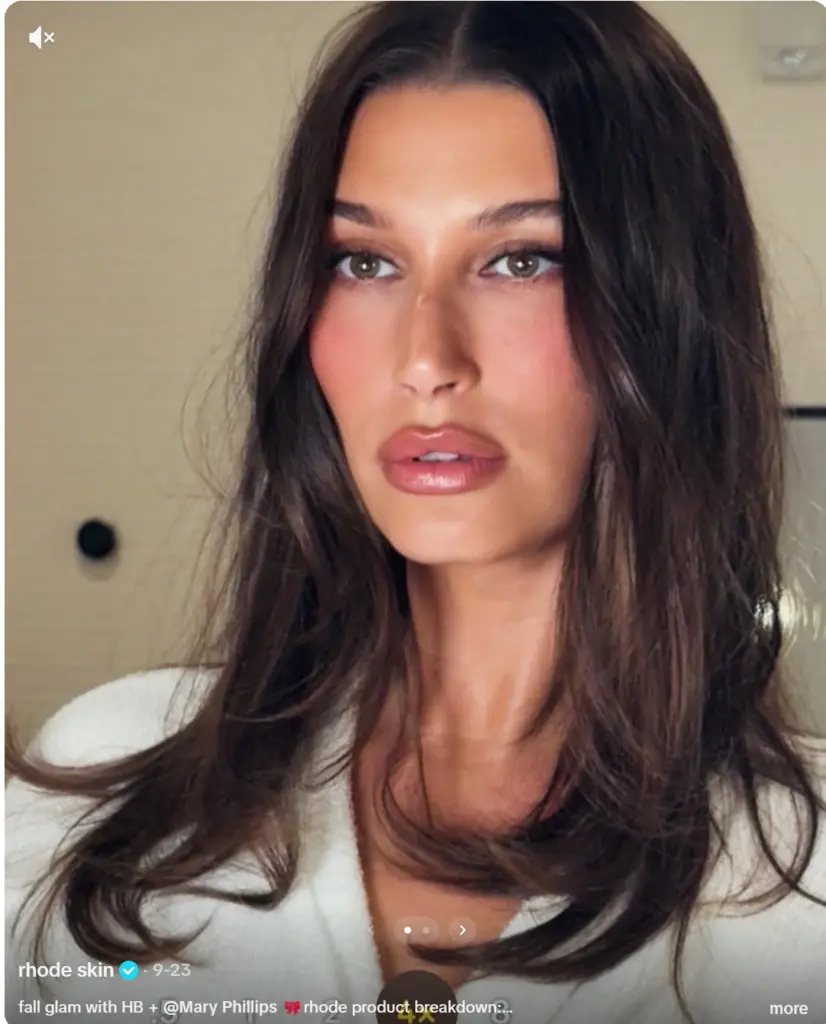
rhode's "fall glam" slideshow shows how much a single image can carry. It has two slides and no on-screen text. Slide 1 is a close-up of rhode founder Hailey Bieber with soft, bronzy makeup, flushed cheeks and glossy lips, looking straight into the lens. The phone camera's zoom buttons are still visible at the bottom of the frame, so it reads as a selfie rather than a campaign shot. Slide 2 is a flatlay of the products she used, and the caption names each one. That first photo handles the whole hook: it tells viewers the topic, shows the result they want and borrows the credibility of the person wearing it. The post earned a 9.09% engagement rate, more than double the benchmark.

- Source: Tiktok.com Rhode
BMW's M3 Touring slideshow has a strong text hook, "When someone calls me fast but that's the least interesting thing about me," over a clean front shot of the car on a race track. Its most striking image, the car drifting through a cloud of tire smoke, is on slide 3. The post landed at 3.20%, just under the benchmark. Moving the drift shot to slide 1 would put the best image behind the best line.
One of the posts we picked cuts against this rule, and it's worth understanding why. A rhode teaser for a new clip-on lip tint opens on a plain macro of a beige capsule with the logo, an image our analysis rated as generic. It still earned a 15.7% engagement rate, second only to Duolingo among the posts in this article. For rhode's 2.4 million followers, a capsule they've never seen before is news, so a picture that means nothing to a stranger works as a tease for a fan. The post also doesn't wait long for a face: slide 2 is Hailey's mirror selfie with a strawberry sticker on her forehead, which our analysis rated stronger than the opener. A product close-up can work as intrigue when your audience already knows the brand. When it doesn't, lead with a person.
The same logic applies to a video's opening frame. Gymshark's "calm mind, heavy lifts" montage opens on a lifter mid-flex, with no text and no voiceover. The image got people to pause (the video passed 4.2 million views), but with nothing telling them what the post was about, engagement settled at 1.71%. Rihanna's launch video for Fenty Beauty's new foundation opens on a macro of the shade label and cuts to her face within the first second, so viewers know the product and the person before anyone says a word.
How to apply it:
- Cover the text on your first slide and look at the image alone. If it doesn't provoke a reaction, swap it.
- Choose a face with a clear expression, or a person who visibly has the result, over a neutral product shot.
- If your most striking image sits on slide 3, move it to slide 1.
- Use a real, engaging photo when you have one. AI-generated images can also work.
- Test the same text over several first images and keep the one that lands.
6. Make Sure the Video Pays Off the Hook
Every claim, shock or promise in the hook has to be delivered by the rest of the video. Bait backfires, because viewers who feel tricked swipe away even faster than viewers who were never interested.
That's not an argument for timid hooks. A bold hook should state something true in its strongest form. It shouldn't promise more than the video can show.
Sephora's video for the same Fenty Beauty foundation, Pro Filt'r Fluid Flex, stars Rihanna and sets up a real pain point. She says "Shade matching is so hard" across three playful takes, then tells viewers to go to Sephora and get shade matched. "With what?" A Sephora staffer holds up a beauty device, and the video ends there. The device is never shown scanning a face or finding a shade, and there's no before-and-after. The hook promises a fix for a frustrating problem and delivers a product shot. Despite 7.8 million views, the video has 147 comments.
@sephora You heard the queen. @Rihanna ♬ original sound - Sephora
Our analysis suggested a simple restructure: show obviously wrong shades first, then the device scan, then a tight before-and-after of the perfect match.
Scrub Daddy's video shows the other side. A fan asks for a product, and the brand answers her directly: new products take time, and a bottle brush is coming. The hook asks a real question, and the video gives a real answer.
Even strong posts can leave a promise half-kept. Rihanna's own launch post promises "50 perfected shades" in its caption, but the video only shows the foundation on her skin tone.
How to apply it:
- List everything your hook claims or promises, then check that the video delivers each one.
- Write the hook from the video's main point instead of drafting it separately.
- Sharpen the wording of a true claim rather than inventing a bigger one.
- Cut any opening line the rest of the video doesn't pay off.
7. Put a Text Hook on Screen, Separate From Captions
People can read a few words on screen faster than they can make sense of an image or a spoken sentence. That makes on-screen text the quickest way to tell viewers what your video is about, and unlike the spoken hook, it still works for anyone scrolling with the sound off.
Captions transcribe what's being said. A text hook works like a headline: larger, placed near the top of the frame and visually distinct from the caption track. It can repeat the spoken line as long as it's styled as a headline. The strongest text hooks pair the subject with one lever: a pain point, a desired outcome or a change.
In the same creative guide, TikTok found that 40% of the auction ads with the highest view-through rates use concise, informative text overlays.
Gymshark's Chris Bumstead video shows what a missing text hook costs. It opens on a cinematic shot of Bumstead talking in his car with nothing written on screen, and the first clear spoken line arrives at 2.8 seconds. Bold kinetic text ("PEOPLE WILL WAIT FOR YOU.") does appear later, but only after the hook window has closed. Star power still carried the video to 9.7 million views, but its 2.19% engagement rate sits below the benchmark. Our breakdown suggested putting the most quotable idea on screen from the first frame: "No one cares if you're five minutes late."
@gymshark @Chris Bumstead’s lesson of the day. #cbum #cbumedit #mindset #motivation #Gymshark ♬ original sound - Gymshark
Several videos in this article get this right. Duolingo spells out "I'm feeling TREMENDOUS" in its own app's word tiles, starting half a second in. Chipotle keeps "Chipotle Honey Chicken." in the top third of the screen from the first frame through the third second. And rhode runs "Toasted teddy will always be the perfect fall blush" over a live application of the blush, which names the shade and the outcome in one line.
How to apply it:
- Put a headline near the top of the frame and keep word-for-word captions smaller at the bottom.
- Build it from the subject plus one lever: a pain point, a desired outcome or a change.
- Write the text after the visual and spoken hook are set, so it reinforces them instead of introducing a new idea.
8. Make Words, Text, Visuals and Sound Say the Same Thing
Viewers check what they hear against what they see. If the spoken line points one way and the footage points another, the hook stops making sense, and the viewer is gone.
Duolingo's "I'm feeling tremendous" video is the best example in this article, and its numbers show it. Within five days of posting, it had a 16.4% engagement rate (more than four times the Socialinsider benchmark) and 32,800 saves. Every lyric of the trending audio is acted out literally:
- "Now people clap when I finish up a sentence" plays over a Duolingo lesson where a sentence gets completed and a crowd cheers.
- "Now they build a statue to honor my existence" cuts to Duo posing in front of a giant statue of himself.
- "Now I got the president filling up my mentions" lands on a phone full of DMs, including one from the "ceo of brawl stars."
@duolingo i’m feeling TREMENDOUS (spike is not) 🎤: @Ray William Johnson @Your Favorite Martian 🎨: @leah 🤢: @Brawl Stars (s/o @Wrahya ♬ original sound - elmer.2847
The sound, the text, the visuals and the product's own interface say the same thing at the same moment. TikTok's creative guide recommends this exact technique, suggesting brands tell stories through music by "re-contextualizing lyrics or interpreting them literally."
Alignment can even rescue a line that makes no sense on its own. Scrub Daddy's fan says, "I would like this on top of this so that I can do this with a stick." Played as audio alone, it's gibberish. On screen, each "this" is a sponge, a brush or a scrubbing motion, and the meaning is instant.
Shopify's "three AI updates" video shows the opposite problem. For most of its 55 seconds, the host describes features viewers can't see. The camera stays on the same talking-head shot until a brief product screen near the end, so the words make claims the footage never confirms.
How to apply it:
- Watch your hook muted, listen to it without looking, then read the text on its own. All three should point to the same video.
- Open by saying what the viewer is looking at.
- Cut to the shot that proves a spoken claim right after you make it.
- Match the music and sound effects to the tone of the claim.
9. Lead With Your Strongest Material
Go through your video and find its most surprising claim, result or visual. If it shows up well after the opening while the hook uses weaker material, you've buried your best asset where most viewers will never reach it.
A video filmed in a Chipotle kitchen to promote the new Chili Lime Chips (tagged #chipotlepartner) shows how this happens. It opens with "I'm gonna give you guys a test with our new chili lime chips," then walks through turning on the fryer, weighing out 18 ounces of chips and frying them for a minute. The most craveable moment, chips dunked in queso and an enthusiastic "I promise you, it will not disappoint," arrives around the 55-second mark of a 59-second video. It reached 14.5 million views and a 0.36% engagement rate. Our analysis recommended moving a first bite and reaction into the first five to seven seconds, then cutting back to the steps.
Shopify's Horizon video buries its best moment the same way. Its most striking footage, an AI tool turning a typed description into a new storefront section, appears about 30 seconds into a 33-second video.
How to apply it:
- Find the single most surprising line, result or visual in your video and move it to the first sentence or the first three to five seconds.
- Show the result first, then rewind to how you got there.
- If you have several angles, lead with the one that's easiest to grasp and most surprising.
10. Start Story Posts in the Middle of the Action
Stories are some of the most watchable content on TikTok, but they're easy to open badly. The instinct is to set the scene first, and on TikTok, the scene-setting is where viewers leave. Open on the incident or the stakes, and add background only when viewers need it to follow along.
Chipotle's honey chicken video starts mid-rant. There's no "so the other day I was thinking about Chipotle." The first words, "We want honey chicken. Chipotle, please bring it back," come from a fan who is already worked up. The story (fan demand, then a cinematic food reveal and a 4/28 return date) begins at its most emotional point and builds from there.
Sephora's Fluid Flex spot opens the other way. A warm-up of "Action," laughter and another "Action" comes before the first line with any content, at 7.6 seconds. It's charming behind-the-scenes material, but it sits in front of the stakes instead of after them.
How to apply it:
- Open on the incident ("Our bestseller sold out in 11 minutes, and then the site went down") or on the stakes ("We had 48 hours to fix 3,000 wrong orders").
- Cut any background viewers don't need to understand the first line.
- On a slideshow, open on the situation and stop before the turn.
A Pre-Publish Hook Checklist
Run every hook through these ten questions before you post. It takes about a minute.
| # | Rule | Ask yourself |
|---|---|---|
| 1 | Topic is clear | Could a stranger name the subject from the first three seconds alone? |
| 2 | Reason to care | What does the viewer gain, fix or find out by watching? |
| 3 | First-listen clarity | Could any sentence in the hook be read two ways? |
| 4 | Curiosity gap | What question does the hook leave open, and does it accidentally answer it? |
| 5 | First image | With the text covered, does the first image or frame provoke a reaction? |
| 6 | Payoff | Does the video deliver every promise the hook makes? |
| 7 | Text hook | Is there a headline on screen, separate from captions, that names the subject? |
| 8 | Alignment | Muted, audio-only and text-only, do all three point to the same video? |
| 9 | Strongest material | Is the video's best moment inside the first five seconds? |
| 10 | Story opening | Does the first line drop viewers into something already happening? |
The Takeaway: Earn the First Three Seconds
The best-performing posts in this article have little in common on the surface. Duolingo acted out a trending song lyric by lyric, Scrub Daddy answered one fan's request and rhode let a single photo of Hailey Bieber carry an entire slideshow. What they share is that viewers knew the subject almost instantly and had a reason to keep watching. The weakest ones had far more reach, and they lost people early anyway: a feature name where an outcome should have been, a taste test saved for second 55, a shade-matching problem the video never solved.
If we had to pick one habit to fix first, it would be burying the best moment. Of the posts in this article, six of the nine that landed below the 3.85% benchmark had something stronger later on than anything in their opening. Sometimes that's a deliberate payoff, like Chipotle's return date. More often it's a great shot sitting in the wrong place, like BMW's drift photo on slide 3. Find it, move it up and put the subject on screen in plain words. Then check that the ending keeps the promise the opening made.

SUGGESTED

How to Get More Views on TikTok (Proven Strategies That Work in 2026)
Learn how to get more views on TikTok with proven strategies algorithm insights and...

Instagram Reels Statistics Marketers Should Know in 2026
Explore Instagram Reels statistics for 2026 covering reach engagement watch time ideal...

10 Influencer Ad Elements That Actually Impact Conversion Rates
Build higher-converting influencer ads with practical strategies for hooks product demos...