
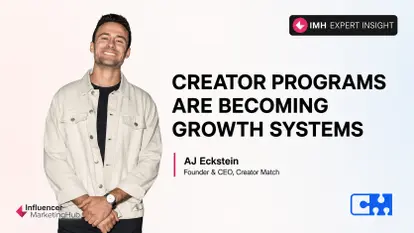
It is a surprising recommendation from AJ Eckstein, founder and CEO of Creator Match. His company manages creator campaigns for technology brands and recently approved $1 million in creator offers within a single week.
That milestone was the subject of our previous coverage. It showed how far Creator Match had moved from the approximately $2,000 LinkedIn creator experiments it offered during its early days. It also pointed toward a larger change in how brands approach creator marketing.
The next stage, according to Eckstein, involves building systems around those investments.
Creator partnerships increasingly sit alongside employee content, customer advocacy, live events, gifting, paid distribution, AI search visibility, and campaign measurement. The opportunity comes from connecting those activities so that each one strengthens the next.
“A real program has architecture behind it,” Eckstein said.
- A Creator Program Begins With Architecture
- The Strongest Creator Programs Begin Inside the Business
- Human Input Protects Content Quality as Volume Grows
- Events, Gifting, and Paid Media Create Connected Distribution
- Different Funnel Stages Require Different Creators and Metrics
- AI Search Adds Another Return on Creator Content
- Operational Infrastructure Determines How Far a Program Can Scale
- The First 30 Days Should Focus on Proof
A Creator Program Begins With Architecture
Brands frequently describe any recurring creator activity as a program. They pay several creators, collect the resulting posts, measure the initial response, and repeat the process during the next campaign.
For Eckstein, recurring activity becomes a genuine program when the brand can explain the strategic decisions supporting it.
A connected program makes deliberate decisions about the role of employee-generated content, user-generated content, and influencer-generated content. It determines where high-touch creator relationships will produce enough value to justify the added time and where a lower-touch, higher-volume model will be sufficient.
It also accounts for the differences between platforms. LinkedIn, YouTube, TikTok, and Instagram have their own content formats, audience expectations, creator economics, and definitions of strong performance. Distributing the same asset across every platform rarely captures those differences.
Content requires another strategic split. Evergreen creator content can continue answering questions and influencing decisions months after publication. Splash content concentrates attention around a launch, event, or other specific moment. Mature programs need a deliberate balance between the two.
The same principle applies to online and offline activity. Bringing creators together in person can produce relationships, access, and content that are difficult to manufacture through an asynchronous brief.
Eckstein does not recommend introducing every component at once. Brands can begin with one channel and one clear objective, develop a repeatable process, and expand once they have evidence that the approach works.
That architecture should be built gradually. Eckstein recommends establishing one component, proving that it works, and then adding the next. The strongest creator programs may eventually cover every layer, but attempting to introduce all of them simultaneously can prevent the company from developing any one component properly.
As Eckstein said:
The Strongest Creator Programs Begin Inside the Business
Eckstein divides creator content into three layers: EGC, UGC, and IGC.
The first is employee-generated content. Founders, executives, and employees share their perspectives on the work already happening inside the business.
This gives companies an accessible starting point. No creator budget has to change hands, and external usage rights or talent contracts are generally absent. The company can test its message, learn how to support individual voices, and generate early evidence for leadership.
Eckstein believes founders are especially important at this stage because audiences often develop stronger connections with recognizable people than with corporate accounts. Founder visibility can give a company a consistent point of view and a human identity.
The second layer is UGC. Some customers already praise products publicly. Others share positive experiences in emails, Slack communities, sales conversations, and customer feedback without ever being encouraged to publish those experiences.
Those customers bring something employees cannot: firsthand evidence from the buyer’s side of the relationship.
IGC, or influencer-generated content, becomes the third layer. Once a brand understands its positioning, ideal customer profile, and strongest messages, it can pay creators to interpret those ideas and distribute them to established audiences.
Creator Match applied the first part of this framework during a recent hiring campaign. Its designer created custom graphics for employees who wanted to participate, while Eckstein offered help reviewing drafts.
The campaign provided early evidence of how internal voices can become a distribution channel.
The three layers ultimately work best together. Employees establish trust and give the company a voice. Customers provide proof. Creators expand reach and introduce the brand to new professional communities.
Human Input Protects Content Quality as Volume Grows
One question followed Eckstein throughout Creator Economy Live East: How can brands scale creator programs while preserving their human quality?
His answer depends on what the campaign is designed to achieve.
A program involving dozens of creators and straightforward deliverables may operate effectively through a strong written brief and asynchronous communication. Adding live calls throughout the process can introduce delays without materially improving the content.
Higher-value partnerships require a different approach. When a brand works with fewer, more influential creators and needs the content to deliver a distinctive idea.
Eckstein’s approach concentrates human involvement at the point where it can have the greatest effect on the finished content.
That becomes particularly important for what he calls “infinite canvas products.” Tools such as Perplexity, Lovable, and Cursor can support many different use cases. A generic feature demonstration will struggle to show why the product matters to a specific audience.
Creator Match researches the creator before the briefing. The team studies the subjects they cover, the formats that have performed well, and the ideas they appear genuinely interested in exploring. The campaign concept is then developed with the creator during the conversation.
Eckstein argues that this additional attention at the beginning can make the overall process faster. A clear concept reduces later rounds of script feedback, edits, and revisions.
The brief also needs to separate consistency from creative control.
Eckstein recommends ending briefs with a checklist containing the elements that must appear in every piece of content. These might include the central message, product positioning, required use case, call to action, disclosure language, and legal requirements.
The creator retains control over the hook, format, story, tone, and personal angle.
When the checklist is covered, every creator can approach the campaign differently while preserving its central message. This gives creators enough freedom to sound like themselves without allowing the wider program to lose its coherence.
Events, Gifting, and Paid Media Create Connected Distribution
Eckstein describes the connection between offline experiences and online distribution as the bridge from “IRL to URL.”
An event can bring creators into the same room, but attendance alone produces limited value. The experience must give them access, moments worth documenting, and enough freedom to find a story.
Gifting plays a similar role. Eckstein treats a product gift as a creative input. Placing the product in a relevant context gives the creator an experience they can interpret for their audience, creating the raw material for content that feels more natural than a conventional product read.
Internal company voices can then add expertise and context. A group of external creators introduces the brand through different perspectives and professional communities. Paid distribution extends the strongest content beyond the people who encountered it organically.
Each activity should create something the next part of the program can use. Eckstein describes this as a connected pipeline rather than a collection of separate marketing line items.
Different Funnel Stages Require Different Creators and Metrics
Creator marketing has traditionally been divided between awareness and conversion. Eckstein believes brands need to decide which role each campaign will play before selecting creators or defining success.
Awareness campaigns are responsible for introducing the company, strengthening category recognition, and creating demand. Relevant indicators can include reach, CPM, engagement, changes in branded search, and qualified inbound interest.
Conversion campaigns capture existing demand. They can be evaluated through clicks, registrations, signups, pipeline, promotional codes, unique URLs, and self-reported attribution.
The two motions should reinforce one another throughout the program. Awareness continually creates demand while conversion activity gives interested buyers a path forward.
Creator selection should also correspond with the intended outcome.
Some creators have the reach and recognition required to place a brand on the map. Others have smaller audiences but exercise considerable influence over a specific professional community. Those creators may be better positioned to move someone from interest to consideration or signup.
Judging every campaign by immediate conversions can make effective awareness activity appear unsuccessful. Evaluating an awareness campaign solely through reach can create the opposite problem.
Eckstein recommends running demand creation and demand capture together, with separate responsibilities and appropriate measurement for each.
Paid amplification can strengthen that connection. On LinkedIn, Creator Match generally builds boosting into its creator programs. Paid distribution makes audience targeting possible, expands reach beyond the creator’s organic network, and provides additional performance data across the funnel.
It also gives campaign teams an opportunity to adjust spending while the program is active. Stronger content can receive more support, while budget can move away from angles or audiences producing weaker business results.
AI Search Adds Another Return on Creator Content
Eckstein sees a third objective emerging alongside awareness and conversion: visibility within AI-assisted search and answer platforms.
Creator content expands the body of publicly accessible information associated with a company, product, and category. Videos, articles, newsletters, transcripts, titles, product demonstrations, and comparisons can all provide context that search and answer systems may retrieve.
This places greater value on content that clearly explains what a product does, who it serves, and which problem it addresses.
On YouTube, for example, a dedicated video containing the brand or use case in its title offers stronger discoverability than a brief integration buried inside an unrelated video. The dedicated asset can also continue attracting viewers and answering category questions after the original campaign ends.
Creator briefs may therefore need to identify the terms, use cases, and comparisons the brand wants associated with its product. Those ideas still need to appear naturally within useful content. Repeating keywords without providing substance will add little value for the audience or the brand.
No individual creator placement can guarantee inclusion in an AI-generated answer. Collectively, however, useful creator content can expand the discoverable evidence available about a brand.
Eckstein sees this as a developing layer of creator marketing rather than a replacement for established campaign goals.
Operational Infrastructure Determines How Far a Program Can Scale
The visible side of creator marketing includes the ideas, personalities, and finished content. The infrastructure behind those campaigns determines how much activity a company can support reliably.
Creator Match’s $1 million week required dedicated systems for contracts and payments. At larger volumes, each relationship can involve different deliverables, approval processes, payment terms, usage rights, and representatives.
Some creators work through talent managers who negotiate each detail. Others manage their partnerships independently and expect to move quickly. Account management teams cannot absorb every contract and payment task indefinitely.
Creator Match developed dedicated payments and contracts functions as its campaign volume increased. According to Eckstein, many of those systems were built after a process failed and the company chose to correct the underlying problem.
That infrastructure establishes the practical ceiling for a large creator program.
Quality control creates another operational requirement.
Creator Match intentionally invests heavily in content review, even as campaign volume grows. Eckstein views bandwidth as a baseline agency responsibility. Protecting creator fit and content quality provides the more valuable service.
That requires retaining the research stage during casting, giving creators consistent contacts, offering substantive feedback, and paying them on time. Repeat relationships become easier to scale because both sides already understand the expectations and working process.
Over time, consistent quality can also build enough trust for a brand to allow content to go live without reviewing every asset individually. Eckstein says Creator Match has reached that level with several partners.
The First 30 Days Should Focus on Proof
Building a connected creator system does not require launching on every platform or introducing every content layer immediately.
For a brand beginning now, Eckstein recommends selecting one objective and one channel. The company can then activate a small group of employees, identify customers already sharing positive experiences, and establish a simple process for supporting and measuring the content.
Early wins do not need to transform company revenue. A few posts that outperform the company’s usual content, relevant inbound messages, increased branded searches, or signups traced to a creator can provide enough evidence to earn leadership support.
Once that proof exists, the company can introduce paid creators, amplification, additional content formats, and eventually another channel. Going deeply into one platform creates knowledge that a broad but shallow launch cannot provide.
For the first 30 days, Eckstein recommends choosing one objective and one channel, demonstrating that the approach can work, and then growing from that evidence.
Patience remains essential. B2B buying cycles can extend for months, and creator programs rarely generate their full return immediately.
That longer timeline matters as technology products become easier to build and competing feature sets become more similar. Eckstein believes the most durable advantages will increasingly come from assets that develop through consistency and relationships.
Sponsored posts can generate a moment of attention. A connected creator program builds voices, relationships, content, distribution, operational knowledge, and demand that continue strengthening one another.

SUGGESTED

Creator Match’s AJ Eckstein to Speak at Creator Economy Live East After a $1 Million Week
Creator Match’s AJ Eckstein will emcee Creator Economy Live East after approving $1...