

Grüns launched its superfood gummies back in August 2023. Less than three years later, Unilever acquired the business in a deal estimated at $1.2 billion.
That growth began with a relatively simple idea: make comprehensive daily supplementation easier to enjoy. But bringing the concept to market was only part of the challenge. Grüns also needed to convince consumers that a packet of gummy bears belonged in their daily wellness routines.
Influencer marketing became an important part of that effort.
Across TikTok and Instagram, creators introduced the gummies through familiar situations, from busy parents forgetting their vitamins to consumers looking for an alternative to greens powders. Grüns supported these different messages with audience-specific advertising, subscription offers, brand partnerships, and an expanding retail presence.
In this Brand Story, we'll explore how Grüns developed its daily gummies, built its influencer marketing strategy, what our HypeAuditor analysis reveals about its creator network, and how the company connects social discovery with customer acquisition, subscriptions, and retail growth.
- How Grüns Turned Greens Powder Frustration Into a Daily Gummy Supplement
- How Grüns Built Its Influencer Marketing Strategy Across Different Wellness Audiences
- What Our HypeAuditor Analysis Reveals About Grüns' Instagram Influencer Network
- How Grüns Connects Creator Messaging With Audience-Specific Advertising
- Grüns' Product Collaborations Create New Opportunities for Creator Content
- How Grüns Connects Daily Wellness Routines With Subscriptions and Retail Growth
- Why Grüns' Influencer Marketing Strategy Works Across Different Audiences
How Grüns Turned Greens Powder Frustration Into a Daily Gummy Supplement
Grüns founder Chad Janis came up with the idea in 2022, shortly before starting his MBA at Stanford.
He had recently begun drinking a greens powder but already disliked the experience. The taste, frothy sediment, preparation, and prospect of keeping a mixing bottle on his kitchen counter made it difficult to imagine maintaining the habit.
Janis began looking for a more enjoyable way to consume comprehensive nutritional supplements.
Developing the product proved difficult. Most manufacturers he approached were unwilling to attempt the formulation. Once he found a willing partner, the gummies went through multiple iterations, with approximately a quarter of his Stanford classmates testing early versions.
Even the packaging required experimentation. During the company's early months, workers manually packed gummies into individual daily servings before Grüns developed a more scalable process.
Those decisions helped shape how consumers would eventually encounter the product.
A single-serving packet is easy to carry, open, and consume. It also gives creators a straightforward product demonstration. One TikTok creator explains that they dislike greens drinks before showing their Grüns packet and describing the flavor. Others make the same comparison through taste tests or morning routines.
@cloud9sales Love these Gruns gummies! #gruns #grunsgummies #vitamins #tiktokshopbacktoschool ♬ original sound - Cloud9sales
The original product proposition translates naturally into content: Grüns offers a different experience from preparing and drinking a greens powder. That connection between product design and everyday behavior would become an important feature of its influencer marketing.
How Grüns Built Its Influencer Marketing Strategy Across Different Wellness Audiences
Grüns entered a crowded supplement market with a product that could be introduced through several different consumer needs. Rather than relying on a single wellness message, its creator strategy helped position the gummies within existing routines and communities.
Influencer marketing was part of the company's early development. Founder Chad Janis has credited the influencer team with building creator relationships at scale, alongside the company's investments in advertising, ecommerce, and retail distribution.
The result is a creator presence that extends from everyday wellness recommendations to established influencers and broader brand partnerships.
Everyday Creators Make Grüns Part of Familiar Wellness Routines
Some of the most interesting Grüns content comes from creators discussing ordinary frustrations.
One mother questions why she remembers everyone else's snacks but regularly forgets her own vitamins. She presents Grüns as something she actually looks forward to consuming, describing the gummies as feeling more like a treat than another task on her daily checklist.
@growingwithlanail GRUNS #tikshopfinds #vitamins #gruns #sahm #probiotics ♬ original sound - Lanail Hamilton
Another creator explains that she decided to try Grüns after repeatedly encountering the gummies on social media. Her review moves from that initial familiarity into her first impressions of the taste and texture, demonstrating how repeated exposure can contribute to product curiosity.
@clareeecella @Grüns you might be my new obsession 🧸 stayed tuned!!!#gruns #guthealth #greengummies #morningroutine #vitamin ♬ FALLING RIZLAS - Actress
Other creators incorporate the gummies into travel routines, morning habits, or conversations about digestive wellness.
These videos approach the product from different directions, but they communicate a similar proposition: daily supplementation can fit into an existing lifestyle.
The approach also lets Grüns reach audiences who might never actively search for greens supplements. A parent following family content, for example, can encounter the gummies through a familiar situation rather than a conventional nutritional advertisement.
Importantly, creator reactions are not uniformly positive.
One reviewer explains that she purchased Grüns after seeing numerous influencer recommendations, only to find the taste extremely unpleasant. Her dissatisfaction provides an interesting contrast to the enthusiastic recommendations found elsewhere on TikTok.
@debonair_danny Sorry Gruns, we need to do something about the taste. 👀 #gruns #fyp #gross #bad #vomit ♬ som original - SuperWave RetroHits - Art Bove
These responses reveal an important consideration for supplement marketers. Creator recommendations can encourage trial, but repeat purchasing ultimately depends on the customer's own experience.
Influencer Partnerships Introduce Grüns to Established Communities
Grüns has also worked with recognizable personalities, including Bethenny Frankel and Jessie James Decker.
These relationships give the brand opportunities to reach established lifestyle audiences, complementing the more personal product demonstrations created by smaller accounts.
Its partnership with Gotham FC places Grüns within an athletic community, connecting daily wellness with an existing sports audience.
Other high-profile associations include celebrity investors Anna Kendrick and Shaun White, whose investment relationships should be distinguished from influencer campaigns.
The different partnerships serve different potential purposes. Everyday creators can demonstrate product usage, established influencers can introduce Grüns to larger audiences, and sports or cultural partnerships can connect the brand with existing communities.
Together, they suggest a strategy designed to build familiarity across multiple environments rather than depending on a single celebrity endorsement.
What Our HypeAuditor Analysis Reveals About Grüns' Instagram Influencer Network
Grüns' publicly announced partnerships offer one view of its influencer strategy. But how far does the brand's visibility extend beyond those relationships?
To examine the wider network, we used HypeAuditor to analyze Instagram mentions of @grunsdaily from the past six months. The analysis identified 922 mentions from 724 influencers, revealing activity across a much broader group of accounts.
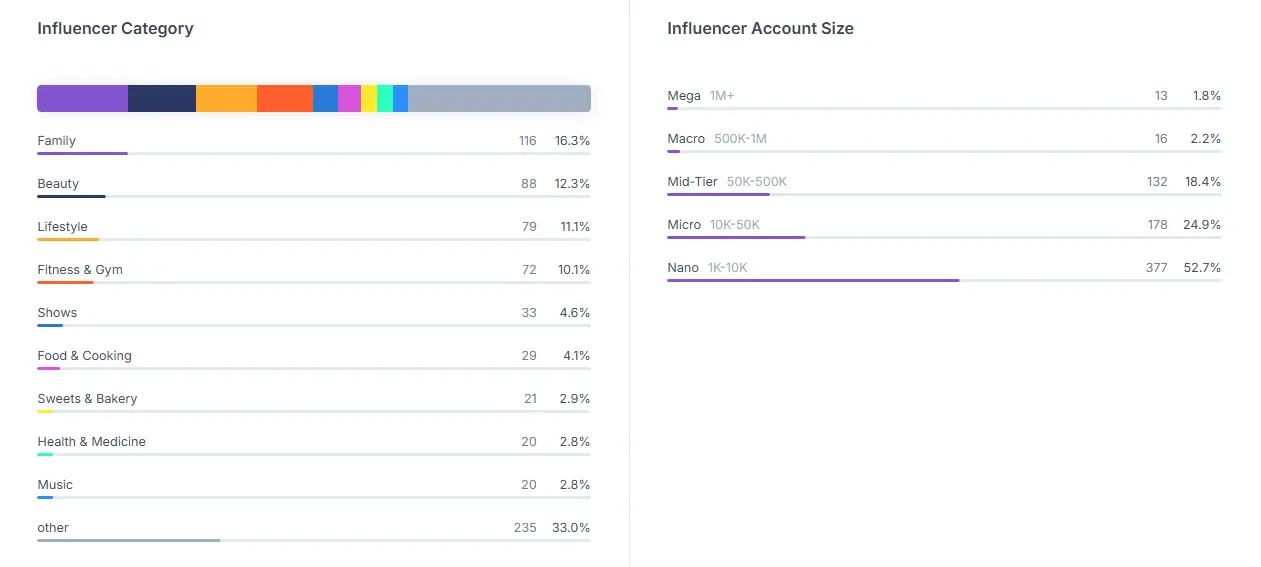
Family creators formed the largest identifiable category, followed by beauty, lifestyle, and fitness accounts. The network also included shopping-oriented publishers such as @costcofinds.armina and @costcodeals.
This variety matters because Grüns can appear in content about everyday wellness, household routines, fitness, and product discovery. Each environment introduces the brand through a different audience interest.
Smaller accounts dominate the network numerically. Of the 716 influencers included in HypeAuditor's size classification, 377 were nano creators and 178 were micro creators.
Together, these groups represented approximately 77.5% of the classified accounts.
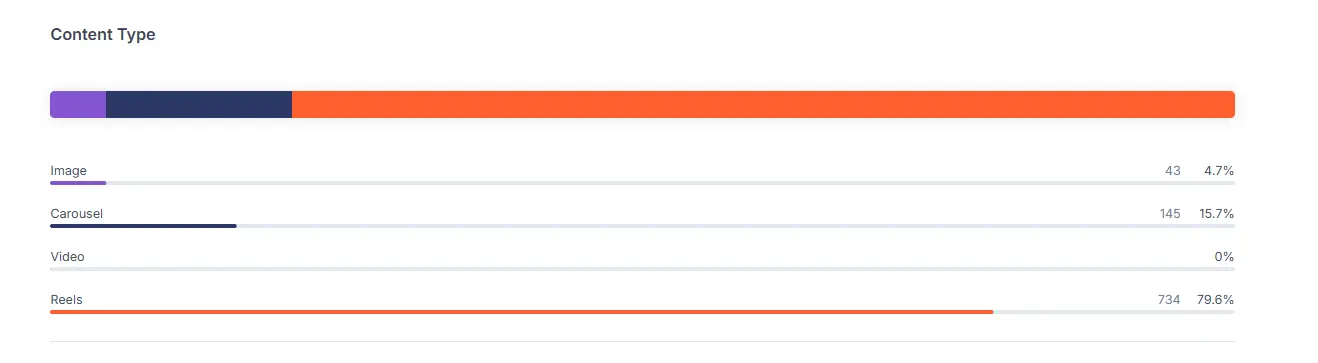
Short-form video was equally prominent. Reels accounted for 734 of the 922 mentions, a format well suited to opening packets, testing flavors, and showing daily routines.
The commercial classification reveals another interesting pattern. HypeAuditor identified just 42 sponsored mentions and 148 likely sponsored mentions, while classifying the remaining 732 as organic.
That suggests Grüns' Instagram presence extends considerably beyond explicitly sponsored content. However, organic classifications do not rule out gifting, affiliate relationships, or other forms of commercial involvement.
Engagement also varied. HypeAuditor reported an average campaign engagement rate of 0.55%, categorized as low, despite favorable cost-efficiency assessments for many influencers.
The broader picture is therefore one of substantial creator participation rather than consistently exceptional engagement. What the analysis cannot establish is which accounts generated customers, how much Grüns paid individual creators, or how the visibility translated into sales.
It does show that the brand appears across numerous smaller accounts and content communities, giving Grüns multiple opportunities to enter consumers' everyday feeds.
How Grüns Connects Creator Messaging With Audience-Specific Advertising
The variety of messages appearing in Grüns' creator content also reflects a broader feature of its advertising strategy.
The same daily gummies can be introduced to consumers interested in digestive wellness, fiber intake, everyday nutrition, or alternatives to greens powders.
Grüns develops advertising around these different motivations rather than depending on a single product description.
In an interview about the company's ecommerce operations, Michael De Lia explained how its creative strategy team identifies customer personas and tests messaging for specific audiences.
When an approach shows promise, other teams develop corresponding landing pages and purchasing offers.
For example, advertising aimed at consumers interested in fiber can lead to a page that addresses that concern. Someone exploring alternatives to greens powders may encounter different creative messaging and product comparisons.
The TikTok content offers a useful illustration of how these audience distinctions appear in creator recommendations.
One creator addresses the GLP-1 community directly, presenting Grüns within her personal supplementation routine while comparing flavors, describing the convenience of individual packets, and discussing her own experiences.
@amy_glp1_journey #gruns #fypシ #fyp #creatorsearchinsights #glp1community ♬ 30 Minutes of Silence - Silenzio
That example shows how a creator can frame a broad nutritional product around a particular audience's concerns, without establishing that the product provides specific medical benefits.
Grüns also experiments with formats such as advertorials, listicles, and gift-with-purchase offers to support these customer journeys. The process involves coordination between creative strategy, conversion optimization, and ecommerce operations.
De Lia acknowledges that excessive personalization can produce diminishing returns. The company evaluates whether individual segments can attract enough customers to justify additional investment.
This is where the relationship with creator marketing becomes particularly interesting.
Creators introduce Grüns through recognizable personal experiences, while paid advertising applies similar audience distinctions through a structured acquisition process.
The available evidence does not establish that every creator video is reused as an advertisement. What it reveals is a consistent marketing principle: different customers can be introduced to the same product through different needs.
Grüns' Product Collaborations Create New Opportunities for Creator Content
As Grüns expanded, limited-edition products and collaborations gave the company additional opportunities to reach consumers beyond its core nutritional messaging.
Its partnership with Popsicle provides a particularly useful example.
Grüns introduced Firecracker gummies and developed a summer campaign called The 40-Day Weekend, connecting the product with familiar seasonal experiences.
According to Grüns Brand & Strategic Partnership Manager Sam Temmins, the activation began with a Chicago street team distributing samples and promoting an upcoming event.
A TikTok Shop livestream extended the campaign beyond the physical activation.
The main event at City Winery on the Riverfront brought together product sampling, workouts, cold plunges, music, games, and other summer activities. The creative idea was to associate the flavor with the recognizable experience of enjoying a Popsicle during summer.
That gave Grüns a reason to appear in lifestyle and event content, while offering consumers a chance to experience the product firsthand.
The same approach appears in other releases.
Grüns has developed seasonal flavors, a Grinch-themed product, and a collaboration with Once Upon a Farm focused on children's nutrition.
These launches provide fresh material for brand channels, creators, and retail promotion. They also give existing customers additional reasons to engage with the brand.
Rather than relying exclusively on the ongoing need for daily supplementation, Grüns creates new products and experiences that can reintroduce the brand to familiar and adjacent audiences.
How Grüns Connects Daily Wellness Routines With Subscriptions and Retail Growth
Creator content helps explain why someone might want to try Grüns. The company's commercial model is designed around what happens after that first purchase. Daily consumption creates opportunities for recurring orders, while an expanding retail presence gives consumers several ways to find and purchase the products.
Subscriptions Turn Daily Consumption Into Recurring Purchases
Grüns built subscription functionality into its ecommerce business from the beginning.
According to a Shopify case study, subscriptions account for more than 90% of company revenue. The company also reports that 80% of subscribers consume Grüns daily, while approximately 94–96% take the product at least four to six times weekly.
Those figures are significant because they connect the founder's original objective of making daily supplementation enjoyable with reported consumption habits.
We can also observe how creators reinforce the idea of regular consumption.
In one TikTok video, a creator describes finishing a long day and reminds viewers to take their Grüns. She explains that she takes a packet daily and discusses her personal reasons for continuing the routine.
@bright.smile.mama Just your daily reminder to take your gruns! They are such a good helper for gut health #gruns #tiktokshopstockup #guthealth #vitamins ♬ original sound - Ashlei | Curvy Fashion
Although the video does not confirm that the creator is a subscriber, it illustrates the habit-oriented messaging that fits Grüns' recurring-purchase model.
It also explains the company's focus on customer lifetime value.
Janis has discussed evaluating acquisition costs against the longer-term value of customers. A consumer who continues purchasing through a subscription represents a different commercial opportunity from someone making a single order. Grüns supports the subscriber experience through limited-edition flavors and the ability to switch upcoming shipments to new variations.
In August 2026, the company also reduced its standard single-subscription price from $59.99 to $49.99, citing improvements in supply-chain efficiency.
These decisions create opportunities to maintain customer relationships beyond the initial advertising or creator interaction. They do not, however, establish how much subscription revenue was directly generated by individual influencers.
Retail Distribution Gives Social Discovery More Paths to Purchase
Grüns initially developed through direct-to-consumer ecommerce before expanding into Amazon and national retailers. The company's retail presence eventually included Sprouts, Target, Walmart, Costco, and Sam's Club.
By the time of Unilever's acquisition, Grüns reported shipping approximately 10 million gummies daily across its portfolio.
Retail expansion matters because social discovery and purchasing do not necessarily happen through the same channel.
A consumer may first encounter Grüns through a creator's recommendation, compare products online, and purchase a packet during a regular shopping trip. The retail-discovery accounts identified in our HypeAuditor analysis provide another context in which shoppers can encounter the brand.
Grüns' distribution strategy therefore complements its influencer and advertising activities by making the products available through familiar purchasing environments.
The company has also expanded into additional supplement categories, including Nütrops, Immün, and Jüced, providing opportunities to serve different consumer needs. Together, these developments help explain how Grüns supports a business built around recurring daily consumption while reaching customers through multiple channels.
Why Grüns' Influencer Marketing Strategy Works Across Different Audiences
Grüns' growth began with a product-design decision that addressed a familiar consumer frustration. Its gummy format and single-serving packets made daily supplementation more convenient while giving creators a product they could easily demonstrate.
The company then developed different ways to introduce that experience to consumers.
Smaller creators brought Grüns into everyday routines, established partners introduced it to larger communities, and audience-specific advertising connected different consumer interests with relevant purchasing experiences.
Subscriptions supported recurring purchases, while retail expansion made the product more accessible.
Limited-edition flavors and collaborations provided additional reasons for consumers and creators to engage with the brand.
The strength of Grüns' approach lies in how these activities support one another. Product design makes the experience easy to communicate, creators make it relevant to different audiences, and the wider business provides ways to purchase and continue using the gummies.
That interconnected strategy offers a more meaningful explanation of Grüns' growth than any individual viral post, celebrity partnership, or advertising campaign.

SUGGESTED

How Caraway Used Influencer Marketing to Make Cookware a Lifestyle Purchase
Explore Caraway’s influencer marketing strategy and how creators turned its cookware...

Top Supplements & Vitamins Influencer Marketing Campaigns
Influencer marketing in supplements thrives on authenticity long-term partnerships and...

Top Supplements & Vitamins Social Media Marketing Campaigns
Explore top supplements and vitamins social media campaigns strategies and results across...