
A creator can spend hours developing an idea, filming several takes, editing the final video, and packaging a product into a story their audience actually wants to watch.
The video performs. It generates views, introduces the product to new people, and pushes some of them closer to buying. Yet unless those viewers complete a specific action, the creator may earn nothing from the attention they generated.
That is one of the biggest gaps in content creator monetization. Affiliate programs reward tracked sales. Flat-fee partnerships depend on securing the next deal. Native platform programs come with eligibility requirements.
In each case, a creator’s ability to earn can be disconnected from the immediate performance of their content.
The money flowing into the creator economy has done little to remove this uncertainty. As per our latest influencer marketing statistics, found that the top 10% of creators received 62% of creator payments last year, up from 53% in 2025. A larger market does not automatically mean more consistent earnings for the creators producing the content.
CPM paid-for-view campaigns offer another route. Through MyyShop, creators can earn from qualified views generated by approved campaign videos. They can also submit multiple original videos to the same campaign, creating more than one opportunity to earn.
Selected no-sample opportunities shorten the process further by allowing eligible creators to start without waiting for a physical product to arrive.
For smaller TikTok and UGC creators, that can create a new route between publishing content and getting paid.
- Why Creator Income Still Feels Unpredictable
- Views Have Value, Even When They Do Not Immediately Convert
- How MyyShop's Paid-for-View Campaigns Work
- Why CPM Monetization Can Work for Smaller Creators
- One Campaign Can Create Multiple Earning Opportunities
- Predictability Starts With Clear CPM Reporting
- How MyyShop Supports a More Repeatable CPM Workflow
- Build a More Repeatable Paid-for-View Workflow
Why Creator Income Still Feels Unpredictable
Creator income rarely follows the same rhythm as creator work.
Content must be planned and produced consistently, but brand opportunities can arrive in bursts. Affiliate revenue changes with product demand, pricing, seasonality, and customer behavior. Platform reach can rise or fall without warning. Payment may then take weeks to arrive after the work has been completed.
Even the numbers used to describe creator earnings can conceal how unevenly income is distributed.
Creators paid through CreatorIQ earned an average of $11,400 in 2025, while the median creator earned only $3,000. The distance between those figures indicates that a relatively small number of large payments can make the typical result appear much stronger than it is.
Research from NeoReach presents a similar picture. The 2025 Creator Earnings Report found that 50.71% of creators earned less than $15,000 annually. Nearly 57% of full-time creators earned below the report’s $44,000 US living-wage benchmark from content alone.
For KOCs, UGC creators, and micro-influencers, the problem is not necessarily an inability to create valuable content. It is that many payment models recognize only a narrow part of the value they produce.
Consider what happens after someone watches a product video. The viewer may remember the brand, search for reviews, compare alternatives, visit a store, or purchase several days later from another device. The creator contributed to the decision, but conventional affiliate attribution may never connect that value back to the original content.
CPM paid-for-view campaigns recognize an earlier, measurable part of that journey. Creators can earn when approved videos generate qualified views during a defined campaign period, rather than depending entirely on a completed purchase.
When a campaign accepts multiple submissions, creators can also spread their earning potential across several original videos instead of relying on one piece of content to perform. Earnings remain performance-dependent, but the event that produces them becomes clearer.
Views Have Value, Even When They Do Not Immediately Convert
A view is not the same as a sale, but it is not commercially meaningless.
Before someone can purchase a product, they need to discover it. They may need to see it in use, understand the problem it solves, or hear about it from someone they trust. Creators regularly perform all of those functions before a customer reaches a product page.
@sydneymohni UGC Beginner Starter Pack: How to Create a Product Demo That Actually Gets You Paid Most creators overcomplicate product demos when really, the formula is simple—and it works every time. Here’s what your demo must have: 🍒 1. A Problem OR Desired Result → Hook viewers in by making them care about what you’re about to show them. 🍒 2. A Clear Product Demonstration → Don’t just show the product—show it in action while naturally weaving in value props. 🍒 3. A Before & After OR End Result → Give the audience a visual payoff so they see the transformation. And let’s talk HOOKS. ❌ “Here’s my favorite coffee concentrate!” → No one cares. ✅ “I used to spend $7 a day on lattes until I found this.” → Now we’re listening. A good demo isn’t just a tutorial—it’s a persuasive piece of content that makes viewers think, “I need that.” Show how the product improves your life, keep it engaging, and make every second count. Got questions? Drop them below!
Their contribution is visible in the scale of the attention they generate.
Across Fortune 100 companies, creators produced 33 times more brand-related content than brand-owned channels. That content generated 11 times more impressions and 14 times more engagement across TikTok, Instagram, and YouTube.
Those results show why conversion-only compensation can leave part of a creator’s contribution unrecognized. It pays for the final measurable action while assigning little direct value to the discovery and consideration that came before it.
CPM campaigns address this gap by assigning a rate to qualified attention. Through MyyShop’s “paid for every view” opportunities, creators can submit campaign content for review and earn according to the eligible views generated by approved videos.
The advertiser sets the CPM and campaign conditions. If multiple submissions are permitted, each approved original video can generate its own eligible views during the campaign period. More purposeful content therefore creates more opportunities to earn, provided every submission follows the brief and passes review.
The distinction matters. Affiliate income asks, “Did this person buy?” CPM-based income asks, “How much qualified attention did this approved content generate?”
Creators still need relevant products, effective content, and genuine audiences. Views do not guarantee stable income on their own. However, rewarding qualified attention gives successful content another way to produce measurable financial value.
How MyyShop's Paid-for-View Campaigns Work
View-based campaigns compensate creators according to the measurable attention their content generates. Instead of making every earning opportunity dependent on a completed sale, the campaign assigns value to eligible views.
MyyShop’s “paid for every view” commercial orders appear under the Opportunities section. Advertisers set the campaign budget and applicable CPM, with example rates ranging from $4 to $12 per 1,000 eligible views.
The creator workflow typically follows five steps:
- Join an eligible paid-for-view campaign.
- Create and publish an original video that follows the campaign brief.
- Upload the published video for the advertiser to review.
- Receive approval and begin earning from eligible views.
- Track the approved video’s performance through the submission details.
Some campaigns accept multiple original submissions. In those cases, creators can publish and submit more than one qualifying video, giving each approved piece an opportunity to generate payable views.
If a campaign offers a $5 CPM and an approved creator video generates 20,000 qualified views during the campaign period, the calculation would look like this:
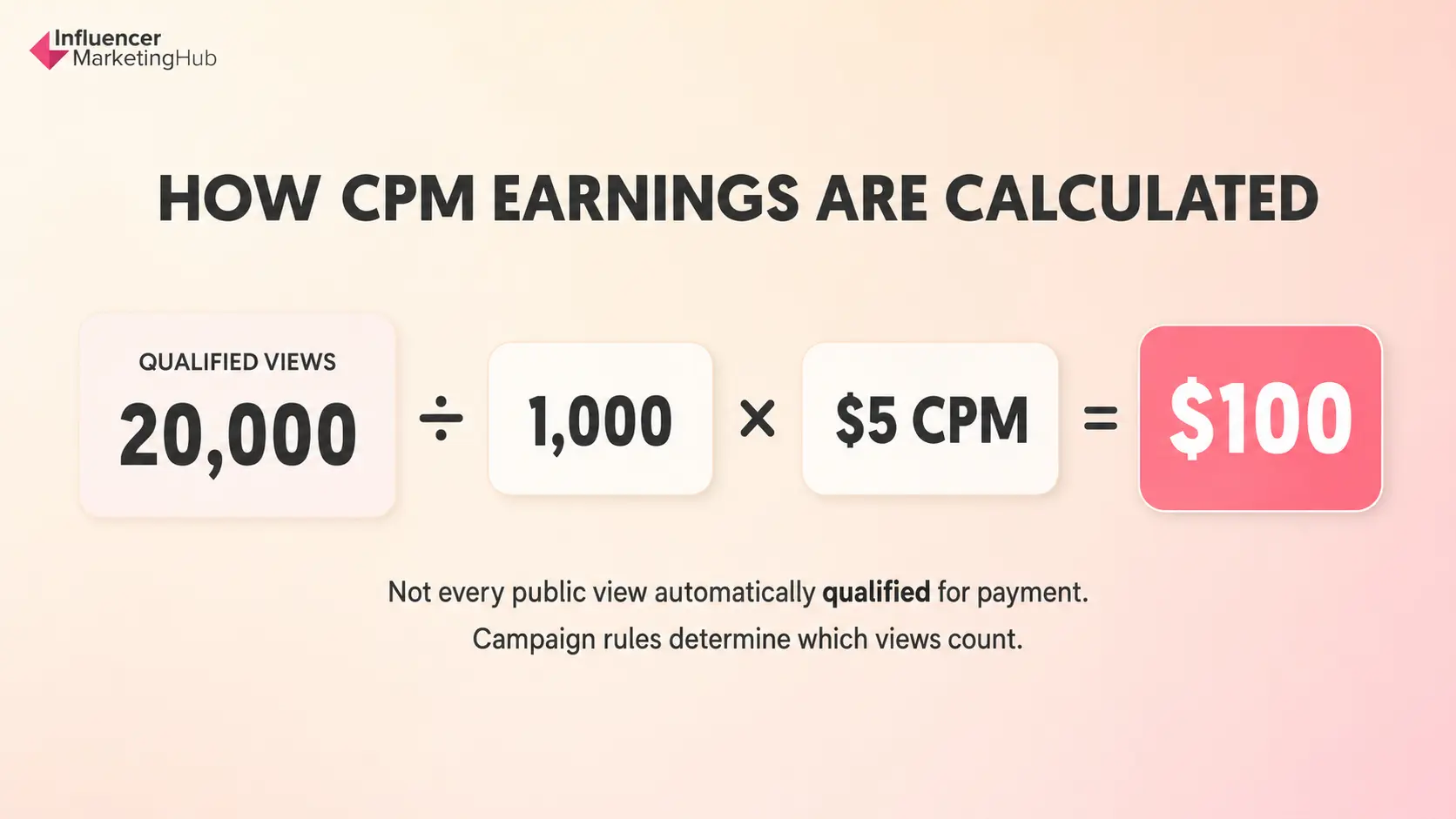
The keyword is qualified. A video may display one view count publicly while the campaign records a different number for payment purposes.
Campaign rules can determine which views qualify according to:
- The viewer’s location
- The campaign period
- Content approval status
- Originality requirements
- Fraud and artificial-traffic detection
- View or earnings caps
- The platform on which the content appears
Creators should review these conditions before joining a campaign. A clearly stated CPM means little if the qualifying criteria, tracking period, or maximum payout remain unclear.
Each campaign also has a defined validity period. Approved videos earn only from eligible views generated during that period, and the campaign closes automatically when it expires.
“Pay-per-view” can also be misleading in this context. Viewers are not paying to access the video as they would with a ticketed stream or premium event. The brand or campaign operator is compensating the creator for the qualified attention generated.
MyyShop uses anti-fraud controls to identify artificial or manipulated traffic. Invalid views do not qualify for payment, and creators who attempt to manipulate traffic risk being blacklisted and losing access to affected earnings.
View-based compensation should not be treated as guaranteed income. Results still depend on the creator’s ability to produce useful content and attract genuine, relevant attention. The model changes which outcome is rewarded; it does not remove the need for performance.
Why CPM Monetization Can Work for Smaller Creators
A large following can open doors, but it does not hold a monopoly on valuable content.
KOCs, UGC creators, nano-creators, and micro-influencers often reach smaller groups with specific interests. Their content may feel closer to a personal recommendation than a polished endorsement, particularly when it shows how a product fits into an ordinary routine or solves a recognizable problem.
These creators can bring several useful qualities to a campaign:
- Strong relevance within a narrow niche
- Relatable product demonstrations
- Familiarity with audience questions
- Faster creative experimentation
- Lower production overhead
- Trust built through regular interaction
CPM monetization gives those qualities a direct performance measure. Compensation reflects the qualified views generated by approved content rather than depending entirely on follower count or completed sales.
Native TikTok monetization is not equally accessible to every creator. TikTok’s Creator Rewards Program generally requires at least 10,000 followers and 100,000 video views during the previous 30 days. Qualifying videos must also be original, at least one minute long, and published from an eligible account in a supported region.
@fakeawayqueen Replying to @GingerSpicex33 hope that helps! #tiktokincome #tiktoktips #creatorrewards #selfemployed #socialmedia
A smaller creator may produce useful commercial content long before reaching those thresholds. Alternative creator campaigns can provide another route to monetization while that audience is still developing.
Selected MyyShop opportunities also use a no-sample format. Eligible creators can begin producing content without waiting for a physical product to be shipped and delivered, reducing delays between joining a campaign, publishing content, and generating eligible views.
No-sample does not mean requirement-free. Creators must still follow the brief, produce original content, meet the publishing deadline, and pass the advertiser’s review before their views qualify for payment.
Follower count does not become irrelevant. Brands may still consider audience size, location, niche, engagement, content quality, and previous performance when approving applications. Certain opportunities may also have their own eligibility requirements.
The difference is that creators have another way to prove their value. Rather than relying exclusively on the size of the audience they have accumulated, they can demonstrate what their content achieves after it is published.
For emerging creators, that creates a more practical starting point. The first goal does not have to be becoming a large influencer. It can be learning how to turn relevant attention into repeatable performance.
One Campaign Can Create Multiple Earning Opportunities
When a MyyShop CPM campaign accepts multiple submissions, creators can turn one opportunity into a series of original videos. Each submission is reviewed separately, and every approved video can generate eligible views during the campaign’s validity period.
Producing more content gives creators more opportunities to earn, but volume alone is rarely the answer.
Publishing five versions of the same idea may produce five similar results. A more useful approach is to treat each piece as a controlled experiment. Different hooks, use cases, formats, and calls to action can reveal what motivates an audience to keep watching or explore a product.
Within MyyShop CPM campaigns that accept multiple submissions, creators can publish distinct videos against the same opportunity and test elements such as:
- The problem introduced in the opening seconds
- The product feature being demonstrated
- The audience or use case being addressed
- The length and pacing of the video
- The balance between storytelling and explanation
- The visual presentation
- The call to action
- The destination used for further discovery
One video might introduce a product through a common frustration. Another might demonstrate how it works. A third could compare the experience before and after using it. Each piece gives the product a different route into the audience’s attention.
Because earnings are calculated from the qualified views generated by approved submissions, creators do not have to rely on one video to carry the entire campaign. More original content creates more potential earning points while also revealing which creative approaches perform best.
The process becomes a repeatable content cycle:
- Publish an initial concept.
- Review its early performance.
- Identify the hook, format, or product angle that attracted attention.
- Produce a distinct variation based on that insight.
- Compare the results.
- Apply the strongest lessons to future content.
Over time, each submission becomes more than an isolated video. It becomes a learning asset that shows which messages, formats, and product categories deserve further investment.
Higher output still needs boundaries. Creators should check whether a campaign limits the number of submissions, requires original concepts, imposes a deadline, or caps the number of payable views. Reposting nearly identical content may violate campaign rules or weaken audience interest.
The goal is not to publish as much as possible. It is to create enough purposeful variation to increase the number of ways content can perform.
Predictability Starts With Clear CPM Reporting
A transparent payment model should allow creators to understand what they have earned, why they earned it, and when the money becomes available.
Without that visibility, even a clearly advertised CPM can leave important questions unanswered. A creator may know the public view count but not the number of qualified views. They may see that content has been accepted without knowing whether earnings are pending, approved, or ready to withdraw.
Before joining a view-based opportunity, creators should look for clear information about:
- The rate used to calculate earnings
- The definition of a qualified view
- The campaign’s tracking period
- Approved and rejected content
- Pending earnings
- Settlement timing
- Withdrawal requirements
- Campaign budgets or earning caps
For MyyShop paid-for-view campaigns, approved creators can review relevant video and earnings data through the submission details. The campaign validity period defines the window in which eligible views contribute to settlement, and the opportunity closes when that period expires.
The dashboard gives creators a clearer connection between the content they submitted, the qualified performance recorded, and the earnings generated. Creators can then review their account balance and request a withdrawal once it reaches the platform’s $50 threshold.
Faster settlement is only one part of predictability. The more important advantage is reducing the number of unknowns surrounding payment.
When creators can see how activity is counted, what rate applies, and when earnings become available, they can evaluate opportunities using actual performance rather than assumptions. That information can then guide which products they select, which content formats they repeat, and where they invest their production time.
How MyyShop Supports a More Repeatable CPM Workflow
MyyShop brings campaign discovery, content submission, advertiser approval, performance reporting, and earnings visibility into one paid-for-view workflow. Creators can browse opportunities, review the CPM and campaign requirements, publish qualifying content, and upload it for review.
Where multiple submissions are allowed, creators can return to the same campaign with different original concepts. Each approved video can generate eligible views until the campaign’s validity period ends, allowing creators to build several earning opportunities around one relevant brief.
Selected no-sample opportunities reduce the time required to get started. Eligible creators can move from campaign selection to content production without waiting for a product delivery, provided they can still create original content that satisfies the brief.
The platform is also accessible to creators who are still building an audience. MyyShop allows registration with zero followers, although individual campaigns may apply their own audience, location, content, or performance requirements.
MyyShop is positioned as a creator business ecosystem rather than a conventional influencer database or SaaS tool that simply provides contact information. Its creators have actively registered on the platform, with MyyShop reporting a daily creator activity rate of 70% to 80%.
MyyShop also addresses another part of the monetization problem: matching the right creator, product, and commercial objective.
Its AI systems draw on data from more than 1.66 million creators and 33 million SKUs. For brands, the objective is to identify creators whose content, audience, and previous performance suggest a stronger ability to drive product sales or build brand awareness. For creators, the system helps surface products that align more closely with their content style, audience interests, and commercial positioning.
Its Find Your Lane experience helps creators identify possible earning paths, while its commercial value report analyzes niche positioning, audience characteristics, commercial adaptability, comparable creators, and potential brand alignment.
MyyShop also offers MyyFinds, affiliate promotions, and other creator opportunities, but those use separate compensation models. CPM commercial orders remain the platform’s direct route for earning from qualified views on approved campaign videos.
According to MyyShop’s policy, creators retain their earnings without paying a platform commission. Combined with clearer campaign terms and performance reporting, the model gives creators more information for deciding whether an opportunity is worth their production time.
Build a More Repeatable Paid-for-View Workflow
No creator monetization model is completely predictable.
Views fluctuate. Brand budgets shift. Platform requirements evolve. Even a strong video may produce a different result from one campaign to the next.
Creators can still make the process more repeatable by concentrating on the factors they can evaluate and control:
- Choose campaigns that fit the audience and content style.
- Confirm the CPM, qualified-view criteria, campaign period, and earning caps.
- Check whether the opportunity allows multiple submissions.
- Use selected no-sample opportunities when the format suits the content concept.
- Plan several genuinely different hooks or product angles.
- Publish and submit each video before the campaign deadline.
- Track qualified views and earnings through the submission details.
- Use the results to improve the next campaign or submission.
This approach gives creators a practical way to monetize TikTok views without requiring every viewer to purchase. Multiple original submissions can expand the number of earning opportunities, while no-sample campaigns can shorten the path between finding an opportunity and producing content.
The goal is not to remove every fluctuation from creator income. It is to reduce the amount of income that depends on one algorithm, one brand deal, or one customer action.
CPM campaigns do not guarantee consistent earnings, but they create a clearer connection between approved content, qualified attention, and payment. For creators already doing the work of generating discovery and interest, that connection can make monetization easier to understand, measure, and repeat.

SUGGESTED

How Much Does TikTok Pay in 2026? (+Free Calculator)
Wondering how much you can get paid on TikTok? Learn earnings per 1 000 views 1M views...

What Is an Influencer? Definition, Types, and How Influencers Work
What is an influencer? Learn how influencers build trust grow audiences work with brands...