
Influencer marketing has matured far beyond one-off sponsored posts.
Today, brands use creators to generate user-generated content (UGC), drive affiliate sales, build long-term ambassador programs, launch products, and amplify paid social campaigns. As investment in creator partnerships grows, so does the competition for creators' attention.
According to our 2026 Influencer Marketing Benchmark Report, 72% of marketers expect to increase their influencer marketing budgets by at least 50% this year, signaling continued confidence in creator partnerships as a core marketing channel.
At the same time, 60% of brands already work with more than 10 influencers on every campaign, meaning many creators receive collaboration requests from multiple companies at once.
But the challenge is no longer about finding influencers. The challenge is to convince the right ones to work with you.
Generic outreach emails, unclear partnership proposals, and mass-produced pitches are often ignored before they're even opened. Successful outreach starts long before you hit Send.
It begins with identifying creators who genuinely fit your brand, defining a compelling collaboration opportunity, and communicating it through a personalized, professional email.
This guide walks through every stage of that process, from planning your outreach strategy and writing emails that encourage replies to managing follow-ups and building long-term creator relationships.
You'll also find ready-to-use outreach templates you can adapt for different campaign types, helping you spend less time writing emails and more time building meaningful partnerships.
- Why Influencer Outreach Fails
- Build Your Influencer Outreach Strategy
- Identify the Right Influencers
- Define Your Collaboration Offer Before You Reach Out
- Craft the Perfect Influencer Outreach Email
- 10 Influencer Outreach Email Templates
- Follow Up Without Damaging the Relationship
- Build a Repeatable Influencer Outreach System
- Great Influencer Partnerships Start with Better Outreach
- Frequently Asked Questions
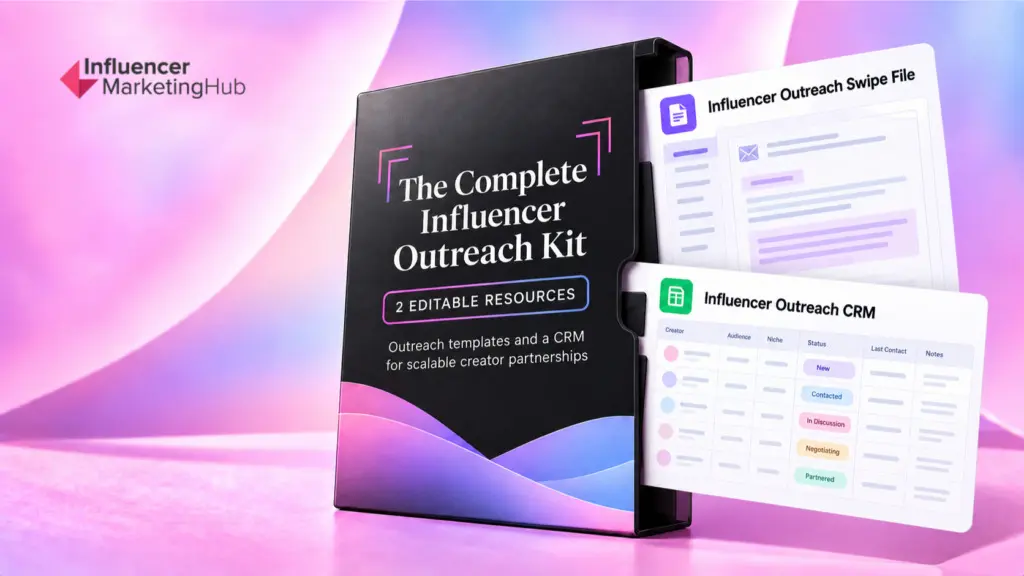
📥 Get the Complete IMH Influencer Outreach Kit
Everything covered in this guide is easier to implement with the IMH Influencer Outreach Kit. Instead of managing influencer outreach across scattered spreadsheets, email threads, and notes, you'll have a structured system for planning campaigns, contacting creators, tracking responses, and managing partnerships from one centralized workspace.
Inside the kit you'll get:
- Influencer Outreach Swipe File (Google Docs) containing editable email templates for product seeding, paid collaborations, affiliate partnerships, UGC campaigns, follow-ups, campaign invitations, and more.
- Influencer Outreach CRM (Google Sheets) to research creators, qualify influencer partnerships, organize outreach campaigns, schedule follow-ups, monitor campaign progress, and build long-term creator relationships.
Whether you're reaching out to five creators or managing hundreds of influencer partnerships, the toolkit provides a repeatable workflow that scales with your influencer marketing program.
Why Influencer Outreach Fails
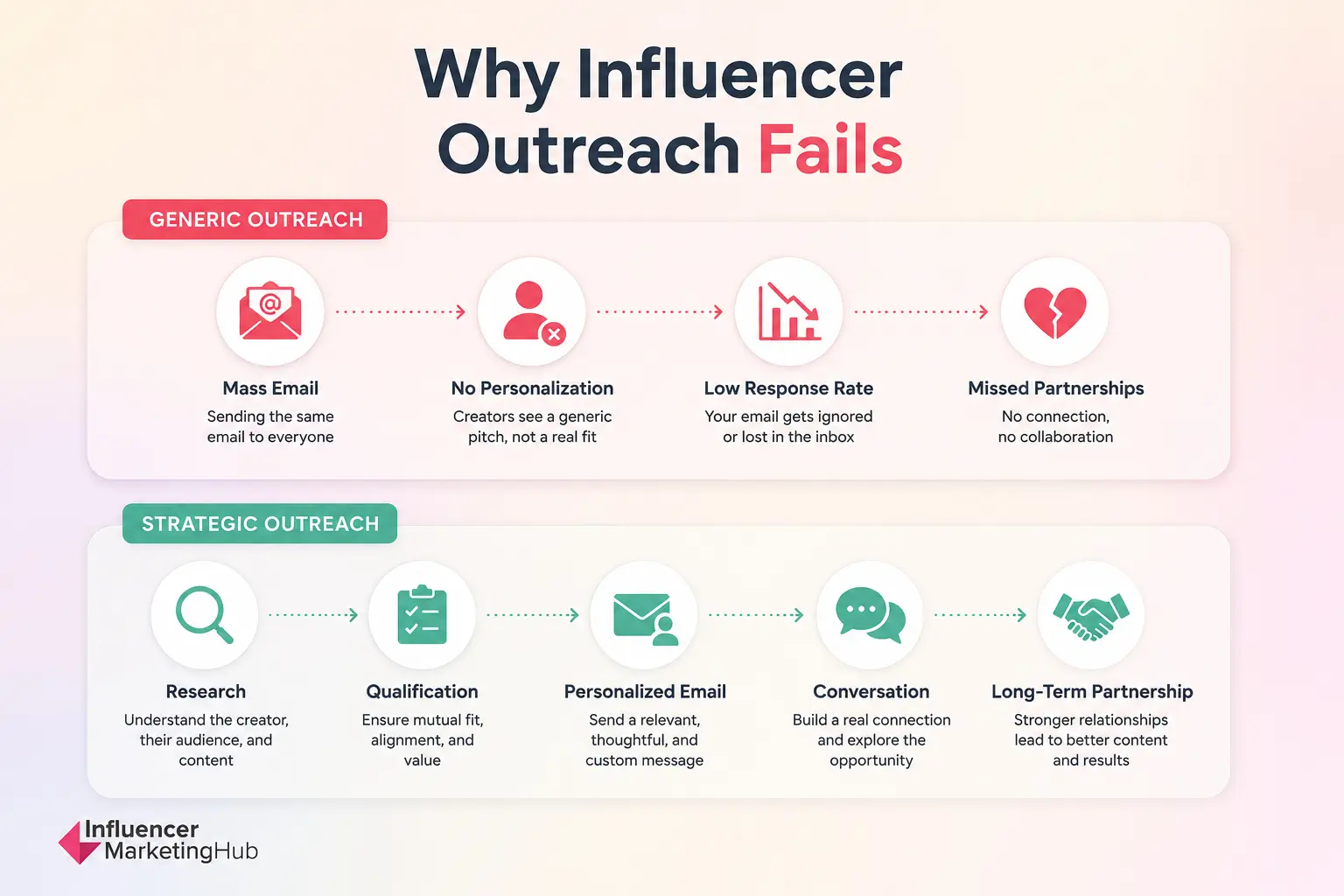
Most unsuccessful influencer outreach is caused by poor preparation.
Many brands focus on crafting the perfect message before they've clearly defined who they're contacting, why the partnership makes sense, or what value they're offering in return. As a result, creators receive emails that feel generic, irrelevant, or indistinguishable from dozens of other pitches in their inbox.
That lack of relevance is often the biggest obstacle to securing a response. According to the Wall Street Journal, nearly seven in ten creators say that a brand's relevance to their audience is one of the most important factors when deciding whether to pursue a partnership.
As such, successful outreach must begin with relevance.
Before writing a single sentence, brands should understand the creator's audience, content style, previous partnerships, and the role that creator will play within the broader campaign. A personalized email becomes significantly easier to write when the partnership itself is a natural fit.
Preparation also helps brands avoid another common mistake: treating influencer outreach as a volume game.
Sending hundreds of identical emails may increase the number of conversations started, but it rarely increases the number of meaningful partnerships. A smaller list of carefully selected creators often produces stronger engagement, better content, and higher campaign performance than mass outreach.
As influencer marketing becomes more competitive, creators increasingly expect brands to demonstrate that they've done their research. Referencing a recent video, acknowledging the creator's niche, or explaining why their audience aligns with your campaign immediately differentiates your outreach from generic requests.
Building successful creator partnerships isn't about sending more emails. It's about sending better ones to the right creators.
Build Your Influencer Outreach Strategy
Effective influencer outreach starts long before your first email.
Every campaign should begin with a clear strategy that defines what success looks like, which creators you're trying to reach, and how those partnerships will support your broader marketing objectives.
Without this foundation, it's difficult to evaluate creators consistently or write outreach emails that communicate a compelling opportunity.
Start by answering a few fundamental questions:
- What business objective should this campaign achieve?
- Which audience are you trying to reach?
- What type of creator best aligns with that audience?
- What type of collaboration are you proposing?
- What budget and resources are available?
- How will campaign success be measured?
Answering these questions upfront creates alignment between your marketing team, campaign goals, and influencer outreach process.
It also helps determine the type of creators you should prioritize. A product launch may require broad awareness through macro creators, while a campaign focused on authentic testimonials or UGC may benefit more from micro creators with highly engaged communities.
Your influencer outreach strategy should also define practical campaign details before contacting anyone. Decide what deliverables you're requesting, whether content usage rights are required, expected timelines, compensation models, approval workflows, and the metrics you'll use to evaluate performance.
The more clearly these expectations are defined internally, the easier they become to communicate externally.
Treat your outreach strategy as the blueprint for every creator conversation that follows. When your campaign objectives, creator criteria, and collaboration offer are already documented, every outreach email becomes more focused, personalized, and relevant.
| Collaboration Type | Best For | Typical Brand Investment | Common Deliverables |
| Product Seeding | Brand awareness, UGC | Product cost | Organic content |
| Paid Partnership | Campaign launches, conversions | Medium–High | Sponsored posts, videos |
| Affiliate Partnership | Performance marketing | Commission-based | Ongoing promotional content |
| Brand Ambassador | Long-term partnerships | Ongoing investment | Multi-campaign collaborations |
| Event Invitation | Product launches, experiences | Event costs | Event coverage, Stories, Reels |
Identify the Right Influencers
The success of your outreach campaign depends just as much on who you contact as how you contact them.
Many brands begin by filtering creators based on follower count. While reach can certainly influence campaign performance, it rarely tells the full story. Audience alignment, content quality, engagement, and authenticity are often much stronger indicators of whether a partnership will succeed.
The goal is to identify creators whose communities genuinely overlap with your target customers.
Start by defining the characteristics that matter most for your campaign. Consider factors such as:
- Audience demographics and interests
- Primary social platforms
- Content style and production quality
- Engagement quality rather than engagement rate alone
- Previous brand partnerships
- Posting consistency
- Brand safety and reputation
- Experience creating sponsored or UGC content
Evaluating creators against consistent criteria also makes decision-making easier when comparing multiple partnership opportunities. Instead of relying on instinct, your team can qualify creators using the same framework before outreach begins.
Remember that selecting creators is all about relationship potential. Creators who naturally align with your brand are generally easier to work with, require less creative direction, and often become valuable long-term partners rather than one-off collaborators.
| Influencer Tier | Typical Audience | Best For | Typical Collaboration |
| Nano (1K–10K) | Highly niche communities | Authentic engagement, local campaigns | Product seeding, UGC |
| Micro (10K–100K) | Engaged niche audiences | Product launches, conversions, affiliate campaigns | Paid partnerships, UGC |
| Macro (100K–1M) | Large established audiences | Brand awareness, national campaigns | Sponsored campaigns |
| Mega (1M+) | Broad consumer reach | Mass awareness, major product launches | Enterprise partnerships |
Define Your Collaboration Offer Before You Reach Out
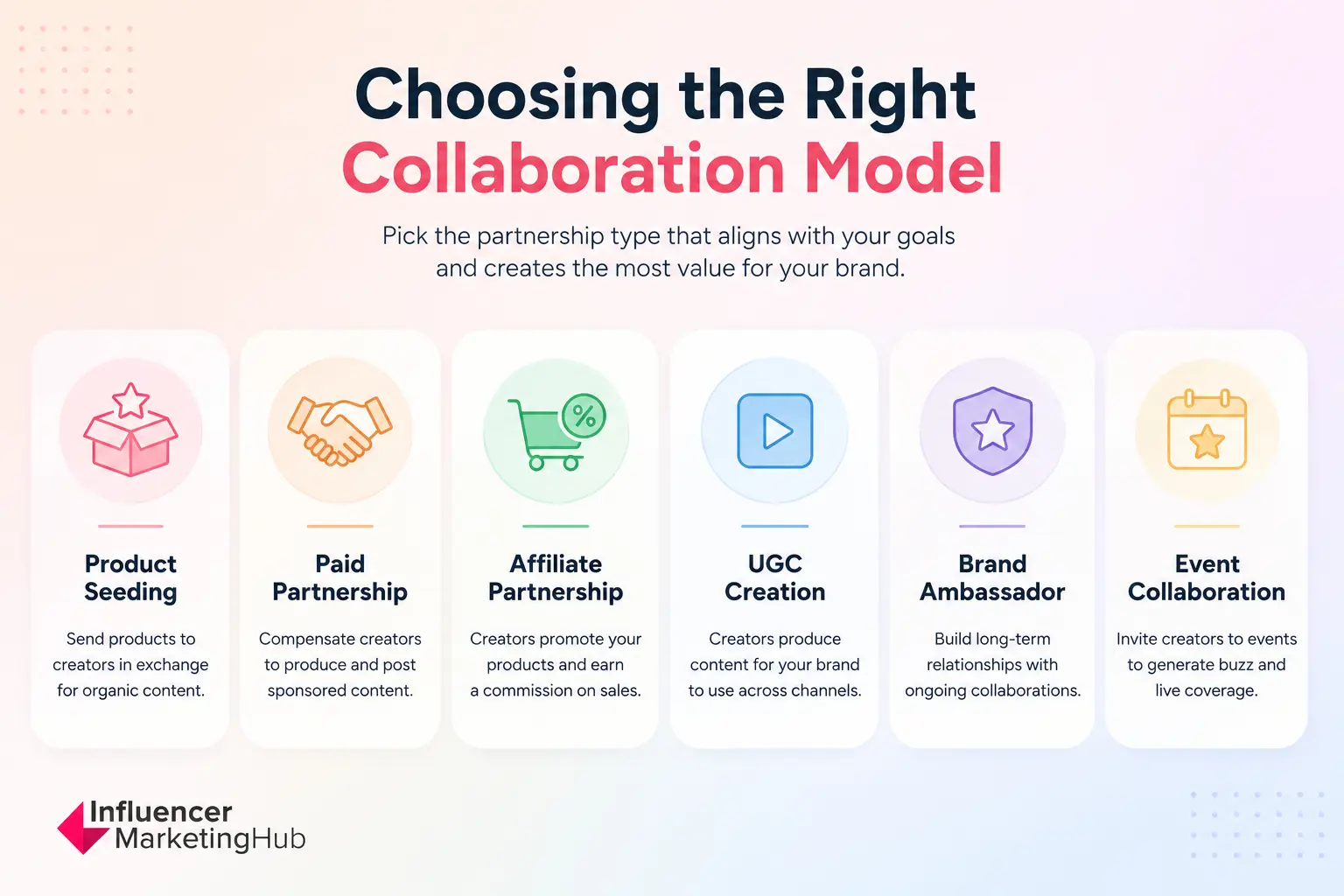
Even the most personalized outreach email will struggle to generate responses if the collaboration itself isn't compelling.
Before contacting creators, clearly define what you're asking them to do, what they'll receive in return, and why the opportunity is worth considering.
Influencers evaluate partnership requests much like brands evaluate creators; they want to understand whether the collaboration aligns with their audience, content style, and business goals.
Start by identifying the type of partnership you're proposing.
For example, your campaign may involve:
- Product seeding
- Paid sponsored content
- Affiliate partnerships
- User-generated content (UGC)
- Spark Ads authorization
- Brand ambassador programs
- Event invitations
- Product launches
Each collaboration type requires different expectations, timelines, and compensation models. Defining these details internally before outreach helps ensure every email communicates a clear, professional proposal.
Creators also appreciate transparency. Wherever possible, explain what deliverables you're requesting, expected deadlines, content usage rights, approval processes, and compensation. Removing uncertainty early in the conversation helps creators determine whether the partnership is a good fit and reduces unnecessary back-and-forth during negotiations.
Finally, think beyond the immediate campaign.
Rather than positioning every collaboration as a one-off opportunity, consider whether the creator could become a long-term partner. Ongoing relationships often produce more authentic content, stronger audience trust, and a deeper understanding of your brand over time.
A well-defined collaboration offer makes outreach easier because every email has a clear purpose. Instead of asking creators if they're "interested in working together," you're presenting a specific opportunity they can quickly evaluate and respond to.
| Collaboration Type | Primary Objective | Typical Brand Investment | Common Deliverables |
| Product Seeding | Generate authentic product awareness | Product cost | Organic posts, Stories, Reels |
| Paid Partnership | Drive awareness or conversions | Fixed campaign fee | Sponsored content |
| Affiliate Partnership | Performance marketing | Commission | Ongoing promotional content |
| UGC Creation | Content production | Fixed asset fee | Videos, photos, ad creatives |
| Brand Ambassador | Long-term advocacy | Ongoing compensation | Multi-campaign partnerships |
| Event Collaboration | Launches and experiences | Event costs + optional fee | Live coverage, social content |
Craft the Perfect Influencer Outreach Email
Once you've identified the right creators and defined your collaboration offer, it's time to make first contact.
A well-written outreach email does more than introduce your brand. It demonstrates professionalism, communicates value, and gives creators enough information to decide whether the opportunity is worth exploring. The goal isn't to sell the partnership in a single email. It's to start a conversation.
The most effective outreach emails are clear, personalized, and respectful of the creator's time. Rather than overwhelming influencers with lengthy brand stories or campaign documents, focus on providing the information they need to evaluate the opportunity quickly.
Write a Subject Line That Gets Opened
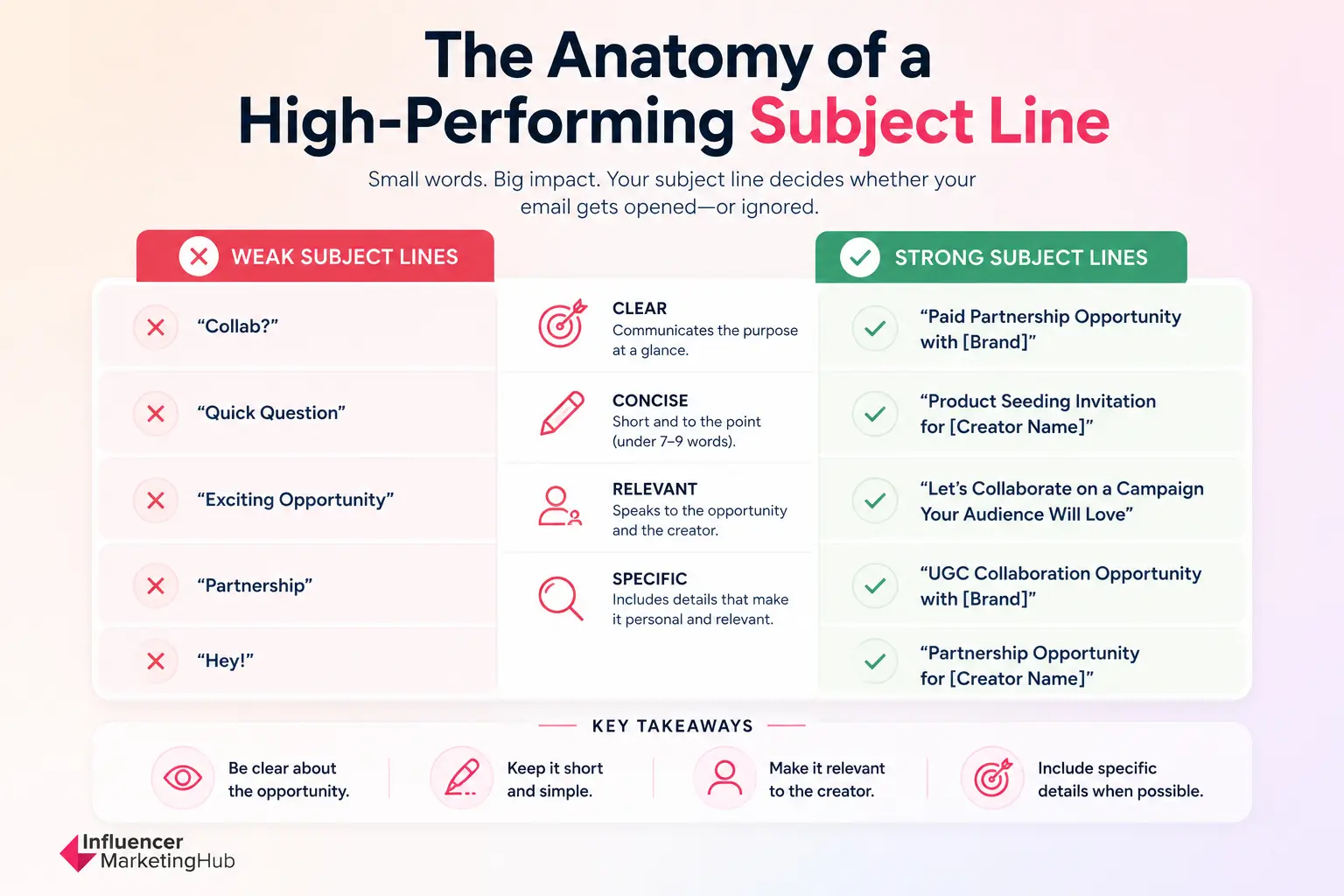
Your subject line determines whether the rest of your email gets read.
Creators receive partnership requests alongside hundreds of other emails every week, so your subject line should immediately communicate relevance without resorting to clickbait or vague messaging.
Good subject lines are concise, specific, and clearly indicate the purpose of the email.
For example:
- Collaboration Opportunity with [Brand Name]
- Paid Partnership Opportunity for [Creator Name]
- We'd Love to Feature You in Our Next Campaign
- Product Seeding Invitation from [Brand]
- UGC Collaboration Opportunity
Avoid subject lines that feel overly promotional or provide little context, such as "Quick Question," "Exciting Opportunity," or "Collaboration?" These give creators little reason to prioritize your email over others.
If appropriate, including the creator's name or your brand name can also increase recognition and help establish legitimacy before the email is opened.
Personalize Your Opening
The first few sentences often determine whether a creator continues reading.
Instead of opening with a generic introduction about your company, begin by explaining why you're contacting that specific creator. Mention a recent post, campaign, content series, or aspect of their work that genuinely aligns with your brand.
Specificity immediately demonstrates that your outreach isn't part of a mass email campaign.
For example, rather than writing:
"We love your content and think you'd be a great fit."
Try something like:
"We've been following your recent skincare tutorials, particularly your comparison videos, and think your educational approach would align well with the launch of our new product range."
The objective isn't flattery—it's relevance.
A personalized opening also creates a smoother transition into your collaboration proposal because you've already established why the partnership makes sense for both parties.
Clearly Explain the Collaboration Opportunity
Once you've introduced yourself, explain exactly why you're reaching out.
Creators shouldn't have to guess what you're asking them to do.
Briefly outline:
- The purpose of the campaign
- The type of collaboration you're proposing
- Expected deliverables
- Campaign timeline
- Compensation model
- Content usage rights (if applicable)
Providing these details upfront demonstrates professionalism and reduces unnecessary back-and-forth during the early stages of the conversation.
If every campaign detail hasn't been finalized, that's perfectly acceptable. Focus on giving creators enough context to understand the opportunity while leaving room for discussion if they're interested.
Remember that creators evaluate partnerships just as carefully as brands evaluate creators. Being transparent early helps establish trust and makes it easier for both sides to determine whether the collaboration is a good fit.
End with a Clear Call to Action
Every outreach email should end with one simple next step.
Avoid asking multiple questions or expecting creators to make complex decisions immediately. Instead, invite them to continue the conversation.
Examples include:
- Would you be interested in learning more about the campaign?
- Are you available for a collaboration during the next month?
- If this sounds like a good fit, we'd be happy to send over the full campaign brief.
- Let us know if you'd like to discuss the opportunity further.
A single, clear call to action makes responding easier while keeping the conversation moving forward.
Finally, close the email with a professional signature that includes your name, company, website, and any relevant contact information. Giving creators an easy way to verify your brand adds credibility and encourages trust.
Keep Your Email Short and Easy to Read
Long emails often bury the information creators care about most.
Aim to communicate your message in a few short paragraphs using clear language and plenty of white space. Most creators review outreach emails on mobile devices, so formatting matters just as much as the content itself.
A concise email should quickly answer four questions:
- Who are you?
- Why are you contacting me?
- What's the opportunity?
- What's the next step?
If additional details are needed, provide them after the creator expresses interest. Campaign briefs, contracts, and creative guidelines are better shared later in the outreach process rather than included in the initial email.
Respecting a creator's time makes your outreach easier to read, easier to respond to, and ultimately more likely to start a productive conversation.
📥 Get the IMH Influencer Outreach Swipe File
Writing one strong outreach email is helpful. Having professionally written templates for every collaboration scenario makes the process significantly faster.
The IMH Influencer Outreach Swipe File includes editable email templates for product seeding, paid partnerships, affiliate programs, UGC collaborations, campaign invitations, follow-ups, and more. Every template is designed to be personalized, helping your team communicate consistently while avoiding the generic messaging creators receive every day.
Inside the swipe file you'll find:
- First collaboration outreach
- Product seeding invitation
- Paid partnership proposal
- Affiliate partnership invitation
- UGC creator outreach
- Campaign launch invitation
- Follow-up email
- Negotiation response
- Thank-you email
- Subject line library
Whether you're reaching out to a handful of creators or managing outreach at scale, the swipe file provides a repeatable starting point for every conversation.
10 Influencer Outreach Email Templates
Every influencer outreach campaign is different.
A product seeding campaign requires a different conversation than a paid partnership, while inviting a creator to become a long-term ambassador calls for a completely different approach. Instead of relying on one generic email for every collaboration, tailor your outreach to the campaign objective, creator relationship, and value you're offering.
The templates below are designed to serve as starting points. Personalize every email with details about the creator, reference relevant content they've published, and adapt the messaging to match your campaign.
1. First Collaboration Email
- Best for: Contacting a creator you've never worked with before.
- When to use: You're introducing your brand and exploring a potential collaboration.
Template:
Subject: Collaboration Opportunity with (Brand Name)
Hi [Creator Name],
I've been following your content for some time, particularly your recent posts around [specific topic]. Your style and the way you engage your audience stood out to our team, and we believe you'd be a great fit for an upcoming campaign.
We're [brief introduction to your brand] and are currently planning a campaign focused on [campaign objective].
We'd love to explore the possibility of working together. If you're interested, I'd be happy to share additional campaign details, including deliverables, timelines, and compensation.
Looking forward to hearing from you.
Best,
[Name] [Company]- Personalization Tip: Reference a specific piece of content rather than complimenting the creator's account in general.
2. Product Seeding Invitation
- Best for: Product gifting campaigns without guaranteed deliverables.
- When to use: You'd like a creator to experience your product before discussing future collaborations.
Template:
Subject: We'd Love to Send You Our New (Product)
Hi [Creator Name],
I'm reaching out from [Brand Name].
We recently launched [product] and immediately thought of your content because of your focus on [niche]. We'd love to send you a complimentary sample to try if you're interested.
There are no posting requirements—we simply enjoy sharing our products with creators whose content aligns with our brand.
If you'd like to receive a package, just let us know the best shipping address.
Thanks, and we hope to hear from you soon.
- Personalization Tip: Make it clear whether you're requesting content or simply offering a gift.
3. Paid Partnership Proposal
- Best for: Sponsored influencer campaigns.
- When to use: Your campaign already includes a defined budget and deliverables.
Template:
Subject: Paid Partnership Opportunity with (Brand Name)
Hi [Creator Name],
We're currently planning a paid campaign for [product or campaign] and believe your audience would be an excellent fit.
The collaboration would include:
- [Deliverable 1]
- [Deliverable 2]
- Campaign timing: [Date]
- Compensation: [Budget or "competitive paid partnership"]
If this sounds interesting, we'd love to discuss the campaign in more detail and answer any questions you may have.
Looking forward to hearing from you.
Best,
[Name]
- Personalization Tip: Be transparent about compensation whenever possible.
4. Affiliate Partnership Invitation
- Best for: Performance-based creator partnerships.
- When to use: You're inviting creators to promote products using affiliate links or discount codes.
Template:
Subject: Affiliate Partnership Invitation
Hi [Creator Name],
We've been exploring creators whose audiences closely align with our community, and your content immediately caught our attention.
We're currently expanding our affiliate program and would love to invite you to participate.
The partnership includes:
- Personalized affiliate link
- Commission on every sale
- Exclusive creator discounts for your audience
- Ongoing campaign opportunities
If you'd like more information, we'd be happy to send over the full program details.
Best,
[Name]
- Personalization Tip: Explain why the affiliate program benefits both the creator and their audience.
5. UGC Creator Outreach
- Best for: Purchasing content rather than influencer reach.
- When to use: Your priority is acquiring creative assets for organic or paid media.
Template:
Subject: UGC Content Opportunity
Hi [Creator Name],
We're looking for creators who produce authentic, engaging short-form content and believe your creative style would fit perfectly with an upcoming project.
This opportunity focuses on creating UGC for our brand rather than publishing content to your own audience.
If you're interested, we'd love to discuss deliverables, timelines, and compensation.
Looking forward to connecting.
- Personalization Tip: Clearly explain that the collaboration focuses on content creation rather than audience promotion.
6. Brand Ambassador Invitation
- Best for: Long-term creator partnerships.
- When to use: You're looking to build an ongoing relationship rather than a one-off campaign.
Template:
Subject: Become a Brand Ambassador for (Brand)
Hi [Creator Name],
We've enjoyed following your work and believe there's an opportunity to build something beyond a single campaign.
We're currently inviting a small group of creators to become long-term ambassadors for [Brand Name]. The program includes ongoing collaborations, early product access, and exclusive campaign opportunities throughout the year.
If you're interested, we'd love to schedule a conversation and share more details.
Best,
[Name]
- Personalization Tip: Emphasize the long-term nature of the relationship.
7. Event Invitation
- Best for: Product launches, conferences, and brand experiences.
- When to use: You're inviting creators to attend an in-person or virtual event.
Template:
Subject: We'd Love to Invite You to Our Upcoming Event
Hi [Creator Name],
We're hosting an exclusive event for creators on [date] and would love for you to join us.
The event will include:
- Product previews
- Networking opportunities
- Exclusive experiences
- Content creation opportunities
We think your audience would enjoy seeing behind the scenes and experiencing the event firsthand.
Let us know if you'd like additional information.
Best,
[Name]
- Personalization Tip: Explain why the event is relevant to the creator's audience.
8. Follow-Up Email
- Best for: Reconnecting after no response.
- When to use: Five to seven days after your initial outreach.
Template:
Subject: Following Up on My Previous Email
Hi [Creator Name],
I just wanted to follow up on the collaboration opportunity I shared last week.
I know schedules can get busy, so I wanted to check whether you had a chance to review it.
If the campaign isn't the right fit, no problem at all. If you're interested, I'd be happy to answer any questions or send additional information.
Looking forward to hearing from you.
Best,
[Name]
- Personalization Tip: Keep follow-ups friendly and pressure-free.
9. Negotiation Response
Best for: Continuing partnership discussions.
When to use: After a creator expresses interest and negotiations begin.
Template:
Hi [Creator Name],
Thank you for getting back to us.
We appreciate your feedback regarding the proposed deliverables and compensation. We've reviewed your suggestions and believe we can adjust the collaboration to better align with both of our expectations.
Here's what we're proposing:
- Updated deliverables
- Revised timeline
- Compensation: [Amount]
Let us know your thoughts, and we're happy to continue the conversation.
Best,
[Name]
- Personalization Tip: Focus on finding a mutually beneficial solution rather than negotiating aggressively
10. Thank-You & Next Steps
- Best for: Confirming the partnership.
- When to use: After both parties agree to collaborate.
Template:
Subject: Excited to Work Together!
Hi [Creator Name],
Thank you for partnering with us.
We're excited to have you involved in this campaign and look forward to seeing your creativity bring the project to life.
Over the next few days, we'll send:
- Campaign brief
- Content guidelines
- Key dates
- Product shipment details (if applicable)
- Primary contact information
If you have any questions before then, don't hesitate to reach out.
We're looking forward to a successful collaboration.
Best,
[Name]
- Personalization Tip: Reinforce enthusiasm while clearly outlining the next steps to keep the project moving smoothly.
Follow Up Without Damaging the Relationship
Sending a well-written outreach email is only the beginning of the conversation.
Creators are often balancing brand partnerships alongside content production, audience engagement, editing, and their own businesses. It's not unusual for legitimate collaboration requests to be overlooked simply because an inbox is busy.
A thoughtful follow-up can significantly improve your chances of receiving a response—as long as it's respectful.
Follow Up at the Right Time
Avoid following up too quickly.
As a general rule, wait five to seven business days after your initial email before sending a reminder. This gives creators enough time to review your proposal without feeling pressured.
If you don't receive a response after your first follow-up, one final reminder a week later is usually appropriate. Beyond that, it's often better to move on and revisit the creator for future campaigns rather than continuing to send additional emails.
Keep Your Follow-Up Short
A follow-up isn't an opportunity to rewrite your original email.
Instead, briefly remind the creator why you're reaching out, acknowledge that schedules can get busy, and invite them to respond if they're interested.
For example:
Hi [Creator Name],
I just wanted to follow up on the collaboration opportunity I shared last week. I know things get busy, so I wanted to check whether you had a chance to review it.
If the campaign isn't the right fit, no worries at all. If you're interested, I'd be happy to answer any questions or send additional information.
Looking forward to hearing from you.
This approach keeps the conversation positive while giving creators an easy opportunity to respond.
Respect Every Response
Not every creator will accept your proposal.
Budget, timing, audience fit, existing partnerships, or personal priorities may all influence their decision.
Treat every interaction as the beginning of a potential long-term relationship rather than a single transaction. A creator who declines one campaign may become an excellent partner for the next.
Maintaining a professional, respectful tone—even after a rejection—helps build your brand's reputation within the creator community.
Build a Repeatable Influencer Outreach System
As your influencer marketing program grows, manually managing outreach quickly becomes difficult.
Tracking creator research in one spreadsheet, campaign notes in another, email conversations in your inbox, and deadlines on a calendar makes it easy to lose track of conversations and miss follow-ups.
Instead, build a repeatable outreach system that documents every stage of the creator journey.
A centralized workflow should help your team:
- Research and qualify creators.
- Record audience and content insights.
- Track outreach status.
- Schedule follow-ups.
- Monitor active campaigns.
- Store partnership history.
- Capture campaign performance.
- Identify creators for future collaborations.
Organizing outreach in one place improves consistency while making it easier for multiple team members to collaborate. Instead of starting from scratch every campaign, you'll build a growing database of creator relationships, campaign learnings, and historical performance that becomes more valuable over time.
It also shifts influencer outreach from a reactive activity to a repeatable business process. Every creator moves through the same qualification, outreach, negotiation, campaign, and relationship stages, making campaigns easier to scale without sacrificing personalization.
Brands that treat influencer outreach as an ongoing relationship-building process, not simply a way to secure individual campaigns, are often better positioned to build trusted creator networks that continue delivering value long after a single collaboration ends.
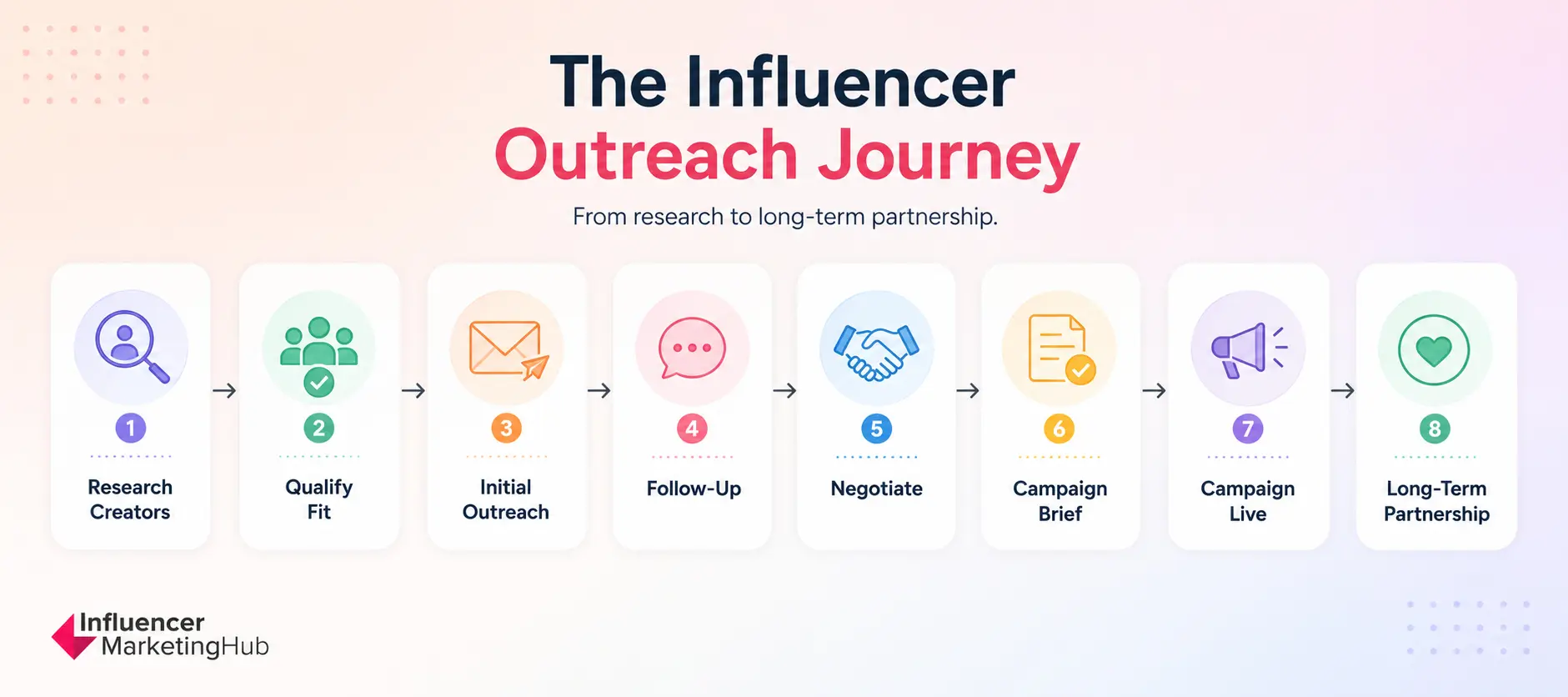
Use rounded cards connected by arrows with simple icons, soft gradients, subtle shadows, and the IMH logo positioned in the bottom corner. Match the visual language established by the previous infographics.
📥 Get the IMH Influencer Outreach CRM
Successful influencer outreach isn't just about sending better emails—it's about building a repeatable process that your entire team can follow.
The IMH Influencer Outreach CRM gives you a centralized workspace to manage creator research, qualify partnerships, track outreach, schedule follow-ups, monitor active campaigns, and maintain long-term creator relationships.
Inside the CRM, you'll find:
- Creator Database to organize influencer research and qualification.
- Outreach Pipeline to track every creator from first contact to partnership.
- Follow-Up Tracker to ensure no opportunity slips through the cracks.
- Campaign Tracker for deliverables, timelines, approvals, and payments.
- Relationship History to document previous collaborations and future opportunities.
Creator Scorecard to evaluate creators consistently before outreach begins.
Whether you're managing ten creators or hundreds, the CRM helps standardize your workflow, reduce administrative work, and build stronger creator partnerships over time.
Great Influencer Partnerships Start with Better Outreach
Successful influencer outreach is all about building better relationships.
The strongest creator partnerships begin long before the first collaboration. They start with careful creator selection, a clearly defined campaign strategy, personalized communication, and a professional outreach process that respects both the creator's time and expertise.
While ready-made templates can accelerate outreach, they're most effective when paired with genuine research and thoughtful personalization. Every creator is different, and the brands that consistently earn replies are the ones that demonstrate they understand that from the very first email.
As your influencer marketing program grows, consistency becomes just as important as creativity. Standardizing how your team researches creators, tracks conversations, manages campaigns, and nurtures long-term relationships helps transform outreach from a one-off task into a scalable marketing process.
Use the templates and resources throughout this guide to streamline your workflow, improve response rates, and build creator partnerships that continue delivering value long after a single campaign ends.
Frequently Asked Questions
How do I write an influencer email template?
To write an email to an influencer, follow these best practices:
- Identify the right influencer for your marketing goals
- Include a catchy subject line
- Don’t be afraid to speak more casually
- Personalize each email to the influencer
- Create a unique pitch to them – avoid templates
- Be concise
What is an influencer outreach email?
An influencer outreach email is a message sent by a brand or agency to a creator to introduce a collaboration opportunity. It typically explains why the creator was selected, outlines the campaign, and invites them to discuss a potential partnership.
What should an influencer outreach email include?
A strong outreach email should include a clear subject line, personalized introduction, brief brand overview, campaign details, proposed deliverables, compensation (where appropriate), and a clear call to action that encourages the creator to respond.
How long should an influencer outreach email be?
Keep the initial email concise—typically between 150 and 250 words. The objective is to generate interest and start a conversation, not communicate every campaign detail in the first message.
How do you personalize influencer outreach?
Reference the creator's recent content, explain why their audience aligns with your campaign, and tailor the collaboration proposal to their niche. Avoid generic compliments or copy-and-paste messaging.
How many times should you follow up with an influencer?
If you don't receive a response, send one follow-up after five to seven business days. A second and final follow-up about a week later is acceptable. If there's still no response, it's generally best to move on and revisit the creator for future opportunities.
Should brands include payment details in the first outreach email?
If your compensation structure is already defined, including it can help creators evaluate the opportunity more quickly. If details are still being finalized, clearly indicate that the partnership is paid and discuss specifics during the next stage of the conversation.
What's the difference between product seeding and paid influencer outreach?
Product seeding involves sending creators products with no guaranteed deliverables, while paid outreach includes agreed-upon deliverables and financial compensation. Both approaches can be valuable depending on your campaign objectives.
How can brands manage influencer outreach at scale?
Using a centralized influencer outreach CRM allows teams to organize creator research, track outreach status, schedule follow-ups, monitor campaigns, document partnership history, and build long-term creator relationships without relying on disconnected spreadsheets or email threads.