


Holiday social media marketing presents brands with plenty of opportunities to reach shoppers, but not every occasion deserves a campaign.
Black Friday might create demand for a limited-time offer, while Mother's Day calls for gift inspiration and National Dog Day may give a pet brand an opportunity to engage its community.
The challenge is deciding which moments matter to your audience and what your marketing should accomplish.
That decision also shapes how brands use their channels. Organic social can build anticipation, influencers can introduce products through relatable experiences, and paid media can extend the reach of creative that supports a specific campaign objective.
When these activities operate independently, brands risk repeating the same messages without moving shoppers closer to a purchase. An effective holiday social media strategy connects the occasion, audience, creative, and commercial goal.
The following framework explores how to select worthwhile holidays, coordinate creators and paid campaigns, build momentum before key dates, and measure results beyond seasonal engagement.
🌟 Find the Right National Day for Your Next Social Media Campaign
Some of the most relevant holiday marketing opportunities happen outside Black Friday, Christmas, and other major shopping events. Industry-specific national days give brands a chance to connect with audiences around interests, occasions, and purchasing motivations that are directly relevant to their products.
Our National Day Finder helps marketers discover these opportunities across a wide range of industries. Search for a national day to find its date, explore suggested campaign angles, and generate alternative creative directions. The calculator also recommends when to brief creators and start teasing the campaign, helping teams turn a relevant occasion into an actionable marketing plan.
- Not Every Holiday Deserves a Social Media Campaign
- Give Every Holiday Social Media Campaign a Measurable Business Objective
- Make Organic Social, Influencers, and Paid Media Work as One Holiday Campaign
- Build Holiday Campaign Anticipation Before Revealing the Offer
- Choose Holiday Influencers for Their Role, Not Just Their Reach
- Make Holiday Social Media Campaigns Relevant to How Customers Actually Shop
- Plan Holiday Social Media Campaigns Early, but Leave Room to Adapt
- Measure Holiday Social Media ROI Beyond Likes and Impressions
- Turn Holiday Social Media Marketing Into a Repeatable Growth Strategy
- Frequently Asked Questions
Not Every Holiday Deserves a Social Media Campaign
A relevant date on the calendar isn't automatically a marketing opportunity. Brands need to consider whether the occasion connects with their audience, creates a reason to engage or purchase, and justifies the resources required to activate it.
National Dog Day, for instance, gives a pet accessories brand a natural opportunity to showcase products through creator content. The same occasion might be less useful for a financial services company unless there's a meaningful connection to its audience or offering.
Prioritize Holidays Based on Their Commercial Potential
Before committing budget, evaluate each occasion against four criteria.
| Selection criteria | What marketers should evaluate |
| Audience relevance | Does the occasion reflect an interest, tradition, or need that matters to the target customer? |
| Purchase intent | Does it create a natural reason to buy, or is it better suited to awareness and community engagement? |
| Creative opportunity | Can the brand develop a distinctive campaign rather than publish a generic celebratory post? |
| Commercial feasibility | Can the team support the campaign with suitable products, creators, inventory, and budget? |
Look Beyond Traditional Gifting Holidays
Travel brand loveholidays provides a useful example of aligning marketing with a seasonal purchasing moment. Its Boxing Day campaign reached 16.5 million impressions, with bookings reportedly exceeding its campaign target by 20%.
Rather than treating the holiday as an occasion for gift purchases, the campaign capitalized on an opportunity to encourage travel bookings.
The lesson isn't that brands should add Boxing Day to every marketing calendar. It's that a holiday becomes commercially valuable when the occasion aligns with how customers are already thinking about a purchase.
For a broader view of major seasonal events and planning windows, consult our Holiday Marketing Calendar.
Give Every Holiday Social Media Campaign a Measurable Business Objective
Holiday campaigns often combine entertaining content, creator partnerships, and promotional offers. But without a clear business objective, marketers can end up celebrating impressive engagement numbers without knowing whether the campaign achieved anything commercially meaningful.
The objective should determine the creative approach, channel investment, and performance metrics before production begins.
Match the Campaign Goal to the Outcome You Want
| Campaign objective | Social media approach | Primary KPIs |
|---|---|---|
| Brand awareness | Creator storytelling, seasonal content, and broad-reach video campaigns | Qualified reach, ad recall, brand lift |
| Product consideration | Creator demonstrations, gift recommendations, and customer testimonials | Product-page visits, engaged sessions, add-to-cart rate |
| Sales and acquisition | Promotional creator content, paid social ads, and retargeting | Conversion rate, CPA, ROAS, new customers |
| Customer retention | Loyalty rewards, exclusive offers, and community-led campaigns | Repeat purchase rate, retention, customer revenue |
| In-store traffic | Location-targeted ads, local creator content, and redeemable offers | Incremental visits, cost per incremental visit |
McDonald's Turned a December Social Campaign Into Measurable Store Visits
A useful example comes from McDonald's Netherlands' holiday TikTok campaign.
Rather than optimizing solely for video views, McDonald's wanted its digital advent calendar, Cadeau Kalender, to encourage customers to visit restaurants. The campaign combined daily rewards with TopView ads, In-Feed Ads, and interactive formats that directed users toward the McDonald's app.
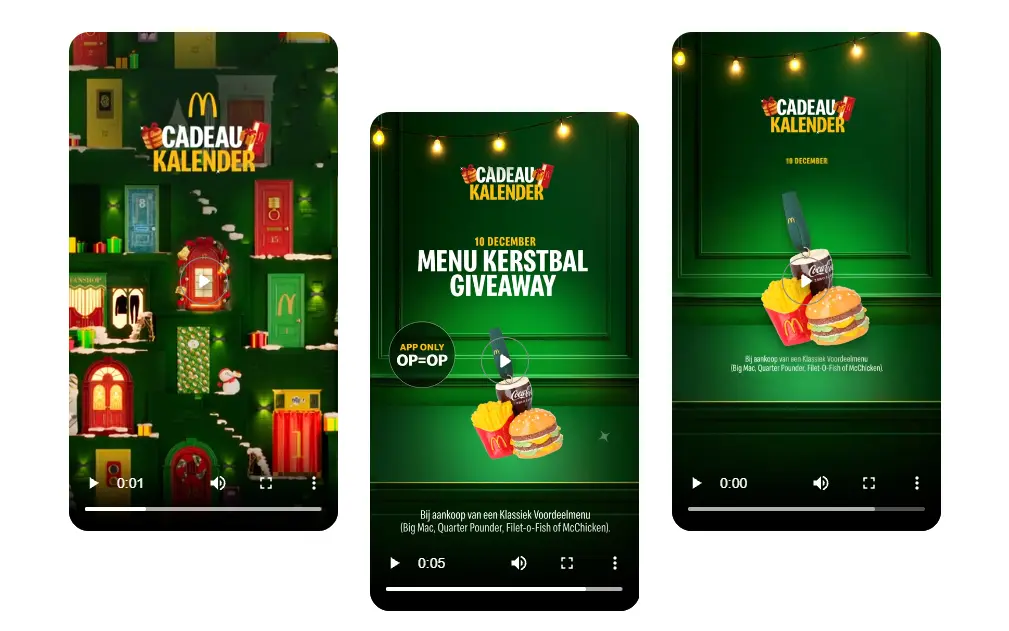
Working with location measurement partner Adsquare, the brand reported 56,465 incremental restaurant visits, a 6.6% lift in visits, and a €1.66 cost per incremental visit. The measurement approach used a modeled baseline to account for visits that might have occurred without the campaign.
The distinction matters. A campaign designed to drive restaurant traffic needs different success criteria from one introducing a new product to potential customers.
For brands, the practical takeaway is to select one primary commercial outcome, then assign supporting metrics to individual channels. Reach and engagement still matter, but they should help explain how the campaign contributed to its intended result rather than become the result itself.
Make Organic Social, Influencers, and Paid Media Work as One Holiday Campaign
Holiday campaigns become more effective when organic social, influencer partnerships, and paid advertising serve complementary purposes. Publishing the same promotional message across every channel may increase exposure, but it doesn't necessarily help shoppers progress from discovering a product to purchasing it.
Give Each Channel a Distinct Role in the Customer Journey
| Channel | Primary responsibility | Holiday campaign application |
| Organic social | Build anticipation and engage existing audiences | Teasers, behind-the-scenes content, community discussions, and promotional updates |
| Influencer marketing | Introduce products through trusted, relevant voices | Gift recommendations, product demonstrations, and creator-led storytelling |
| Paid social | Extend reach and drive measurable actions | Amplified creator content, product ads, retargeting, and conversion campaigns |
The channels should reinforce one another. A creator might introduce a holiday gift collection, the brand's organic account can reinforce the message, and paid advertising can bring that content to relevant audiences beyond the creator's followers.
How NEST New York Connected Creator Content With Paid Holiday Advertising
Fragrance brand NEST New York demonstrated this approach in its holiday TikTok campaign.
Working with Chameleon Collective, NEST launched an eight-week campaign featuring 13 creator videos highlighting seasonal gifts, best-selling fragrances, and Black Friday/Cyber Monday offers.
The brand combined Spark Ads, which amplify authorized organic posts, with Catalog Ads showcasing its holiday products. Promotional Display Cards provided additional calls to action.
According to TikTok, the campaign generated more than 6 million impressions, 59,700 clicks, and a 0.97% CTR. Google Analytics also indicated that 94% of visitors arriving through TikTok were new users.
TikTok reported that videos featuring Display Cards generated twice as many clicks as those without them, although this wasn't presented as a controlled experiment.
Plan Distribution Before Creators Start Filming
The practical lesson is to decide how creator content will be distributed before commissioning it. Confirm paid usage permissions, capture alternative hooks and CTAs, and identify which assets will support discovery versus conversion.
This allows brands to extend the value of creator partnerships without assuming every organic post needs paid amplification. For more on the mechanics, see our Guide to Spark Ads Collaborations.
Build Holiday Campaign Anticipation Before Revealing the Offer
Launching a holiday promotion without building anticipation means relying on shoppers to notice it when the sale begins. A stronger approach gives audiences a reason to pay attention beforehand, using a sequence of teasers, creator content, and promotional reveals to build interest over time.
How Myprotein Built Anticipation Around Its Black Friday Campaign
Rather than competing with increasingly aggressive discount messaging, Myprotein developed a Black Friday campaign around an unexpected idea — making shopping feel calmer.
According to their marketing agency, THG, the brand introduced Deal Genius, a relaxed character who helped shoppers navigate promotional offers.
The campaign connected several activities before and during the sale. Influencers teased the launch across social platforms, a YouTube holding page featured a countdown, and the final promotional reveal directed shoppers to a curated shopping experience.
THG reported 3.7 million influencer views, 7.23 million organic social views, and a 36.88% increase in organic social engagement. Myprotein also generated £90 million in revenue during the Cyber period, although that figure represents overall commercial performance rather than revenue attributable to the teaser campaign.
The important distinction is that anticipation wasn't created through repeated reminders alone. Myprotein gave the campaign a recognizable creative identity and connected its pre-launch content to a clear shopping experience.
Structure the Campaign Around Three Moments
| Campaign stage | Content approach | Intended outcome |
| Build anticipation | Creator teasers, product previews, and hints about upcoming announcements | Generate interest and establish an audience for the launch |
| Reveal the offer | Announce promotional details, demonstrate products, and activate paid creator content | Turn existing interest into product consideration and purchases |
| Sustain momentum | Answer shopper questions, feature customer reactions, and communicate verified deadlines | Resolve purchase hesitation and maintain relevance |
Not every campaign needs an extended teaser period. A smaller national-day activation might require only a few days of preparation, while a major Black Friday launch could justify several weeks.
The important distinction is to give each campaign stage a purpose. Teasers should build relevant interest, launch content should explain the offer, and follow-up messaging should help shoppers make a decision.
Choose Holiday Influencers for Their Role, Not Just Their Reach
The creator with the largest audience isn't necessarily the best choice for a holiday campaign. A brand launching a gift collection may need creators who can introduce products to new audiences, while a Black Friday campaign might benefit more from creators who consistently demonstrate products and generate purchases.
The starting point should be the campaign objective, followed by the creator's audience, content strengths, and demonstrated performance.
Match Creator Strengths to Campaign Objectives
| Creator role | What to look for | Best holiday application |
| Discovery | Relevant audience, strong storytelling, consistent reach | Introducing seasonal collections or unfamiliar products |
| Product education | Clear demonstrations, credible expertise, useful explanations | Showing how products work and why they're worth buying |
| Conversion | Relevant affiliate sales history, persuasive demonstrations, measurable purchase activity | Black Friday offers, bundles, and shoppable content |
| Community engagement | Active conversations, audience loyalty, authentic interactions | Niche holidays, community campaigns, and brand celebrations |
How Magnifiscience Used Creator Performance to Guide Its Black Friday Campaign
Skincare brand Magnifiscience took a performance-led approach to creator selection during its Black Friday TikTok campaign.
Working with agency Adopterz, the brand sent approximately 100 product samples per week to generate affiliate content. Rather than distributing investment equally, the team used GMV Max analytics to identify successful creators and videos, then prioritized those partnerships.
Magnifiscience also introduced a creator challenge during Black Friday and promoted its Hydration Pack to encourage larger purchases.
According to TikTok, the campaign generated 3,300 orders, a 2.42× month-over-month increase, while reducing cost per order by 10% compared with October. Creator output reached 2,126 videos, up 161% from October. These results reflect the combined affiliate and advertising strategy, not creator selection in isolation.
Build Creator Briefs Around the Job Each Creator Needs to Do
Give creators a clear commercial objective while leaving room for their own presentation style. A discovery-focused creator might introduce a holiday collection through a personal story, whereas a conversion-focused affiliate may need to demonstrate the product, explain the offer, and answer common purchase objections.
Review audience fit, previous content quality, and relevant performance before allocating budget. For creators expected to drive purchases, prioritize attributable sales or conversion evidence over engagement rate alone.
The goal isn't to find one creator who does everything. It's to build a creator mix that supports different stages of the holiday buying journey.
Make Holiday Social Media Campaigns Relevant to How Customers Actually Shop
A holiday theme alone doesn't make a campaign relevant. Shoppers approach different occasions with different motivations, whether they're searching for a thoughtful gift, planning a celebration, treating themselves, or looking for a discount.
The creative should reflect that motivation rather than simply adding seasonal graphics and messaging to an existing promotion.
How Crumbl Turned Everyday Cookies Into Holiday Gifts
Crumbl faced a challenge during the holiday season. Its cookies were familiar as everyday treats, but the brand wanted shoppers to consider them as gifts.
Working with Later, Crumbl launched a creator campaign that positioned its products around holiday gatherings, gift exchanges, and shared experiences.
According to Later's Crumbl holiday campaign case study, the brand partnered with five creators across different niches, producing 17 pieces of content. The campaign generated 39.7 million impressions, 175,500 engagements, and $1.2 million in reported earned media value. Paid amplification also helped extend the content's reach.
The important shift wasn't the product itself. Crumbl changed the buying occasion by showing how cookies could fit into existing holiday traditions.
Adapt the Message to the Customer's Seasonal Motivation
| Customer motivation | Creative direction | Example |
| Finding a gift | Show who the product is for and why they'd appreciate it | Personalized gifts, gift bundles, recipient-focused recommendations |
| Planning a celebration | Demonstrate how the product fits into the occasion | Holiday recipes, entertaining ideas, party preparations |
| Treating themselves | Position the purchase as a personal reward | Seasonal collections, limited-edition products |
| Saving money | Communicate genuine promotional value | Black Friday offers, bundles, verified discounts |
| Participating in a community moment | Build content around shared interests or traditions | National days, community challenges, audience stories |
Test the Buying Motivation Before Scaling the Creative
The same product can support several seasonal messages, but marketers shouldn't assume they'll perform equally well.
Test distinct motivations using comparable audiences and campaign conditions. For example, compare a gifting-focused product demonstration against a self-purchase angle, then evaluate product-page engagement, conversion rate, and CPA.
The strongest seasonal message connects the product to something customers already want to do, rather than asking them to care about a holiday simply because the brand has chosen to celebrate it.
Plan Holiday Social Media Campaigns Early, but Leave Room to Adapt
Holiday campaigns operate within deadlines that marketers can't easily move. Creator availability, product shipments, promotional approvals, and advertising schedules all need to align before launch. But planning every detail in advance can also leave brands unable to respond when certain products, creators, or messages outperform expectations.
How Spectrum Brands Coordinated 10 Holiday Creator Campaigns
For its holiday activation, Spectrum Brands partnered with Later to promote four pet care brands across Instagram and TikTok.
According to Later's breakdown, the program involved 10 campaigns, with Spectrum Brands managing product shipping and creator communication while Later coordinated strategy, paid media activations, and reporting.
The campaign generated 387 pieces of creator content, 407,500 impressions, and 52,000 engagements, with a reported 12.8% average engagement rate. Some content was also repurposed for paid advertising, including a TikTok Spark Ads activation for SmartBones.
The operational lesson is that creator production, logistics, and distribution need clearly assigned responsibilities, especially when several campaigns run simultaneously.
Build a Timeline Around Production Dependencies
| Planning stage | What needs to happen | Potential bottleneck |
| Campaign preparation | Finalize objectives, creators, products, offers, and content requirements | Unconfirmed budgets or product availability |
| Creator production | Ship products, approve concepts, capture footage, and secure usage rights | Late deliveries or missing approvals |
| Pre-launch checks | Verify promotional claims, tracking, landing pages, and advertising assets | Incorrect prices or incomplete tracking |
| Campaign launch | Publish content, activate paid media, and monitor early performance | Underperforming creative or fulfillment issues |
| Live optimization | Adjust budgets, refresh messaging, and replace expired offers | Delayed decisions or outdated promotional content |
Decide What Can Change Before the Campaign Goes Live
Not every adjustment should require another approval cycle. Establish who can pause an underperforming ad, reallocate budget, replace a promotional CTA, or respond to an inventory issue.
Keep product demonstrations separate from time-sensitive promotional messaging wherever possible. This makes it easier to reuse footage when an offer changes without commissioning another shoot.
For detailed channel-specific scheduling, see our Holiday Social Media Timing Blueprint.
The objective is to lock in production requirements early while keeping campaign decisions flexible enough to respond to actual performance.
Measure Holiday Social Media ROI Beyond Likes and Impressions
Holiday campaigns can generate impressive reach, engagement, and sales while leaving an important question unanswered. How much of that performance happened because of the campaign, rather than the seasonal demand that would have existed anyway?
That distinction matters during Black Friday, Christmas, and other high-demand periods, when shoppers may already be planning purchases.
How Argos Measured Incremental Purchases During Christmas
UK retailer Argos took a full-funnel measurement approach during its 2024 Christmas campaign.
The retailer combined creator partnerships, paid advertising, and catalog-driven Video Shopping Ads to reach shoppers throughout their buying journey. Rather than relying exclusively on attributed conversions, Argos used a Unified Lift Study to evaluate the campaign's incremental contribution.
The study reported statistically significant improvements across several outcomes, including:
- 5.5% lift in ad recall
- 3.3% incremental lift in product content views
- 3.7% lift in add-to-cart actions
- 4.2% incremental lift in completed purchases
These results reflect the overall TikTok campaign, not the independent contribution of any single creator or ad format.
Separate Campaign Performance From Incremental Business Impact
| Measurement level | What to evaluate | What it tells marketers |
| Creative performance | Hook retention, engagement, CTR | Which messages attract attention and encourage further action |
| Conversion performance | CPA, ROAS, conversion rate | How efficiently campaigns generate attributed purchases |
| Customer value | New customer rate, AOV, contribution margin | Whether purchases contribute to profitable growth |
| Incremental impact | Conversion lift, sales lift, geographic experiments | Whether marketing generated additional outcomes beyond expected demand |
Use the Results to Improve the Next Holiday Campaign
Compare performance against previous campaigns, but account for differences in promotional offers, media investment, and seasonal demand.
Where budget and measurement capabilities allow, use holdout groups or lift studies to estimate incremental impact. Otherwise, distinguish attributed results from proven incremental outcomes.
For a deeper explanation of attribution methods and their limitations, see our Social Media Attribution Modeling Guide.
The goal is to identify which holidays, creators, and campaign approaches deserve future investment, not simply report how much attention the promotion received.
Turn Holiday Social Media Marketing Into a Repeatable Growth Strategy
The most effective holiday social media campaigns start with a relevant opportunity, a clear business objective, and a coordinated plan for reaching the right audience. Whether it's Black Friday, Christmas, or an industry-specific national day, the occasion should support a genuine customer need rather than become another reason to publish promotional content.
For marketers, the long-term value comes from learning which holidays generate meaningful results, which creators influence purchasing decisions, and which messages deserve further investment. Use those findings to refine your campaign calendar, improve creative production, and build on what worked.
The goal isn't to participate in every holiday. It's to make each campaign you choose more commercially valuable than the last.
Frequently Asked Questions
How Early Should Brands Start Planning Holiday Social Media Campaigns?
Major shopping events such as Black Friday and Christmas often require several months of preparation, particularly when campaigns involve influencer partnerships, product shipments, and paid advertising.
Smaller national-day campaigns may need only a few weeks, depending on production requirements. Work backward from the launch date to establish creator briefing, content approvals, and promotional deadlines.
Which Social Media Platforms Are Best for Holiday Marketing?
The best platforms depend on the target audience, campaign objective, and creative format.
TikTok and Instagram are useful for creator-led product discovery and short-form demonstrations, while YouTube can support more detailed product research. Pinterest may be particularly relevant for gift inspiration and seasonal planning.
Rather than maintaining an equal presence everywhere, prioritize channels that reach relevant audiences and support measurable campaign outcomes.
How Much Should Brands Spend on Holiday Influencer Marketing?
There isn't a universal budget that works across brands or holidays. Investment depends on the campaign objective, creator fees, production requirements, paid usage rights, and media distribution.
Separate creator production costs from advertising spend, and reserve flexibility for amplifying content that demonstrates promising performance. Our holiday marketing budget guide explores allocation decisions in more detail.
Can Smaller Brands Compete With Larger Holiday Marketing Campaigns?
Yes, particularly when they focus on relevant niche occasions rather than competing for attention during every major shopping event.
Smaller brands can work with specialized creators, activate existing communities, and develop campaigns around specific customer interests. A well-matched national day may provide a more practical opportunity than a broad Black Friday promotion requiring substantial media investment.
How Can Brands Measure Holiday Influencer Marketing ROI?
Start by identifying the campaign's primary objective and establishing appropriate tracking before launch.
Use creator-specific links, promotional codes, platform reporting, and website analytics to evaluate attributed traffic and purchases. Where feasible, supplement attribution with lift studies or controlled experiments to estimate incremental results.
Compare campaign outcomes against creator fees, production costs, and paid media investment rather than evaluating influencer performance through engagement alone.
Should Brands Reuse Holiday Social Media Content Across Different Campaigns?
Yes, when the content remains relevant and the brand has the necessary usage permissions.
Product demonstrations, customer testimonials, and creator reactions can often be reused with updated hooks, promotional messages, and CTAs. However, remove expired discounts, outdated shipping promises, and holiday-specific references that no longer apply.

SUGGESTED

2026 Holiday Marketing Calendar: Key Dates, Campaign Timeline & Strategies
Plan Thanksgiving Black Friday Cyber Monday and Christmas campaigns with our 2026 holiday...

Black Friday Consumer Behavior 2026: What Drives Purchases
Why do Black Friday shoppers distrust discounts switch retailers and use AI? Explore the...

TikTok Shop Holiday Playbook: Live, Bundles, Spark-style Ads & Creator Collabs
TikTok Shop is the new holiday sales engine. Use bundles live runs and Spark-style ads to...