
I've helped build north of 500 Shopify stores over the last 12 years. A good share of them were rebuilds, brands that came to me after another agency left them with a half-finished Plus migration, a checkout that fell over on Black Friday, or a six-figure invoice and not much to show for it.
Nobody warns you about that part when you start shopping for a Shopify Plus agency. The wrong choice doesn't only cost you the retainer. It costs you the growth you were trying to buy, plus the months you spend cleaning up before you can move forward again.
So here’s the vetting process I would hand to any founder who asked how to hire a team like mine. I run Lantern Sol, and after years of hearing client frustrations, untangling failed builds, and diagnosing what went wrong, the difference between strong agencies and costly ones has become surprisingly easy to spot.
Let me walk you through it.
Start by Confirming You Need Plus
Before you hire anyone, be honest about whether you belong on Shopify Plus in the first place. I turn down brands that ask for it and don't need it yet. That’s because the jump in cost only pays off once you hit a certain scale, and paying for headroom you won't use for two years is not a growth strategy.
The price tag is the first reality check. Plus starts in the low four figures a month, several times what the standard plans run, and that number climbs with revenue on the higher tiers. If your margin can't absorb that comfortably yet, the smart move is to grow into it, not to stretch for the badge.
Plus makes sense once your business reaches a certain scale. The usual signals:
- You're doing seven figures a year and climbing
- You need checkout customization that standard Shopify won't allow
- You're managing multiple brands, markets, or a complex B2B operation
- Your operations have become complex enough that you need enterprise-level automation and integrations
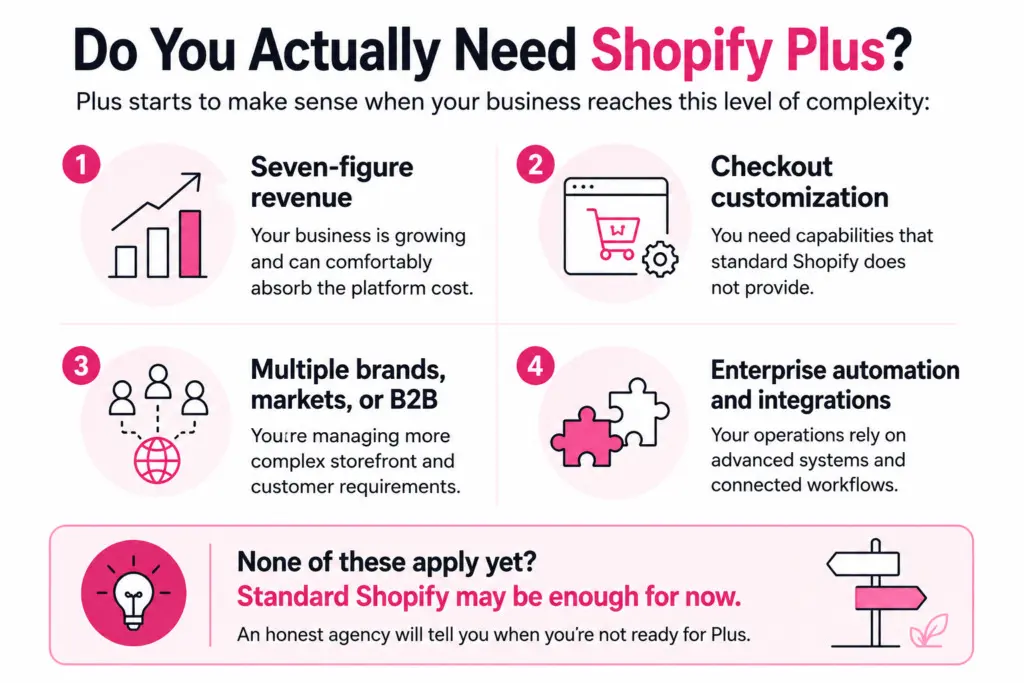
If none of that sounds like you, standard Shopify is plenty, and an honest agency will say so. If you want to see what you get with Shopify Plus that you don't with standard Shopify, this Shopify pricing and features breakdown lays it out, and IMH keeps a running list of Shopify Plus stores worth studying if you want proof of what brands build once they make the move. Once you're sure Plus is the right platform, the next question is who builds it.
Know What a Shopify Plus Agency Should Cover
"Agency" is a loose word. Before you compare firms, get clear on what you're buying because the label stretches from a solo freelancer with a Slack channel to a full team running strategy, design, and engineering under one roof.
A real Shopify Plus ecommerce agency should handle the whole build. That means:
- Migrating from your current platform without losing SEO equity or order history
- Custom themes, front-end development, and Shopify Functions–based checkout customization
- App development and integrations with ERPs, subscription platforms, CRMs, and other business systems
- Ongoing optimization and conversion rate improvements after launch
Some also specialize in headless commerce and advanced B2B implementations.
Here's a distinction most founders miss. Shopify development services and Shopify marketing are not the same skill set, and plenty of shops are strong at one and thin on the other. A team of Shopify experts can build you a beautiful store that nobody visits. A marketing shop can pour traffic into a store that converts at half the rate it should.
Decide which gap is bigger for you before you start making calls. If you only need to hire a Shopify developer for one defined build, you may not need a full retainer at all. If you need the store and the growth engine behind it, you do.
One more thing worth setting expectations on early: a proper Plus migration is rarely a two-week job. Depending on catalog size, integrations, and how much custom work the store needs, a realistic build runs from a month to a full quarter. Any agency promising a complex migration in a matter of days is either cutting corners you'll pay for later or hasn't run many.
6 Checks Before You Hire a Shopify Plus Agency
Every founder wants a shortcut here. There isn't one, but there’s a checklist. Start with these six checks, and the first two alone will eliminate most agencies.
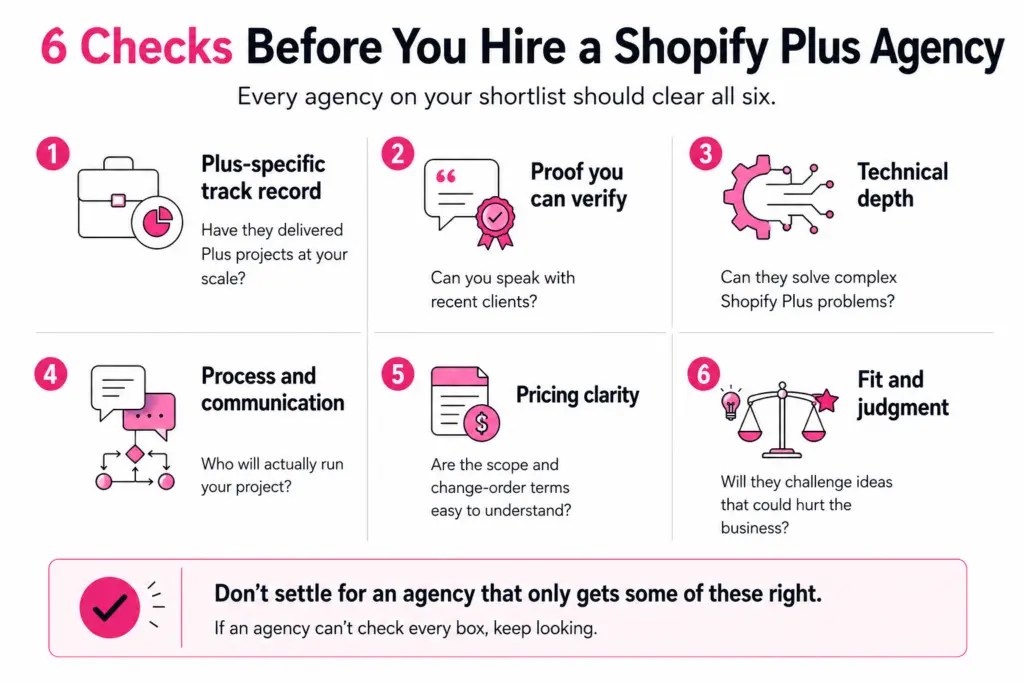
#1. Plus-Specific Track Record
Every agency will tell you they do Shopify. Far fewer have shipped Plus builds at your scale. Plus is a different animal from standard Shopify, with different checkout capabilities, different scripting, and different limits.
Ask directly how many Plus migrations they've run in the last year and for stores doing what kind of revenue. If the answer is that they mostly install standard themes, they'll be learning Plus on your budget, and you'll pay for the education.
#2. Proof You Can Verify
Case studies are easy to write and hard to fake once you pick up the phone. Ask for two or three references from brands close to your size, then call them. Ask what the agency shipped, whether it launched when they promised, and what went wrong along the way because something always does.
Real figures beat adjectives here: conversion lift, revenue in the quarter after migration, page load time. If the case study is heavy on buzzwords and light on metrics, keep asking questions.
#3. Technical Depth
This is where real Shopify Plus experience becomes obvious. Can they customize checkout using Shopify Functions, or do they only reskin the theme? Have they built with the native B2B features, gone headless, or wired up messy third-party integrations without breaking the store?
Hand them a real problem you're facing and watch who answers. If a developer walks you through the tradeoffs, good sign. If an account manager recites a rehearsed line, you've learned something useful.
#4. Process and Who You Talk To
Ask how they scope a project, how often they ship, and who sits in your calls once the contract is signed. At plenty of firms, you meet an impressive senior during the pitch and never hear from them again, and the work quietly moves to a junior you were never introduced to.
Get the name and the role of your day-to-day contact in writing before you commit to anything.
#5. Pricing You Can Read
Fixed fee, monthly retainer, and hourly can all work. What you want is a model you can read without a lawyer. Ask exactly what sits inside the scope and what triggers a change order. The shops that burn people quote low to win the deal, then charge extra for anything they decide wasn't included.
If the pricing is easy to understand, the working relationship usually is, too.
#6. Fit and Judgment
The best partners push back. If an agency nods along with everything you say in the sales call, you're buying a pair of hands, not judgment. You want the team that tells you a homepage idea will hurt conversion or that a feature you asked for isn't worth the build cost. Those are the people who protect your revenue when you're not in the room.
Run every firm through all six. The names that clear the entire list, not four out of six, are your shortlist. If only a few remain, you're doing it right.
If you only have time to do one of these properly, make it the reference calls. Ten minutes with a founder who just went through a Plus build with the team you're weighing will teach you more than any deck, and the agencies worth hiring will hand over those contacts without flinching.
Red Flags That Tell You to Walk
I've inherited enough broken stores to know the warning signs. Most aren't hard to spot if you know what to look for.
- The cold pitch with no portfolio: If someone emails you about their "best-in-class Shopify Plus agency services" and can't show you three live stores they built, delete it and move on.
- "We work with every platform.”: A shop that juggles WordPress, Wix, Magento, and Shopify is likely not a Shopify Plus specialist. On a Plus build, depth beats breadth every time.
- No senior oversight: Offshore teams can do excellent work, but if no senior developer reviews it and no one in your timezone answers when the checkout goes down, you'll feel it during your first big sale.
- Scopes that stay vague: If the proposal won't tell you exactly what you get and when, that ambiguity can become expensive later.
- No plan for after launch: The build is the starting line, not the finish. Ask what happens in the 90 days after go-live. A store with no optimization plan slowly slides backward.
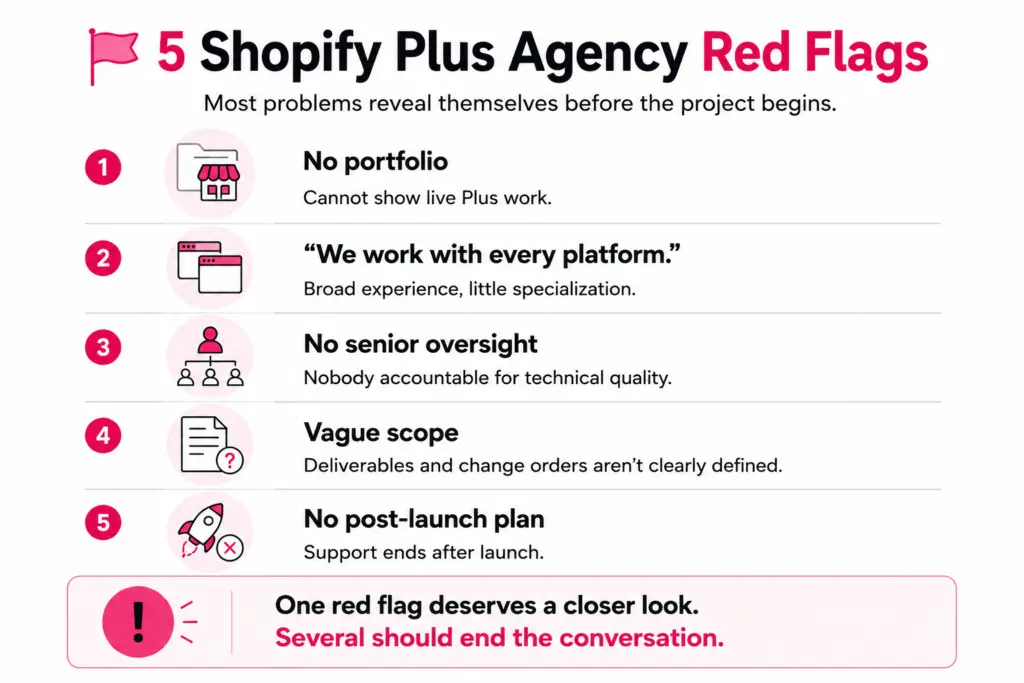
Almost every rescue project my team takes on traces back to at least one of these.
The partners worth hiring give you a clear scope, a realistic timeline, and a straight answer on who's doing the work before you pay a cent. That's the standard we hold ourselves to at Lantern Sol, and it's a fair one to hold any agency to. If they won't meet it, that's your answer.
If you're weighing a move to Shopify Plus and want a straight read on whether it's the right call, book a call with my team.
The Questions to Ask Before You Sign
If you take nothing else from this piece, take this list. Put these in front of any agency before you commit, and the way they answer will tell you as much as the words themselves.
- How many Shopify Plus builds or migrations have you shipped in the last 12 months, and for brands at what revenue?
- Can I speak with two clients your team worked with in the past year?
- Who will be my main point of contact, and are they a developer or an account manager?
- How do you handle checkout customization on Plus?
- What sits inside the fixed scope, and what counts as a change order?
- How do you protect SEO and data during a migration?
- What does the first 90 days after launch look like?
- Who owns the code and the store if we part ways?
- What's your timeline, and what happens if you miss it?
- How do you report on results, and how often?
If the responses come back vague, over-rehearsed, or paired with a push to close fast, keep looking. The right team wants you to ask hard questions because they already know their answers hold up.
Where This Leaves You
Choosing a Shopify Plus agency is more of a risk decision than a shopping decision. You're not hunting for the cheapest quote or the flashiest deck. You're looking for the team least likely to leave you with a mess, and the checks above are how you find them.
Do the work up front. Verify the Plus experience, call the references, read the scope line by line, and trust the partner who tells you the truth over the one who tells you what you want to hear.
Get that right, and the agency becomes the reason you scale. Get it wrong, and it becomes the thing you spend next year recovering from.