
Influencer pricing has never been particularly simple. Two creators with similar follower counts can quote very different rates, and both prices may be reasonable once you account for reach, engagement, audience quality, content format, usage rights, exclusivity, production requirements, and creator demand.
That matters even more as brands increase their investment in the channel. Our 2026 Influencer Marketing Benchmark Report found that 87.49% of surveyed marketers expect their influencer marketing budgets to increase, while 72.22% expect those budgets to grow by at least 50%.
As more money moves into influencer marketing, knowing what constitutes a fair creator rate becomes increasingly important. A brand needs to understand whether a creator quoting $500, $5,000, or $50,000 is asking for a reasonable amount based on what the partnership actually includes.
And that means looking beyond follower count.
The price of an influencer partnership can change substantially depending on whether you're buying a single post or a multi-platform package, whether the creator is producing a simple Story or a high-production YouTube video, and whether the brand also wants paid media rights, exclusivity, raw footage, additional revisions, or permission to reuse the content elsewhere.
There is also an important distinction between an influencer's rate and the total cost of an influencer campaign. A creator's base fee is only one potential expense. Product costs, creator management fees, paid amplification, licensing, campaign technology, agency support, and other add-ons can all affect the final budget.
In this guide, we'll break down what influencers charge in 2026, how rates differ by platform and creator tier, the factors that determine a quote, and the additional costs brands should account for. We'll also show you how to evaluate whether an influencer's rate is fair and how different compensation models can affect the total cost of a partnership.
If you're looking for the broader strategic picture, including campaign planning, creator selection, measurement, and program structure, see our complete Guide to Influencer Marketing.
⭐ Calculate the True Cost of Your Creator Campaign
Comparing influencer quotes gets complicated once you add usage rights, exclusivity, paid amplification, management fees, and campaign costs.
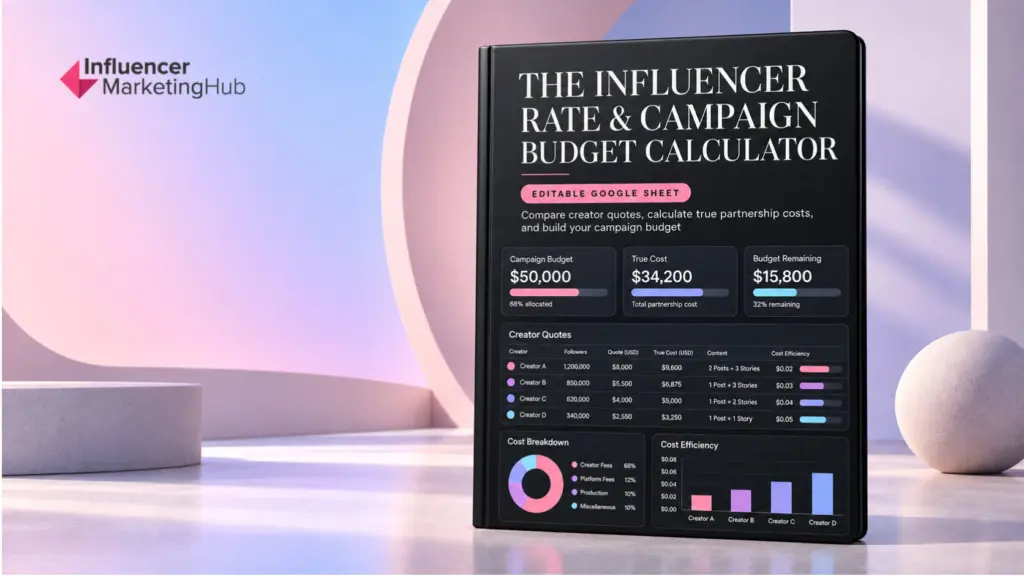
Download our Influencer Rate & Campaign Budget Calculator to compare creator quotes, calculate the true cost of each partnership, estimate CPM, CPV, CPA, and ROAS, and build your complete influencer campaign budget in one Google Sheet.

- 2026 Influencer Rate Cheat Sheet
- How Much Does Influencer Marketing Cost?
- Influencer Rates by Platform
- Influencer Rates by Creator Tier
- How Influencers Are Paid
- Base Rate vs. Total Creator Cost
- What Determines Influencer Rates?
- Finding the Best Influencers Within Your Budget
- Final Thoughts
- Frequently Asked Questions
2026 Influencer Rate Cheat Sheet
If you need a starting point for campaign budgeting, the ranges below show what brands can typically expect to pay for a single sponsored creator deliverable in 2026 across Instagram, TikTok, and YouTube.
These are planning benchmarks, not fixed rate cards. Actual creator quotes can move significantly depending on performance, niche, content format, production requirements, usage rights, exclusivity, and campaign scope.
Platform | Creator Tier | Audience Size | Typical Rate |
Nano | Under 10,000 | $10–$100+ per post | |
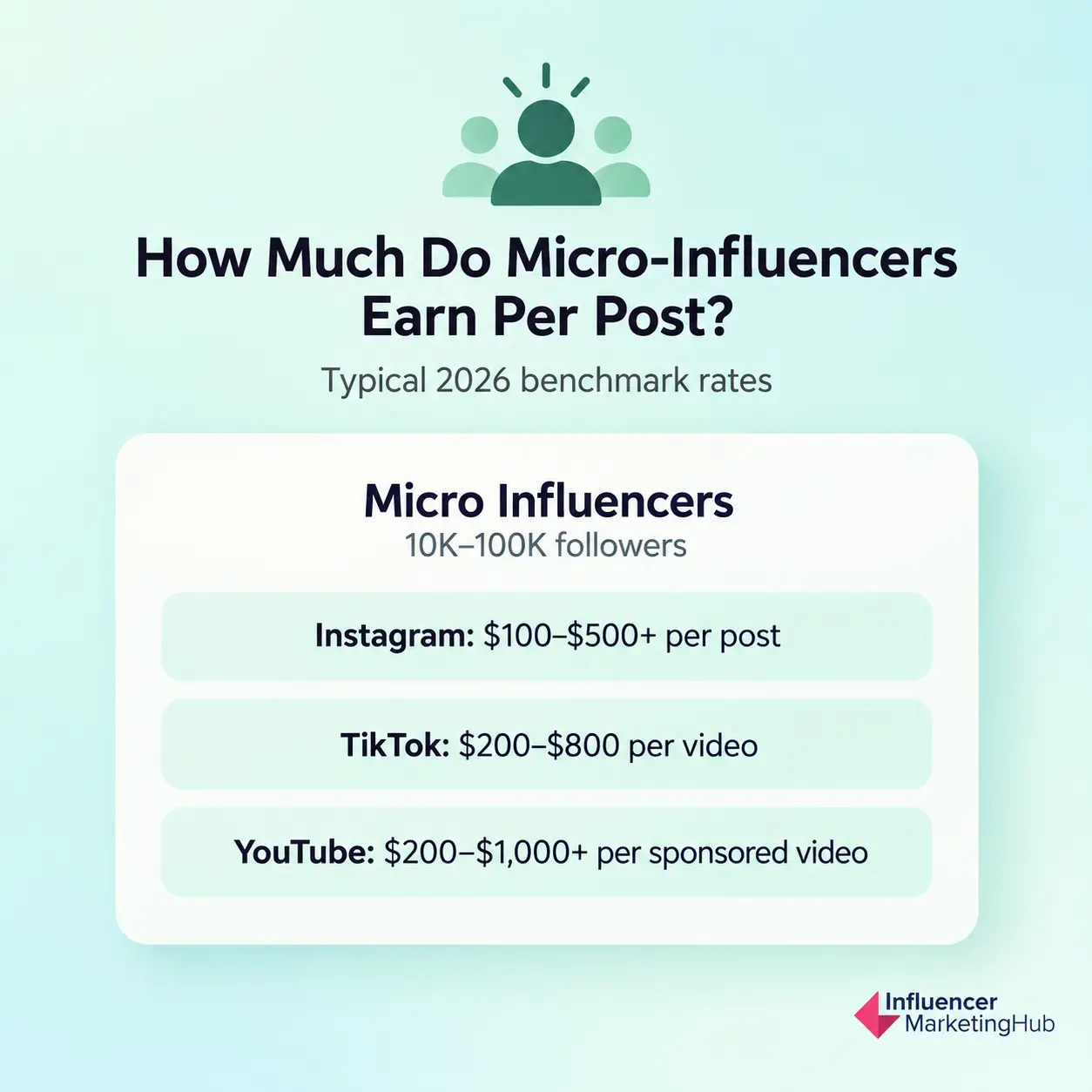
Micro | 10,000 - 100,000 | $100–$500+ per post | |
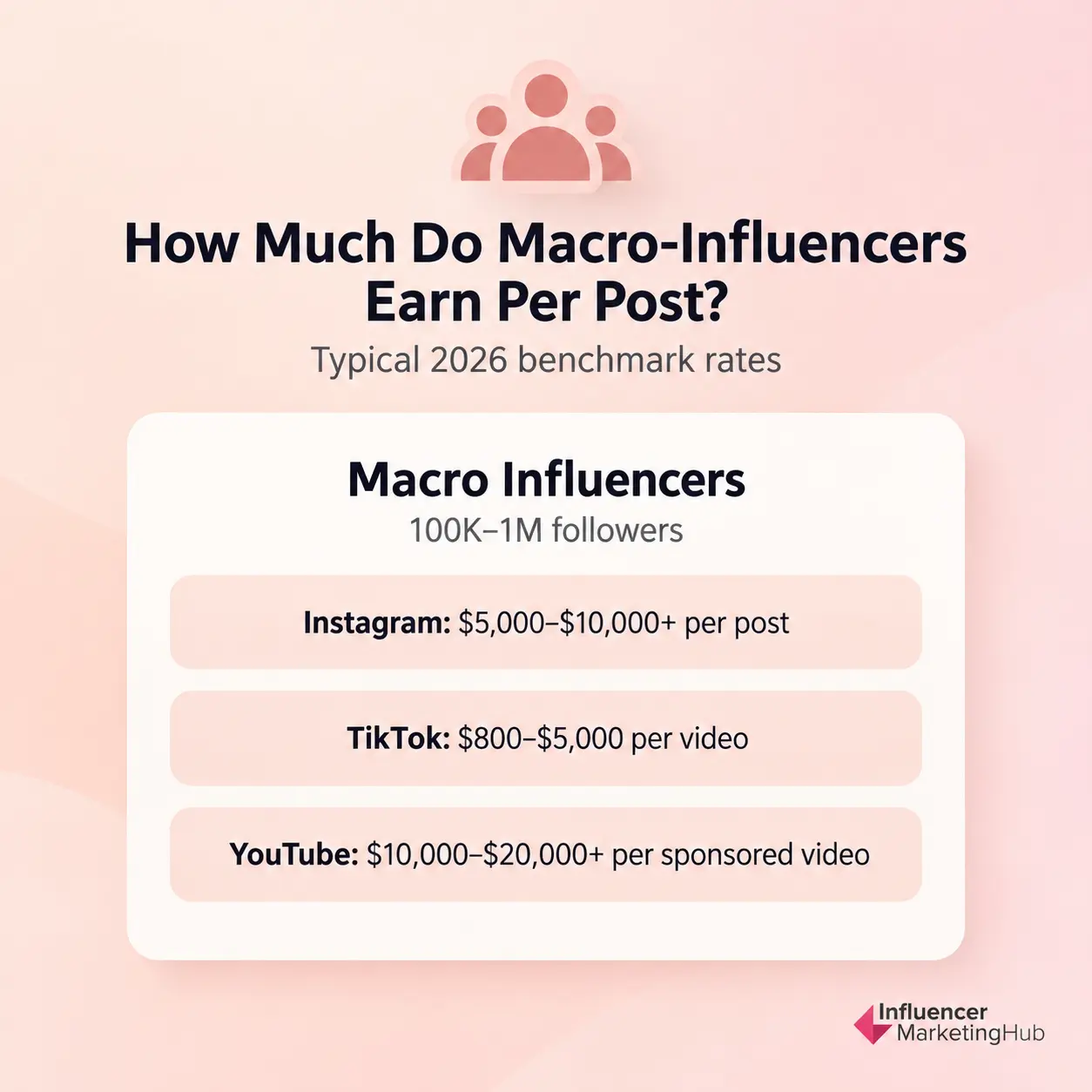
Macro | 100,000 - 1,000,000 | $5,000–$10,000+ per post | |
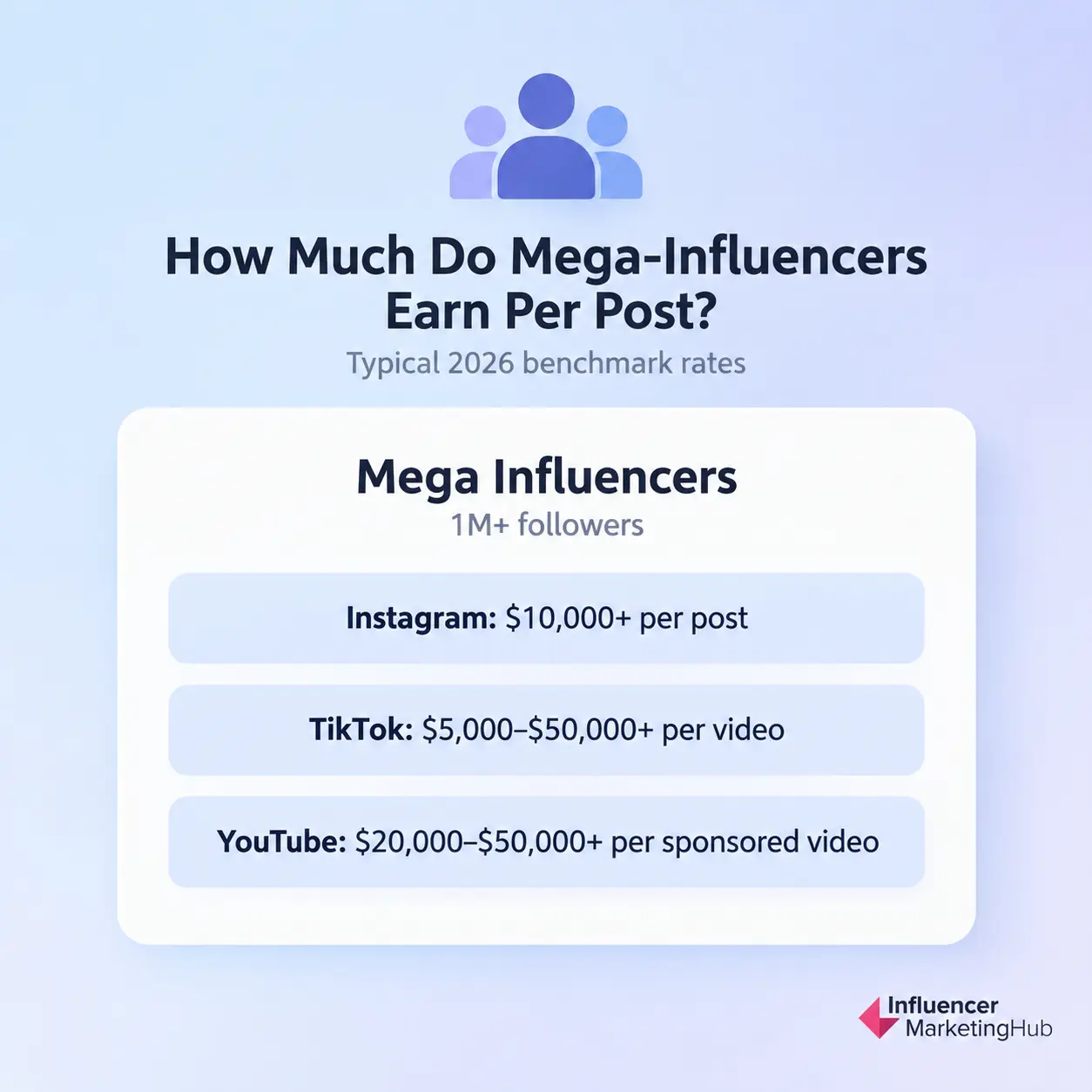
Mega | 1,000,000+ | $10,000+ per post | |
TikTok | Nano | Under 10,000 | $50–$200 per video |
TikTok | Micro | 10,000 - 100,000 | $200–$800 per video |
TikTok | Macro | 100,000 - 1,000,000 | $800–$5,000 per video |
TikTok | Mega | 1,000,000+ | $5,000–$50,000+ per video |
YouTube | Nano | Under 10,000 | $20–$200+ per sponsored video |
YouTube | Micro | 10,000 - 100,000 | $200–$1,000+ per sponsored video |
YouTube | Macro | 100,000 - 1,000,000 | $10,000–$20,000+ per sponsored video |
YouTube | Mega | 1,000,000+ | $20,000–$50,000+ per sponsored video |
The ranges immediately show why there is no single answer to “How much does an influencer cost?”
A nano creator may charge less than $100 for a straightforward sponsored post, while a large creator producing long-form video can command tens of thousands of dollars before additional commercial rights are added.
Content format matters, too. On Instagram, for example, Reels generally command higher fees than static posts because they require more scripting, filming, editing, and production work. Story packages are typically priced below permanent feed content, while bundles combining Reels, Stories, and other assets increase the total deal value.
TikTok pricing is similarly influenced by creative complexity and recent video performance. A creator whose videos consistently outperform their follower count may reasonably charge above the typical range for their tier.
YouTube generally becomes more expensive as production requirements increase. A dedicated product review or long-form sponsored video requires considerably more work than a short integration, which is why two partnerships involving creators with similar subscriber counts can still carry very different price tags.
And none of these figures necessarily represent the total amount a brand will pay.
Usage rights, paid amplification, category exclusivity, raw footage, additional revisions, cross-platform distribution, creator management fees, and other requirements can all sit on top of the base creator rate.
So, use these numbers to answer “What should we roughly budget?”, not “What should this creator definitely charge?”
Plan Influencer Campaigns and Track Creator Performance
Later helps brands discover influencers, manage creator partnerships, and organize campaign content across social platforms. Plan deliverables, track performance, and manage influencer collaborations from a single dashboard.
How Much Does Influencer Marketing Cost?
There is no standard influencer marketing budget.
A small campaign with a handful of nano or micro-influencers might cost a few thousand dollars, while a large program involving major creators, paid amplification, content licensing, and agency support can run into six or seven figures.
What matters is understanding that the creator fee is only one part of the total campaign cost. That distinction is becoming more important as influencer budgets grow.
Therefore, a typical influencer marketing budget may need to account for:
| Cost | What it covers |
| Creator fees | Payment for creating and/or publishing the agreed content |
| Usage rights | Permission to reuse creator content in ads, websites, email, retail, or other channels |
| Paid amplification | Media spend used to extend creator content through paid advertising |
| Exclusivity | Additional compensation for restricting the creator from working with competitors |
| Product and shipping | Samples, gifting, fulfilment, and logistics |
| Production costs | Locations, props, travel, specialist production, or other campaign requirements |
| Platform or software fees | Influencer discovery, campaign management, reporting, payments, or analytics tools |
| Agency or management fees | Strategy, creator sourcing, negotiations, campaign execution, and reporting |
| Creator management fees | Additional fees charged when creators are represented by talent managers or agencies |
This is why a $2,000 creator quote does not necessarily mean the partnership will cost $2,000.
If a brand also wants paid advertising rights, category exclusivity, raw footage, several rounds of edits, and cross-platform usage, the true cost of that creator can rise significantly.
Creator Rate vs. Campaign Budget
It helps to think of the two separately:
- Creator rate = what an individual influencer charges for the agreed partnership.
- Campaign budget = everything the brand spends to plan, create, distribute, manage, and measure the campaign.
For example, imagine a brand has a $10,000 campaign budget.
It might allocate:
- $6,000 to creator fees,
- $1,500 to paid amplification,
- $1,000 to usage rights,
- $500 to product and shipping,
- and $1,000 to campaign technology, management, or other operating costs.
❗ Note: That is only an illustrative example, not a recommended budget split. The right allocation depends on what the campaign is designed to achieve.
A brand focused primarily on organic awareness may put most of its budget into creators. A performance campaign may reserve more for paid amplification, affiliate commissions, and measurement. A campaign built around reusable creator content may dedicate a larger share to licensing and usage rights.
Start With the Outcome, Then Build the Budget
Instead of asking “How much should we spend on influencer marketing?” in isolation, start with what the campaign needs to accomplish.
A useful budgeting sequence is:
Objective → creators → deliverables → rights → amplification → measurement → total budget
That makes it much easier to decide whether you need ten smaller creators, one larger creator, a mix of tiers, or fewer creators with additional paid media behind their content.
IMH's broader 2026 guidance uses the same principle: Influencer marketing costs vary according to creator tier, platform, campaign scope, deliverables, content complexity, and usage rights. Smaller creators can provide a more cost-efficient way to reach highly targeted audiences, while larger partnerships can require substantially greater investment.
The important thing is to avoid treating the influencer's quoted rate as the entire budget. Plan for the full cost of activating, using, and measuring the content before deciding how much you can afford to spend on creator fees.
Budget ranges are useful, but they’re hard to act on until you can picture what a campaign actually produces: how many creators you activate, how much content goes live, and what that output tends to translate into (impressions, engagement, clicks). This is where platforms like Stellar are helpful—not just for reporting after the fact, but also for forecasting influencer rates, projected expenses, and expected performance before a campaign launches.
To give you a practical reference point, here are two real campaign snapshots that were tracked and consolidated in Stellar:
Creator-heavy, 100% organic activation (Tourisme Laval)
Tourisme Laval ran a spring campaign with 18 creators and 186 pieces of content, with no sponsored content. The activation generated 1.3M impressions, 50.3K engagements, and 8.9K clicks, with Reels averaging 24K views.
What that looks like as a planning benchmark:
- Roughly 10 pieces of content per creator (186 pieces / 18 creators).
- On average, about 72K impressions, 2.8K engagements, and ~500 clicks per creator (based on the campaign totals).
- Overall, that’s about a 3.9% engagement rate (engagements ÷ impressions) and about a 0.68% click-through rate (clicks ÷ impressions).
Retail promo burst with scale (La Redoute, Black Friday period)
For Black Friday/end-of-year promos, La Redoute collaborated with 80+ ambassadors on Instagram and reported 39M reach, 726K engagements, and 100K clicks, alongside a reported 14% ROI.
As a benchmark from the reported totals, that’s roughly a 1.9% engagement rate and about a 0.26% click-through rate (using engagements/clicks against reported reach).
How to use these benchmarks when you’re budgeting: instead of starting with “cost per post,” start with the shape of your campaign (number of creators × content volume × expected outcomes), then use your expected deliverables to negotiate rates. A creator who posts once vs. one who delivers a multi-format package (Reels + Stories + TikTok) changes your true cost per result—so planning and tracking at the campaign level is what keeps spend predictable.
Influencer Rates by Platform
Influencer rates vary by platform because brands aren't buying the same type of content, audience behavior, or production effort everywhere.
A sponsored Instagram Reel, TikTok video, and YouTube integration may come from creators with similar-sized audiences, but the amount of work involved and the way audiences consume that content can be very different.
Instagram Influencer Rates
Instagram remains one of the most established platforms for paid creator partnerships, and its pricing is relatively mature.
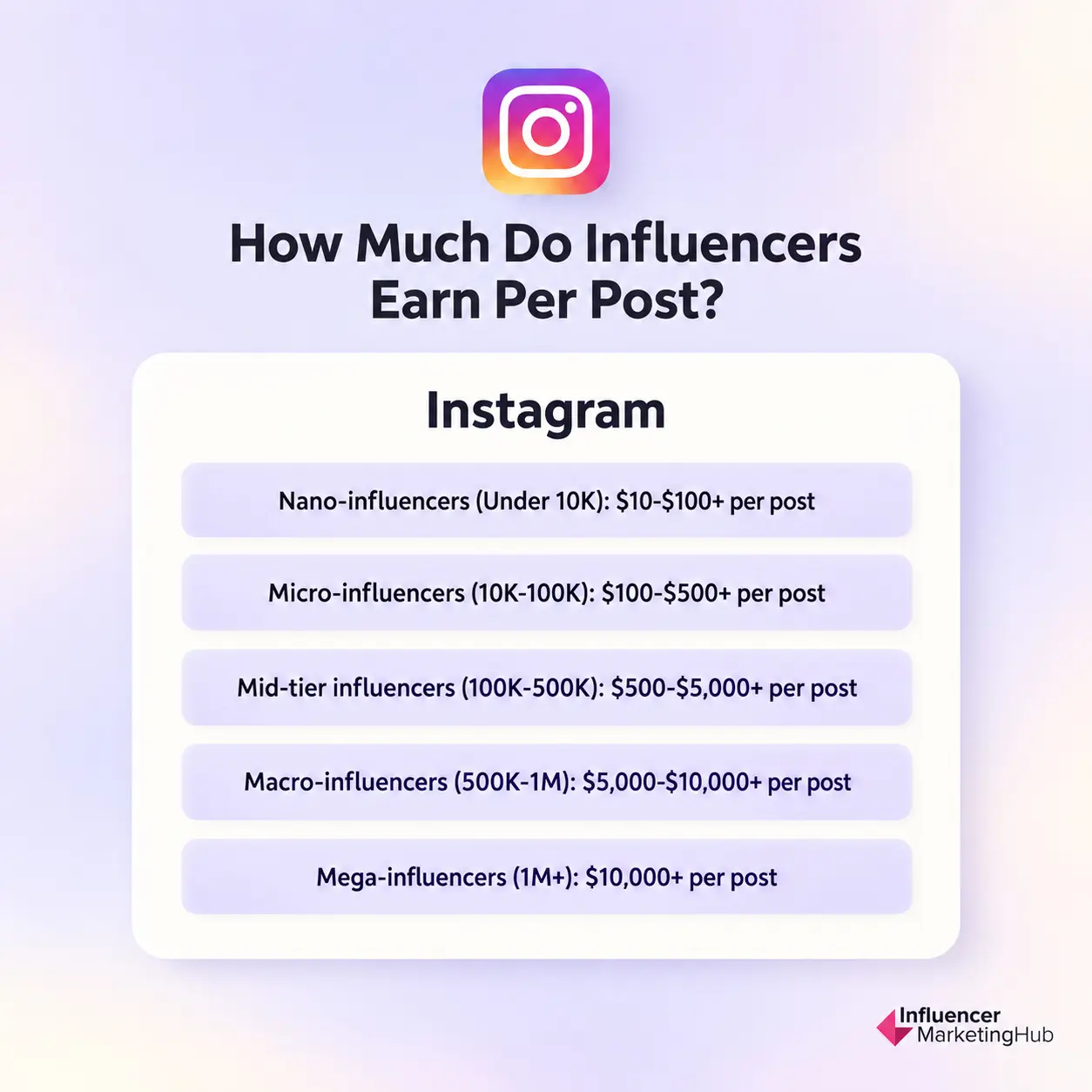
Our 2026 benchmarks put typical rates at approximately:
- Nano influencers: $10–$100+ per post
- Micro influencers: $100–$500+ per post
- Mid-tier influencers: $500–$5,000+ per post
- Macro influencers: $5,000–$10,000+ per post
- Mega influencers: $10,000+ per post
The format matters considerably.
A static sponsored post will usually require less production than a Reel, while a package combining a Reel, Stories, carousel content, and additional assets will cost more than a single deliverable.
Usage rights can increase the price further if the brand wants to take that creator content beyond the influencer's own account and reuse it in paid ads or other marketing channels.
Instagram pricing should therefore be evaluated based on the specific format and rights being purchased, not just the creator's follower tier.
For a full breakdown by creator size, Reels, Stories, feed posts, and other pricing factors, see our complete guide to Instagram Influencer Rates.
TikTok Influencer Rates
TikTok pricing is particularly sensitive to recent content performance.
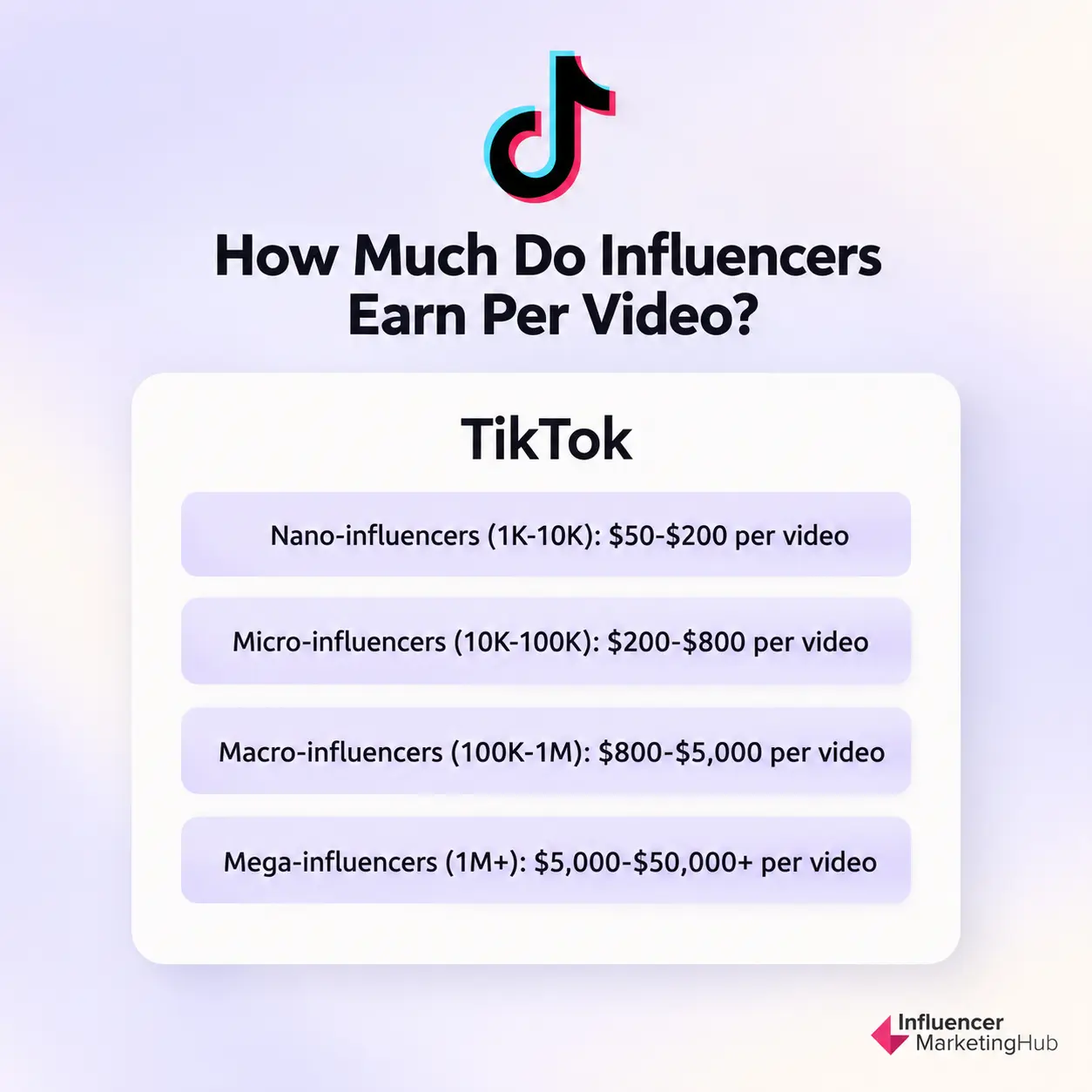
Our current 2026 benchmarks are approximately:
- Nano influencers: $50–$200 per video
- Micro influencers: $200–$800 per video
- Macro influencers: $800–$5,000 per video
- Mega influencers: $5,000–$50,000+ per video
Follower count still provides a useful starting point, but it can be misleading on TikTok because creators with relatively modest audiences can generate videos that reach far beyond their existing follower base.
When evaluating a TikTok quote, brands should therefore look closely at average recent video views, watch behavior, engagement, content consistency, and the performance of previous sponsored posts.
Creative requirements can also change the quote substantially. A straightforward product mention will usually cost less than a concept requiring scripting, multiple scenes, complex editing, several revisions, or permission to amplify the post through Spark Ads.
For more detailed pricing by creator tier and the factors that influence TikTok quotes, see our TikTok Influencer Rates Guide.
TikTok Shop Creator Campaigns: When Rates Should Be Measured Against Sales
TikTok pricing is harder to benchmark than Instagram or YouTube because many campaigns no longer behave like a single sponsored post. On TikTok Shop, a creator partnership can include product seeding, affiliate commission, livestream selling, short-form UGC, and paid amplification. That changes the budgeting question from “what does one TikTok post cost?” to “how much commerce output can this creator system produce?”
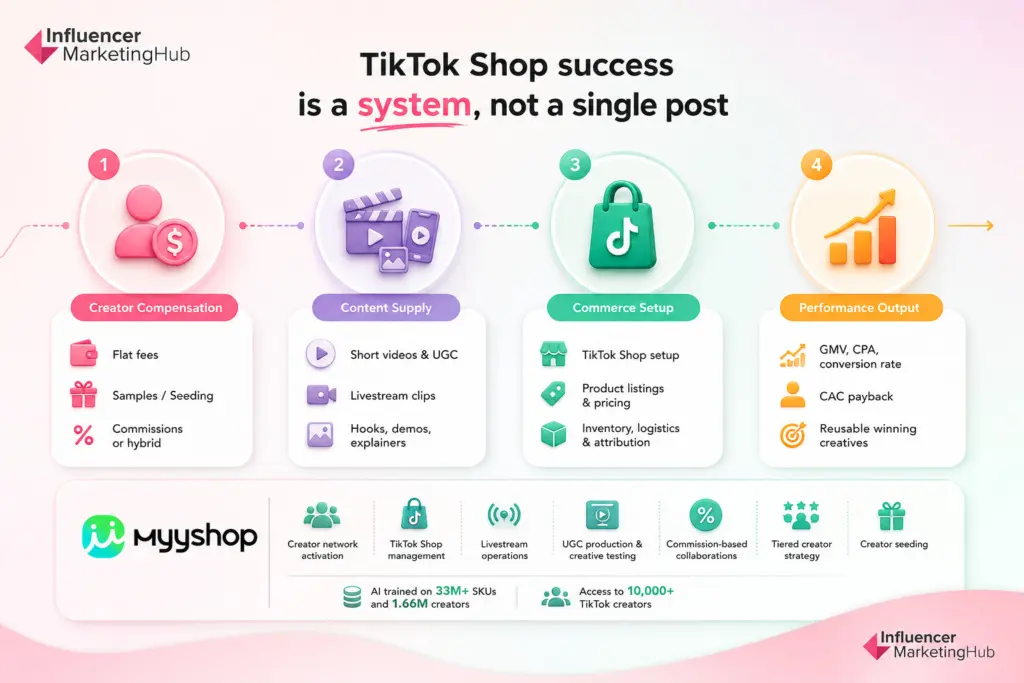
A useful benchmark is to separate the campaign into four cost layers:
- Creator compensation: flat fees, samples, commissions, or a hybrid model
- Content supply: the number of usable videos, livestream clips, hooks, demos, and product explainers created
- Commerce setup: TikTok Shop setup, product listings, pricing, inventory alignment, logistics, and attribution
- Performance output: GMV, CPA, conversion rate, CAC payback, and reusable winning creatives
This is where a platform like MyyShop becomes relevant for brands building TikTok Shop programs. Its model combines TikTok Shop management, creator network activation, livestream operations, UGC production, commission-based collaborations, creator seeding, and short-form creative testing. On the creator-matching side, MyyShop’s AI layer is trained on 33M+ SKUs and 1.66M creators, while its brand offering gives access to 1.66M TikTok creators.
For budgeting, that means a $2,000 TikTok creator fee should not be evaluated in isolation. If the same spend can activate a wider creator pool, produce multiple testable assets, generate affiliate-tracked sales, and identify content worth scaling through paid media, the real comparison becomes cost per validated asset and cost per sale, not cost per post.
YouTube Influencer Rates
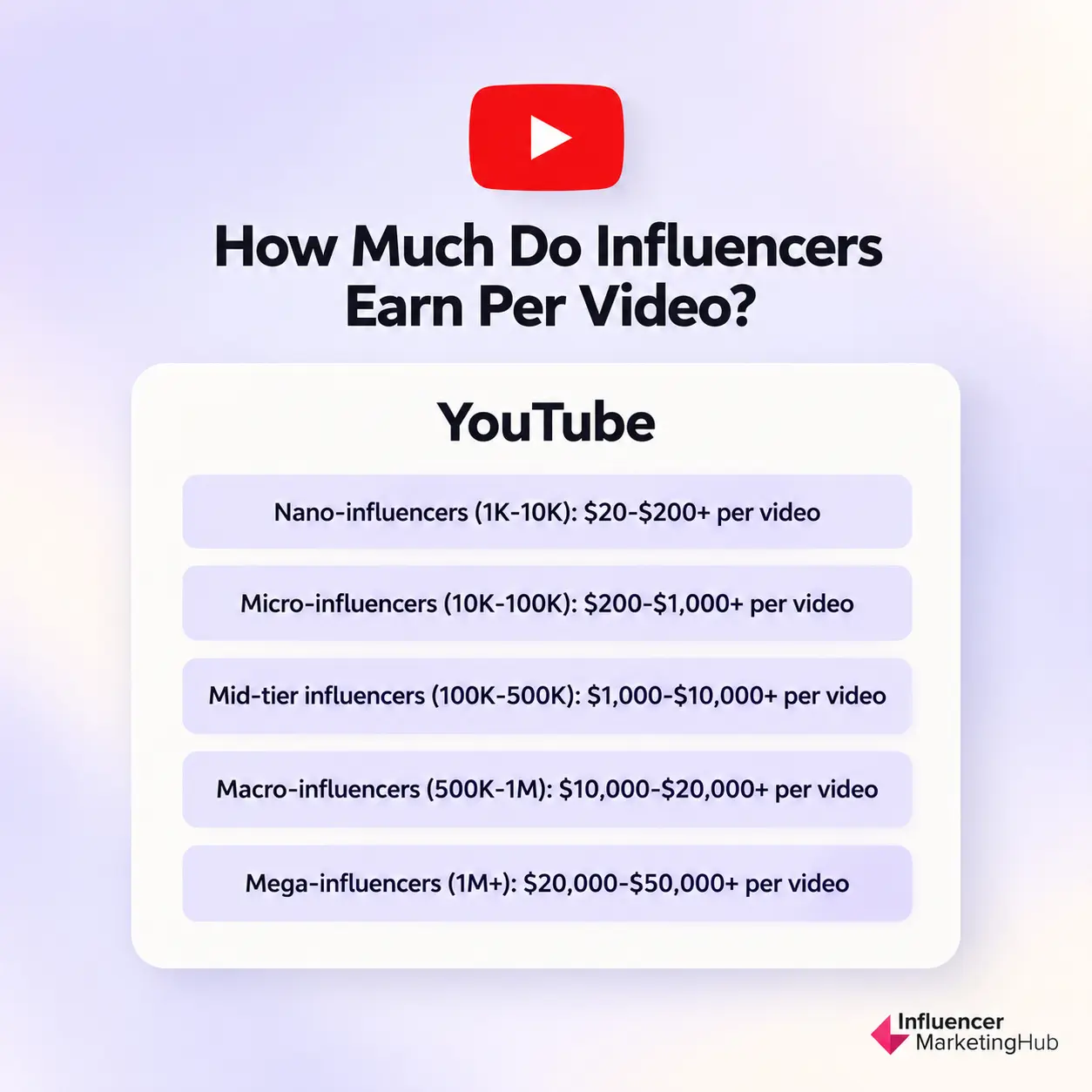
YouTube generally involves a different cost structure because producing long-form video can require significantly more time, planning, filming, and editing than creating a short social post.
Our 2026 benchmarks put sponsored YouTube content at approximately:
- Nano influencers: $20–$200+ per sponsored video
- Micro influencers: $200–$1,000+ per sponsored video
- Mid-tier influencers: $1,000–$10,000+ per sponsored video
- Macro influencers: $10,000–$20,000+ per sponsored video
- Mega influencers: $20,000–$50,000+ per sponsored video
The type of sponsorship matters just as much as creator size.
A short sponsor mention within an existing video is not equivalent to a dedicated review, tutorial, integration, or full branded video. The more heavily the creator needs to build the content around the brand, the more the partnership is likely to cost.
Brands should also pay attention to average views rather than subscriber count alone. A channel with 100,000 subscribers that consistently generates 150,000 views per video may offer very different value from a channel of the same size averaging 15,000 views.
YouTube content also tends to have a longer lifespan than short-form social content, which can affect how creators and brands think about pricing and usage value.
For rates by creator tier, sponsorship format, CPM considerations, and other cost drivers, see our full guide to YouTube Influencer Rates.
What About Facebook, X, and Other Platforms?
Influencer partnerships also happen across Facebook, X, LinkedIn, Twitch, Amazon, Pinterest, and other platforms.
However, pricing data for these channels is often less standardized or highly dependent on the type of creator and campaign, so we don't recommend applying a generic per-post benchmark simply because one exists online.
Facebook Influencer Rates
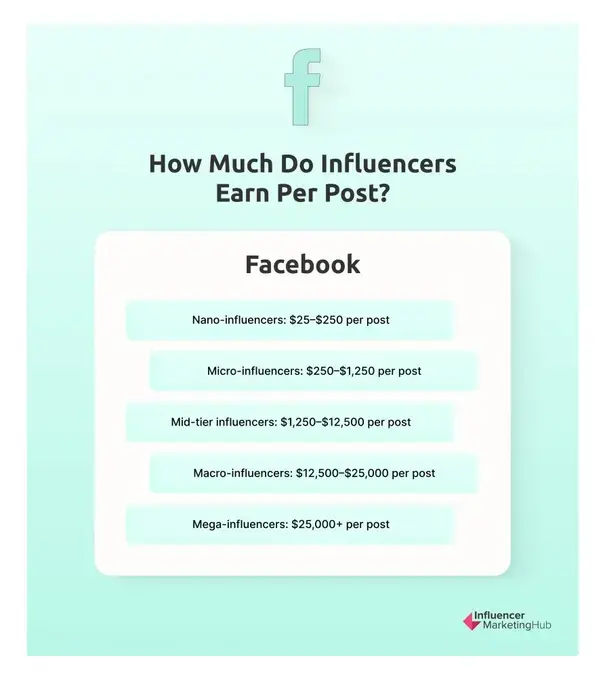
Although Facebook’s popularity in influencer marketing has dwindled over the years, influencer rates on the platform are still comparatively high. Even micro-influencers may charge as high as $1,250 per Facebook post, depending on their following size and content.
X (Twitter) Influencer Rates
X (formerly Twitter) may be in the top five, but its usage is significantly lower compared to the other platforms, with less than 10% of brands using it. So, influencer rates on the platform are slightly lower. Nano-influencers on X may charge as low as $2 per post.
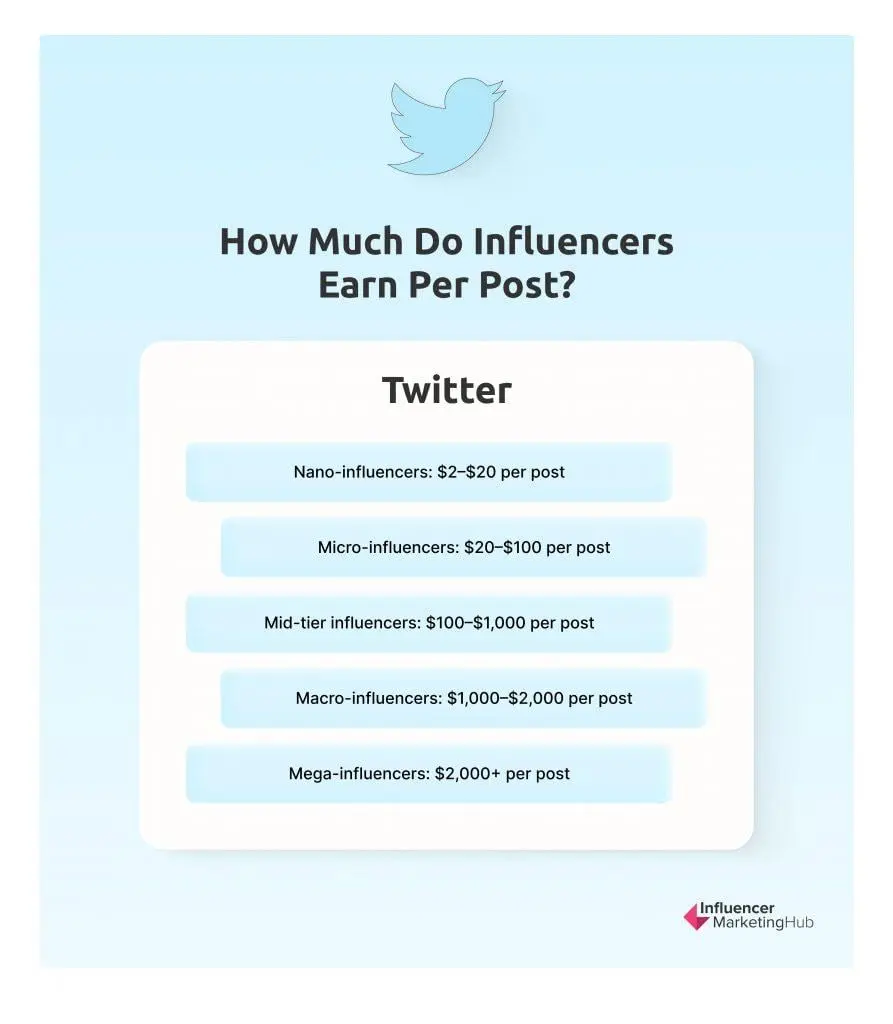
Influencer Rates by Creator Tier
Follower count still provides a useful starting point for influencer pricing, particularly when brands are building an initial campaign budget.
But moving from a nano influencer to a micro, macro, or mega creator does more than increase potential reach. Larger creators are also more likely to have professional production workflows, management representation, established rate cards, higher demand, and more complex commercial terms.
At Influencer Marketing Hub, we generally use four core creator tiers:
| Creator tier | Typical audience size | General pricing pattern |
| Nano | 1K–10K | Lowest entry cost; highly dependent on format and niche |
| Micro | 10K–100K | More established pricing; often strong balance of reach and engagement |
| Macro | 100K–1M | Premium pricing for larger-scale reach and polished production |
| Mega | 1M+ | Bespoke pricing; large campaigns can function more like media buys |
These tiers are useful for budgeting, but they should not be treated as fixed rate cards. A high-performing creator at the lower end of one tier can easily command more than a weaker creator with a larger following.
Nano Influencer Rates
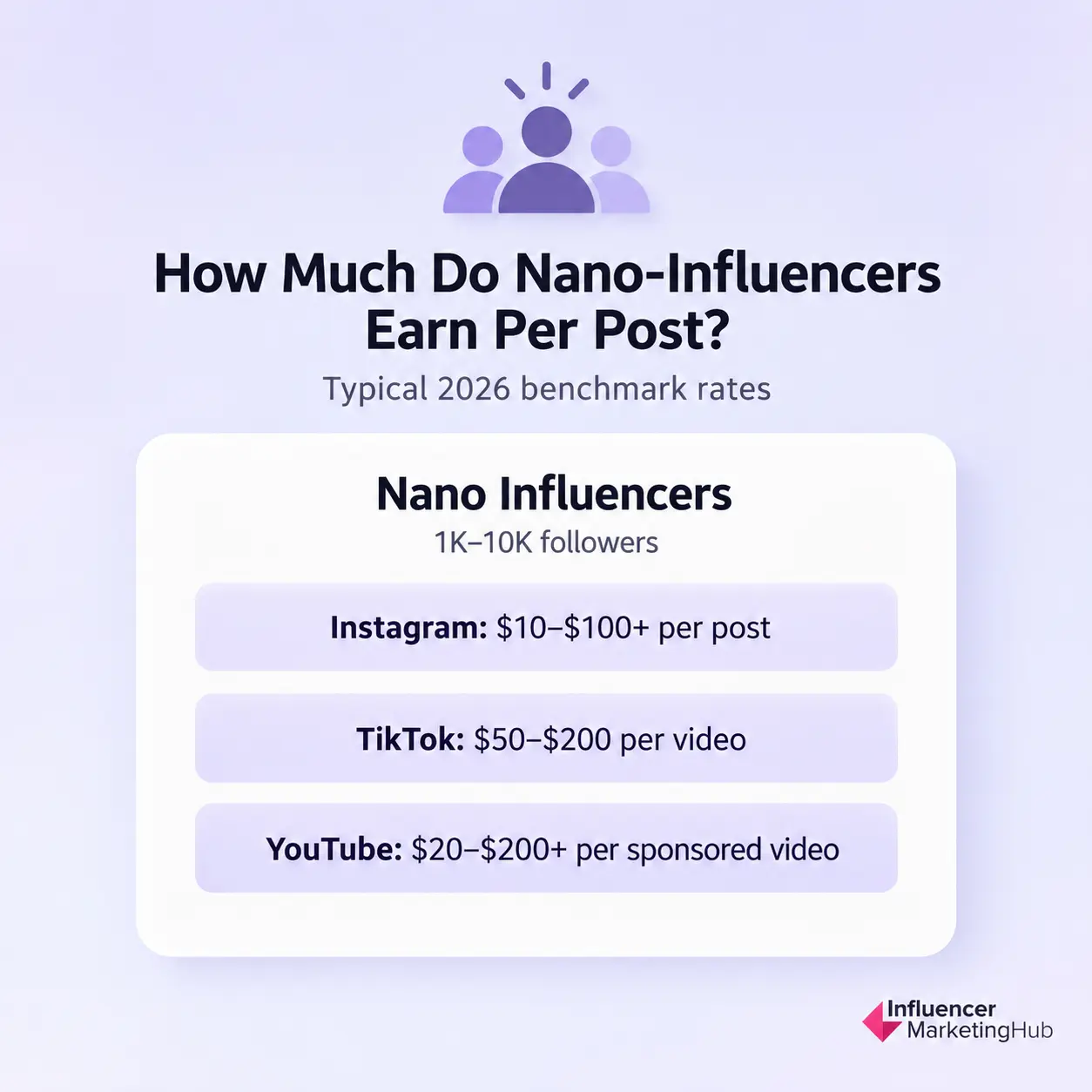
Nano influencers generally have 1,000 to 10,000 followers and tend to sit at the most accessible end of influencer pricing.
Our dedicated 2026 nano-rate research finds that Instagram nano creators commonly charge around $10-$50 for a static feed post, while Reels often fall between $20 and $100. TikTok nano creators commonly sit around $50-$200 per video, while YouTube Shorts from creators in this tier often fall into a similar $20-$100 range.
That lower entry cost makes nano influencers useful when brands want to work with many niche or local creators, test a new influencer program, or generate a larger volume of authentic-looking content without concentrating the entire budget into one partnership.
Pricing can still increase significantly when a creator operates in a commercially valuable niche, consistently generates strong engagement, or grants usage rights for paid advertising.
For a deeper breakdown by platform, content format, engagement, and usage rights, see our complete guide to Nano Influencer Rates.
Micro Influencer Rates
Micro influencers typically have 10,000 to 100,000 followers and often represent the point where creator pricing becomes more formalized.
Across most campaigns, our current research finds that micro-influencer collaborations can range from roughly $100 to $2,000+ per deliverable or campaign element, depending heavily on the platform and scope. On Instagram, standard feed content commonly falls around $100-$500, while TikTok videos frequently sit around $200-$800. YouTube pricing can be slighly higher, coming in at $200-$1,000 per video.
Micro creators can be attractive because they offer more reach than nano influencers while often retaining relatively focused audiences and strong community relationships.
This is also where comparing quotes becomes particularly important. Two creators with 50,000 followers can charge very different amounts if one has stronger engagement, better production quality, a more commercially valuable niche, or a track record of performing well for brands.
Our Micro Influencer Rates Guide goes deeper into platform pricing, campaign bundles, engagement, licensing, and the factors that move a creator above or below the typical range.
Macro Influencer Rates
Macro influencers generally sit between 100,000 and 1 million followers, although some platform-specific pricing frameworks split this group further into mid-tier and macro creators.
At this level, the economics change considerably.
Our 2026 macro-influencer research finds that campaigns can range from roughly $5,000 to more than $50,000, depending on the platform, deliverables, audience, usage rights, and exclusivity. On Instagram, sponsored feed posts commonly fall around $5,000-$10,000+, while macro TikTok videos can sit around $800-$5,000 and YouTube sponsorships around $10,000-$20,000+.
The large differences between platforms show why follower count should never be used as a standalone pricing formula.
A macro YouTube creator producing a detailed product integration may require substantially more time and production than a short-form TikTok post from a creator with the same audience size.
Macro creators also become more likely to have management representation, professional production standards, stricter contract terms, and additional fees for paid media or exclusivity.
For more detailed benchmarks and campaign-cost examples, see our full guide to macro influencer rates.
Mega Influencer Rates
Mega influencers have audiences above 1 million followers or subscribers, and pricing at this level becomes increasingly bespoke.
Our current research finds that a single sponsored post from a mega creator can cost anywhere from around $10,000 to well over $100,000, depending on the platform and commercial terms. Larger cross-platform partnerships can move into six or even seven figures once brands add recurring deliverables, licensing, paid media rights, exclusivity, events, and long-term ambassador agreements.
Platform differences remain significant.
Mega Instagram creators can charge $10,000-$100,000+ for sponsored feed posts, while Reels can rise to $20,000-$150,000+. Mega TikTok videos commonly start around $5,000 and can exceed $50,000, while sponsored YouTube integrations frequently sit around $20,000-$50,000+.
At this scale, brands are often buying more than creator content. They are paying for mass distribution, cultural visibility, production quality, scarcity, and association with a recognizable personality.
That means mega-influencer deals should often be evaluated more like major media partnerships than simple sponsored posts.
Our complete Mega Influencer Rates Guide covers these deals in more depth, including platform pricing, usage rights, cross-platform packages, and when the premium can make sense for a brand.
Bigger Does Not Automatically Mean Better Value
The rate rises as creators become larger, but campaign efficiency does not necessarily rise with it.
Nano and micro creators may give brands access to smaller but highly relevant communities at a lower cost. Macro and mega influencers can provide scale much faster, but that reach comes at a significant premium.
The right tier therefore depends on what the campaign needs:
smaller creators for targeted reach, community relevance, and scalable testing; larger creators for mass awareness, major launches, and concentrated visibility.
For many brands, the best answer is not choosing one tier exclusively but building a creator mix that balances reach, relevance, performance, and cost.
How Influencers Are Paid
Influencers are not always paid through a single fixed fee.
Depending on the campaign, compensation can be structured around content production, performance, recurring partnerships, product value, or a combination of several models.
Understanding the payment structure matters because two creators quoting the same total amount may be taking on very different levels of risk and responsibility.
| Compensation model | How it works | Best suited for |
| Flat fee | The creator receives a fixed payment for agreed deliverables | Sponsored posts, launches, awareness campaigns |
| Affiliate or commission | Payment is tied to tracked sales or conversions | Performance and commerce campaigns |
| Hybrid fee + commission | The creator receives a guaranteed fee plus performance upside | DTC, affiliate, TikTok Shop and conversion-focused programs |
| Product or gifting | The creator receives a product rather than, or sometimes alongside, cash | Seeding, testing new relationships |
| Retainer | The creator receives recurring payment for ongoing deliverables | Ambassadors and long-term partnerships |
| Usage or licensing fee | Additional payment gives the brand permission to reuse creator content | Paid social, websites, email, retail and other media |
Flat Fee
A flat fee is the most straightforward model.
The brand and influencer agree on a fixed amount for specific deliverables, such as one Reel, three Stories, or a sponsored YouTube integration. The creator is paid the agreed fee regardless of how the content ultimately performs.
This is one of the most common structures because both sides know the commercial terms before the campaign starts. IMH’s current Instagram pricing guidance identifies flat-fee pricing as a standard model for clearly defined sponsored deliverables.
The important thing is to define exactly what the fee includes. A $2,000 quote for one Reel can mean something very different if one creator includes filming, editing, two rounds of revisions, and organic posting while another charges separately for each.
Affiliate or Commission-Based Payment
Affiliate compensation ties creator earnings to a measurable outcome, usually a sale or conversion.
The influencer may receive a percentage of revenue, a fixed amount per sale, or another agreed commission when customers purchase through a tracked link, code, storefront, or social-commerce feature.
This reduces the brand’s guaranteed upfront cost but transfers more performance risk to the creator.
Affiliate-only deals can work when creators are comfortable with the product, attribution is reliable, and the commercial upside is meaningful. But they should not automatically be treated as a replacement for compensating creators for production work.
Hybrid Fee + Commission
Hybrid compensation combines a guaranteed base fee with performance-based earnings.
For example, a creator might receive $1,000 for producing and publishing the content plus 10% of tracked sales.
This model gives creators a guaranteed floor for their work while giving both sides an incentive when the campaign performs well. IMH’s 2026 compensation guidance notes a broader move toward structures that combine guaranteed creator pay with transparent performance incentives.
For performance-focused campaigns, this can provide a useful middle ground between paying entirely upfront and asking the creator to carry all of the sales risk.
Product or Gifted Compensation
Some partnerships begin with product rather than cash.
This is particularly common in product seeding, where brands send items to creators to introduce the product, test interest, or begin building a relationship. But gifting and guaranteed sponsored content are not the same thing.
Sending a free product does not automatically guarantee that a creator will publish about it. If the brand requires a specific post, deadline, message, or other deliverable, those expectations should be agreed explicitly rather than assumed.
@kaitlynrhumphrey This was such a good PR haul! I can’t wait to try this new @reale actives eek #prhaul #prunboxing #influencergifting #newbeauty #alixearle ♬ Morning Blend Bossa - Sum Dekinaita
Retainer or Ambassador Payment
Longer-term creator relationships are often structured through retainers.
Instead of negotiating every post independently, the brand pays the influencer a recurring monthly or campaign-period fee for an agreed package of deliverables.
That might include regular social posts, event participation, product launches, affiliate content, or access to the creator for ongoing campaigns.
Retainers can make costs more predictable for brands and revenue more predictable for creators. They can also be combined with affiliate commissions or performance bonuses when the partnership includes measurable sales objectives.
Usage and Licensing Fees
A creator’s fee for making and publishing content does not automatically give the brand unlimited rights to use that content elsewhere.
If the brand wants to run the creator’s video as a paid ad, place it on a product page, include it in email, use it in retail media, or continue using it after the original agreement expires, the creator may charge a separate usage or licensing fee.
The price depends on factors such as:
- Where the content will appear
- Whether the use is organic or paid
- How long the rights last
- and How widely the content will be distributed
This distinction is especially important because usage rights can materially increase the total cost of a creator deal. Our 2026 Usage-Rights Clause Library specifically separates fixed-term organic reposting, paid-social licensing, email, out-of-home, and other forms of reuse.
The broader lesson is that brands should compare influencer quotes based on the full compensation structure, not simply the headline fee.
A $1,500 flat-fee post and a $750 post with affiliate commission, paid usage, and a long-term retainer are fundamentally different commercial arrangements.
Base Rate vs. Total Creator Cost
A creator's quoted rate is usually only the starting point.
A brand might see $2,000 for one Instagram Reel and assume that is the full cost of the partnership. But once usage rights, paid amplification, exclusivity, revisions, additional deliverables, management fees, and production requirements are added, the final amount can look very different.
That is why brands should separate the base creator rate from the total creator cost.
What Is the Base Rate?
The base rate is the amount a creator charges for the core deliverable.
For example:
- One Instagram Reel posted to the creator's account: $2,000
That fee may cover concept development, filming, editing, and publishing, but brands should never assume every additional right or service is included.
The scope needs to be defined clearly.
A base rate may or may not include:
- a specific number of revisions,
- Stories supporting the main post,
- raw footage,
- cross-posting to another platform,
- link placement,
- extended content availability,
- or approval rounds.
Two creators can therefore quote the same base fee while offering very different packages.
What Can Increase the Total Creator Cost?
Common add-ons include:
| Additional cost | Why it changes the price |
| Usage rights | The brand wants to reuse creator content beyond the original post |
| Paid amplification | Content will be used through Spark Ads, whitelisting, or other paid media |
| Exclusivity | The creator cannot work with competing brands for an agreed period |
| Additional deliverables | Extra Stories, videos, images, or platform posts are required |
| Raw footage | The brand wants access to unedited creator files |
| Revisions | Additional rounds of creative changes require more production time |
| Extended licensing period | Content can be reused for longer |
| Cross-platform rights | The content will appear on multiple channels |
| Travel or production | Locations, props, travel, crew, or specialist production are required |
| Management fees | A talent manager or agency may add representation fees |
Usage rights are one of the biggest areas brands underestimate.
As per our current pricing research, standard sponsorship fees generally cover organic publication on the creator's own account, while paid advertising, websites, email, retail media, and broader reuse commonly require additional licensing.
At the macro level, those additions can become significant. Our 2026 macro-influencer research finds that campaign budgets can rise 30% to more than 100% when creator content is extended into paid advertising, landing pages, email, retail media, and other owned channels.
Exclusivity Has a Price Too
Exclusivity is another cost that is easy to overlook.
If a skincare brand asks a creator not to work with competing skincare companies for 30, 60, or 90 days, the creator may lose other sponsorship opportunities during that period.
That lost earning potential has value.
Our current rate guides consistently identify exclusivity as a pricing factor across nano, micro, macro, and mega creators. The longer or broader the restriction, the more likely it is to increase the quote.
Example: How a $2,000 Reel Can Become a $4,000+ Deal
Imagine a creator quotes:
| Item | Cost |
| Base fee for 1 Instagram Reel | $2,000 |
| 60-day paid usage rights | +$800 |
| 60-day category exclusivity | +$600 |
| Raw footage | +$300 |
| Additional revision round | +$200 |
| Management fee | +$300 |
| Total creator cost | $4,200 |
This is an illustrative example, not a recommended pricing formula.
The point is that the original $2,000 rate only accounted for 48% of the final partnership cost.
That is why comparing creator quotes based only on the headline rate can be misleading.
Compare Like With Like
Before deciding that one creator is expensive and another is affordable, normalize both quotes to the same scope.
Ask:
- Are the deliverables identical?
- Do both quotes include the same usage period?
- Is paid amplification included?
- Is there exclusivity?
- How many revisions are included?
- Are raw files included?
- Are there management fees?
- Is content being posted on one platform or several?
Only once those terms match can the two prices be compared fairly.
This is also a better way to negotiate. IMH's current TikTok pricing guidance recommends adjusting scope before simply asking creators to reduce their fee. Brands can lower costs by reducing deliverables, shortening exclusivity, limiting revisions, or narrowing usage rights rather than expecting the same workload for less money.
A useful rule is:
- Base rate tells you what the content costs to create and publish. Total creator cost tells you what the partnership actually costs the brand.
Brands should budget around the second number.
What Determines Influencer Rates?
Influencer pricing is rarely based on a single metric.
Follower count may help establish an initial range, but the final quote usually reflects a combination of audience value, expected performance, creative workload, commercial rights, and the opportunity cost of taking the partnership.
That is why two creators with similar-sized audiences can reasonably quote very different amounts.
1. Audience Size and Actual Reach
Follower count remains one of the first signals brands use when estimating creator costs, and larger creators generally command higher rates because they offer greater potential distribution.
But follower count should be considered alongside actual recent reach or views.
This is especially important on platforms such as TikTok and YouTube, where two creators with the same number of followers or subscribers can generate very different average views. Our 2026 TikTok pricing guidance specifically recommends evaluating recent video performance rather than treating follower count as the primary indicator of value.
2. Engagement and Audience Quality
A creator with an active, relevant audience can command a premium even when their following is relatively small.
Brands should look at:
- engagement rates,
- comment quality,
- shares and saves,
- repeat audience interaction,
- follower authenticity,
- and whether the audience matches the target customer.
A large audience with weak engagement, suspicious follower growth, or poor geographic fit may be worth considerably less than the headline follower count suggests.
Our current micro-influencer research illustrates this clearly: creators within the same 10K–100K follower band can range from roughly $100 to $2,000+ per deliverable depending partly on engagement, audience quality, platform, and usage rights.
3. Platform
Different platforms require different creative skills and production workloads.
A sponsored Instagram Story, TikTok video, and 10-minute YouTube integration should not be expected to cost the same simply because the creator has a similar audience on each platform.
YouTube commonly carries higher production demands because long-form content may involve research, scripting, filming, editing, thumbnails, integrations, and a longer production cycle. TikTok pricing, meanwhile, is often more sensitive to recent content performance and expected reach.
4. Content Format and Production Complexity
Not all deliverables require the same amount of work.
A static image may take considerably less time to create than a scripted Reel, product tutorial, multi-scene TikTok, or dedicated YouTube review.
Rates can increase when the brief requires: complex filming, specialist equipment, locations, props, travel, multiple edits, detailed scripting, demonstrations, or substantial post-production.
Our current TikTok rate guidance explicitly identifies scripting, multiple edits, higher production quality, and complex creative integration as factors that raise creator costs.
5. Niche and Audience Commercial Value
Some audiences are commercially more valuable than others.
Creators working in niches such as finance, B2B technology, luxury, healthcare, software, or other high-value categories may command higher rates because each qualified viewer can represent more potential revenue for the advertiser.
Geography matters too.
Our 2026 TikTok pricing research notes that creators whose audiences are concentrated in higher-spending markets such as the United States, United Kingdom, Canada, or Western Europe often command higher rates than creators with equivalent reach in lower-CPM markets.
6. Creator Demand
Popular creators have limited inventory.
If several brands want to work with the same influencer, that creator can charge more for access to their audience and production capacity.
Demand can also rise seasonally. Major retail periods, product-launch seasons, and events such as Black Friday can increase competition for established creators, which may push prices higher or reduce availability. Our current TikTok pricing guidance identifies both creator demand and campaign timing as rate drivers.
7. Deliverable Volume
One post and a six-week content package are different commercial agreements.
A campaign might include:
- multiple videos,
- Stories,
- static posts,
- livestreams,
- product photography,
- raw footage,
- cross-platform adaptations,
- or follow-up content.
The total price rises as deliverables increase, although larger packages and long-term partnerships can sometimes reduce the effective cost per asset compared with negotiating every post separately.
8. Usage Rights and Licensing
If the creator is only publishing content organically on their own account, the base sponsorship fee may be enough.
If the brand wants to reuse that content elsewhere, the economics change.
Paid social advertising, ecommerce pages, email, retail media, websites, out-of-home advertising, and extended content reuse can all require additional licensing.
The price typically depends on where the content will be used, for how long, and whether the use is organic or paid. Our current Usage-Rights Clause Library separates these uses specifically because each represents a different commercial right.
9. Paid Amplification
Brands increasingly want the option to turn high-performing creator content into paid media.
That might involve Spark Ads on TikTok, partnership advertising on Meta, whitelisting, or another form of creator-authorized amplification.
Creators can charge extra because the content is no longer limited to their organic audience. The brand is using the creator's likeness, account, or creative work as an advertising asset.
Our macro-influencer pricing research shows how quickly costs can rise once paid amplification rights are added to the base partnership.
10. Exclusivity
Exclusivity prevents the creator from working with competing brands for a defined period. That restriction can increase the rate because the influencer is giving up potential future income.
The broader the competitive category and the longer the exclusivity period, the greater the potential cost. A 14-day restriction against one direct competitor is very different from asking a creator to avoid an entire industry for six months.
11. Turnaround, Revisions, and Approval Requirements
Operational complexity affects pricing too.
A creator may charge more when a campaign requires: very short deadlines, several revision rounds, multiple stakeholders, tightly scripted messaging, legal approvals, or coordinated launch timing.
These requirements add time and reduce the creator's flexibility. They should therefore be agreed before the fee is finalized, rather than introduced after production has started.
12. Management and Representation
Established creators are increasingly represented by talent managers or agencies. Those intermediaries may negotiate rates, contracts, deliverables, licensing, and payment terms on the creator's behalf.
This can increase the total partnership cost, particularly at the macro and mega levels where deals often involve management representation, more complex rights, and larger campaign scopes.
Our current mega-influencer research shows that once brands combine distribution, paid usage, exclusivity, events, and long-term arrangements, deal values can move rapidly into six or seven figures.
The takeaway is simple: influencer rates should reflect the complete commercial value and workload of the partnership, not just the size of the creator's following.
A fair quote considers what the creator is making, who they reach, how their content performs, what rights the brand receives, and what opportunities the creator is giving up to participate.
Finding the Best Influencers Within Your Budget
Finding the right influencer for your brand is a balancing act between what you can afford and how much they charge. As such, it really helps to think about your budget before you start looking for influencers. If you don’t know how much you can spend, it’s going to be a lot harder to figure out if the influencer you like is going to fit in your budget as long as you need them.
There are a few things to consider as you’re setting up your budget, namely your influencer marketing goals and whether or not you’ll be using influencer marketing tools or an influencer marketing agency. Additionally, it’s also important to evaluate the influencers carefully and the potential of your collaboration so you can avoid scammers or overpaying accounts with a huge following of bots.
Let’s walk you through the detailed steps to find influencers that fit your budget.
1. Understand Your Budget Constraints
Start with a clear understanding of how much you can afford to set aside for influencer marketing. Consider the typical cost of influencer marketing discussed earlier to set a budget for your campaign. Keep in mind your overall marketing goals so you can align your influencer marketing budget accordingly. For example, if you’re looking to drive sales, you’ll want to consider the cost of paying influencers a commission for the sales they help generate.
Don’t forget that your influencer marketing budget should cover both direct costs and indirect costs. For example, direct costs would include influencer fees whereas indirect costs would include content production costs. Additionally, your budget will need to cover influencer marketing platform fees, agency fees, and so on.
According to Delaney Trail, social media and influencer expert at Next PR,
“Understanding how much your team can allocate to pay influencers, both monetarily and with products, sets necessary parameters for the campaign.”
2. Define Your Goals
Having a clear goal for your campaign will help you understand what to look for in an influencer. It will also give you an idea of the types of campaigns you can run and how to align this with your budget.
“Every influencer campaign should start with a goal,”
stresses Delaney.
“This may be increasing sales, boosting brand awareness through social media, securing attendees for an upcoming event, or highlighting a product launch. Once your goal is identified, the strategy can be built around it,”
she explains.
Some common influencer marketing goals include:
- Building brand awareness
- Driving sales
- Increasing social media followers
- Generating leads
- Enhancing community engagement
3. Identify Your Target Audience
A crucial step is to determine who you want to reach with this specific campaign. You’ll then be able to figure out which influencers can reach your target audience and how they should get your message across to achieve your goal.
Look into your brand’s social media following to assess your audience demographics breakdown. Additionally, you’ll also want to consider the product or service and determine the types of people who need it. So you can build your campaign to specifically target the right people.
“Your target audience for the campaign should determine the influencers you choose to partner with,”
explains Delaney.
“An organic snack brand isn’t going to see the same engagement from a collaboration with a high-end lifestyle influencer as they will with a mommy vlogger, as their audiences have different interests and purchasing habits.”
“Consider creating audience personas, researching who your target audience follows and engages with to better understand what content resonates most with them,”
she advises.
4. Research and Identify Potential Influencers
Next, it’s time to conduct an influencer search so you can narrow down potential influencers within your budget. This is the most crucial step as it’s where you’ll start to really refine your search process.
Most influencer marketing platforms will let you conduct an influencer search based on categories and niches to ensure content alignment. Follower size is another common search field to ensure you’re working with influencers who have the kind of reach to help you meet your goal.
Discover Influencers and Manage Campaign Deliverables
Later helps brands find creators, coordinate campaign deliverables, and track influencer performance across multiple social platforms. Build campaigns, manage content schedules, and measure results from one workspace.
You’ll further fine-tune your search based on the engagement rate they’re able to generate, so you know you’re working with an influencer who can engage their audience.
In addition, you’ll want to look into a platform that lets you filter your search based on influencer rates. If you already have an idea of how much you’re willing to pay influencers, make sure to filter your search using this field.
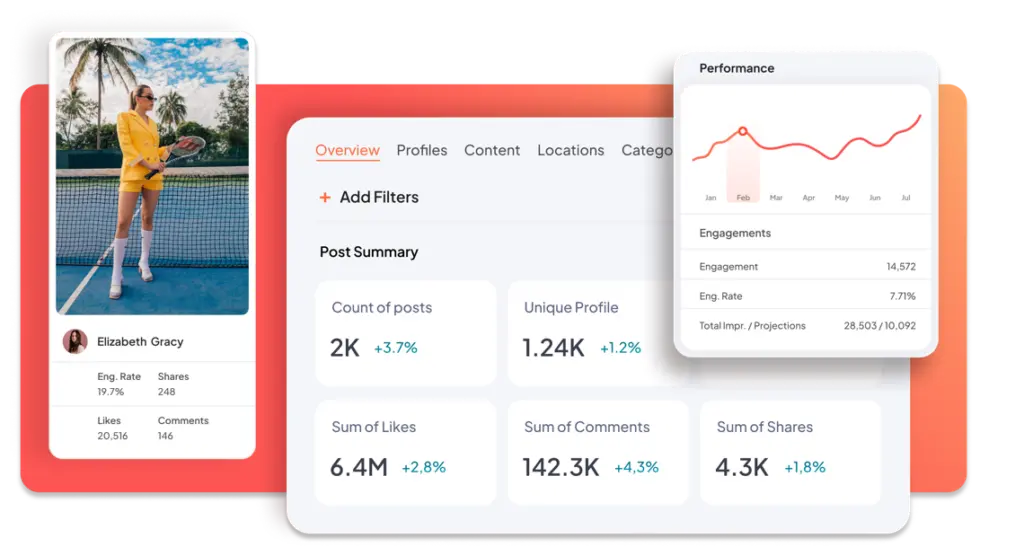
Platforms like Sprout Social will give you consolidated profile data of each influencer to simplify your search. The platform uses an Affinity Engine that leverages machine learning and audience psychographics to automatically match brands with influencers with a strong affinity. This simplifies your search process and helps you narrow down influencers who are perfectly aligned with your brand in terms of pricing and values.
5. Analyze Sponsored Post Engagement
Besides simply looking at how much an influencer charges, it’s crucial to make sure that you’re getting your money’s worth. So you’ll need to analyze the type of engagement they’re generating for their sponsored posts.
Sure, they may be getting tons of engagement for their organic posts. But if they’re not engaging their followers in their sponsored posts, you might want to reconsider your options. This is a sign that they’re unable to effectively promote the brand, possibly because they make the post come off as sales-y or ingenuine.
A manual search of the influencer’s feed will show you some sponsored posts so you can compare the engagements they receive against their organic posts. Or use an influencer marketing platform to identify the influencer’s most engaging posts. Then see if any of those posts include sponsored content.
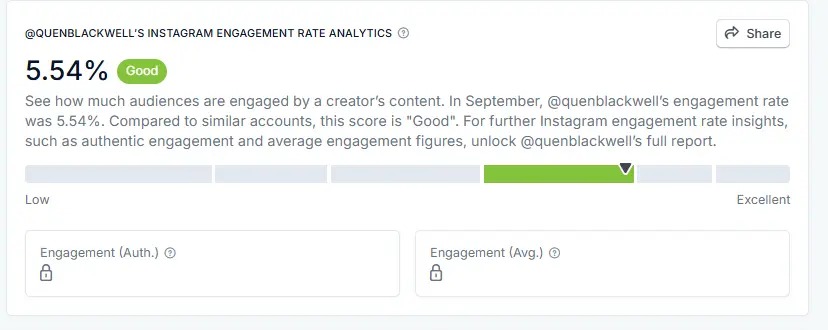
An even simpler option is to use platforms like HypeAuditor which lets you see the influencer's engagement rate across both organic and sponsored posts. This simplifies the process of knowing how much you can charge for paid posts.
6. Assess Influencer Audience Demographics
Once you’ve narrowed down a few influencers whose rates are aligned with your budget, it’s time to further filter your list. A key step is to make sure the influencer’s audience demographics match your target audience.
Even if someone creates content in your niche, it doesn’t necessarily mean that they have influence over the specific types of people you want to reach. Similarly, even if they have a significant following, that doesn’t necessarily mean that their following is made up of people in the right demographic as your target audience.
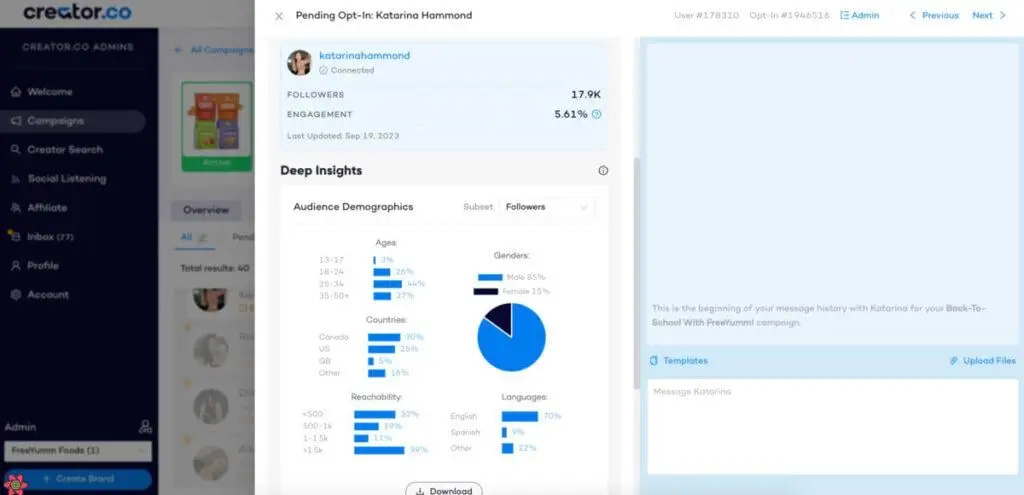
Make the most of influencer marketing platforms that give you a comprehensive breakdown of an influencer’s audience demographics. Platforms like Creator.co offer deep insights into each creator’s audience demographics. You can view the breakdown of the ages, genders, countries, languages, and reachability of an influencer’s followers.
7. Detect and Avoid Bots
With influencer fraud being a major concern among brands working with influencers, another crucial step is to weed out creators who fake their influence. Otherwise, you could end up spending money on influencers who fail to generate real results. Sure, they may get engagements, but if those engagements mostly come from bots, you won’t be able to reach real consumers or drive sales.
You can look for signs such as sudden spikes in followers or inconsistent engagement rates. Generic or repetitive comments are another key sign that someone has bought engagement.
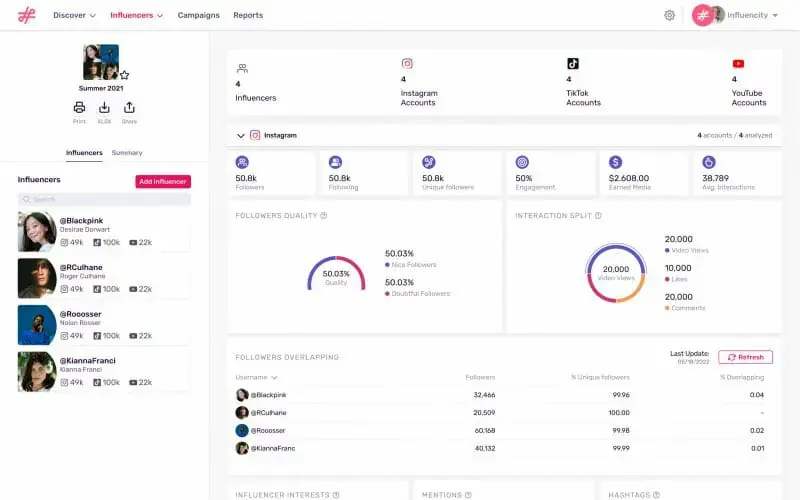
While manually vetting influencers for authenticity will pay off, it can be extremely time-consuming. Use platforms like Influencity that come with the capability to check an influencer’s follower quality. This platform will analyze each influencer’s followers and assess their quality. It will measure the percentage of followers that are “Nice” and the percentage that are “Doubtful,” so you can easily see which influencers possibly bought their influence.
8. Establish a Delivery Schedule
By now, you would’ve come up with a neat list of potential influencers who are perfectly aligned with your brand and budget. However, you’ll also need to make sure that these influencers are capable of meeting your needs within the necessary timeframe.
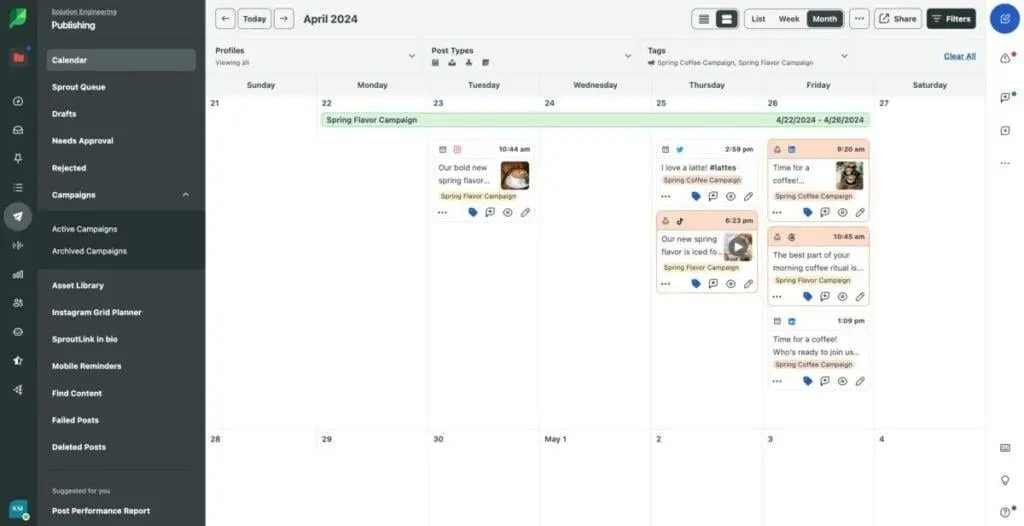
Set clear timelines for content delivery so your campaign can stay on track. Say you’re running the campaign for the month of September and expect four pieces of content from your influencers. In this case, you’ll want to make sure that each piece of content is ready to go live at the start of each week.
Make use of platforms like Sprout Social to create a content calendar. This helps you visualize your content deliverables so you can easily manage your content schedules. You can assign team members to follow up and make sure that the pieces are ready to go live by the expected due date.
9. Track Your Metrics
When it comes to finding influencers within your budget, it’s not enough to simply look at the rates to see if you can afford those influencers. You also need to see the results they’re generating to make sure that you’re getting good value for your money. At the end of the day, whatever you’re paying your influencers should be able to translate to real business results.
Start by measuring key metrics during the campaign to get real-time insights on how each influencer is performing. The key performance indicators (KPIs) to measure will vary depending on your goal. Some of the most common metrics to measure are:
- Impressions
- Reach
- Follower growth
- Engagements
- Conversion rates
- Clicks
- Earned media value
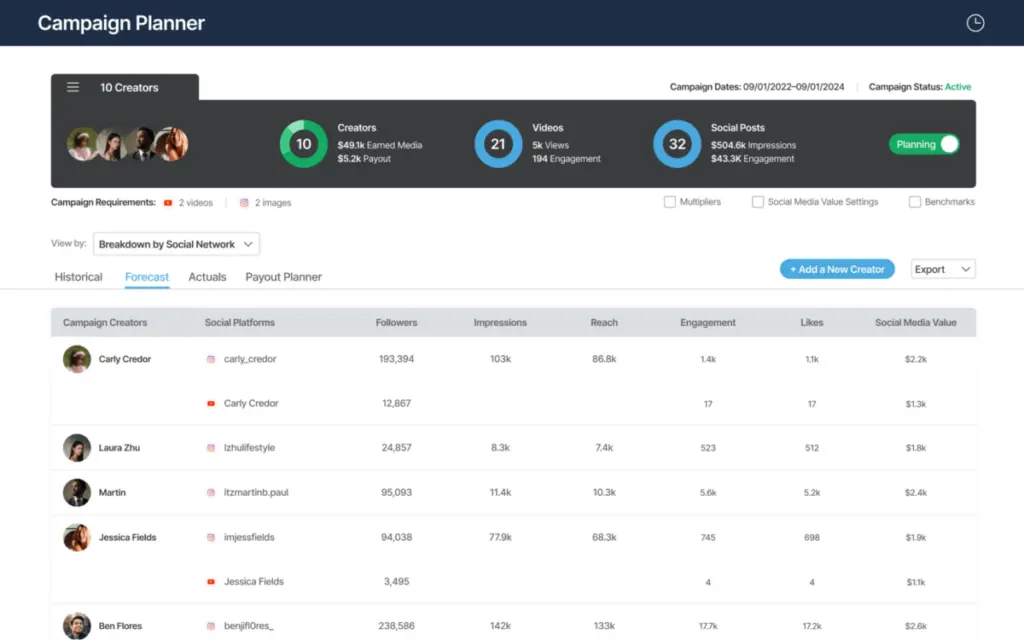
You can use a platform like CreatorIQ to get comprehensive performance metrics on your influencer marketing campaigns. The platform gives you a forecast of how each influencer is likely to perform and breaks down the actual performance metrics. So you can easily see which influencers are giving you a good value for your money.
10. Refine Your Strategy Over Time
Finally, you can use the insights from your campaign analytics to inform and optimize your strategy. Make sure you’re constantly monitoring these performance metrics to see how you can refine your strategy to maximize your influencer marketing impact.
This is particularly important if you’re running an ongoing influencer marketing campaign, such as brand ambassador campaigns. You’ll need to make sure you’re not overspending on influencers who aren’t generating real results for your business. At the same time, you’ll also want to make sure you’re investing in influencers who can add value to your strategy.
If you’re using the CreatorIQ platform, as suggested earlier, you can compare the forecasted performance against the actuals to see if an influencer is underperforming. Then consider removing them from future campaigns or providing feedback to help them yield better results. Similarly, make a list of your favorite influencers so you can easily activate them again for future campaigns instead of performing a new influencer search all over again.
Final Thoughts
There is no universal influencer rate card.
Follower count can help establish a starting range, but it rarely tells you what a creator partnership is actually worth. Audience quality, recent performance, platform, content format, production requirements, usage rights, exclusivity, and campaign scope can all change the final quote.
That is why the benchmark ranges in this guide should be treated as a budgeting reference rather than a fixed pricing formula.
For brands, the more useful question is not simply “How much does this influencer charge?” It is “What are we getting for that price?”
A $5,000 creator who reaches the right audience, produces reusable content, and delivers measurable results may provide better value than a $1,000 creator with weak audience fit. Likewise, an apparently reasonable base rate can become expensive once licensing, paid amplification, exclusivity, and other add-ons are included.
The best approach is to compare creators on a like-for-like basis, understand the complete commercial terms, and evaluate the total creator cost alongside expected reach, performance, and campaign value.
Use the benchmarks to set expectations. Then let the actual audience, deliverables, rights, and campaign objective determine whether the rate is fair.
Frequently Asked Questions
How much do influencers charge per post?
Influencer rates can range from tens of dollars for nano creators to tens of thousands for macro and mega influencers. Platform, engagement, content format, audience quality, usage rights, and campaign scope all affect the final price.
How much do influencers with 10,000 followers charge?
Creators around the 10K mark generally sit between the nano and micro tiers. Rates can range from roughly $100 to several hundred dollars per deliverable, depending heavily on the platform and content format.
How much do influencers with 100,000 followers charge?
Creators around 100K followers can charge anywhere from hundreds to several thousand dollars per deliverable. The platform matters considerably, as a TikTok video, Instagram Reel, and YouTube sponsorship require different levels of production and offer different reach patterns.
How much do influencers with 1 million followers charge?
Mega influencers with 1M+ followers can charge $10,000 to well over $100,000 for a sponsored post or campaign, depending on the platform, creator demand, deliverables, usage rights, and exclusivity.
Which platform has the highest influencer rates?
There is no single platform that is always the most expensive. YouTube often carries higher production costs, while large Instagram and TikTok creators can also command substantial fees depending on reach, format, and campaign requirements.
Do influencers charge extra for usage rights?
Often, yes. A base sponsorship fee usually covers creating and publishing the content. Brands may need to pay additional licensing fees to reuse that content in paid ads, websites, email, retail, or other channels.
Can brands negotiate influencer rates?
Yes. The most effective negotiations usually focus on scope rather than simply asking for a discount. Brands can reduce costs by adjusting deliverables, shortening exclusivity, limiting usage rights, reducing revisions, or building a longer-term package.
Should influencers be paid upfront?
Payment terms vary. Some creators require partial or full payment upfront, while others agree to milestone-based or post-publication payments. The schedule should be clearly defined in the contract before work begins.


