

Most jeans are easy to understand until you have to spend an entire day wearing them.
That tension is what eventually gave Mugsy its opening. Founder Leo Tropeano was working at PwC when he started looking for jeans that felt comfortable without sacrificing the sharper fit he wanted outside college. The options he found kept forcing the same compromise between appearance and comfort. The inspiration for an alternative came from an unlikely place: the softness and stretch of his wife’s jeggings.
Tropeano did not want to put men in jeggings. He wanted to take some of what made them comfortable and build it into denim that still looked and felt like a proper pair of jeans. Getting there took years of experimentation, several product iterations, an early Kickstarter, customer testing, and plenty of jeans that he later acknowledged were not good enough.
Eventually, that long product-development process created something useful beyond the product itself.
Mugsy had made a pair of jeans whose main benefit could be demonstrated almost instantly.
Creators could squat in them. Golf in them. Dance in them. Do yard work in them. Wear them from work to dinner. Athletes could show how the stretch accommodated builds that often struggle with conventional denim. Comedians could exaggerate the same idea into sketches. Everyday customers could demonstrate the difference without needing to explain fabric technology.
That gave Mugsy a remarkably flexible creative proposition: the product could provide its own proof.
Over time, Mugsy built on that advantage through media relationships, athlete partnerships, everyday creators, paid amplification, an internal creative team, and a growing physical retail footprint.
This Brand Story examines how Mugsy developed its stretch-denim proposition, built a creator strategy around product demonstrations, expanded from early media and athlete partnerships into a wider influencer network, and connected that attention to paid media, physical retail, and repeat purchases.
- How Mugsy Turned a Comfort Problem Into Stretch Denim
- Why Mugsy’s Stretch Denim Works So Well in Creator Content
- How Mugsy Built Its Influencer Marketing Strategy From Barstool to Athlete Partnerships
- How Mugsy Uses Athletes, Comedy and Everyday Creators for Different Marketing Jobs
- What Our HypeAuditor Analysis Reveals About Mugsy’s Instagram Creator Network
- How Mugsy Amplifies Creator Content Beyond Organic Social
- How Mugsy Connects Creator Awareness With Physical Retail
- How Mugsy Turns Stretch Jeans Into Repeat Purchases Across Its Product Range
- Why Mugsy’s Creator Marketing Strategy Works
How Mugsy Turned a Comfort Problem Into Stretch Denim
Mugsy started with a product problem Leo Tropeano understood firsthand.
Before launching the company, Tropeano worked at PwC and had no background in fashion or apparel manufacturing. As he started dressing more professionally, he found that the slimmer jeans he preferred visually were often uncomfortable, particularly for an athletic build. The better they looked, the more restrictive they tended to feel.
The idea for Mugsy started taking shape when Tropeano noticed how much softer and more flexible his wife’s jeggings were. The opportunity was to bring some of that stretch into men’s denim while preserving the weight, appearance, and durability people expected from a traditional pair of jeans.
Turning that idea into a sellable product took much longer than finding the problem.
Tropeano spent several years learning the denim business, working through different factories, fabrics, fits, and prototypes. An early Kickstarter even exceeded its funding target, but customer interest in the concept did not convince him that the product itself was ready. He continued refining it.
One of the more important changes came from how Mugsy gathered feedback. Early reactions from friends and family were encouraging, but Tropeano realized encouragement was a poor substitute for purchase behavior. He began putting prototypes in front of actual denim shoppers, including through an independent Chicago retailer that allowed him to sell directly to customers in the store.
Those conversations exposed weaknesses much faster. Fit needed work. The fabric needed to deliver more of the comfort promised by the idea. Mugsy also needed a manufacturing partner willing to keep experimenting rather than simply producing what already existed.
By the time Mugsy's commercial DTC business took shape in 2016, the proposition had become much clearer: denim that maintained the look of a fitted pair of jeans while offering substantially more softness and range of motion.
That distinction would eventually become more than a product feature. It gave Mugsy something unusually useful in marketing: a benefit customers could actually watch someone prove.
Why Mugsy’s Stretch Denim Works So Well in Creator Content
Once Mugsy had a product that behaved differently from conventional denim, creators did not need much setup to communicate the difference.
A recurring format across Mugsy content starts with a familiar complaint: jeans look good, but they become uncomfortable the moment you have to move in them. The creator then puts that complaint to the test.
@nickbarrotta When it comes to comfort, stretch and versatility — nobody is doing it like @Mugsy Jeans! My new go-to! 👖 #mugsyjeans #dad #fyp ♬ This Will Be (An Everlasting Love) - Natalie Cole
Some squat or perform mobility exercises. Others golf, dance, do yard work, chase after their kids, or wear the same pair from work into the rest of their day. One particularly exaggerated demonstration involved a creator stuffing his son’s toys inside the legs of his Mugsy jeans to show how far the fabric could stretch.
@vam0n0s1 #ugc #productsyouneed ♬ Summer Deep House - Alexander Virko
The scenarios vary, but the message stays remarkably consistent. Mugsy gives creators a way to show the difference between looking like denim and moving more like performance wear.
That matters because comfort is otherwise difficult to sell visually. A creator can say a pair of jeans is soft or flexible, but watching someone drop into a full squat makes the claim much easier to understand.
The product also lends itself to several creator niches at once. A fitness creator can focus on range of motion. A menswear creator can build an outfit around the fit. A dad can show how the jeans hold up through an active day. A golfer can take them onto the course. A comedy creator can push the stretch proposition into something deliberately ridiculous.
Mugsy therefore gets repetition without requiring repetitive content.
The underlying product message remains stable while the creator changes the context around it. That gives the brand a broad creative runway, particularly for short-form video where a physical demonstration can communicate the benefit within seconds.
It also helps explain why so much of Mugsy's creator marketing feels closer to entertainment or lifestyle content than a conventional apparel endorsement. The creator has something to do with the product.
And for Mugsy, that action is often the sales argument.
How Mugsy Built Its Influencer Marketing Strategy From Barstool to Athlete Partnerships
Mugsy’s creator strategy did not begin with a large ambassador roster or a formal influencer program. Its earliest partnerships were closer to audience fit than influencer scale.
One of the most important early relationships came through t. Mugsy began advertising with the company while it was still a relatively young DTC brand, including through Pardon My Take.
That audience was a natural match for Mugsy: predominantly male, sports-oriented, comfortable with irreverent humor, and unlikely to respond to polished fashion advertising in the same way they might respond to familiar personalities talking about jeans they actually wore.
The relationship also had a longer-term effect on Mugsy’s marketing organization. Adam Lebowitz, who later became Mugsy’s CMO, has said Mugsy was one of the first brands he worked with after joining Barstool in 2016. Years later, after continuing to work with the brand from the media side, Leo Tropeano brought him into Mugsy.
That progression matters because it shows how Mugsy’s marketing evolved. What began as buying access to an established audience eventually helped bring media and audience-development expertise inside the company.
Mugsy took a similarly product-led approach when it began working with professional athletes.
Chicago Cubs player Ian Happ became one of the brand’s first formal ambassadors after discovering Mugsy through a friend and trying the jeans himself. Tropeano has explained that the partnership made particular sense because athletes often have the exact fit problem Mugsy was designed to address. Larger thighs and athletic proportions can make conventional slim denim uncomfortable or difficult to buy off the rack.
That meant Happ was useful for more than visibility. His body type helped validate the stretch proposition, his Cubs connection reinforced Mugsy’s Chicago roots, and his existing familiarity with the product made the partnership feel more credible than a celebrity endorsement built entirely around reach.
Mugsy’s early influencer strategy therefore established a pattern that would continue as the brand grew: the strongest partnerships were the ones where the person could make the product benefit easier to believe.
That gave the company a useful filter for future creator work. Audience size mattered, but context mattered more.
How Mugsy Uses Athletes, Comedy and Everyday Creators for Different Marketing Jobs
As Mugsy’s creator strategy expanded, the brand began using different types of personalities for different jobs rather than treating every partnership as another product endorsement.
Athletes remain particularly useful because they make the fit and mobility story credible. More recently, Mugsy worked with former NFL players Brian Hoyer and David Andrews on a comedy concept built around the pair supposedly running its Newbury Street store. Their athletic backgrounds supported the product story, but the content itself was designed as entertainment.
The athletes were part of the joke, the store became the setting, and Mugsy’s stretch proposition could surface naturally within the scenario.
Comedy gives Mugsy another way to repeat the same core message without making every piece of content feel interchangeable. Bert Kreischer has appeared in branded material built around his personality, while other Mugsy videos use exaggerated movement, awkward social situations, or deliberately ridiculous demonstrations to keep the product visible without turning the entire piece into a standard ad.
The brand has experimented even further. Mugsy's VP of growth, Cael Schwartz, has shared how Mugsy once paid a SoundCloud rapper to create a song about the company. The project is a small example, but it reveals a wider willingness to test entertainment that can earn attention first and find its marketing use afterward.
Everyday creators perform a different job.
Their content tends to place Mugsy inside recognizable routines: getting dressed for work, going on a date, doing home projects, parenting, golfing, running errands, or simply trying to look put together without spending the day in stiff denim.
That type of creator helps reduce purchase uncertainty. Viewers can see how the jeans fit into ordinary life, what they look like with familiar outfits, and whether the stretch claim still matters outside a gym or sports environment.
Behind these different creator types, Mugsy has also been building more creative capability internally. CMO Adam Lebowitz has said he went nine months without attending a Mugsy photoshoot because the team had developed enough understanding of the brand voice to run the process themselves.
The company has also recruited specifically for creative strategy across paid and organic social.
Together, these pieces point to a more developed creator system. Athletes make the performance claim credible. Comedy earns attention. Everyday creators make the product relatable. Mugsy’s internal team then keeps those different executions connected to the same recognizable product story.
What Our HypeAuditor Analysis Reveals About Mugsy’s Instagram Creator Network
The headline partnerships only show part of Mugsy’s creator strategy. To understand what sits around those more visible relationships, we used HypeAuditor to analyze Instagram content mentioning Mugsy in the last six months.
The analysis tracked 39 posts from 21 influencers, and the first thing that stands out is how distributed the network is.
HypeAuditor classified 24 of those posts as organic, 13 as likely sponsored, and just two as sponsored. Those labels are modeled classifications rather than confirmation of payment or contractual relationships, so they should not be read as a definitive breakdown of Mugsy’s paid creator activity. What they do show is that the brand’s Instagram visibility extends well beyond a small group of clearly identifiable paid placements.
The creator mix reinforces that point.
Micro creators represented 38.1% of the tracked accounts, mid-tier creators 33.3%, and nano creators 28.6%. Mugsy therefore appears across a relatively broad range of account sizes rather than concentrating its visibility around a handful of large influencers.
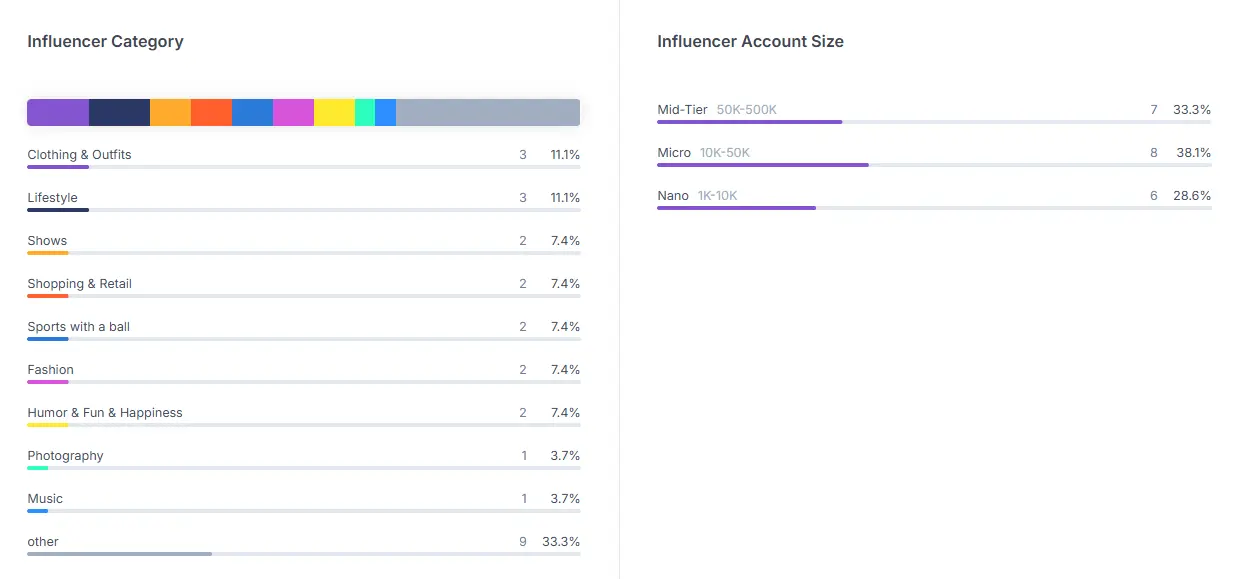
The content environments are varied too. HypeAuditor identified creators across clothing and outfits, lifestyle, sports, fashion, retail, humor, and entertainment. That matches what we saw in Mugsy’s wider creator content: the jeans do not need to live exclusively inside fashion content to make sense.
A sports account can focus on movement. A lifestyle creator can show everyday wear. A humor creator can turn the stretch into a joke. A retail account can introduce the store experience.
The strongest signal, though, is the format.
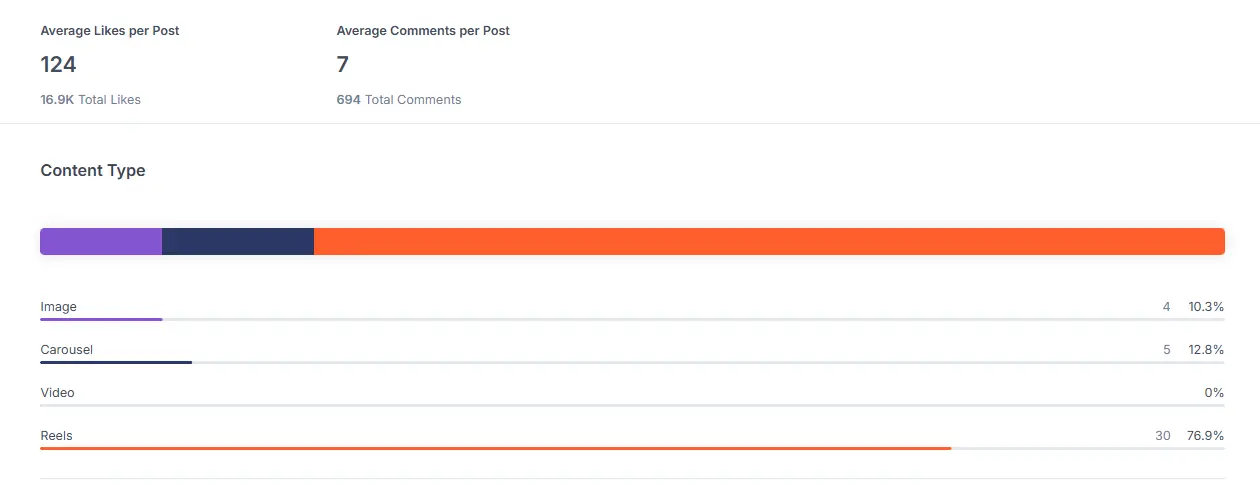
Reels accounted for 76.9% of the content tracked by HypeAuditor. That is a natural fit for a product whose main differentiator becomes clearer once someone starts moving. Short-form video gives Mugsy enough time to establish the familiar problem, show the stretch, and demonstrate how the jeans behave in a real scenario.
The analysis also highlights how different accounts contribute in different ways. Legends of Sport was the most active account in the dataset with 11 posts, while Johnny Anastopoulos stood out across several HypeAuditor performance measures, including engagement and cost-efficiency indicators.
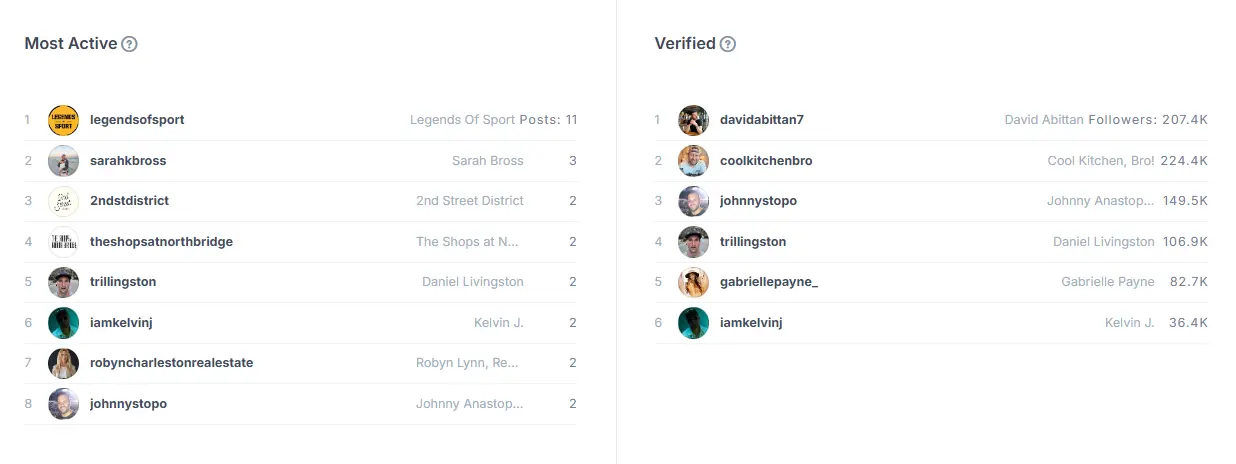
Those individual results are useful signals, but they matter less than the broader pattern. Mugsy’s creator network appears to work as a mix of recurring media accounts, everyday creators, and more recognizable personalities rather than as one centralized ambassador program.
The more useful conclusion is structural: Mugsy has built visibility around a product that can travel easily between creator types and content categories. The open question is how much of that visibility converts into sales, repeat purchases, or measurable customer acquisition. That is where creator reach alone stops being enough and distribution becomes more important.
How Mugsy Amplifies Creator Content Beyond Organic Social
Creator reach is only one part of the value Mugsy gets from creator content.
As the brand has grown, its marketing team appears to have become more deliberate about treating strong creator concepts as reusable assets rather than one-time posts. That matters in an environment where the original creator upload may reach only a fraction of the audience a brand ultimately wants to influence.
CMO Adam Lebowitz has spoken publicly about that problem, arguing that brands cannot depend entirely on organic distribution when commercial content is involved. For Mugsy, the implication is straightforward: if a creator produces something that clearly communicates the product benefit, the value of that asset does not end with the creator’s own feed.
A strong Mugsy video can potentially move into paid social, brand-owned channels, email, website creative, YouTube, community content, or other parts of the customer journey. That makes the creative itself a marketing asset, separate from the size of the creator’s audience.
This also helps explain why Mugsy has invested in internal creative strategy while maintaining long-term relationships with external growth specialists.
James Peacock, Mugsy's ex paid social consultant, has worked with the brand for more than five years, which directly points to a stable performance-marketing relationship rather than a revolving door of short-term agencies.
The structure that emerges from these relationships is a useful one. Mugsy keeps brand voice, creative concepts, and content development close to the company while using specialist partners to help distribute and scale the strongest ideas.
That model gives the brand more control over what creators are asked to communicate, while still allowing successful content to travel beyond the original post.
There are signs Mugsy is testing that logic outside the largest social platforms as well. The team has promoted its own Reddit community and used giveaways to attract participation, suggesting an interest in building places where customer and creator content can keep circulating without depending entirely on an Instagram or TikTok feed.
The broader strategy is less about chasing every available channel and more about extending the lifespan of good creative.
For Mugsy, the creator partnership may start the content. Paid media, owned channels, and community distribution determine how far that content can ultimately travel.
How Mugsy Connects Creator Awareness With Physical Retail
Creator content can make Mugsy’s comfort proposition visible, but denim is still a tactile product. At some point, many customers want to feel the fabric, check the fit, and see whether the stretch actually changes the experience of wearing jeans.
That helps explain why physical retail became an increasingly important part of Mugsy’s growth.
The brand first experimented with a Michigan Avenue pop-up before opening its first permanent store in Lincoln Park in August 2020. The timing was unconventional, but the reasoning was practical. Leo Tropeano had already described stores as more than places to complete a transaction. A physical location could also function as a billboard, a customer-service point, and a place where someone could experience the product before committing to a purchase.
That idea appears to have scaled with the business. By June 2026, The Georgetowner reported that Mugsy operated eight stores, with its Georgetown location among the newest.
The experience inside those stores is deliberately informal. Locations have used free drinks, local décor, music, and community-specific touches to make shopping feel more relaxed than a conventional menswear fitting room.
Cael Schwartz highlighted that same approach when promoting Mugsy’s Newbury Street location in Boston.
The strategic role of those stores becomes clearer when viewed alongside Mugsy’s creator marketing.
A Reel can show someone squatting in the jeans. An athlete can explain why the fit works for larger thighs. A lifestyle creator can show how the product looks through a normal day. The store then gives a first-time buyer the chance to verify those claims personally.
That matters for a brand built around a sensory benefit such as comfort.
Retail also creates another feedback loop. Mugsy’s operations team has spoken about spending significant time talking directly with customers about why they bought, what they liked, and what needed improvement. That gives the company another source of qualitative product intelligence beyond ecommerce data.
In that sense, Mugsy’s stores do more than extend distribution. They help close the gap between creator-led discovery and first-hand product proof.
Social content can make the jeans look different. Physical retail lets customers decide whether they actually feel different.
How Mugsy Turns Stretch Jeans Into Repeat Purchases Across Its Product Range
Mugsy’s jeans remain the clearest entry point into the brand, but the commercial opportunity does not end with the first pair.
Head of Growth Cael Schwartz has described stretchy jeans as accounting for roughly 90% of sales during the period he discussed, even as Mugsy expanded into shirts, shorts, swimwear, hats, belts, chinos, and other categories. The company’s challenge was figuring out how to introduce those products without paying the same customer-acquisition cost it takes to sell its hero item.
That is where post-purchase merchandising becomes useful.
Instead of running separate acquisition campaigns for every lower-priced accessory or apparel category, Mugsy can introduce those products once a customer has already committed to the brand. Checkout and post-purchase placements give the company another opportunity to surface items that may have been overlooked during the original shopping journey.
Schwartz summed up the goal simply: fill the customer’s closet with all things Mugsy.
The logic is straightforward. Stretch jeans solve the clearest problem and attract the customer. Once the buyer trusts Mugsy’s fit, comfort, and quality, shirts, shorts, belts, and other products require less persuasion than they would from a completely new shopper.
That approach also fits Mugsy’s broader resistance to constant discounting. Rather than relying heavily on promotions to drive another transaction, the brand can increase order value and repeat purchasing by giving existing customers more reasons to stay inside the Mugsy assortment.
As the product range and store network expanded, however, that strategy created a new challenge: operational complexity.
More categories meant more SKUs, more inventory decisions, and more fulfillment pressure across ecommerce and physical retail. Mugsy eventually had to strengthen its 3PL and inventory infrastructure to support that growth.
The marketing system therefore comes full circle. Creator content helps sell the hero product, but the real value of that first purchase grows when Mugsy can turn one successful pair of jeans into a longer customer relationship.
Why Mugsy’s Creator Marketing Strategy Works
Mugsy’s creator strategy works because the marketing starts with a product benefit that is easy to prove.
Stretch denim gives creators something visual to work with. Athletes can test the fit. Lifestyle creators can show how the jeans move through an ordinary day. Comedy creators can exaggerate the same idea into entertainment. Smaller creators can repeat the message in different contexts without making the content feel identical.
That consistency matters. The creator may change, but the underlying story stays the same: Mugsy looks like denim and behaves differently from the jeans many customers are used to wearing.
From there, the brand extends that attention through paid distribution, physical retail, and a wider product range.
The system is simple, but it is tightly connected: product design creates the proof, creators make that proof relatable, and the rest of the business gives that first point of interest more places to convert into a customer relationship.