
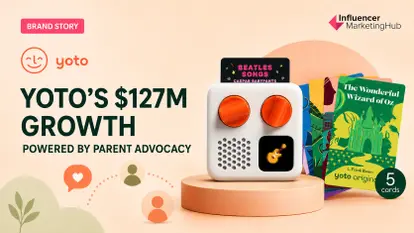
A Yoto Player is unusually easy to explain without saying much. A child chooses a physical card, places it in the player, and starts a story, song, or activity without asking an adult to unlock a screen.
That simple interaction has become one of Yoto’s most effective marketing assets. Parents can immediately see the product working, children can operate it themselves, and creators can place it inside familiar routines such as bedtime, travel, and independent play.
By 2024, Yoto was generating £95 million, approximately $127 million, in annual revenue. But its growth came from more than selling screen-free hardware. Yoto turned family use into recommendation, recommendation into customer acquisition, and each new customer into an audience for more cards, programming, and partnerships.
The result is a business in which parent advocacy brings families into the product ecosystem and a constantly expanding content catalogue gives them reasons to remain there.
- How Yoto Built a Screen-Free Audio Player Around Child Independence
- How Parent Creators Demonstrate Yoto Through Everyday Family Routines
- How Customer Feedback and Word of Mouth Fueled Yoto’s Early Growth
- How Yoto Built Its Influencer Marketing and Social Media Strategy
- What Data Reveals About Yoto’s Creator Strategy
- How Yoto’s Content Strategy Drives Repeat Card Purchases
- How Yoto Uses Experiential Marketing and Retail to Reach Families
- Why Yoto’s Parent Advocacy Strategy Worked
How Yoto Built a Screen-Free Audio Player Around Child Independence
Yoto co-founders Ben Drury and Filip Denker met while working at digital music company 7digital. Both became parents around the same time and began questioning why children’s access to audio increasingly depended on a screen, microphone, or adult-controlled device.
Their answer was a connected audio player inspired by Montessori principles. Children would choose what to hear by handling physical cards, while parents retained control over the content available. The product had no camera, microphone, or advertising.
Early prototypes were assembled from plywood, Raspberry Pis, laser-cut parts, and hand-soldered electronics. Drury and Denker tested them with their own children, then with other families. A small Kickstarter campaign in 2017 showed that the idea had demand beyond their immediate circle, including early interest from the United States.
That initial proposition has remained remarkably consistent: parents buy reassurance, while children receive autonomy.
How Parent Creators Demonstrate Yoto Through Everyday Family Routines
The second-generation Yoto Player arrived in early 2020, followed by a US launch that June. The timing placed it inside homes when parents urgently needed ways to occupy children without adding more screen time.
But Yoto’s creator appeal extends beyond the broad screen-free promise. Parent videos show the Player solving specific moments: keeping a toddler occupied in a café, giving children something to do during a car journey, making bedtime calmer, or buying parents another 20 minutes of rest in the morning.
One creator reduced the entire value proposition to a household routine. The video moved from screen-free mornings to independent play, showing the outcome instead of reciting specifications.
@harrisparty6 AD A little screen-free chaos control thanks to Yoto. My kids love choosing their own stories, music, and learning cards and I love the calm it brings to our mornings, car rides, and bedtime! Black Friday deals are live with up to 40% off bundles like Disney Stories, Daniel Tiger and more and 20% off everything else! Such a good time to grab one! Link in bio. #Ad @Yoto @Yoto US
Other creators lead with the questions parents actually search. Comparisons with Tonies discuss portability, card storage, age suitability, app backups, and whether younger children find figurines easier to handle. Cost-focused reviews include the Player, cards, protective jacket, storage, and membership rather than presenting the hardware price in isolation.
That honesty gives the category credibility. A creator opening with an honest assessment may create more purchase confidence than a polished product endorsement because the viewer understands the full commitment.
@haleyreidtay In depth @Yoto review !! #yoto #yotoplayer #yotocards #toddlerchristmas #christmasgiftsforkids
How Customer Feedback and Word of Mouth Fueled Yoto’s Early Growth
Yoto involved customers before it had a formal global creator operation. The company shipped an imperfect early product, communicated openly about its limitations, and used family feedback to improve later versions.
A Facebook group started by an early customer grew to roughly 70,000 members, with hundreds of related subgroups emerging around cards, age recommendations, Make Your Own content, and regional communities. Drury has said around 60% of customers arrive through word of mouth.
The Make Your Own Card feature deepened that participation. Parents could add recordings from grandparents, family playlists, home-language stories, or audio unavailable in the official catalogue. Customers were no longer confined to consuming Yoto’s library. They could adapt the system to their family.
@samacdonald Is this a little extra? Yes. But I won’t do it any other way 😌 If you’re a @Yoto player owner you need to make your own cards with songs and stories your kids already know and love. Our favourites are the Disney Storyettes 🤩 there are sooo many of them to choose from What audios are you putting on your make your own cards? #yoto #yotocard #kidsstories #mumhack #mumlife #toddlermum #mumsoftiktokaustralia #aussiemum #mumtok
This also made Yoto a recurring gift. Creators describe keeping cards ready for birthdays, holidays, Easter baskets, and Christmas stockings. One hardware purchase therefore opens several future reasons to buy and recommend the brand.
How Yoto Built Its Influencer Marketing and Social Media Strategy
As Yoto expanded, it began turning the parent advocacy already surrounding the product into a more deliberate operating model.
Influencer marketing sits close to Communications and Advocacy under Sophie Mawby, which reflects the role creators play for the brand. Their job extends beyond generating clicks. They help families understand the category, assess the product, and picture where it would fit into their lives.
Yoto has gradually built that capability across markets. Faisal A.’s global influencer remit focuses on developing creator partnerships internationally, while Geri Somers has recruited influencer, affiliate, and social talent for North America.
The company has also looked for regional teams and agency relationships with established creator networks in markets such as Australia and New Zealand.
Organic social performs a different but connected role. Instead of treating customer questions as support requests that disappear into an inbox, Yoto turns them into public content.
Senior Social Manager Sophie Timmons said its Tip Tuesday series responds to questions about features, settings, and creative uses with short how-to videos. The series passed one million views, showing how product education can become an ongoing social format rather than a one-time launch campaign.
Paid social sits within Yoto’s acquisition and growth organization, supported by dedicated creative and testing roles. That creates a practical division of labor. Communications and creator partnerships build trust, organic social answers recurring questions, and paid media can scale messages and formats that have already demonstrated their relevance.
Yoto’s influencer strategy is therefore less about assembling a recognizable ambassador roster and more about building layers of recommendation around the customer journey.
What Data Reveals About Yoto’s Creator Strategy
A conventional influencer program usually leaves a recognizable footprint: a defined group of creators, repeated sponsored posts, and a campaign message that remains relatively consistent from one account to the next. Yoto’s footprint looks different.
Across six months of social media activity analyzed through HypeAuditor, the conversation was spread across hundreds of accounts. Only a relatively small share of the mentions were clearly sponsored, while most appeared outside Yoto’s visible paid activity.
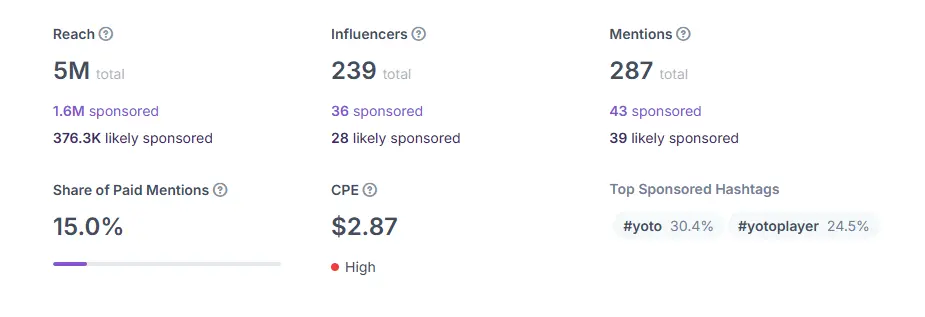
HypeAuditor’s classifications are modeled, so they cannot confirm every relationship, but the overall shape is still revealing. Yoto is being discussed by a much wider group than the creators it visibly pays.
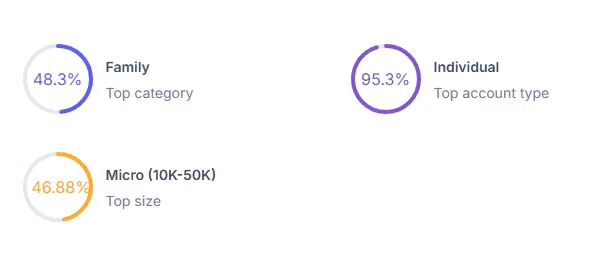
The accounts themselves reinforce that interpretation. Almost three quarters were nano or micro creators, family content was the largest category, and individual accounts overwhelmingly outnumbered brand profiles. These are the kinds of voices parents encounter while looking for product advice, activity ideas, travel tips, or help choosing between Yoto and Tonies.
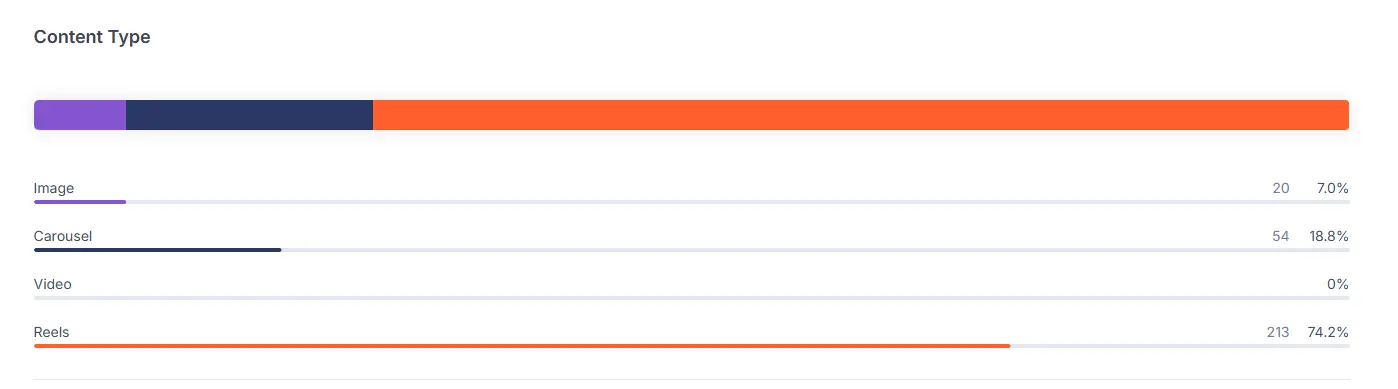
Short-form video dominated because Yoto needs to be seen in use. A Reel can show a child inserting a card, changing stories, carrying the Mini through an airport, or settling down at bedtime. In that format, the creator is simultaneously reviewing the product, teaching the viewer how it works, and proving that a child can use it independently.
The aggregate engagement rate across the activity was modest, but that does not make the content ineffective. Many of these videos are designed to answer a specific purchase question rather than attract mass entertainment. They can influence a decision through demonstration, search visibility, saved recommendations, affiliate clicks, or repeated exposure across several parent accounts.
When a Yoto post does travel widely, the product is usually supporting a larger parenting point. A video from @mum_mode_unhinged opened by arguing that toddlers do not need an iPad, then showed how Yoto helped during cafés, bedtime, early mornings, and independent play.
It attracted more than 117,000 likes because it began with a recognizable tension and used Yoto as evidence for the creator’s position.
The post’s calculated engagement rate was an outlier, but its structure captures the wider strategy. Yoto performs best when it is part of a parent’s story rather than the entire story itself.
How Yoto’s Content Strategy Drives Repeat Card Purchases
The Player begins the customer relationship, but the catalogue determines how valuable that relationship becomes. Every new card can generate another purchase, renew a child’s interest, and give parents or creators something new to recommend.
Yoto uses familiar children’s franchises to make the hardware easier to adopt. A parent may know little about audio players, but they already understand why their child would want Bluey, Paw Patrol, Disney, Harry Potter, or Roald Dahl. Recognizable characters reduce the uncertainty attached to buying an unfamiliar device.
@epicfamilyquests Do you love audiobooks? @Yoto has two different Yoto Player options and SO MANY different audiobooks & soundtracks on cards. My daughter loves the Harry Potter audiobooks and my son loves the Minecraft audiobook narrated by Jack Black himself. Thank you to Yoto for gifting this to us. It has made our bedtime routine so much easier and helps the kids relax before bed too. The perfect screen free option. #yoto #yotoplayer #yotoplay #harrypotter #audiobook
Music serves a different purpose. Releases from Queen, Elton John, the Spice Girls, KPop Demon Hunters, Rockabye Baby, and Olivia Dean turn Yoto into something parents and children can enjoy together. They also connect the platform to wider cultural moments and give music, lifestyle, and family creators a reason to discuss Yoto beyond children’s audiobooks.
@littlebookbasket On repeat, all day every day 😂 He’s going to be furious with Geri!! #yoto #spicegirls #yotoplayer #mumlife #toddlermum @Yoto
Yoto Originals and educational partnerships give the company greater control over its identity. BrainBots, Yoto Daily, and Wildlife Defenders help distinguish the platform from competitors that can pursue many of the same entertainment licences. They also let Yoto combine listening with quizzes, learning, environmental themes, and interactive activities.
@sahmmorgann We’ve officially filled up our binder ahaha 🤣 I’m gonna get the rings now so that Theo can use his cards easier! 🥹 #yotocards #yoto #yotoplayer #yotoreview #newyoto
♬ Opening (Spirit of Adventure) - Andrea Datzman & Curtis Green
The individual releases show how these roles overlap. Bluey: The Beach and Other Stories responds to demand for a familiar franchise that young families already trust. The KPop Demon Hunters soundtrack shows how quickly Yoto can respond to a cultural phenomenon, while the HUNTR/X interview on Yoto Daily extends the launch into Yoto’s owned media.
@daliahdzc so much fun for on the go 💜🎤✨🎶 @Yoto @KPop Demon Hunters Netflix #kpopdemonhunters #yoto #momsoftiktok #creatorsearchinsights #fyp
♬ Takedown - HUNTR/X & EJAE & AUDREY NUNA & REI AMI & KPop Demon Hunters Cast
Wildlife Defenders combines Yoto’s BrainBots characters with Chessington World of Adventures, an interactive quiz, physical resort distribution, and support for Chessington Conservation. It is simultaneously a product, educational experience, partnership, and purpose-led story.
Content therefore performs two connected jobs. It gives existing families reasons to keep spending and gives creators, partners, and the press new ways to introduce Yoto to families who have not yet bought a Player.
How Yoto Uses Experiential Marketing and Retail to Reach Families
Yoto’s strongest physical campaigns place the product inside the moments it claims to improve. Rather than creating an event around a generic product display, the brand builds situations where families can experience screen-free listening together.
For the Hogwarts Library Collection, Yoto invited press, influencers, and selected community members aboard the British Pullman. The setting gave the launch a sense of occasion, but it also demonstrated the product’s practical value.
Families were spending several hours travelling with children, which is precisely the kind of situation in which a portable audio player is meant to help.
Mini Pit Stops followed the same logic in a more accessible environment. By bringing screen-free activities and Yoto content to UK motorway service stations, the company encountered parents during long journeys when portable entertainment was already an immediate concern.
Australia’s Big Switch Off worked at the level of brand positioning. The campaign invited families to spend 24 hours away from screens and replace them with play, stories, music, and shared activities. Yoto was present in the campaign, but the larger subject was how families wanted to spend their attention.
It allowed the company to advocate for the behavior its product supports instead of limiting the message to another product demonstration.
Yoto in the Wild extends that principle into restaurants, museums, bookstores, hotels, and other family-oriented businesses. These placements introduce the Player in environments where parents are already looking for ways to keep children occupied.
Across these initiatives, the setting performs part of the marketing. Each one puts Yoto close to the problem it was designed to solve, then gives parents, creators, and journalists an experience they can describe to others.
Retail expansion gives this demonstration strategy a permanent physical presence. In 2026, Yoto moved into the Play aisle across Target stores in the United States with expanded shelf space, a broader card selection, and dedicated demo stations.
Those stations reproduce what creator videos do online: they let families see the card interaction, hear the Player, and understand the product through use. Creator content can generate curiosity, but hands-on retail removes the final layer of uncertainty before purchase.
Why Yoto’s Parent Advocacy Strategy Worked
Yoto did not succeed because it found a single influencer campaign that unlocked the market. Instead, success came through building a product whose value becomes clearer when families show it in use.
The physical card interaction gives creators something visible to demonstrate. Parent videos then translate an unfamiliar category into recognizable situations such as bedtime, travel, cafés, and independent play. Honest reviews and comparisons help families decide whether the product suits their child, while community discussions continue that education after purchase.
Once a Player enters a household, Yoto’s content catalogue takes over. New cards create repeat purchases, extend the product across different ages and interests, and continually renew the social conversation around the brand. Licensed franchises attract families through characters they already trust, music broadens the platform, and original programming gives Yoto its own identity.
Communications, influencer partnerships, organic social, paid acquisition, events, and retail each expand a different part of that journey. Advocacy creates trust. Product education reduces uncertainty. Content keeps families engaged. Paid media and retail make the system available at greater scale.
That is Yoto’s real success method. It turned a product interaction children could control into an experience parents wanted to recommend, then built a recurring-content business around the households those recommendations brought in.

SUGGESTED


Top Baby & Kids’ Products Social Media Marketing Campaigns
Explore top baby and kids’ social media marketing campaigns and see how brands use...