
Instagram influencer pricing looks straightforward until you actually start comparing creator quotes.
One creator with 50,000 followers might ask for $300 for a sponsored post. Another with a similar audience might quote $1,500 for a Reel. Both prices could make sense once you account for recent reach, engagement, content format, production quality, audience value, usage rights, exclusivity, and whether the brand wants to turn the content into paid media.
That makes follower count useful, but only as a starting point.
Instagram also remains commercially important enough for brands to get this right. Our latest research found that 32% of marketers say Instagram delivers their strongest influencer marketing returns, reinforcing its position as one of the most valuable platforms for paid creator partnerships.
And creator budgets are moving in the same direction. Across influencer marketing more broadly, our 2026 Benchmark Report found that 87.49% of surveyed marketers expect their influencer marketing budgets to increase, while 72.22% expect increases of at least 50%.
As more money moves into creator partnerships, knowing whether an Instagram quote is reasonable matters more than ever.
In this guide, we’ll break down Instagram influencer rates for 2026, including what nano, micro, mid-tier, macro, and mega influencers typically charge. We’ll also look at how pricing changes between Feed posts, Reels, and Stories, why Partnership Ads and usage rights can increase the final cost, and how to evaluate whether an Instagram influencer’s quote is actually fair.
If you need pricing across several platforms rather than Instagram alone, our broader Influencer Rates Guide compares Instagram with TikTok, YouTube, and other creator channels.
⭐ Compare Your Instagram Influencer Quotes
Trying to work out whether an Instagram creator’s rate is fair gets complicated once you add usage rights, Partnership Ads, exclusivity, management fees, and expected performance.
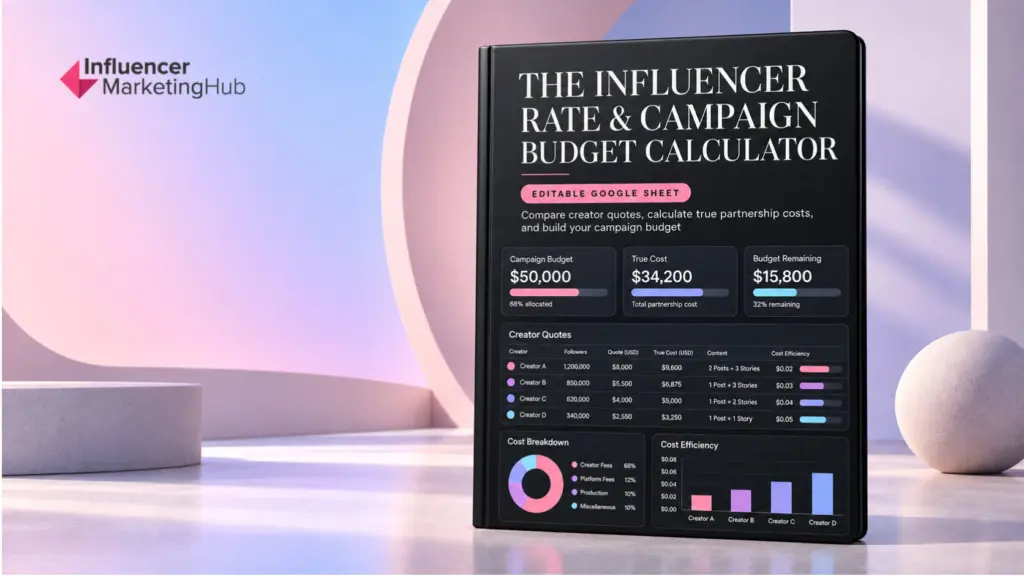
Use our free Influencer Rate & Campaign Budget Calculator to compare creator quotes, calculate the true cost of each partnership, and model metrics such as CPM, CPV, CPA, and ROAS in one working sheet.
- Estimate Your Instagram Influencer Marketing ROI
- 2026 Instagram Influencer Rates at a Glance
- Instagram Influencer Rates by Creator Tier
- Average Instagram Influencer Rates by Content Format
- What Actually Drives Instagram Influencer Cost?
- Common Instagram Influencer Pricing Models Brands Will See
- How to Set a Realistic Budget for an Instagram Influencer Campaign
- What Brands Should Take Away?
- Frequently Asked Questions
Estimate Your Instagram Influencer Marketing ROI
Use inBeat’s Influencer Marketing ROI Calculator to estimate the potential return from your Instagram campaign. Enter your campaign budget, average followers per influencer, and planned number of Stories, posts, and videos to generate an instant projection.
Use the result as an initial budgeting benchmark, then validate it against actual reach, engagement, conversions, revenue, and final campaign costs.
2026 Instagram Influencer Rates at a Glance
So, how much do Instagram influencers charge?
Our current 2026 pricing research puts typical sponsored-post rates at approximately:
Instagram Creator Tier | Followers | Typical Rate per Sponsored Post |
Nano Influencer | Under 10,000 | $10 - $100+ |
Micro Influencer | 10,000 - 100,000 | $100 - $500+ |
Mid-tier Influencer | 100,000 - 500,000 | $500 - $5,000+ |
Macro Influencer | 500,000 - 1,000,000 | $5,000 - $10,000+ |
Mega Influencer | 1,000,000+ | $10,000+ |
These are planning benchmarks, not fixed Instagram rate cards. They reflect the ranges used in our current 2026 Instagram pricing research. Actual creator quotes can fall below or well above them depending on the partnership.
Follower count is only one part of the equation.
A creator with 80,000 followers who consistently generates 100,000+ Reel views may reasonably charge more than a creator with 150,000 followers whose recent content averages 20,000 views. The brand is ultimately buying access to attention and influence, not the follower number displayed on the profile.
Content format matters too.
A static Feed post generally requires less production than a Reel involving scripting, filming, editing, voiceover, or several scenes. Stories are shorter-lived and are often priced differently, while a package combining a Reel, Story frames, Feed content, and additional usage rights can cost substantially more than any one deliverable on its own.
And the headline creator fee may not be the final bill.
Brands can also pay separately for paid usage or Partnership Ad rights, category exclusivity, raw footage, additional revisions, cross-platform publishing, extended licensing, and talent-management fees.
Instagram Influencer Rates by Creator Tier
Follower count is still one of the easiest ways to establish an initial Instagram pricing range, but it should never be the only number a brand looks at.
Creators within the same tier can perform very differently. A smaller account with consistently strong Reel views, high Story completion, and a tightly matched audience can justify a higher fee than a larger creator whose recent content performs inconsistently.
Nano Instagram Influencer Rates
Nano influencers sit at the smallest end of the Instagram creator spectrum, typically with fewer than 10,000 followers.
At this level, brands commonly see sponsored-post rates around $10-$100+, although the exact price depends heavily on content format and engagement.
Our dedicated nano-influencer research breaks that down further:
- Static Feed post: around $10-$50
- Story: around $5-$25 per story
- Reel: around $20-$100
Nano creators are particularly useful when a campaign needs niche relevance, local audiences, product seeding, or a larger volume of creator content without concentrating the entire budget into a handful of partnerships.
Their size can also work in their favor. Our current nano-influencer research estimates that roughly 75% of Instagram's influencer ecosystem sits within the nano tier, giving brands an enormous pool of smaller creators to work with.
For a full breakdown of platform rates, engagement, usage rights, and fair-pricing calculations, see our dedicated Nano Influencer Rates Guide.
Micro Instagram Influencer Rates
Micro influencers generally have between 10,000 and 100,000 followers, and Instagram sponsored-post pricing commonly falls between $100 and $500+.
This tier is often attractive because it gives brands a meaningful increase in reach without immediately moving into macro-level pricing.
But the range can widen quickly once the campaign moves beyond a straightforward Feed post.
A micro creator with strong Reel performance, a highly valuable niche, or proven sponsored-content results may reasonably charge above the benchmark. Adding Stories, usage rights, affiliate incentives, or Partnership Ad permissions can push the total deal higher again.
Micro influencers also remain widely used by marketers. Our broader micro-influencer research found that 64% of marketers have already partnered with micro influencers, while 47% said this tier produces their strongest campaign results.
That does not mean every micro creator automatically offers better value. Brands should still compare recent reach, Reel views, Story performance, audience fit, and sponsored-content results rather than assuming the tier itself guarantees efficiency.
For more detailed pricing benchmarks, see our complete Micro Influencer Rates Guide.
Mid-Tier Instagram Influencer Rates
Mid-tier Instagram creators typically sit between 100,000 and 500,000 followers, with sponsored-post rates ranging from roughly $500 to $5,000+.
This is where pricing starts to become much less predictable.
Creators in this tier often have more established production workflows, clearer commercial terms, higher brand demand, and more experience negotiating usage rights and multi-deliverable packages.
At the lower end, you may still find straightforward Feed partnerships in the hundreds of dollars. At the upper end, a creator with strong video performance, a valuable audience, and significant brand demand can command several thousand dollars before any paid usage or exclusivity is added.
That is why the $500-$5,000 range should be treated as a starting point rather than a rate card.
For mid-tier creators in particular, recent performance can tell you much more than follower count alone.
Macro Instagram Influencer Rates
Macro Instagram influencers typically have between 500,000 and 1 million followers, and sponsored Feed posts commonly fall around $5,000-$10,000+.
At this size, brands are paying for significantly greater distribution, but the deal also tends to become more commercially complex.
Macro creators are more likely to have management representation, established rate cards, structured approval processes, higher production standards, and separate fees for licensing, exclusivity, or paid amplification.
The content format matters considerably too. A polished Reel can cost substantially more than a static Feed post because the creator may be handling concepting, scripting, filming, editing, captions, and revisions.
That makes macro pricing much more dependent on the full scope of the partnership than on one headline number.
For a deeper breakdown, see our Macro Influencer Rates Guide.
Mega Instagram Influencer Rates
Mega influencers have audiences above 1 million followers, and Instagram pricing at this level becomes increasingly bespoke.
Our current research puts sponsored Feed posts at roughly $10,000 to $100,000+, with Stories and Reels potentially priced very differently depending on the creator and campaign. Mega Reels, for example, can reach $20,000–$150,000+ in our current benchmark research.
At this level, brands are often buying more than a single piece of content.
They may be paying for mass reach, cultural visibility, creator association, production quality, scarcity, paid usage, campaign appearances, exclusivity, and cross-platform distribution.
That is why mega-influencer negotiations often look more like major media partnerships than simple sponsored-post transactions.
For more detailed benchmarks and deal structures, see our complete Mega Influencer Rates Guide.
A Larger Audience Does Not Automatically Mean Better Value
Rates increase as creator audiences grow, but campaign efficiency does not necessarily increase at the same pace.
A nano or micro creator may deliver stronger engagement or better audience relevance at a much lower cost. A macro or mega influencer may give the brand much faster reach and broader awareness, but that scale comes at a premium.
Average Instagram Influencer Rates by Content Format
Beyond follower tier, content format is one of the most important variables affecting Instagram influencer pricing. Brands do not simply pay for access to an audience; they pay for a specific type of content with a defined lifespan, production effort, and performance profile.
As a result, influencers typically price deliverables differently depending on whether a brand requests feed posts, Stories, Reels, or bundled packages. Video and multi-asset formats command higher rates than single static posts due to increased creative labor and audience attention.
Our current IMH research supports the following pricing patterns:
| Instagram format | Current IMH pricing benchmarks |
| Static Feed post | Nano: $10–$50 • Micro: $150–$500 • Mid-tier: $500–$5,000 • Macro: $5,000–$10,000+ • Mega: $10,000–$100,000+ |
| Reel | Nano: $20–$100 • Micro: generally above static pricing • Mid-tier: often toward the upper end of its tier • Macro: $7,000–$20,000+ • Mega: $20,000–$150,000+ |
| Story | Nano: $5–$25 per frame • Micro: generally below permanent Feed pricing • Macro campaigns: $2,500–$8,000 • Mega campaigns: $5,000–$30,000+ |
| Carousel / package | No reliable universal rate; priced according to number of assets, production scope, creator size, and commercial terms |
These are planning benchmarks rather than fixed prices. Where our current research does not support a stable numerical range, we have deliberately avoided inventing one.
Sponsored Feed Post Rates
- Nano: $10–$50
- Micro: $150–$500
- Mid-tier: $500–$5,000
- Macro: $5,000–$10,000+
- Mega: $10,000–$100,000+
Feed content generally involves photography or designed creative, caption development, brand review, and publication to the creator's profile.
But the final quote still depends on what the brief actually requires.
A straightforward product photograph with one approval round is very different from a professionally styled shoot involving locations, props, multiple concepts, detailed brand messaging, and extensive revisions.
For this reason, feed posts are typically the most expensive single deliverable. Across tiers, feed post pricing aligns closely with follower-based benchmarks, ranging from under $100 for nano creators to $10,000 or more for mega influencers, before factoring in usage rights or exclusivity.
Instagram Stories
Stories generally cost less than permanent Feed posts or Reels on an individual-asset basis, but Story pricing needs some context.
Brands often purchase several frames together rather than one isolated Story.
A creator might use the sequence to introduce the product, demonstrate it, explain the offer, and then add a link or call to action. At the nano level, our current research puts individual Story frames around $5–$25.
For macro creators, Story campaigns commonly fall between $2,500 and $8,000, depending on the number of frames, link integrations, and overall campaign complexity.
Mega-influencer Story campaigns can start around $5,000 and exceed $30,000, particularly when several frames, coordinated launch timing, affiliate integrations, or additional commercial requirements are involved.
Instagram Reels Rates
Reels generally command more than static content because they require more production.
A sponsored Reel may involve concept development, scripting, filming, multiple takes, editing, voiceover, captions, music selection, product integration, and revisions.
At the nano level, our research puts sponsored Reels around $20–$100, compared with roughly 10–50 for static Feed content.For macro creators, branded Reels commonly fall around $7,000–$20,000+, while mega-influencer Reels can reach approximately $20,000–$150,000+.
The premium makes sense when you look at how central Reels have become to Instagram content strategy. Our 2026 Instagram Reels research found that brands published nearly 35% more Reels in early 2026, although stronger performance still depended on earning attention and shares rather than simply publishing more video.
Instagram Carousel Rates
Carousels are harder to benchmark with one universal number.
A carousel might contain two simple product photos or ten custom-designed educational slides. Those are very different production jobs.
Pricing can increase based on number of slides, photography requirements, graphic design, copywriting, revisions, and how much original creative work the creator is expected to produce.
For that reason, I would not create a separate universal carousel-rate range unless the underlying pricing data supports one.
Instead, compare the quote with the creator's normal Feed rate and then account for the additional production involved.
Instagram Content Packages
Brands frequently buy several formats together.
For example:
- 1 Reel + 3 Story frames
or:
- 1 Feed post + 1 Reel + 3 Stories
Packages can be useful because each format plays a different role.
A Reel may drive discovery. Stories can add explanation and a direct link. A permanent Feed post can give the campaign longer visibility on the creator's profile.
But do not assume that a bundle automatically means a discount. Some creators may offer package pricing, while others price each deliverable separately and then add commercial rights or production costs on top.
The important thing is to request a line-item breakdown so you know exactly what is included.
What Actually Drives Instagram Influencer Cost?
While follower tier and content format establish baseline expectations, Instagram influencer pricing is ultimately shaped by a combination of performance signals and commercial terms.
This is why two creators with similar follower counts can quote dramatically different rates for the same deliverable. For brands, understanding these drivers is essential to evaluating whether a quoted rate is reasonable or inflated.
Audience Reach and Average Impressions
Many influencers price based on expected reach rather than total followers, reflecting how Instagram distribution actually works. Average impressions per post are often used as a proxy for value, particularly for feed posts and Reels.
CPM-style logic is a common internal benchmarking method for brands, with influencer CPMs frequently landing between $5 and $25, depending on audience quality, geography, and format.
Creators who consistently generate strong reach relative to their size can justify higher rates.
Calculate and Compare Instagram Influencer CPM
Use inBeat’s CPM Calculator to evaluate a creator’s quoted fee against their expected impressions. Enter the proposed rate as the campaign cost and the creator’s average projected impressions to calculate the implied CPM.
Switch to advanced mode to compare multiple creator proposals and identify which partnership offers the most cost efficient reach.
Engagement Rate and Interaction Quality
Engagement signals such as likes, comments, saves, and shares directly influence pricing. Influencers with above-average engagement rates often charge more because their audiences are demonstrably responsive to sponsored content.
In some campaigns, brands also evaluate cost per engagement, which rewards creators whose audiences interact meaningfully rather than passively scrolling.
Niche, Industry, and Audience Demographics
Not all followers carry equal commercial value. Creators in high-intent niches like beauty, fitness, finance, or B2B technology typically command higher fees than general lifestyle influencers because their audiences convert more reliably.
Audience geography is another major factor. Creators with audiences concentrated in high-CPM markets such as the United States or Western Europe often price above creators with predominantly global or lower-value regional audiences.
Production Effort and Creative Complexity
The scope of work required affects rates significantly. A simple product mention costs far less than a fully scripted Reel with editing, captions, and revisions. Multi-location shoots, custom concepts, and tight turnaround timelines further increase pricing because they require more time and disrupt a creator’s publishing schedule.
Usage Rights, Licensing, and Paid Amplification
Standard influencer fees usually cover posting content on the creator’s own Instagram account only. When brands request rights to reuse content in ads, on websites, or across channels, creators commonly charge additional licensing fees.
Extended usage rights, whitelisting, and paid amplification are among the largest drivers of rate increases.
Key Takeaway
influencer pricing is not arbitrary. Rates reflect a combination of measurable performance, audience value, creative workload, and commercial rights, all of which should be evaluated together rather than reduced to follower count alone.
Common Instagram Influencer Pricing Models Brands Will See
Not every Instagram partnership is priced as a one-off sponsored post.
Brands and creators can structure compensation in several ways depending on whether the campaign is focused on content production, awareness, sales, or a longer-term relationship.
| Pricing model | How it works | Best suited for |
| Flat fee | Fixed payment for agreed Instagram deliverables | Reels, Stories, Feed posts, launches |
| Fee + commission | Guaranteed creator fee plus affiliate or sales commission | Ecommerce and performance campaigns |
| Performance-based | Some or all compensation depends on agreed results | Conversion-focused campaigns |
| Retainer | Recurring payment for ongoing Instagram content | Ambassadors and long-term creator programs |
Flat Fee Per Deliverable
This is the most common pricing model in Instagram influencer marketing. The brand pays a fixed amount for a clearly defined deliverable, such as one feed post, one Reel, or a Story bundle.
Shopify and The Cirqle both describe flat-fee pricing as the default for sponsored content because it provides clarity on scope, timelines, and approvals. Flat fees are easiest to manage for one-off campaigns, launches, or short-term promotions where performance risk sits primarily with the brand.
Flat Fee Plus Affiliate or Commission
In this hybrid model, influencers receive a guaranteed base fee plus a commission on tracked sales or conversions. This structure is frequently used in e-commerce and DTC campaigns where influencers drive traffic through affiliate links, discount codes, or Instagram Shopping features.
This approach helps brands control upfront costs while still incentivizing creators to optimize content performance. However, most established influencers still require a base fee to account for production effort and opportunity cost.
Performance-Based Pricing (CPM, CPE, CPA)
Pure performance pricing is less common but does exist, particularly in long-term or test-and-learn partnerships. Under CPM (cost per thousand impressions), CPE (cost per engagement), or CPA (cost per acquisition) models, payment is tied directly to measurable outcomes.
Influencer CPMs often fall between $5 and $25, depending on audience quality and geography. Many creators are cautious with these models because Instagram reach is algorithm-dependent and outside their full control.
Calculate and Compare Instagram Influencer CPA
Use inBeat’s CPA Calculator to calculate total campaign cost, verified acquisitions, or cost per acquisition. Fill in any two fields, and the calculator will automatically generate the third value.
Advanced mode lets you compare multiple creator partnerships based on purchases, leads, sign ups, or other tracked conversions. This helps identify which influencers generate customers most efficiently.
Retainers and Always-On Ambassador Programs
For brands running consistent creator programs, monthly retainers are increasingly common. In these arrangements, influencers are paid a recurring fee in exchange for a set number of deliverables per month.
Retainers provide brands with predictable content pipelines and often reduce the effective cost per asset. Influencers benefit from income stability, which is why retainer rates are usually discounted compared to one-off pricing.
Choosing the right pricing model depends on campaign goals, risk tolerance, and the level of creative control required.
How to Set a Realistic Budget for an Instagram Influencer Campaign
Setting a realistic Instagram influencer budget starts with defining the business objective, not selecting creators. Brands that anchor budgets to goals such as awareness, engagement, or conversions are better positioned to choose the right creator mix and pricing structure.
First, brands should clearly identify campaign KPIs. Awareness-focused campaigns typically prioritize reach and impressions, while performance campaigns emphasize engagement, traffic, or sales. Aligning budget expectations with these KPIs, as cost-efficient reach often comes from different creator tiers than conversion-driven results.
Next, determine the creator tier mix. Many brands allocate budget across multiple tiers rather than concentrating spend on a single large influencer. For example, combining several micro influencers with one mid-tier creator can deliver both scale and authenticity while spreading risk.
The number and type of deliverables also shape budgets significantly. A single Reel may cost more than multiple Story frames, but may deliver stronger discovery and engagement. Brands should budget at the campaign level rather than per post, accounting for bundles, reposting cadence, and content sequencing.
Importantly, brands must allocate budget for usage rights and paid amplification if they plan to reuse influencer content beyond organic posting. Licensing fees, whitelisting, and ad usage can materially increase total spend and should be planned upfront rather than negotiated mid-campaign.
Finally, it is best practice to reserve a contingency buffer, typically 10% to 20% of the total budget, for revisions, reshoots, or scope changes. This prevents cost overruns and protects creator relationships.
A realistic influencer budget balances creative ambition with measurable outcomes, ensuring brands pay for value rather than visibility alone.
What Brands Should Take Away?
Instagram influencer rates are not fixed price tags. They are market signals shaped by audience value, content format, creative effort, and commercial rights. For brands, the most important takeaway is that “average rates” are useful benchmarks, not buying rules. A $300 post can outperform a $10,000 placement if the audience, format, and objective are aligned.
Successful brands approach influencer pricing the same way they approach paid media: by starting with goals, estimating expected reach or engagement, and then assessing whether a creator’s quote reflects realistic performance.
Understanding how rates vary by follower tier, content type, and usage rights allows brands to compare proposals objectively and avoid overpaying for vanity metrics.
Ultimately, Instagram influencer marketing delivers the strongest results when cost decisions are tied to outcomes, not just follower counts. Brands that price partnerships strategically turn influencer spend into a measurable growth channel rather than a guessing game.
Frequently Asked Questions
Do brands need agencies to manage Instagram influencer rates effectively?
Brands running complex or multi-market campaigns often use agencies to standardize pricing, contracts, and creator vetting, especially when scaling beyond a few partnerships, which is why many turn to Instagram influencer marketing agencies to reduce negotiation friction and pricing inconsistencies.
How should influencer rates fit into an overall Instagram marketing plan?
Influencer spend works best when aligned with content goals, paid media, and conversion paths rather than treated as a standalone cost line, which is why rates are usually planned as part of a broader Instagram marketing strategy.
Are influencer platforms useful for comparing Instagram rates?
Many brands rely on platforms to benchmark pricing, evaluate engagement, and manage outreach at scale, making Instagram influencer marketing platforms a practical way to assess whether quoted rates align with market norms.
Can tools help brands justify what they are paying influencers?
Analytics and campaign management software allow brands to connect spend with performance signals like reach and engagement, which is why teams often use Instagram influencer marketing tools to support pricing decisions.
How can brands evaluate if an influencer rate is worth it after a campaign runs?
Post-campaign analysis using metrics like impressions, saves, and profile actions helps brands assess value beyond follower count, especially when tracked through Instagram analytics.
Are Instagram influencer calculators reliable for setting rates?
Calculators can provide directional benchmarks but work best as a reference point rather than a pricing rule, which is how many brands use an Instagram money calculator during early budgeting.
How are influencer rates changing going into 2026?
Pricing is increasingly shaped by video performance, licensing, and long-term creator relationships rather than one-off posts, reflecting broader influencer marketing trends influencing rate structures.
Does how influencers connect with brands affect pricing expectations?
Creators who build stronger trust and clearer alignment with their audiences often command higher rates, which reflects how influencers connect brands with engaged Instagram communities.


