
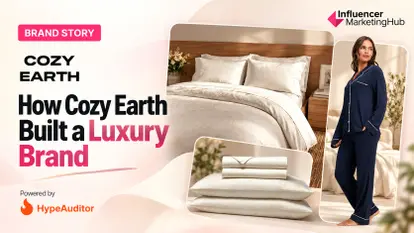
A bedding company that started with one founder selling sheets at trade shows now has products featured in Oprah's Favorite Things, Kardashian-Jenner family celebrations, and thousands of social media conversations.
For Cozy Earth, recommendations have played an unusually consistent role in that development.
Founder Tyler Howells initially relied on interior designers to introduce his products to customers. Oprah later helped bring the brand to national attention, while social media creators began demonstrating why its premium-priced bedding and sleepwear were worth buying.
The company has since expanded into hundreds of products, developed entertainment campaigns, and invested in personalized marketing to encourage repeat purchases.
This Brand Story examines Cozy Earth's development, the influencer strategy behind its product recommendations, what our HypeAuditor analysis reveals about its Instagram creator network, and how the brand connects customer trust to additional purchases.
- How Tyler Howells Built Cozy Earth Around a Better Bedding Experience
- Oprah's Favorite Things Helped Cozy Earth Reach a National Audience
- How Cozy Earth Built Its Influencer Marketing Strategy Around Product Recommendations
- What Our HypeAuditor Analysis Reveals About Cozy Earth's Instagram Influencer Network
- Cozy Earth Expands Creator Marketing Through the Bed Rot Challenge
- How Cozy Earth Turns Customer Trust Into Repeat Purchases
- Cozy Earth's Retail Expansion Lets Customers Experience Products Firsthand
- Why Cozy Earth's Recommendation-Led Growth Strategy Worked
How Tyler Howells Built Cozy Earth Around a Better Bedding Experience
Cozy Earth's origins go back to a problem Howells had experienced since childhood. He was unusually particular about fabrics, even asking his mother to help him find exceptionally soft sheets for his eleventh birthday.
Years later, nighttime temperature discomfort became a recurring problem for him and his wife, who was experiencing hot flashes. Howells began investigating alternative bedding materials, eventually becoming interested in bamboo-based textiles.
His background gave him a practical advantage. Having learned Mandarin Chinese and worked with overseas manufacturers, he knew how to move beyond intermediaries and investigate different stages of textile production.
Rather than simply importing finished bedding, he worked on refining the materials, construction, and feel of the products.
The first challenge was finding customers.
For approximately six years, Howells operated largely alone, attending trade shows and working with high-end interior designers. These designers had exacting product requirements. Their feedback helped him improve Cozy Earth's bedding, while their recommendations introduced the products to affluent households.
It was an early form of recommendation-led marketing, built around professionals whose customers already trusted their judgment.
By the time Cozy Earth began expanding its direct-to-consumer business, it had an established product proposition centered on qualities customers could recognize through use.
Those same qualities would eventually become the language of its influencer marketing.
Oprah's Favorite Things Helped Cozy Earth Reach a National Audience
Cozy Earth's relationship with Oprah began through the same professional network that supported its early growth. At a trade show, the brand connected with Adam Glassman, Oprah Daily's creative director, who experienced the sheets and introduced them to the editorial team.
In 2018, Cozy Earth earned its first inclusion in Oprah's Favorite Things. They then went on a seven-year-streak!
The recognition gave the relatively small company access to a much larger audience and helped consumers feel more comfortable purchasing unfamiliar premium bedding.
However, the relationship also influenced what Cozy Earth would sell next.
According to the company's marketing leadership, Oprah subsequently expressed interest in pajamas. Cozy Earth developed sleepwear, which appeared in her Favorite Things selections in 2019.
Further product categories followed. The longer-term value extended beyond the initial publicity.
Cozy Earth continued using eligible Favorite Things recognition across product pages, email, and other marketing communications, giving prospective customers a familiar endorsement when considering a purchase.
Weston Clark, the company's former Head of Customer Retention, explained in a 2024 interview that the immediate sales increase around an Oprah announcement eventually subsides.
The credibility associated with that recognition can continue supporting the product afterward. For Cozy Earth, the endorsement helped establish a foundation that its growing influencer program could build upon.
How Cozy Earth Built Its Influencer Marketing Strategy Around Product Recommendations
As Cozy Earth expanded online, influencer marketing became one of its earliest significant acquisition channels. Former CMO George Davis joined the company in 2018, initially handling customer support before taking on marketing responsibilities.
McKoy Molyneaux subsequently joined to help develop influencer partnerships.
The program grew around a straightforward challenge. Cozy Earth's products were relatively expensive, and their most frequently discussed qualities were difficult to communicate through ordinary ecommerce photographs.
Creators could explain those benefits through their own experiences.
Creator Reviews Help Justify Cozy Earth's Premium Pricing
To analyze Cozy's content strategy, we scoured across hundreds of UGC videos across TikTok. What we found is that creators repeatedly emphasize softness, breathability, cooling comfort, and fabric quality in their content. But an equally important pattern concerns price.
Creators frequently acknowledge the expense before explaining why they believe the products justify it. One fashion creator describes purchasing Cozy Earth bedding for more than two years before discovering the company's pajamas.
Having already experienced the bedding, she bought the sleepwear because she expected similar comfort and quality. She also explains that she purchased her earlier products herself.
@styledbymuse @Cozy Earth ♬ original sound - STYLED4U
This recommendation does two jobs.
It explains why someone might pay more for Cozy Earth while demonstrating how trust in one product category can encourage purchasing in another.
Other creators approach the same products through different routines. One begins by describing the rare moment when her home finally becomes quiet at night. She then introduces Cozy Earth pajamas as a way to make an ordinary evening feel more luxurious.
@bee.mccartt Little luxuries with @Cozy Earth🤎 use code BEEMCCARTT for 20% off✨🫶🏻 #evening #eveningroutine #night #goodnight #cozyearth ♬ original sound - Brandi McCartt💖
Another creator focuses on practical concerns such as pajama fit, pockets, breathability, and the needs of someone who sleeps hot.
@carlosshopfinds 10/10 I rather buy a couple of bamboo pajamas than a bunch of cheap pajamas that don’t compare to this feeling and quality #cozyearth #bamboopjs #pajamaset #giftsforher ♬ original sound - Johanna | Mom Finds
These examples illustrate why Cozy Earth can appear across fashion, parenting, home, and lifestyle content. Different creators emphasize different purchasing motivations while returning to the same central product qualities.
Exclusive Influencer Discounts Create Buying Opportunities
Cozy Earth's influencer program also has a direct-response component.
In a marketing leadership interview, Molyneaux explained that the company gives creators promotional offers that can be more attractive than those available on Cozy Earth's own website.
Instagram Stories have been especially useful for these campaigns.
Their 24-hour lifespan aligns with temporary offers, allowing creators to combine recommendations with a limited purchasing window. The company also negotiates individual creator partnerships, uses promotional codes, and evaluates spending against other marketing channels.
That approach connects awareness to a more immediate commercial objective.
Someone might discover Cozy Earth through a creator's recommendation, understand why the product is desirable, and then receive an incentive to purchase.
Attribution remains complicated, however. A customer could encounter a creator's content and later purchase through Google, email, or another channel. Cozy Earth's marketing leadership has acknowledged this challenge and discussed incrementality measurement as a way to better understand cross-channel effects.
Kris Jenner and Seasonal Partnerships Extend the Brand's Visibility
Cozy Earth's celebrity partnerships extend beyond conventional product endorsements.
Its relationship with the Kardashian-Jenner family provides an example. During Easter celebrations in 2024 and 2026, family members wore custom Cozy Earth pajamas developed for the occasion.
Rather than simply inserting a product into a sponsored message, the company created sleepwear for an existing family tradition that was already shared publicly.
The partnership connected Cozy Earth with recognizable personalities and seasonal content. It also demonstrated another use for the company's growing product range.
Pajamas could become part of a holiday occasion, a family photograph, or a gift recommendation.
The marketing team's earlier assessment of its Kris Jenner investment was less favorable than its experience with Oprah, however. That distinction matters because cultural visibility and measurable commercial returns are different outcomes.
Taken together, Cozy Earth's creator partnerships serve several purposes. Celebrity endorsements build recognition, everyday creators explain product value, and promotional partnerships create opportunities for purchases.
What Our HypeAuditor Analysis Reveals About Cozy Earth's Instagram Influencer Network
How far does Cozy Earth's visibility extend beyond its recognizable celebrity partners?
To examine that question, we used HypeAuditor to analyze Instagram mentions of @cozyearth from the past six months.
The analysis identified 401 creators producing 630 brand mentions.
The most interesting finding was the composition of that network.
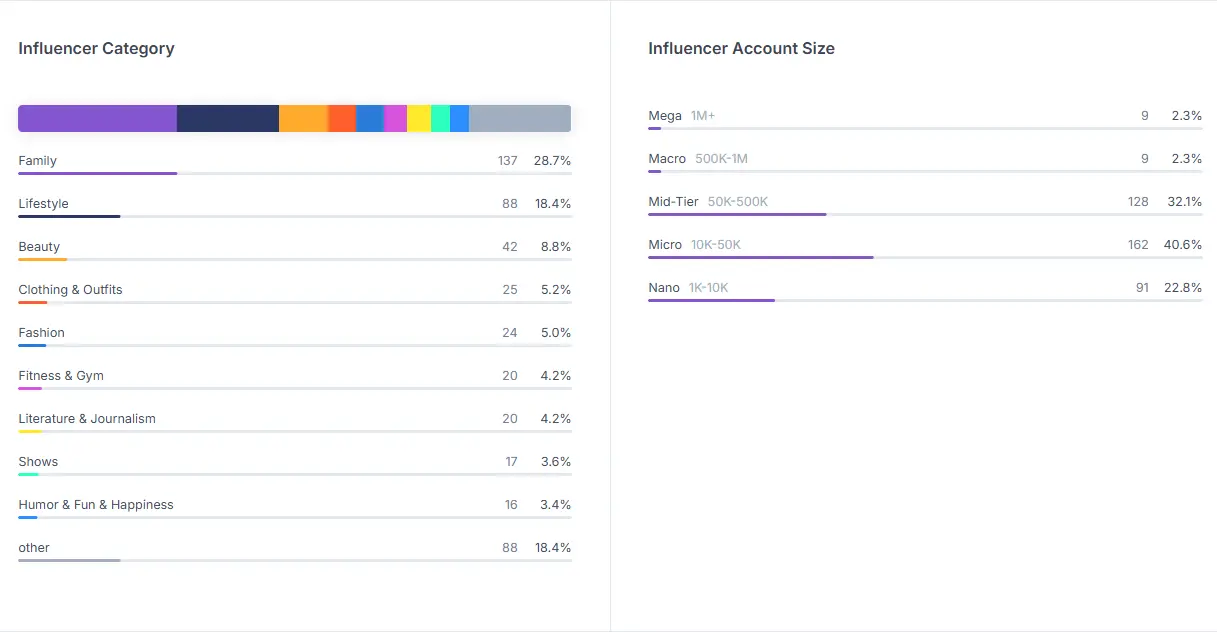
Nano and micro-influencers accounted for approximately 63.4% of tracked creators, while family and lifestyle accounts represented 47.1% of the categorized network.
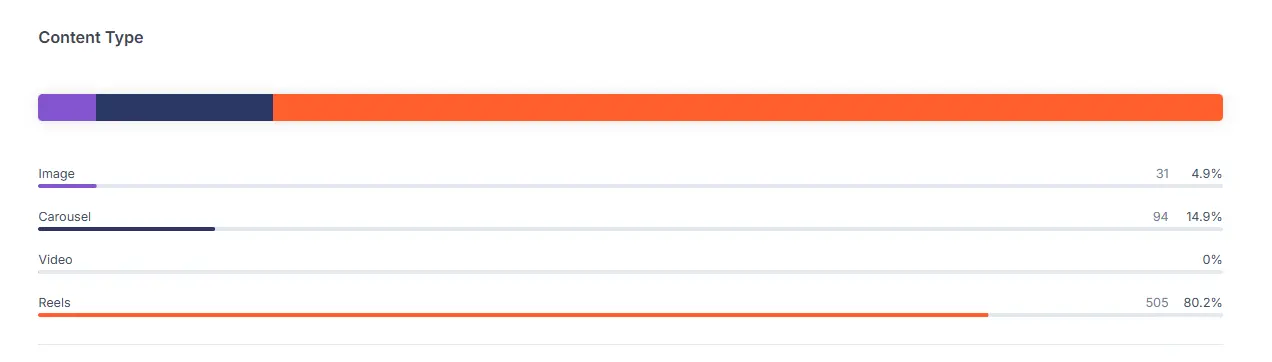
Reels accounted for 80.2% of the tracked content.
These figures suggest that Cozy Earth's Instagram exposure extends through numerous smaller creators discussing products in everyday lifestyle environments. Family creators, fashion accounts, and home-focused personalities provide different settings in which the brand can appear. The report also recorded substantially more organic-classified mentions than identifiable promotional posts.
Of the 630 mentions, HypeAuditor classified 549 as organic, 49 as likely sponsored, and 32 as sponsored.
That does not mean all organic-classified posts were unpaid. Gifting, affiliate arrangements, and other commercial relationships may not be visible to the classification model.
Creator Giveaways Add Another Form of Exposure
One example of a more explicitly promotional activation came from mega influencer Addie McCracken. Her Cozy Earth giveaway encouraged followers to follow both accounts, interact with the post, and tag friends for additional entries. The post generated approximately 84,300 comments, making it the most-commented post in the report.
The unusually high comment volume reflects the giveaway's participation mechanism rather than verified customer demand.
Overall, the data points to a broad creator ecosystem around Cozy Earth, although the commercial results remain harder to establish. HypeAuditor classified the sponsored campaign's average engagement rate of 2.33% as low, and its modeled reach and earned media value should not be treated as verified sales or return on investment.
Cozy Earth Expands Creator Marketing Through the Bed Rot Challenge
Beyond product recommendations, Cozy Earth has experimented with creating entertainment that audiences can enjoy independently of shopping.
Its Bed Rot Challenge takes a familiar social behavior and turns it into a competition. Contestants attempt to remain in bed while completing challenges, with a $100,000 prize for the winner.
@whitneyleavitt Letttsssss goooooo! #bedrotchallenge @Cozy Earth ♬ IT GIRL x HOLLABACK GIRL by ALTÉGO - ALTÉGO
In a founder interview with Shopify, Howells described the company's philosophy with a simple observation: "The content that we make is a product."
He reported that the challenge had reached four seasons and accumulated approximately 85 million organic views.
The production itself has also become increasingly ambitious. Creator London Lazerson, who worked on the fourth season, described spending eight hours filming a single sequence on the Utah Salt Flats. It offers a glimpse into the production effort behind a campaign designed to compete for attention as entertainment rather than conventional product advertising.
@londonlazHave you guys been seeing this???♬ original sound - London Lazerson
This represents a different form of creator collaboration. A product review asks viewers to consider purchasing. The Bed Rot Challenge gives them a reason to watch a branded entertainment property.
How Cozy Earth Turns Customer Trust Into Repeat Purchases
Cozy Earth's continued growth has also depended on giving customers reasons to return after purchasing their first product.
A customer who initially discovers bamboo sheets can now choose from pajamas, robes, towels, blankets, and other home products. TikTok creators provide several examples of this behavior.
One creator describes buying additional sleepwear for herself while also purchasing Cozy Earth shirts for her husband.
@realchloebarnold Are you team pajamas or just a tee? A little Cozy Earth unboxing of some of our favorites #CozyEarth #ElevatedEveryday #EverydayStyle ♬ Moment Of Reflection - Jhonatan Rodrigues & Piano Sky & Dee Piano
Another presents a large Cozy Earth haul containing pajamas, robes, blankets, and pillowcases, demonstrating how multiple categories can become part of a single purchase.
@lindsayrienstra $1000 cozy earth haul☁️⭐️✨ #shopping #haul #shoppinghaul #bedroommakeover #clothinghaul @Cozy Earth ♬ Sakura-lined street - KCNX
Cozy Earth's lifecycle marketing supports this broader product strategy. In a Retail TouchPoints interview, Davis described the company's use of personalized email and SMS, customer segmentation, automated messages, and testing to improve communications. The company consolidated its email and SMS operations into Attentive to improve coordination and reporting.
In November 2024, Weston Clark reported that approximately 40% of Cozy Earth's customers were repeat purchasers.
The figure does not establish the contribution of individual marketing programs, but it illustrates the importance of existing customer relationships to the business. Creator recommendations help introduce products. Personalized communications and new categories provide additional opportunities to purchase from the company afterward.
Cozy Earth's Retail Expansion Lets Customers Experience Products Firsthand
In 2025, Cozy Earth opened stores in Brentwood, Corona del Mar, and San Diego. That expansion has particular relevance to the brand's original product positioning.
Creators frequently tell audiences they wish viewers could feel the softness of Cozy Earth's products through their screens. Physical stores address that limitation. Customers can touch fabrics, compare materials, and assess the quality of bedding or sleepwear before purchasing.
Retail therefore adds another dimension to the recommendation-led model that supported Cozy Earth's early development.
The company first relied on interior designers to introduce its products through physical experiences. It now has stores where customers can evaluate those products themselves.
Why Cozy Earth's Recommendation-Led Growth Strategy Worked
Cozy Earth's growth reflects a series of connected decisions.
Howells developed bedding with qualities he believed customers would recognize through experience. Interior designers introduced those products to premium buyers, while Oprah helped establish wider consumer credibility.
Influencers subsequently translated the same qualities into recommendations, personal stories, and promotional campaigns.
As the business expanded, additional product categories and customer retention programs created more opportunities for purchasing. Entertainment-led content introduced different forms of brand exposure, while physical retail allowed customers to experience the products directly.
The channels have evolved considerably since Cozy Earth's trade-show years, but the central purchasing argument remains recognizable. The company continues to depend on people experiencing its products, understanding what makes them different, and communicating that value to others.

SUGGESTED

How Brooklinen Built an Influencer Marketing Strategy Around Life at Home
Brooklinen’s influencer marketing strategy uses creators and home routines to build...
![What Conversion Data From 10,000+ Creator Storefronts Reveals [Warm Click, Cold Page Problem]](https://s.influencermarketinghub.com/imaginary/resize?width=400&height=200&type=webp&url=https://influencermarketinghub.com/wp-content/uploads/2026/07/5a619d4d-chatgpt-image-jul-3-2026-12_33_04-pm.jpg)
What Conversion Data From 10,000+ Creator Storefronts Reveals [Warm Click, Cold Page Problem]
Creator traffic often fails after the click. Here’s why dedicated landing pages can...

Best Social Media Marketing Strategies for Retail & E-Commerce Brands
Discover top social media strategies that leverage social media automation and niche...