
A reusable water bottle should be a difficult product to keep talking about. Once a customer buys one, the practical need has been met. Owala solved that marketing problem in two connected ways: it made the product unusually easy to demonstrate, then surrounded it with colors, limited releases and collaborations that give creators new reasons to put the same bottle back on camera.
The result is a creator system rather than a sequence of isolated sponsorships. FreeSip provides the functional story. Color combinations turn the bottle into a form of self-expression. Reviews and how-to videos answer purchase questions. Drops and retail exclusives create urgency. Owala’s ambassador program, social listening and experiential campaigns then give the brand ways to recognize, reward and extend the attention its customers generate.
This Brand Story examines how those elements work together, tracing FreeSip’s development, the short-form creator formats that educate and convert customers, and the ambassador, collaboration, drop and social-listening strategies that keep Owala circulating across feeds and communities.
- FreeSip Gave Owala a Demonstrable Difference
- Why FreeSip Fits the Grammar of Short-Form Video
- Drops Turn Product Owners Into Retail Correspondents
- Owala’s Creator Network Is Broad, Small-Scale and Video-Led
- The Ambassador Program Gives Advocacy a Commercial Path
- Collaborations Give Creators Bigger Cultural Stories
- Social Listening Lets Owala Build on Unplanned Creator Moments
- The Lesson: Make the Product Carry the Creator Strategy
FreeSip Gave Owala a Demonstrable Difference
Owala launched in 2020, but its defining product was years in development. Parent company Trove Brands grew from the BlenderBottle business founded by Kim and Steve Sorensen. Trove first tried selling the FreeSip design under BlenderBottle. The attempt largely failed because shoppers associated that name with protein-shake bottles.
The company withdrew the product, refined it and eventually built Owala as a separate brand. CEO Michael Sorensen said the FreeSip took seven years to develop.
That history matters because Owala’s eventual social success began with a visible product behavior. The FreeSip lid lets someone drink through a built-in straw or tilt the bottle and use the larger opening. Its push-button cover also protects the mouthpiece. Each feature can be understood in seconds without technical explanation.
Early timing helped. Nurses began sharing the bottles during the pandemic, giving Owala advocacy from people whose work made hydration and covered mouthpieces especially credible. In 2021, the brand added giveaways and online scavenger hunts. It later turned color releases into recurring events. What began as product education gained an emotional and collectible layer.
Why FreeSip Fits the Grammar of Short-Form Video
FreeSip produces the raw material creators need: movement, contrast and a clear before-and-after. A creator can press the button, reveal the mouthpiece, demonstrate two drinking modes, remove the gasket, test for leaks or compare bottle sizes. The product does something on camera.
Creators repeatedly turn those actions into consumer education. One month-long review opens:
@kitan.isawumi 📌 Save this before buying an Owala. I've been using an Owala every single day, and I honestly think it's one of the best water bottles you can buy. But there are 2 things I wish someone had told me before I bought it that could be dealbreakers depending on how you use yours. What's your favorite water bottle right now? #owala #waterbottle #college #review #essentials @Owala
The creator gives the bottle an 8.5, praising its built-in straw and covered mouthpiece before raising two objections: the bottle does not fit the creator’s car cupholder and does not keep water as cold as a previous bottle. That mixed verdict is more useful than uncomplicated praise. It shows the benefit, identifies the tradeoffs and gives viewers a reason to trust the judgment.
Another creator goes in detail, emphasizing that you actually need to clean the lid.
@world.shaker Sorry to shatter the glass for the other #owala people out there
The creator removes the lid gasket and shows viewers where residue can collect. Cleaning content may seem like a liability, but it expands the brand’s search footprint and gives existing owners a reason to participate after purchase. It also lets creators provide genuine service instead of simply repeating product claims.
Across viral Owala-related TikTok content, four creator formats recur.
Reviewers test insulation, leakage and cupholder fit. Educators explain sizes and cleaning. Lifestyle creators show a “first Owala,” match colors to an outfit or personalize a bottle with boots, charms and stickers. Retail scouts report new releases, stock levels and restock dates.
@supermoonsparkles My daughter decorated her Owala! 💙🌸 #owala #targetfinds #momanddaughtertime #target #owalawaterbottle @Owala @target
Together, these formats move viewers from awareness to product understanding, identity and purchase intent.
Drops Turn Product Owners Into Retail Correspondents
Function explains why someone may choose an Owala. Color explains why that customer might want another one.
Owala has released hundreds of color combinations and extended the system through retailer exclusives and licenses including Disney, Marvel, Star Wars and Pokémon. This changes the creator brief without requiring a formal brief at all. A bottle can become a haul, a ranking, an unboxing, a gift guide, a collection tour or a store hunt.
A Target-shopping TikTok captures the resulting behavior:
@eatandgather Did anyone find the Owala x Pokemon water bottle drop today?! #owalawaterbottle #targetexclusive #hydrationtok
They show the line, worries that the bottles will sell out and ultimately leaves without one. The video still markets Owala despite ending in disappointment. Scarcity supplies the plot, Target supplies the setting and the creator documents demand in public.
Another product video compresses beauty, feature education and conversion into 19 seconds. After calling a blush-pink design “the water bottle of my dreams,” the creator identifies its leakproof construction, insulation and built-in straw, then closes by emphasizing the scarce nature of these limited edition drops.
@thesunnycoconut The prettiest Owala I have EVER SEEN!!!! I love the coquette lace design and the soft blush pink color! Give me 10 of them right now!! #owala #owalawaterbottle #pinkcoquette #pinkaesthetic #girlythings
Other creators point viewers to a link in bio or the TikTok Shop orange cart. This is where creator storytelling becomes commerce: the aesthetic stops the scroll, the feature demonstration justifies the product and the stock warning accelerates the decision.
@workingthefairway I’m so glad this water bottle is back on sale! #owalawaterbottle #golfproduct #golffind #golfgift #CapCut
The mechanism also supports retention. A durable bottle has a naturally slow replacement cycle, but seasonal colors, accessories and cultural licenses shift the purchase from replacement to collection. Every launch can reactivate existing customers while giving creators a fresh search term and visual asset.
Owala’s Creator Network Is Broad, Small-Scale and Video-Led
To understand the structure behind that visibility, we used HypeAuditor to analyze worldwide social media activity mentioning Owala in the past six mnths. The pattern looks distributed rather than dependent on a few celebrity endorsements.
HypeAuditor identified 1,620 mentions from 1,182 accounts. Nano creators represented 46.6% of the accounts and micro creators another 27.2%, meaning almost three-quarters of the observed network had fewer than 50,000 followers.
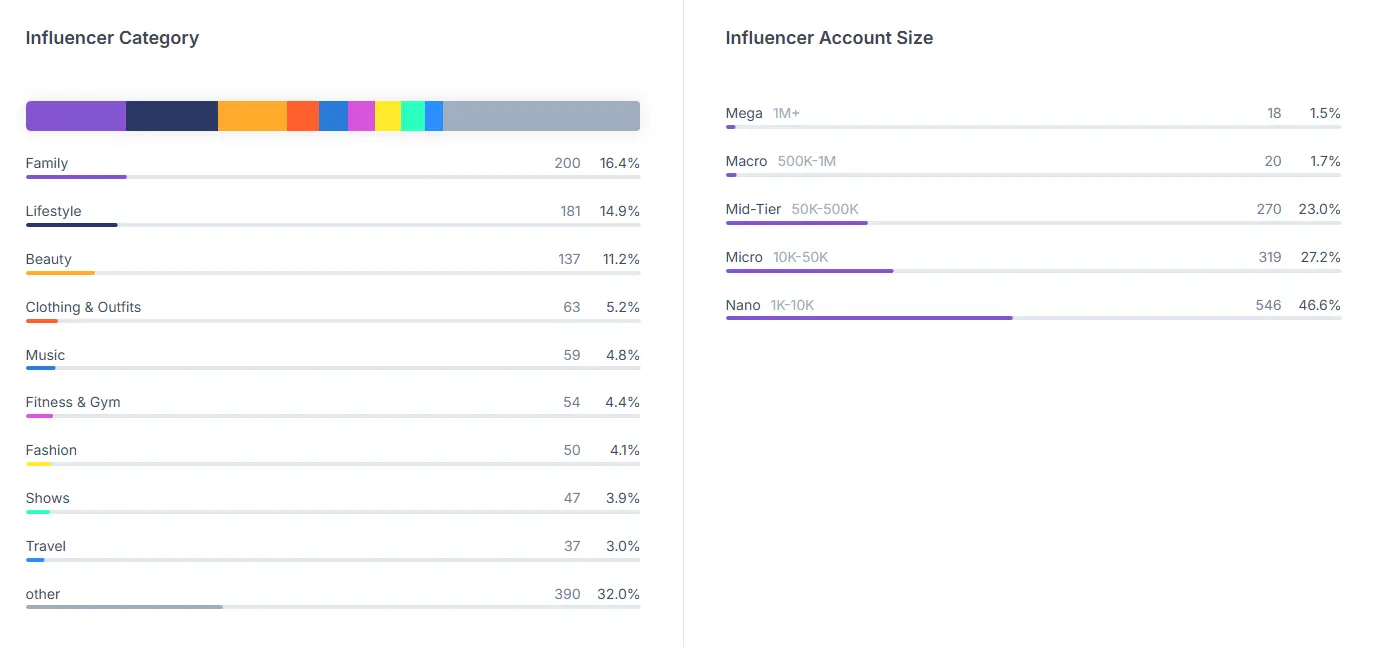
Reels accounted for 81.4% of the content. Family, lifestyle and beauty were the three largest creator categories, while the modeled audience was 77% female and just over half was in the United States.
Those figures fit the creative patterns visible across Owala content. The bottle appears in classrooms, cars, homes, gyms and shopping trips because it belongs naturally in everyday routines. Smaller creators do not need a large production concept to feature it. They need a bottle, a use case and an opinion.
The commercial classifications require care.
HypeAuditor labeled 20 mentions sponsored, 128 likely sponsored and approximately 1,500 organic. “Likely sponsored” is a model-based classification, not confirmation that money changed hands, and “organic” does not rule out gifting, affiliate links or another commercial relationship.
Modeled reach and earned-media-value estimates should not be treated as verified sales, spend or return on investment. A giveaway-driven engagement outlier also makes report-wide averages less reliable. The defensible conclusion is about network shape: Owala benefits from a large volume of video-led, mostly small-creator visibility, while the revenue attributable to that activity remains undisclosed.
The Ambassador Program Gives Advocacy a Commercial Path
Owala’s ambassador program formalizes part of this fan activity. Applicants can receive an individual link, earn commission, unlock product rewards and gain early access to drops. Selected ambassadors may join gifting programs and paid-content campaigns. A social following is not required, which is consistent with a strategy built around enthusiasm and repeated participation rather than reach alone.
This creates a progression from customer to advocate to measurable partner. A fan can begin with an ordinary collection or review post. Referral links add a conversion layer. Milestones encourage continued activity. Early access equips selected partners to publish when search interest is highest, while paid campaigns give Owala a route to commission more controlled work.
Brand gifting is also something Owala does with its ambassador network. In one TikTok video we found, a teacher announces that Owala sent bottles for every student, lets the children choose between two colors and captures their reaction.
@mrshanksclassroom_ Thank you @Owala 🫶🏽🍎 they were so happy !!! #owala #mrhanks #gotit #kidsfirst
The product placement works because it is also a classroom event. The creator receives a story, the students receive something useful and Owala appears inside a community rather than as an interruption.
Collaborations Give Creators Bigger Cultural Stories
Licensing expands Owala beyond the water-bottle category by attaching releases to existing fandoms. The Wicked collection shows the amount of infrastructure behind what viewers experience as a simple drop. Public portfolio material for the Wicked x Owala campaign includes product design, photography, set design, a campaign video and social advertising.
Taylor Morse, director of content and community at Owala parent company Trove Brands, offered a view from inside the launch. In a LinkedIn post, Morse announced that the Owala x Wicked collab already sold out, praising their partnership team consisting of Ally Moss and Nicole Tyler for a job well done.
That full-funnel preparation matters to influencer marketing. A collaboration gives creators recognizable characters and colors; the brand supplies a coordinated visual world; email, retail and social distribution concentrate attention around the release. Creators are not being asked to manufacture relevance from an ordinary SKU. They are interpreting a cultural object their audiences already recognize.
Social Listening Lets Owala Build on Unplanned Creator Moments
The creator system is not limited to scheduled launches. When artist and tennis coach Binoy Zachariah posted that he had used an Owala during an attempted home invasion, two TikToks drew 13.7 million and 19.4 million views. Owala’s social-listening team surfaced the story, and the company responded within a week with a custom “Sipcurity Safe” filled with bottles and a paid weekend trip.
@binoymusic This is so crazy 😭 huge thank you to @Owala and everyone who’s watched / commented on this series of videos ❤️ #fyp #foryou #unboxing #owala #storytime
The response created a second content beat through Zachariah’s unboxing, but the brand also acknowledged the seriousness of the experience. Brand director Chad Sorensen said to MarketingBrew that Owala tries to balance being playful with being helpful and decides how to respond case by case. That distinction is important: effective social listening is not permission to turn every customer experience into a stunt.
Owala has carried the same participation logic into planned activations. Its 2025 Owalafy It campaign invited social nominations, delivered surprises and converted them into episodic content. Its 2026 college tour is scheduled for 10 campuses with engraving, heat-press customization, exclusive merchandise and a human claw machine. Both create experiences designed to be lived first and filmed second.
The Lesson: Make the Product Carry the Creator Strategy
Owala’s strongest influencer-marketing asset is a product system that keeps generating credible creator assignments. FreeSip makes the first video easy: show the lid and explain the choice between sipping and chugging. Reviews, cleaning and comparisons build trust. Colors and customization turn ownership into identity. Drops, licenses and retail exclusives create urgency and repeat purchases.
Ambassadors add attribution, while social listening helps the brand identify customer stories worth amplifying.
The commercial lesson is not that every product needs artificial scarcity or a rainbow of limited editions. It is that creator marketing becomes more durable when the product supplies demonstration, opinion, identity and news. Owala gives creators all four, then keeps replenishing the reasons to press record.