
Even as shoppers return to brick-and-mortar stores, their online shopping habits have been set in stone, and the eCommerce industry continues to experience growth, albeit at a slower pace. It’s projected that the eCommerce share of retail sales will continue to experience double-digit growth until it reaches 24% by the end of 2026. This is despite the massive dip in the global eCommerce growth rate from 17% in 2021 to 9.7% in 2022.
It is clear that eCommerce is here to stay, and businesses need to adopt omnichannel retail strategies to remain competitive. That’s why we’ve compiled the ten top SaaS eCommerce platforms that can help boost your online sales.
SaaS eCommerce Platforms You Need to Check Out
Managing an online store involves intricate components and processes such as fulfillment services, payment gateways, CRM, CMS, email marketing, and many others. Thanks to eCommerce software, running a store online is an easy feat even beginners with zero experience can manage.
This list consists of platforms that will help every aspect of your eCommerce business run smoothly so you don’t have to deal with the headaches of overseeing multiple moving parts.
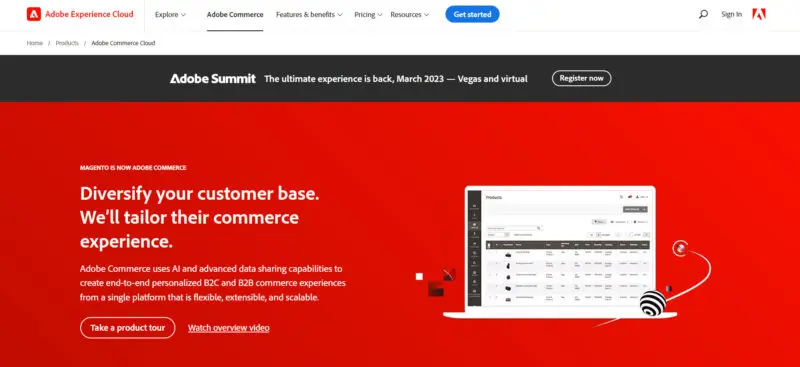
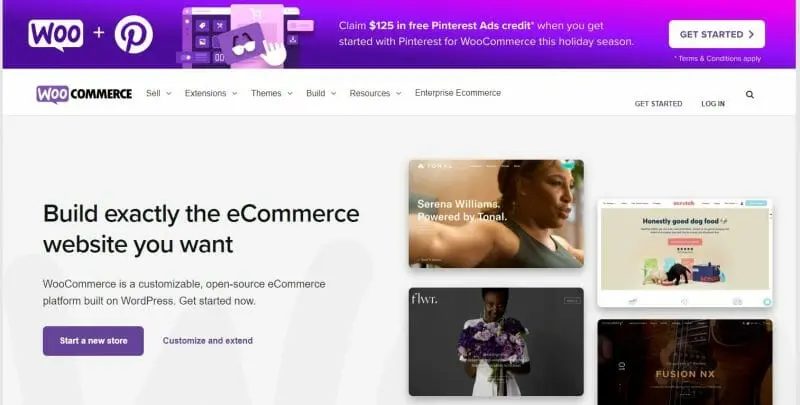
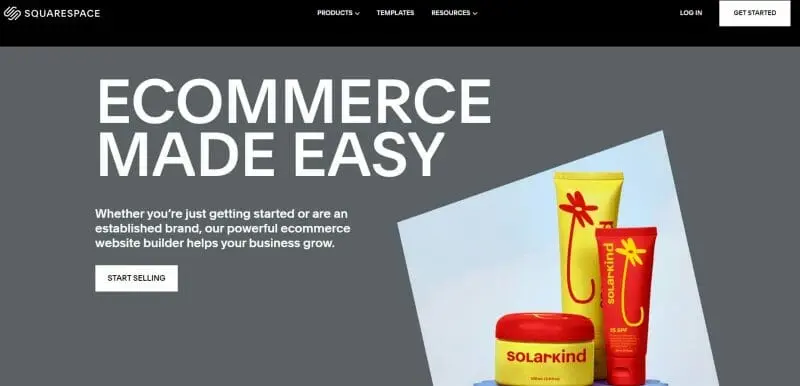
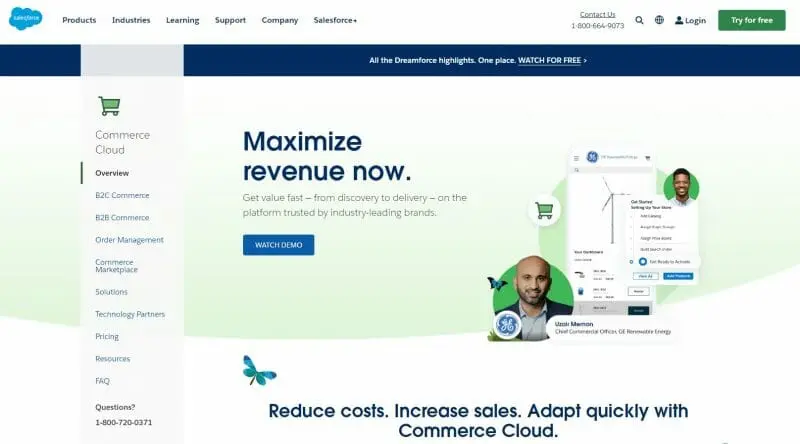
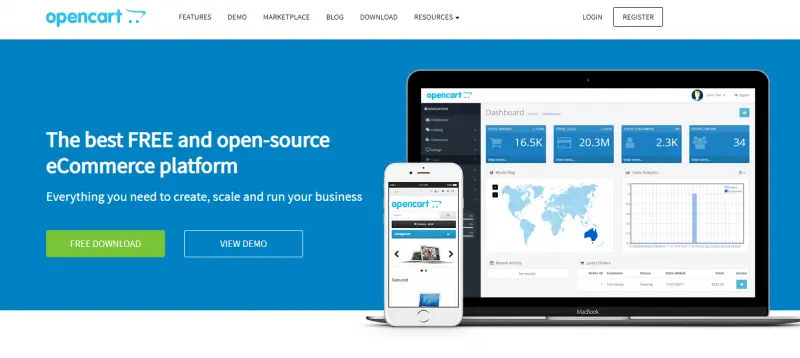
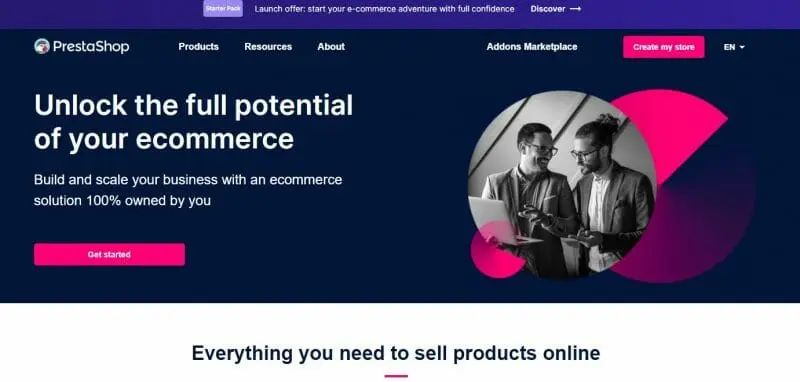
Sanity is a Content Operating System that sits behind your eCommerce platform, holding product content, marketing copy, imagery, and merchandising rules as structured data that can be published to any storefront, marketplace, mobile app, or AI shopping agent. Where the platforms in this list handle checkout, catalog, and theming, Sanity handles the source of truth for what actually appears on those surfaces. Product content lives in the Content Lake as schema-defined JSON, queryable through GROQ and APIs. Editors work in Sanity Studio, a customizable React workspace, while developers connect it to Shopify, BigCommerce, Adobe Commerce, or a custom stack. Content Releases coordinate cross-channel launches, and the Agent API lets teams wire AI workflows directly into their content operations. Magento powers over 700,000 websites and is the 3rd most popular platform in the Top 10K sites in the eCommerce category. Magento is an open-source eCommerce platform used by big brands like Samsung, Nike, North Face, Ford, and more. It’s one of the oldest platforms, developed in 2007 and becoming a closely popular solution next to WooCommerce in 2017. Shopify is currently the most popular eCommerce platform in the English-speaking world, generating more than $175 billion in sales for its merchants. This makes it the 3rd most widely used eCommerce software behind WooCommerce and Squarespace, according to data from Statista. Large and small business owners flock to Shopify because of its wide array of features and functions that makes building and operating an online store a breeze. There’s also an option to integrate an offline retail location, making it the ideal platform for brands with both an online and offline presence. If you’re already using WordPress as your CMS, then WooCommerce is the automatic choice to support your online store. WooCommerce is a free plugin for WordPress and is very customizable, making it a popular choice among web developers. You can create the perfect online store with all the features you’d actually use. WooCommerce may not be as synonymous with e-Commerce as Shopify, but it enjoys the biggest market share at 29%—more than double Shopify’s. It is no surprise since WordPress powers almost 50% of the world’s websites. Wix is widely known as a website builder rather than an eCommerce platform, but the company has Business Plans that incorporate eCommerce functionalities into its intuitive drag-and-drop website builder. With four plans to choose from depending on the storage space and functionalities you need, business owners can easily integrate an online store into their beautiful Wix websites. Squarespace is a website builder that allows you to create stunning sites for your portfolio, blog, local business, and others. It also has an online store functionality that goes beyond templates and lets you access marketing automation tools, inventory management, SEO, and reporting analytics. It has one of the lowest Business packages at $23 per month but has high transaction rates at 3%. Salesforce Commerce Cloud unifies your online and offline channels to an AI-powered platform that helps you deliver a consistent customer journey across various touchpoints. The solution, available to B2C and B2B retailers, promises to generate better conversions to help grow your business. It’s the 5th most popular solution in the Top 10k sites in the Multi-Channel category according to BuiltWith and powers over 10,000 websites. Companies like GE Renewable Energy attest to the platform’s ability to triple their growth compared to other platforms. As an All-in-One eCommerce platform, the Salesforce Commerce Cloud integrates with other solutions that make CRM, order fulfillment, payment, and other processes seamless. Pricing: Free trial available, Pricing upon request OpenCart is an open-sourced eCommerce platform that’s free to download and easy to run. It has powerful built-in features like store management, SEO, product management, order management, and more. There are also built-in themes and modules to choose from. It’s built using PHP and MVC architecture, and as an open-source solution, its source code can be manipulated by anyone. This becomes one of its greatest limitations because you need a dedicated web developer to make the platform work. It’s not easy to set up the platform for companies without a dedicated developer who can tinker with it. However, it has the potential to turn into the exact online store you dreamed of with its highly customizable features. PrestaShop is another open-source eCommerce platform built on PHP that powers over 700,000 websites, according to BuiltWith. It’s ranked the 7th most popular platform in the open source category across the entire internet. Like any other open-source platform, it’s free to download and install the main software. There are hundreds of developers working within the PrestaShop ecosystem to deliver complimentary modules. However, to fully maximize the platform, you need technical expertise to transform it into the eCommerce solution your business needs. You are also in charge of managing the hosting provider and ensuring it’s something that can support your store. Pricing: Free to download, but additional modules can be costly. Starter pack costs 169.99 EUR1. Sanity

2. Magento (now Adobe Commerce)
3. Shopify

4. WooCommerce
5. Wix

6. Squarespace
7. Salesforce Commerce Cloud
8. OpenCart
9. PrestaShop
Wrapping Up
Online shopping is here to stay, and with the rise of social commerce, you can’t afford to miss out on another profitable sales channel. The eCommerce platforms listed here will help you finally gain the confidence to open an online store. Or, if you already have one but it’s not performing, you may want to explore other marketing strategies and website optimization techniques to boost your online sales.
Ultimately, eCommerce is a trend you can’t ignore, and the sooner you set up an online store, the better for your business.
Frequently Asked Questions
What’s the largest eCommerce platform?
In terms of market share, WooCommerce is the largest eCommerce platform currently used by over 3 million websites worldwide. However, in terms of popularity, Shopify beats WooCommerce by a wide margin. According to Google Trends, Shopify has more searches than any other eCommerce platform combined.
This trend is despite Shopify only having a 19% share vs. the 25% WooCommerce share in the top 1 million eCommerce sites. If the valuation indicates popularity, Shopify is currently valued at $40.3 billion – a far cry from the $3 billion valuation of Automattic, the parent company of WooCommerce, which is also responsible for WordPress, WooThemes, and dozens of other products.
WooCommerce may be the top right now, but with the aggressive growth campaigns of Shopify, it won’t be a surprise if this Canadian company overtakes the famous giant.
What’s the best eCommerce platform for small businesses?
There is no straight answer to the best eCommerce platform for startups and small businesses. With so many options, the correct answer is to determine your goals and current skill sets for launching an online store.
If you have a dedicated web team with knowledge about web development, an open-source platform like WooCommerce or OpenCart will be an ideal solution. Your team can take care of the setup and maintenance, plus there’s a huge chance your existing site is already running on WordPress.
However, a hosted solution like Shopify, Wix, or Squarespace may be the better option if you're starting from scratch and have a small team wearing many hats. These sites are quick to set up and won’t require any technical maintenance. It’s like a plug-and-play solution where you sell hundreds of products automatically online.
Choosing an eCommerce platform will also depend on what you’re selling. If you’re only selling a few items or digital services, you’d need fewer functionalities than selling thousands of fast-moving consumer goods.
Before settling down with any eCommerce software, conduct your research by reading reviews and asking other businesses who’ve leaped to sell online. Their honest opinion and experiences using their current solutions will help you determine the best platform for your needs.
Which eCommerce platform works with TikTok shopping?
Social commerce is rising with the success of TikTok shopping and the hashtag #TikTokMadeMeBuyIt. In a recent press release, TikTok announced that the company would offer a full-service eCommerce solution where merchants can upload products on the platform. TikTok will handle points of purchase, shipping, and fulfillment within the app.
The same press release announced that TikTok has partnered with Shopify, Square, PrestaShop, and Ecwid. Merchants on these platforms can connect their accounts so users can explore their product catalogs without leaving the app. This enables merchants to harness the organic power of TikTok and promote their products to its billions of users.
Other upcoming eCommerce platforms partnering with the app are Wix, OpenCart, BASE, and SHOPLINE. TikTok will also release a TikTok Shopping API to let businesses integrate product catalogs directly into TikTok.
Which eCommerce platform supports Instagram Shopping?
Instagram was one of the first social media platforms to cash in on the social commerce trend by allowing qualified users to tag their products on their posts. You can create a storefront on Instagram and tag products in your photos that link to a product and checkout page. This process is integrated with Facebook Catalog, which you’d use to manage your product listings and availability.
If you’re running a full-fledged online business, selling on multiple channels, having a separate Instagram store can be painful. Luckily, popular eCommerce platforms like Shopify and Big Commerce support Instagram shopping. You can connect your online store to Instagram for a seamless and automated selling process.
Other platforms like WooCommerce, Magento, and OpenCart are not directly integrated with Instagram, but they are integrated with the Facebook Catalog, which is how products end up on Instagram in the first place.


