A few years ago, conversations across the world were dominated by the pandemic. Social distancing made it into everyday conversation.
Now, the new two-word buzz phrase is — artificial intelligence.
Similarly to the pandemic, some of the conversation around AI does involve a degree of fear, though. Much of this fear can be attributed to fear of the unknown. The tech is new; the tools are new.
Not knowing which AI-powered marketing platforms to check out and possibly add to your MarTech stack shouldn’t be holding you back. We can’t predict the future, but we know that the following 12 solutions can change how marketing teams go about their work moving forward.
As AI-powered marketing tools are still pretty new to many, we’ve also included some case studies. These will give you a better idea of how others are using AI to optimize digital marketing campaigns and the type of results that you can expect.
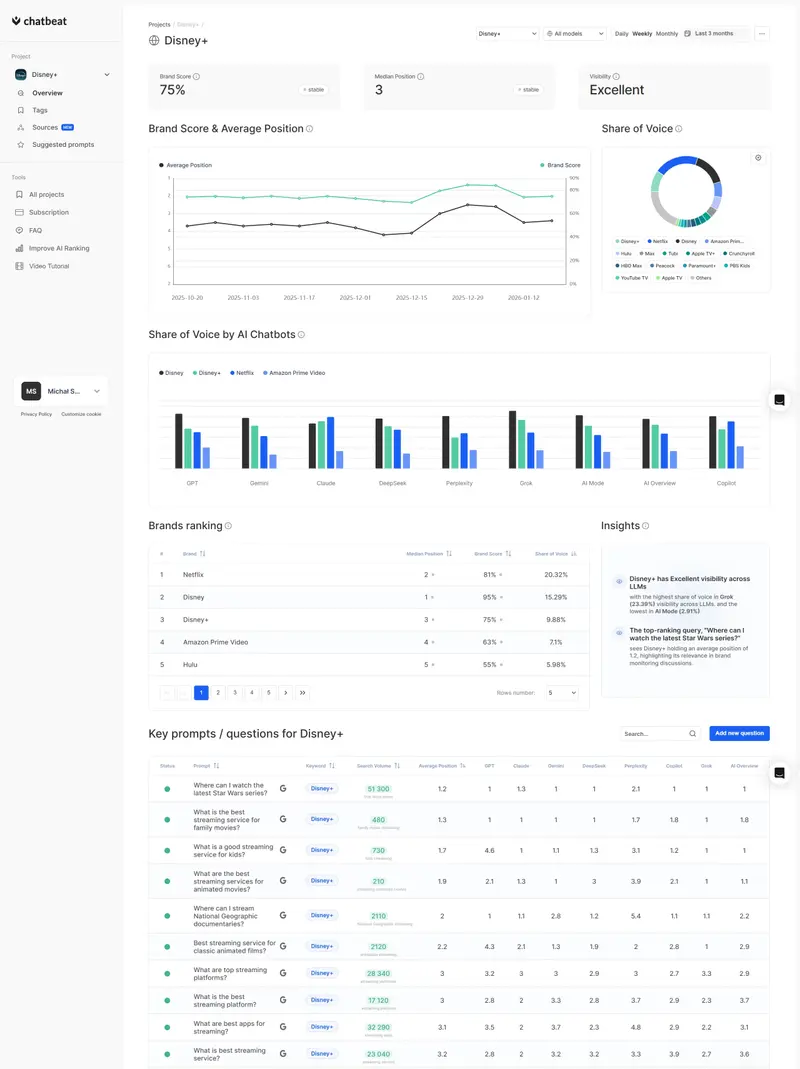
For marketing teams building an AI-search program, Chatbeat provides the measurement and decision layer. It tracks customer-like prompts across major generative AI platforms and brings visibility, Brand Score, ranking position, competitive share of voice, sentiment, and cited sources into one dashboard. This helps teams evaluate the full journey from what buyers ask to which brands and sources the model ultimately recommends.
The platform is particularly useful when AI visibility involves several functions. SEO teams can study prompts and cited pages, brand teams can monitor narrative and sentiment, and PR teams can identify third-party publications that repeatedly shape answers. Chatbeat then recommends actions for weak prompts, missing sources, or unclear positioning, giving teams a starting point for deciding whether the next move should involve onsite content, authority building, or external distribution.
There is evidence that the workflow can connect visibility metrics to commercial outcomes. In Chatbeat’s Base case study, the ecommerce software company mapped prompts, studied source patterns, and adapted its content with deeper original material, comparison-friendly formats, trusted references, and FAQs. Over roughly two months, its Brand Score increased from 50% to 65%, its average AI position improved from eight to five, and it moved from #4 to #2 among monitored competitors. Overall AI traffic increased by 48.6% at its peak compared with the starting month.
Chatbeat also scales beyond a single in-house team. Advanced plans support data exports and Looker Studio, while the Business tier adds unlimited projects and seats, white-labeled reporting, and a dedicated project manager. Enterprise customers can access an API, unlimited prompts, custom AI-response analysis, an AI Visibility report, and GEO strategy workshops.
Key features of Chatbeat include:
Multi-model prompt monitoring
Brand Score, position, and share-of-voice trends
Sentiment and narrative analysis
Cited-source intelligence
Recommended optimization actions
Exportable and white-labeled reporting on qualifying plans
Plans and pricing:
Plans start at $99 per month for 30 prompts, one project, and two seats. Higher tiers increase prompt and response-analysis capacity and add team, reporting, and integration features. A free trial is available without a credit card.
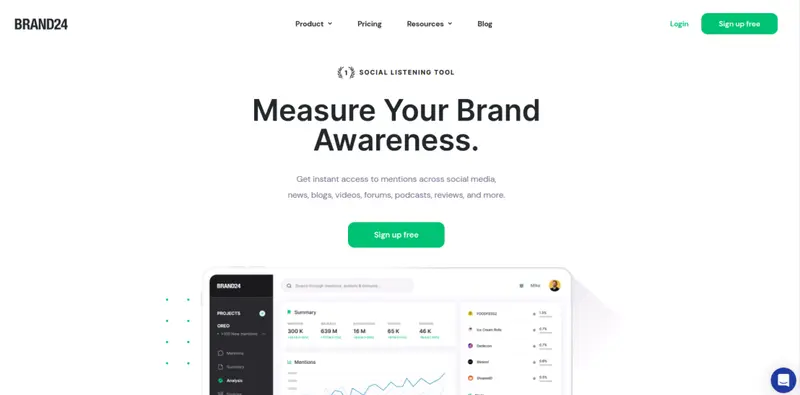
For help with media monitoring, there’s Brand24. Rated as one of the top tools to help in you in time of a social media crisis, it has helped names like Uber, Twitch, and Omnisend to track media mentions and uncover actionable insights about their customers.
One of its standout features is its AI-powered language detection. It supports over 100 languages, making it much easier to track important brand mentions.
Not only can it track mentions, but it also applies natural language processing (NLP) and machine learning (ML) algorithms to help make sense of the data in real time. With the help of this powerful sentiment analysis, you can understand consumers’ attitude towards your brand, helping you to adapt your marketing strategy accordingly.
Omnisend, for example, has used these features specifically to measure the effectiveness of their press releases. Brand24 has offered them a centralized place from where they could track backlinks, social mentions and engagements, and reviews. This has helped them to realize that their press releases and guest posting strategy were in fact more effective than what they initially thought and they could target their content better.
Key features of Brand24 include:
Engagement tracking
Daily reports
Filtering by various factors such as engagement, sentiment, and source
Sorting by the importance of the mention, date, or popularity
Plans and pricing:
Brand24 doesn’t include a free plan, but they do offer a free 14-day trial (no credit card required) and a generous discount of up to two months free when you sign up for yearly billing. Pricing starts at $79 per month.
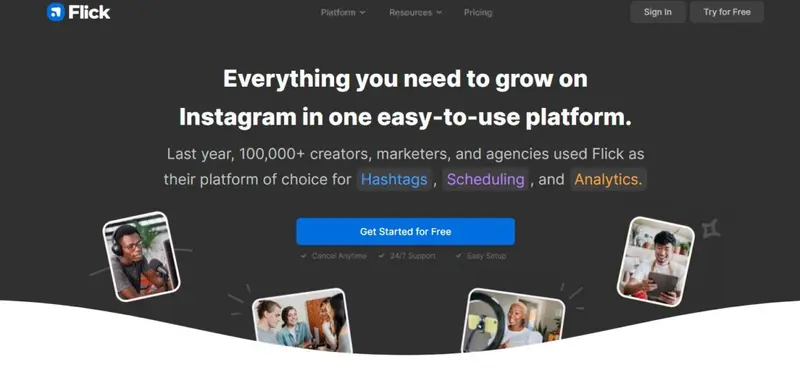
For help specifically with social media marketing, there’s Flick. It describes itself as an all-in-one Instagram marketing platform. That being said, it also supports scheduling for Facebook, TikTok, and LinkedIn.
It includes an AI social marketing assistant that acts as your planning partner. Whether you need help brainstorming unique ideas for what to post next or you can do with assistance when it comes to writing the caption, it will help you to speed up the content creation process. It can also repurpose long-form blog posts by shortening it. Then, to help you keep track of all your new and repurposed content, it has a “Content Planner” section.
However, they’re still in the early stages of development. As such, there’s a waiting list and each week they onboard users from this waiting list. So, the sooner you sign up, the sooner you can meet your new (potentially long-term) AI-powered social media planning partner.
Key features of Flick include:
Content ideas
Social media captions
Hashtag tools
Post scheduling
Instagram analytics
24/7 support
Plans and pricing:
After a free seven-day trial (credit card required, unfortunately), pricing starts at about $18 per month when billed monthly. However, if you pay yearly, you can save 20%.
Flick's AI Social Marketing Assistant is an innovative platform that uses AI algorithms to revolutionize social media content creation, empowering users with creative ideas, personalized captions, easy repurposing, and efficient planning.
Ratings
Features & Pricing
Pros and Cons
Ratings
Ease of Use
4.3
Customer Service
5.0
Features
4.2
Overall Score
4.5
Features & Pricing
AI caption and content writing
AI post idea brainstorming
Post scheduling & analytics
Price starting at:$13.60
Pros and Cons
Infinite content ideas
Connects with Flick's Scheduler
AI features are still in beta stage
Best for: Small Businesses
4.5 out of 5 stars
Flick's AI Social Marketing Assistant is an innovative platform that uses AI algorithms to revolutionize social media content creation, empowering users with creative ideas, personalized captions, easy repurposing, and efficient planning.
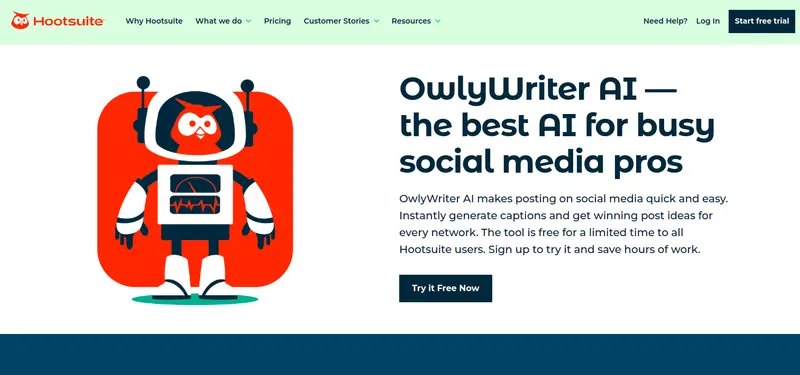
We’ve featured Hootsuite in several of our listicles. However, one feature that we haven’t really explored is its AI writing assistant, OwlyWriter AI, that’s powered by GPT technology. You can think of it as an AI-powered content-generator for social media networks.
Aimed at social media professionals, it can help you to create post ideas and captions for your posts. Then, once you’ve whipped up a top-performing post, you can use it to recreate the formula automatically and copy the success without copying the post.
Another way that it can help ensure that you don’t have any gaps on your content calendar is that it will keep track of important events. You can integrate it with your current approval workflows so that others in your team also have a say about which events are worthy to be celebrated by your brand.
Key features of Hootsuite include:
Customizable templates
An AI hashtag generator
Recommendations for the best times to post
Integration with Grammarly
Copywriting formulas
Plans and pricing:
OwlyWriter AI is currently available free of charge to all Hootsuite users for a limited time. After a free 30-day trial, pricing starts at $99 per month.
One of the first platforms designed to streamline social media management, Hootsuite continues to be one of the market leaders.
Ratings
Features & Pricing
Pros and Cons
Ratings
Features
5.0
Ease of Use
5.0
Reporting
5.0
Overall Score
5
Features & Pricing
Analytics
Automated Publishing
Contact Management
Content Management
Conversion Tracking
Customer Targeting
Keyword Filtering
Multi-Account Management
Post Scheduling
Brand Tracking
Customer Engagement
Multi-User Collaboration
Reporting/Analytics
Social Media Monitoring
Price starting at:$99
Pros and Cons
Connected Social OS structure brings publishing, listening, care, analytics, and advocacy into one suite
Wisdom adds a conversational AI layer across the platform, helping teams ask questions, surface insights, draft content, and take action from one workflow
Perch keeps Hootsuite’s core publishing strength, including content planning, scheduling, AI-assisted post generation, and performance review
Nest centralizes messages, comments, mentions, routing, and customer care workflows
Lumen strengthens Hootsuite’s listening and intelligence layer, especially for teams that need brand, competitor, trend, and audience insight
Advanced and Enterprise plans support more structured collaboration, approvals, routing, governance, reporting, SSO, compliance, and advanced listening
Pricing now scales per user, so larger teams need to calculate seat costs carefully
The new product naming may require existing users to relearn where older Hootsuite features now live
Some of the strongest Social OS capabilities, including advanced listening, governance, compliance, and advocacy, are concentrated in higher-tier or Enterprise plans
Best for: Social media teams of all sizes
5 out of 5 stars
One of the first platforms designed to streamline social media management, Hootsuite continues to be one of the market leaders.
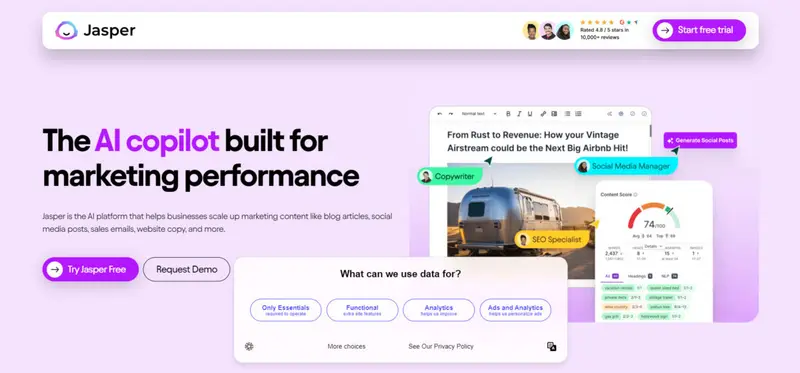
From profile bios to product descriptions to paid ads, Jasper can generate various types of content, making it one of the most popular AI tools for content generation aimed at businesses and creators.
You can ask its AI chatbot to come up with new content ideas or improve content that you’ve already written. Not only can it improve content but also repurpose it and you can, for example, ask it to summarize a transcript. Other popular use cases include changing the tone of emails and coming up with ideas for headlines.
Another worthy mention is that unlike other AI marketing platforms that focus purely on writing, Jasper also includes basic art generation. From thumbnails to super realistic illustrations, it can create various visual assets to match your AI-generated message.
For example, when Mongoose Media signed up to Jasper, the benefits were twofold. They saved 240 hours but also managed to boost their organic traffic by 166%.
Lauren Petrulla, the founder and CMO of Mongoose Media, emphasizes that it shouldn’t be used to replace your copywriter, though. Instead, it’s a tool that can empower your marketing team by helping them with, for example, repetitive tasks. If you use it in isolation, you’ll only do your potential customers a disservice.
Key features of Jasper include:
A plagiarism checker
Language translations
A template library
Plans and pricing:
After a free seven-day trial (credit card required, unfortunately), pricing starts at $39 per month when billed annually. Jasper also offers custom packages for growing businesses.
If you’re looking to get started with AI and you’re not ready for a huge financial commitment yet, you can check out Yotpo. It’s one of the best free AI marketing tools for leveraging user-generated content (UGC).
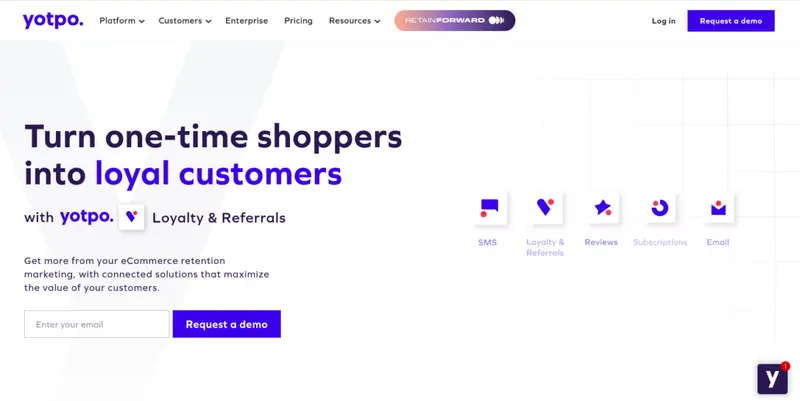
Yotpo describes itself as an eCommerce retention marketing platform. It’s fancy talk for a tool that can help you to convert one-time customers into loyal ones.
Trusted by major brands like Volcom, Steve Madden, and Chubbies, it’s a powerful tool for optimizing how your brand uses reviews in your content. It uses AI to collect reviews and identify the top product reviews.
Yotpo’s platform can also help you to generate more reviews. You can, for example, also use AI to suggest relevant topics that customers can write about in their reviews.
Reviews, though, is just one of Yotpo’s many use cases. Thanks to its wide range of capabilities, Steve Madden could simplify their tech stack and use Yotpo for visual marketing, customer loyalty, and reviews. Not only has it simplified their own marketing, but it has also improved the overall customer experience. After switching to Yotpo, the fashion label enjoyed a significant growth in the number of shoppers that interacted with reviews (which Yotpo also helped to increase by 57%).
Key features of Yotpo include:
Post-purchase review requests sent via email
Review sorting
User-friendly reviews moderation
Email analytics
AI-enhanced customer segmentation
Plans and pricing:
Yotpo offers a Free plan, a number of paid plans as well as product bundles. Custom pricing is also available to enterprise clients. Depending on your needs, pricing starts at $9 per month.
Customer reviews are one of the best forms of social proof there is, and Yotpo has been the leading force in helping e-commerce businesses collect, publish, and even syndicate reviews for a decade now.
Ratings
Features & Pricing
Pros and Cons
Ratings
Features
4.8
Ease of Use
4.5
Reporting
4.5
Integrations
4.8
Overall Score
4.6
Features & Pricing
Reviews Management
Mobile Access
Loyalty Program Management
Price starting at:$9
Pros and Cons
Automated review requests can prompt even the uninitiated to leave feedback
AI powered Smart Prompts help to guide customers into submitting detailed and useful reviews
Partnerships with Google and Facebook take feedback from your website and shares it with a much wider audience
Too many different plans and pricing levels
Analytics leave you in the dark about customer demographics
Best for: Small, Medium, and Large businesses
4.6 out of 5 stars
Customer reviews are one of the best forms of social proof there is, and Yotpo has been the leading force in helping e-commerce businesses collect, publish, and even syndicate reviews for a decade now.
Solid writing is foundational to any marketing campaign. It takes only one typo to undermine the credibility of your brand. It’s not only typos that you have to worry about. Get the tone wrong and you run the risk of offending your target audience.
You get the idea – there’s a lot riding on your writing. In addition to content generation tools, you’ll also want to add a type of grammar checker to your list.
Unlike some of the other platforms on this list, Grammarly has been around before the major buzz around AI erupted. It has become much more than simply an editing tool. From generating drafts or email replies to sharing suggestions, it offers end-to-end writing help.
It recently announced GrammarlyGO, an assistant that’s currently available in beta and powered by generative AI. It combines various NLP approaches with machine learning to enhance writing.
One of the big benefits of Grammarly is its flexibility. Unlike your English teacher, Grammarly acknowledges that in some instances you need to bend the rules slightly. It’s this feature that makes it such a great platform for marketing campaigns. It can help you to find better ways to express yourself, depending on the specific situation.
Key features of Grammarly include:
Draft writing
Revision suggestions
Preferred tones
Integration with Gmail, Microsoft Word, Slack, and LinkedIn
Plans and pricing:
GrammarlyGO is available to all Grammarly Premium, Grammarly Business, and Grammarly for Education users. It’s also available to users on the free plan in select countries. Pricing starts at $12 per month.
There might have been many advances in tech and tools lately, but the importance of search engine optimization (SEO) remains. Sure, social media platforms have risen to fame, but they haven’t replaced search engines.
To help you climb the search engine rankings, you’ll need a tool like Surfer. It describes itself as a content intelligence tool that can help you to grow organic traffic by combining content strategy, creation, and optimization.
Rated as one of the top AI-powered content writing tools, it shares easy-to-implement AI-generated tasks to boost your overall SEO strategy. This AI-powered feature affectionately dubbed Grow Flow will, for example, share keyword optimization suggestions for existing articles found on your web page and identify internal linking opportunities. It can also share new topics to help you fill gaps in your current website content. Then, to help you create the content needed to climb the rankings, it also includes a free AI article outline generator.
It’s these types of features and tools that have helped a major brand like ClickUp to take their content marketing to a whole new level. Thanks to Surfer, they managed to publish over 150 articles in a year, helping them to grow their blog traffic by a massive 85%.
Key features of Surfer include:
SERP analyzer
Integration with other AI marketing tools like Jasper and Writesonic
A plagiarism checker
WordPress and Google Docs integration
Plans and pricing:
Surfer offers four paid plans with pricing starting at $29 per month (or $19 per month when you pay annually). A custom plan is also available for enterprise clients. In addition to these subscription plans, Surfer also offers a number of add-ons, like Grow Flow, starting from as little as $9 per month extra.
If you’re searching for an alternative to Surfer, you can check out GrowthBar. It’s an AI-powered SEO tool aimed specifically at bloggers and marketers.
It offers a suite of features, while still remaining intuitive. Irrespective of your skill level, you’ll find the platform is easy to navigate and use. One way that it does that is with its drag-and-drop functionality. This makes it easy to turn your blog post outline into a proper post.
As you can see, it’s more than just a tool for SEO. It takes it one step further to help you with various types of writing including press releases and product descriptions. It also recently introduced the ability to create a custom AI model. By uploading a few content pieces that capture the brand’s essence best, it will be able to emulate your brand voice and style moving forward.
Key features of GrowthBar include:
Keyword research
A keyword ranking tool
Blog ideas
Meta descriptions
Content outlines
Plans and pricing:
After a free five-day trial, pricing starts at $48 per month. However, if you opt for yearly billing you can save almost 50%. What’s more, it also includes a seven-day money-back guarantee for extra peace of mind.
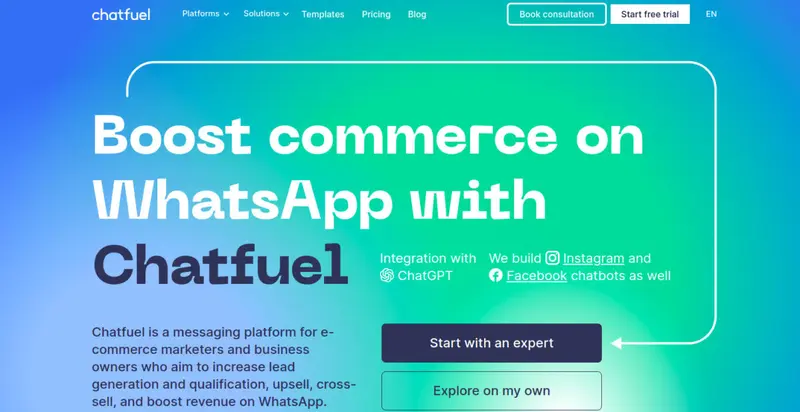
For marketers that want to leverage conversational marketing, there’s Chatfuel. It’s a no-code platform for building chatbots. Since it was started in 2015, it has helped more than 7 million businesses to send billions of messages each month.
Its chatbot builder is based on AI tech and uses built-in GPT-4 to share product recommendations, introduce users to your business, and answer questions. All you need to do is add your basic business info and link it to the messengers that you use. It works on most of the popular messengers including Facebook Messenger, WhatsApp, Instagram, Telegram, and LINE and also includes a widget for websites.
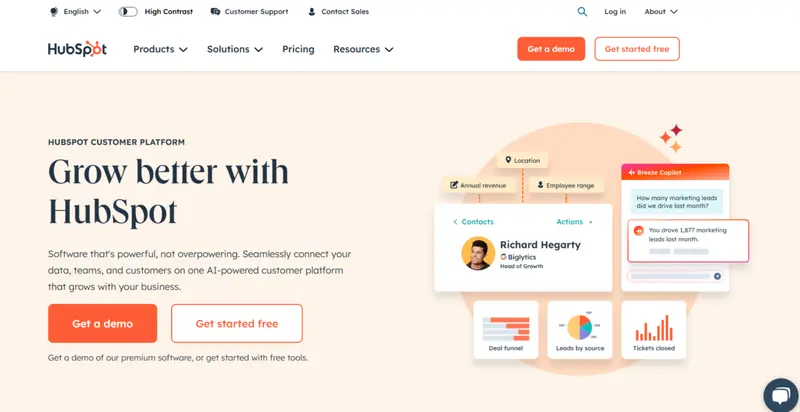
If you’re leveraging influencer marketing, HubSpot’s AI-powered tools can supercharge your strategy. Their AI Content Assistant helps you craft everything from blog posts to social media captions—ideal for brands juggling multiple campaigns. Plus, the AI Social Media Post Generator repurposes content by platform and tracks ROI, making influencer partnerships more data-driven.
Struggling with campaign copy? HubSpot’s Campaign Assistant generates ad, email, and landing page copy in seconds, streamlining the entire content creation process. And with AI-powered forecasting, you get predictive insights to optimize your influencer marketing spend.
For brands prioritizing engagement, HubSpot’s AI Chatbot (built on ChatGPT) enhances customer interactions by instantly responding to inquiries using your knowledge base. Meanwhile, their Buyer Intent tool helps you identify companies actively interested in your brand—perfect for refining influencer outreach strategies.
Data-driven decision-making is another win. AI-powered reporting automates performance tracking, while predictive sales forecasts help you anticipate trends and fine-tune your influencer collaborations.
Key features of HubSpot include:
AI Content Assistant
AI Social Media Post Generator
Campaign Assistant
AI-Powered Forecasting & Reporting
Plans and pricing:
Free Plan – Includes basic CRM, email marketing, and limited AI features.
Starter Plan – Pricing starts at $20 per month, offering advanced marketing and automation tools.
Professional Plan – Starts at $890 per month, adding AI-powered reporting, predictive analytics, and automation workflows.
Enterprise Plan – Starts at $3,600 per month, providing AI-driven buyer intent tracking, advanced analytics, and enterprise-grade automation.
Top AI Marketing Platforms: As Voted By The Community
Who better to recommend the top AI marketing platforms than the professionals who use them every day? We asked industry experts to share their preferred tools, and these rankings reflect their votes, giving you an insider’s view of the platforms driving innovation in AI marketing.
Tools and trends come and go. One constant, though, is the need for marketing.
Brands will always need to dedicate resources to marketing. To help your marketing become less of a guessing game, consider allocating some of your budget to one of these 12 solutions.
Whether it's for social media posts or email campaigns, these tools shouldn’t be used in isolation. After all, it’s a tool and not a sales team. Instead, use it for repetitive tasks that can help to streamline your marketing efforts. It’s when you apply it in this way that you’ll see results.
Frequently Asked Questions
What is artificial intelligence (AI)?
In easy terms, artificial intelligence (AI) refers to any situation in which a machine learns the capability to mimic a human being’s cognitive functions such as when a device completes a task that would typically need human intelligence. Examples of AI in work include Siri, facial recognition being used by your mobile device for security purposes, and Instagram’s selection of posts that it displays in your Explore tab.
Is AI and machine learning (ML) the same thing?
There are a few main differences between machine learning and artificial intelligence. For starters, AI is broader than ML. While all ML is technically AI, it’s only one of the subsets of AI. AI creates intelligent systems to complete tasks like human beings, while ML’s focus is solely on those systems that learn data and complete tasks based on that learning. While both AI and ML can work with structured and semi-structured data, AI also has the ability to handle unstructured data.
Are there any free AI marketing tools and apps available?
There are a number of AI-powered apps and tools that you can use for free. All the following tools have either a free version available or a generous free trial:
Which AI tools can you use for social media marketing?
While most AI tools focus on writing, there are a couple of AI tools that also include features to help specifically with social media marketing. You can, for example, try out:
Buffer’s AI assistant
Emplifi
Hootsuite’s OwlyWriter AI
Flick’s AI-powered social media planning partner
Brand24
How can you use AI to improve your digital marketing?
AI can help digital marketers in various ways. These include:
Creating relevant content
Personalizing the user experience
Identifying trends and patterns in customer behavior
Offering help and customer support in real time
Identifying potential influencers for future marketing campaigns
Ensuring compliance by monitoring influencer content for ad requirements
Koba Molenaar brings nearly a decade of rich experience in content writing, specializing in digital marketing, branding, SaaS, and eCommerce. Her passion for helping brands, from solopreneurs to established companies, connect with their audiences shines through her work. As a member of the Golden Key International Honor Society, Koba’s commitment to excellence is evident in her work, showcasing her as a relatable and knowledgeable voice in the industry.