
Years ago, you probably would've had to pay quite a bit of money for a software developer (or even a full team of developers) to come up with a custom website just for you. Thankfully, technology has improved dramatically, so you can build eCommerce websites that are robust, fast, and beautiful using an eCommerce platform. Some of these platforms are built on existing content management systems (CMS), like WordPress, or at least offer content management features (great for SEO). Others might be stand-alone eCommerce platforms that include only what's necessary for selling.
Let's explore some of the more popular eCommerce platforms to see how they compare.
What to Look for in an eCommerce Platform
There are tons of eCommerce platforms to choose from. So, how do you find the best eCommerce platform for your unique business? Here are seven key features to look for when shopping for an eCommerce platform.
Ease of Use
Before committing to an eCommerce platform, be honest with yourself about the time you're willing to put into learning how to use it. If you're a bit lacking in technical skills, you'll want to make sure that the platform you choose is simple and straightforward to use. The platform you choose should allow you to create a beautiful eCommerce site without taxing your patience.
Payment Processing
Offering multiple payment options will help minimize friction during the checkout process and increase the likelihood that shoppers will complete their purchases. You'll want to make sure that your eCommerce platform not only accepts popular options like PayPal, Stripe, and Apple Pay but local payment gateways, too, if your site is international.
Analytics
How will you know if your site is performing as well as it could? Any eCommerce platform you choose should have built-in analytics that will make it easy for you to track the eCommerce metrics that are important to your business. You'll want to be able to track average order value, sales conversion rates, customer lifetime value, churn rate, and more. If the platform you're looking at is perfect in all ways except analytics, make sure that it integrates with a third-party eCommerce analytics tool.
SEO-friendly
Your eCommerce store should come up in search results for not only your brand name but for the products and services you sell. That means you need an eCommerce platform that's SEO-friendly. Look for platforms that let you use your own domain, collect and publish customer reviews, and add content (like a blog) so you can pull in traffic organically.
Mobile-friendly
Currently, there are an estimated 6.3 billion smartphone users around the globe. This figure is expected to rise steadily, reaching approximately 7.6 billion by 2027. In this mobile-first era, ensuring your eCommerce store is mobile-friendly is no longer optional—it's essential. Your site should be designed to offer a seamless browsing and purchasing experience on any device. Intuitive navigation, fast-loading pages, and responsive layouts are key to meeting the needs of mobile shoppers and staying competitive in the ever-evolving digital marketplace.
Integrations and Apps
Another important feature to consider when you're trying to find the right eCommerce platform is the integrations and apps it offers. Integrations can extend the functionality of your eCommerce platform and fill the gaps for the features that your chosen platform might not have right out of the box. Plus, you'll want to make sure that your eCommerce platform works with the tools you already use, like email marketing, accounting, or inventory management tools.
Support
With even the most simple and easy-to-use eCommerce platform, you'll eventually need support. When that time comes, you want support to be accessible and swift. After all, you don't want to be waiting on support to respond if your site's down, do you? Your eCommerce platform should offer multiple support options including live chat, email, phone, and self-help options like a knowledge base or community forum.
1. Shopify

Shopify is the “biggie” of eCommerce platforms. It’s the most popular in the English-speaking world and caters to businesses of all sizes. More than 1 million merchants use Spotify’s platform, across nearly 1.5 million websites. Shopify has a market share of 31% in the United States for websites using eCommerce. One of the most crucial reasons for Shopify’s success is its flexibility. There are more than 2,400 apps in the Shopify App Store.
As well as standard Shopify, Shopify Lite is for those with an existing website that merely needs a way to take payments. Shopify Plus is for companies so large they can easily spend $2,000 a month on their eCommerce platform.
Read More

2. WooCommerce

WooCommerce is an open-source, customizable eCommerce platform for entrepreneurs. It is built on WordPress, and you run it behind your existing WordPress site. It also means that you can benefit from WordPress’s SEO capabilities. However, being on WordPress means that you have to separately buy hosting, a domain name, and an SSL certificate, all of which are catered for by many of the stand-alone eCommerce platforms.
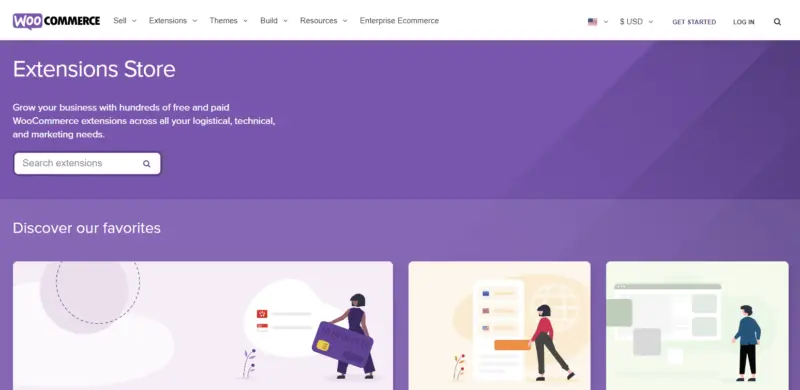
You will need many extensions if you are to create a usable WooCommerce site. This includes payment gateways, like Stripe, PayPal, Square, Amazon Pay, and Authorize.Net, as well as plug-ins for your shipping and email tracking.
WooCommerce allows unlimited products and product variants, including digital products.
Ease of Use
Read More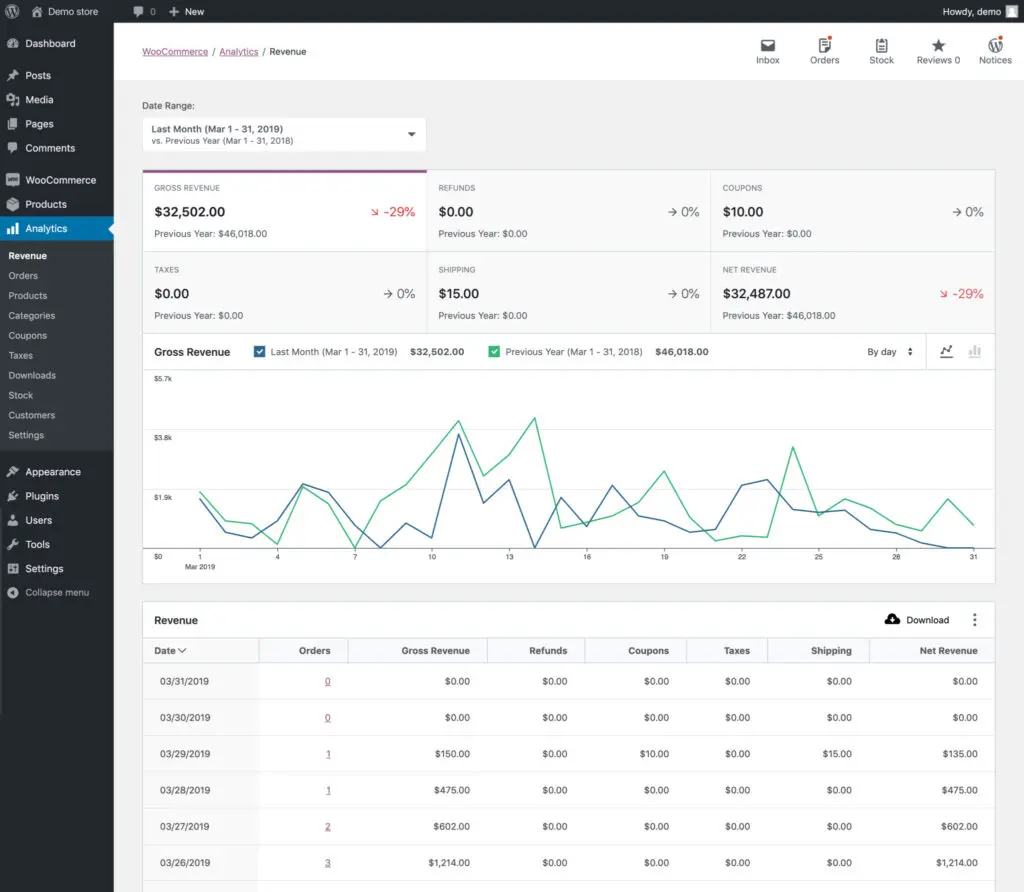
3. Ecwid

Ecwid differs from many of the other platforms here, in that rather than using it to build a stand-alone eCommerce platform, you use it to add an online store to your existing website. Indeed, you can use Ecwid to easily sync and sell across your website, social media, marketplaces like Amazon, and even live in-person. Recently, however, Ecwid has added some capability to create a basic one-page “Instant Site.”
At its core, Ecwid generates an electronic widget that you place on sites where you want eCommerce functionality – Ecwid stands for “eCommerce widget.”
Read More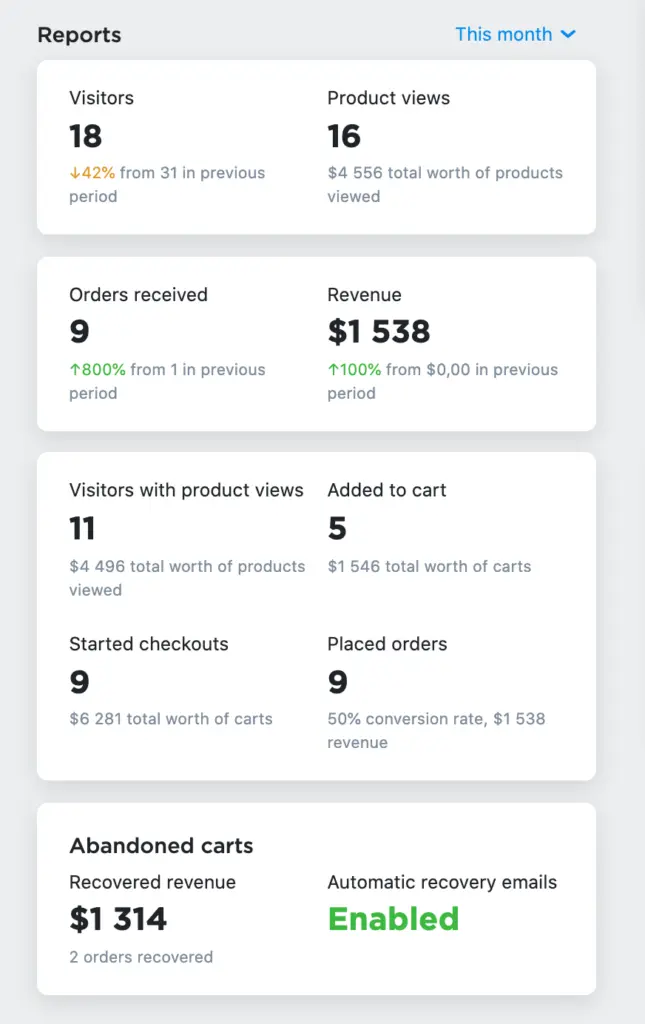
4. Salesforce Commerce Cloud

Salesforce Commerce Cloud is a cloud-based platform for businesses. Salesforce offers different products targeting B2C and B2B firms. Salesforce B2C Commerce was previously called Commerce Cloud Digital. You can integrate all your sales channels, both digital and physical, into Salesforce Commerce Cloud: mobile, social media platforms, your web store, your brick and mortar shop, and more.
The platform is exceptionally comprehensive. You can use it to launch your eCommerce business, and it includes all the tools you need to run your business daily. It contains tools relating to sales, customer service, marketing, developing your community, and order fulfillment, amongst others. In addition to its core functionality, Salesforce Commerce Cloud offers over 4,000 pre-integrated apps in its app store.
Read More
5. Adobe Commerce (Powered by Magento)

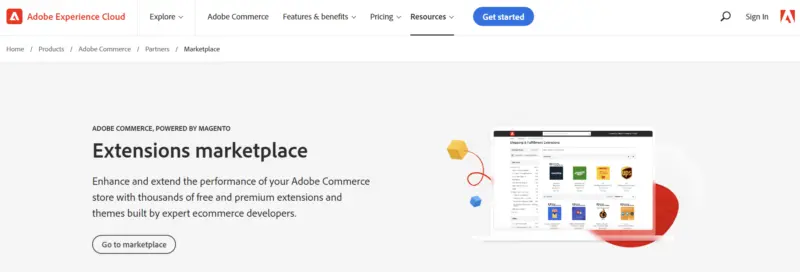
Another highly popular eCommerce solution is Adobe Commerce (Magento). There are two options with Magento—open-source and Magento Commerce. The open-source option is best for people with professional web development experience, so not as suitable for do-it-yourself website developers as some of the other platforms. It’s generally used on medium to large eCommerce sites that can afford a web person or department.
Magento has an expansive back-end interface and an in-depth feature list. You can expand and customize however you desire. Your developer should be able to adapt Magento to meet virtually any eCommerce need.
A beginner will probably find Magento daunting, but experienced users should learn to use the most relevant features easily enough.
Read More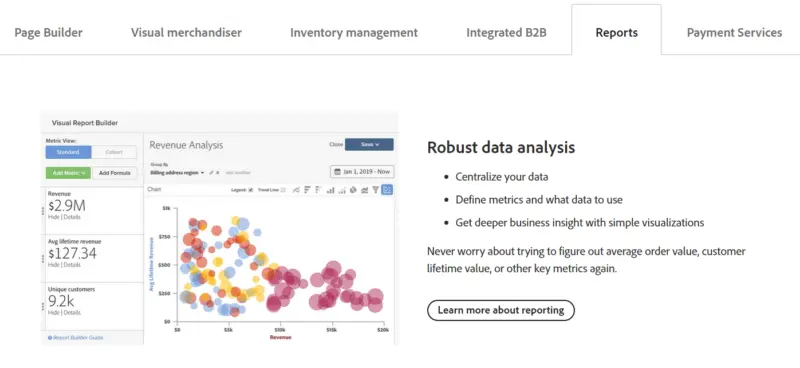
6. nopCommerce

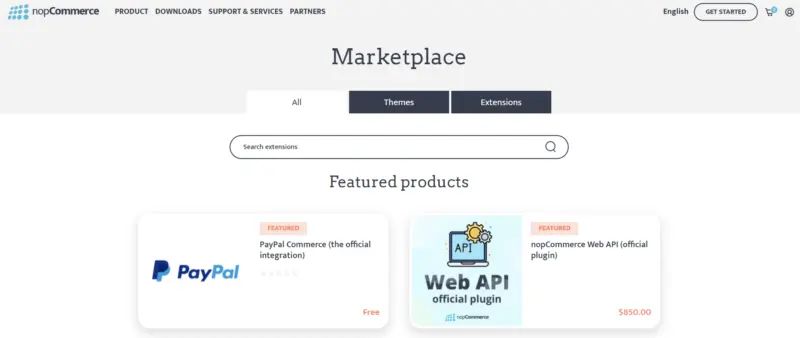
nopCommerce is an open-source eCommerce shopping cart solution that allows you to upload an unlimited number of products, manage several stores from one admin panel, and increase your sales with built-in marketing tools. Every 6-7 months, the developers release a new version of their eCommerce software to keep up with the latest technologies and development trends.
nopCommerce offers powerful out-of-the-box features for effective B2C and B2B sales, without any restrictions and is free. It includes a variety of tools for professional marketing and sales growth. The platform caters to all popular payment methods and gateways, and multiple shipping features. It also caters to multi-vendor and multi-store functionality.
Ease of Use
Read More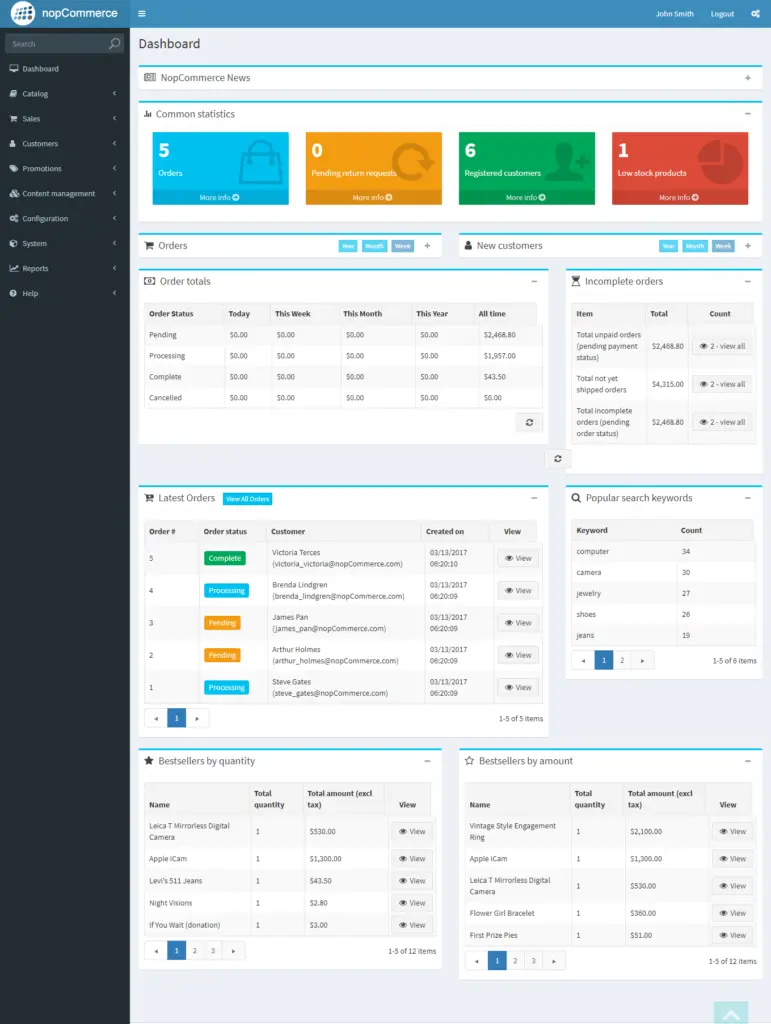
7. Oracle Commerce

Oracle CX Commerce is a cloud-native, fully-featured, extensible SaaS commerce solution, delivered in the Oracle Cloud, supporting B2C and B2B models in a single platform. With it, you can create innovative brand experiences designed to meet the unique demands of your business.
Oracle CX Commerce enables you to provide fantastic buying experiences to your customers anytime, anywhere they engage. It offers unified SaaS solutions that allow you to innovate quickly, deliver seamless, personalized experiences, and drive customer engagement, sales, and loyalty across channels.
If you’re a B2B firm, Oracle CX Commerce delivers all of the native B2C eCommerce capabilities buyers expect, paired with B2B-specific functionality, meeting the unique needs of you and your customers’ businesses.
Read More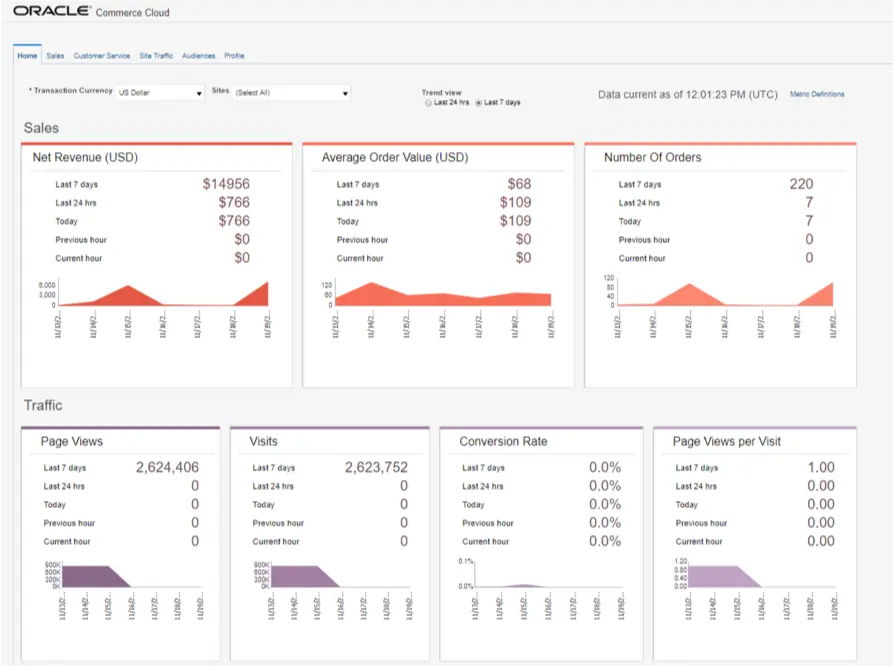
8. PrestaShop

PrestaShop is an open-source cloud-hosted eCommerce platform. It currently boasts over 300,000 merchants using the platform.
PrestaShop is based on the Symfony framework. It includes more than 600 features, and more than 5,000 modules and themes are available in the marketplace. Being open-source, users and developers are guaranteed a secure, scalable, flexible, and sustainable solution for all their eCommerce projects.
PrestaShop Add-ons is PrestaShop’s official marketplace. PrestaShop and its developer community have developed these products. While PrestaShop’s core functionality is free, you will have to pay for add-ons to make your site functional.
Read More
9. Wix

Wix is one of the most popular eCommerce platforms and much of this popularity is thanks to its ease of use. In as few as seven steps, you can create an online store.
You begin by creating an account and selecting one of its professional online store templates. You can then customize the design of your online store before you start adding your products. Not only does it offer loads of customization, but as you can add as many as 50,000 products, it’s a great choice if you’re looking to scale soon.
Ease of Use
Read More10. Squarespace

Squarespace is another well-known eCommerce platform. The chances are good that they’ve sponsored at least one of your favorite YouTubers. Founded in 2003, they’ve helped millions of aspiring entrepreneurs to launch their website. With regards to its eCommerce capabilities, you can use it to sell not just products but also services or subscriptions, making it one of the most versatile eCommerce platforms. All in all, it’s a great product for smaller online stores that want to prioritize beautiful design.
Ease of Use
Read More
11. Zyro

Zyro, by Hostinger, is an eCommerce platform aimed at small business owners or those looking to let one of their side-hustle ideas come to life. Headquartered in Lithuania, it was only launched in 2019, making it one of the newer and less well-known eCommerce platforms on our list. According to their website, with the help of their sophisticated AI technology, you can create a website in less than an hour.
Ease of Use
Read More12. Volusion

Founded in 1999, Volusion was one of the first eCommerce website builders. It’s aimed at medium to large businesses, but, compared to platforms like Shopify or BigCommerce, it doesn’t offer that much functionality. That said, as it’s an all-in-one eCommerce online selling platform, it still offers all the features you’ll probably need.
Ease of Use
Compared to other eCommerce platforms, Volusion is not as easy to use. If you want to add more sophisticated features, the learning curve quickly becomes very steep. Even more experienced website builders will have a harder time following the setup process.
Payment Processing
In addition to credit cards, Volusion offers various alternative payment types including:
- Amazon Pay
- Cash on delivery
- Wire transfer
- PayPal
Analytics
Read MoreBest eCommerce Platforms Compared
| Shopify | Large Stores | 🤩 Easy to use | Storefront | 4.4 | 4.4 |
| 🤩 Flexible and scalable | Shopping Cart | 4.4 | |||
| 🤩 Big community | Payment | 4.8 | |||
| 🤩 Many apps | Marketing | 4.2 | |||
| 🤩 Reliable support | Management | 4.2 | |||
| 😞 Multilingual costs | Ease of Use | 4.8 | |||
| 😞 Additional fees | Customer Rating | 4.3 | |||
| 😞 Content creation | |||||
| WooCommerce | WordPress Users | 🤩 Advanced features | Storefront | 4.2 | 4.3 |
| 🤩 Solid SEO | Shopping Cart | 4.1 | |||
| 🤩 Highly customizable | Payment | 4.6 | |||
| 🤩 Big community | Marketing | 4.0 | |||
| 😞 No support | Management | 4.1 | |||
| 😞 Updates & security | Ease of Use | 4.5 | |||
| Customer Rating | 4.4 | ||||
| BigCommerce | Features | 🤩 No transaction fees | Storefront | 4.2 | 4.3 |
| 🤩 Scalability | Shopping Cart | 4.4 | |||
| 🤩 Options & variants | Payment | 4.5 | |||
| 😞 Sales threshold | Marketing | 4.1 | |||
| 😞 Content creation | Management | 4.1 | |||
| 😞 No multilingual | Ease of Use | 4.8 | |||
| Customer Rating | 4.2 | ||||
| Ecwid | Small to mid-sized businesses | 🤩 Ease of use | Storefront | 4.0 | 4.1 |
| 🤩 Payment methods | Shopping Cart | 4.2 | |||
| 😞 Limited designs | Payment | 4.2 | |||
| 😞 Existing site needed | Marketing | 3.8 | |||
| Management | 3.5 | ||||
| Ease of Use | 4.4 | ||||
| Customer Rating | 4.8 | ||||
| Salesforce Commerce Cloud | Omni-channel marketing | 🤩 Very strong native merchandising | Storefront | 3.8 | 4.0 |
| 🤩 Extendable page designer | Shopping Cart | 4.0 | |||
| 🤩 Strong omni-channel features | Payment | 4.1 | |||
| 😞 User interface inconsistencies | Marketing | 4.0 | |||
| 😞 Some features are buried | Management | 3.7 | |||
| Ease of Use | 4.0 | ||||
| Customer Rating | 4.1 | ||||
| Magento | Enterprise Stores | 🤩 For larger stores | Storefront | 3.8 | 3.7 |
| 🤩 Highly customizable | Shopping Cart | 3.0 | |||
| 🤩 Large community | Payment | 3.5 | |||
| 😞 Very difficult to use | Marketing | 3.0 | |||
| 😞 No support | Management | 4.0 | |||
| 😞 Updates & security | Ease of Use | 4.5 | |||
| 😞 Special hosting | Customer Rating | 3.9 | |||
| nopCommerce | Mid to large sized businesses | 🤩 Multi-store and multi-vendor support | Storefront | 4.7 | 4.6 |
| 🤩 Mobile-optimized design | Shopping Cart | 4.4 | |||
| 🤩 Product management | Payment | 4.8 | |||
| 😞 Confusing pricing | Marketing | 4.5 | |||
| 😞 Charges for premium support | Management | 4.8 | |||
| Ease of Use | 4.7 | ||||
| Customer Rating | 4.5 | ||||
| Oracle CX Commerce | Small to large-scale businesses | 🤩 Mobile-optimized | Storefront | 4.0 | 4.0 |
| 🤩 End-to-end solution | Shopping Cart | 4.1 | |||
| 🤩 Scalable | Payment | 4.3 | |||
| 😞 Limited-to-no marketplace integration | Marketing | 4.2 | |||
| 😞 No single-click checkout | Management | 3.9 | |||
| Ease of Use | 3.7 | ||||
| Customer Rating | 3.9 | ||||
| PrestaShop | eCommerce developers | 🤩 Open-source, free | Storefront | 3.4 | 3.5 |
| 🤩 Some in-built advanced eCommerce features | Shopping Cart | 3.4 | |||
| 😞 Add-ons can be costly | Payment | 3.6 | |||
| 😞 Developer skills needed | Marketing | 2.8 | |||
| 😞 Expensive customer support | Management | 4.1 | |||
| Ease of Use | 3.0 | ||||
| Customer Rating | 4.3 | ||||
| Square Online | Value | 🤩 Easy to use | Storefront | 3.1 | 3.9 |
| 🤩 Ideal for low-volume merchants | Shopping Cart | 3.9 | |||
| 😞 Limited customization | Payment | 3.9 | |||
| 😞 Limited features | Marketing | 3.9 | |||
| Management | 4.2 | ||||
| Ease of Use | 4.1 | ||||
| Customer Rating | 4.2 |
Frequently Asked Questions
What are the best eCommerce platforms?
While views on the best eCommerce platforms will necessarily be subjective, we have covered 18 in this article. In no particular order, these are:
- Sellozo
- Trellis
- Route
- BigCommerce
- Square Online
- Shopify
- WooCommerce
- Ecwid
- Salesforce Commerce Cloud
- Adobe Commerce (Powered by Magento)
- nopCommerce
- Oracle Commerce
- PrestaShop
- Wix.com
- Squarespace
- Zyro
- Volusion
- Videeo
You will notice significant variation between these sites. Some focus on small businesses, others on medium to large companies. And some stress that they are enterprise-level platforms with an appropriately sized price.
What are the top eCommerce platforms?
All the eCommerce platforms that we have covered in this post can be considered top eCommerce platforms. It very much depends on your needs. Shopify is probably the best-known platform and has a comprehensive feature set. It is quick to load and easy to set up. BigCommerce is most suited for larger eCommerce stores and excels for multi-channel selling. WooCommerce is excellent if you still want to use an existing WordPress site. Likewise, Magento is robust and feature-rich with excellent SEO.
What is the best free eCommerce platform?
We haven’t really covered the easiest eCommerce platforms in this article, although it is relatively straightforward to build a Shopify site, and you will find many tutorials online. Probably the easiest type of eCommerce platform for a beginner is one that lets you create your site modularly, like Wix. If you also run a traditional offline store, you might find Square of value to you. It is relatively simple, without themes, and caters best to stores with few products without many variants.
Is Shopify free to use?
Shopify isn’t free to use, although it does offer a 14-day free trial. Also, Basic Shopify only costs you $24 per month (along with additional 2% fees if you don’t subscribe to Shopify Payments.) Regardless, you will have to pay more if customers use credit cards. Of course, the higher tiers (Shopify and Advanced Shopify) cost more, but you will usually only need these once you are taking sufficient income to pay for them. In the meantime, you might as well use the basic version.
Is Shopify the next Amazon?
Technically, Amazon and Shopify offer different services. The only way that Shopify could become the next Amazon is on the stock market if Shopify’s shares take off in the same way as the eCommerce giant. Shopify is a tool you can use to make an eCommerce site. Although Shopify does host stores, you still run your own website. Stores on the Amazon Marketplace are really just leasing space on the Amazon website. Amazon can unilaterally choose to have you there or to remove you.


