Influencer marketing platforms have become the operating system for modern social commerce.
As budgets shift from traditional ads to creator partnerships, marketers are asking: Which platforms actually drive measurable sales — and which just add noise?
In 2026, brands aren’t chasing vanity metrics; they’re investing in scalable creator ecosystems that integrate directly with TikTok Shop, Instagram Shopping, and YouTube Shorts.
Become a Partner: if you are looking to partner with us click here.
The lines between influencer marketing, UGC production, and performance media have officially blurred. Platforms are now judged on AI-driven discovery, automated briefing, and cross-channel ROI tracking, not just influencer lists.
And as automation expands, one clear pattern is emerging: the highest-growth brands are those unifying influencer management and attribution in a single workflow.
The days of managing influencer spreadsheets are over. These tools now centralize discovery, outreach, content approvals, and payments while giving marketers real-time performance data. Whether you’re an agency scaling client campaigns or a DTC brand running ambassador programs, choosing the right platform can directly impact your creative output — and your bottom line.
In this guide, we break down the Top Influencer Marketing Platforms for brands, highlighting their unique strengths, standout features, and real-world results showing how marketers are scaling UGC creation, campaign management, and attribution with confidence.
Top Influencer Marketing Platforms to Boost Your Campaigns:
Summary
Platform:
Best For:
Pricing:
Modash
In-house marketers at ecommerce brands using Shopify
From $199
View
Upfluence
E-commerce businesses of all sizes
From $478
View
Creator.co
Brands and Agencies of all sizes
From $460
View
Brandwatch Influencer Marketing Software
Medium to Large organizations and Agencies
From $750
View
Resonate by Linqia
On request
View
Humanz
Medium and Large brands; Agencies
On request
View
Twirl
Brands and agencies scaling paid-social UGC production
Best for: Brands and eCommerce teams running large-scale influencer and affiliate campaigns with full Shopify integration.
Pricing: Starts with a 14-day free trial; paid plans start at $199/month
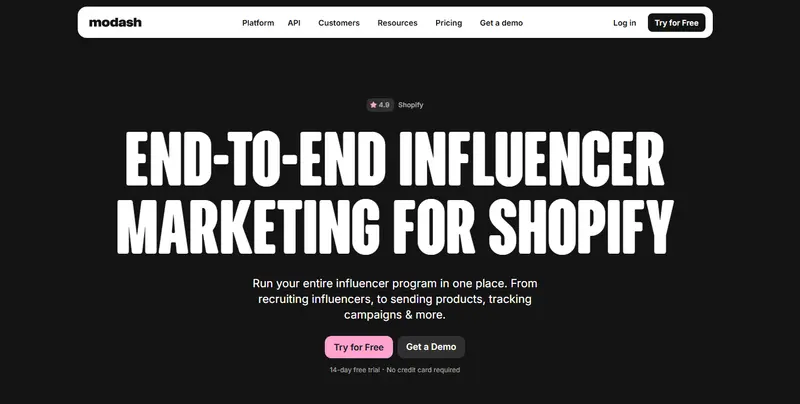
Modash is an all-in-one influencer marketing and affiliate management platform purpose-built for eCommerce. It allows brands to discover creators, manage collaborations, send products, track content, and measure performance, all in one connected workspace.
With over 1,700 brands using Modash, it stands out for its Shopify-native workflow, which automates influencer tracking, promo code creation, and ROI reporting.
Whether managing a dozen creators or scaling to thousands, Modash replaces spreadsheets and disjointed outreach tools with one unified system.
Modash’s AI Creator Search scans millions of influencer profiles across Instagram, TikTok, and YouTube, with filters for niche, engagement, audience demographics, and past brand collaborations. Users can instantly view verified contact emails, follower authenticity, and historical sponsor timelines.
Its bulk outreach and email sequencing tools enable teams to run multi-influencer recruitment campaigns directly from the platform—no separate CRM or cold outreach platform required. For brands seeking transparency, Modash also displays influencers’ previous sponsorships, helping teams avoid competitor overlap and identify high-conversion creators.
Tracking, Payments, and Shopify Integration
Once creators are onboarded, Modash automates the full campaign lifecycle. It tracks every post, click, and conversion automatically without requiring influencers to sign up or install anything. Campaign dashboards show real-time clicks, sales, and ROAS, replacing manual reporting.
The Shopify integration is one of Modash’s strongest differentiators. Brands can send products, track coupon code performance, and view affiliate conversions directly in their store dashboard. Built-in payment workflows allow marketers to send payouts or affiliate commissions instantly, no third-party system needed.
Proof of Performance
BioTechUSA: Activated 70+ influencers and 500+ nano influencers via Modash’s discovery tools, achieving international scale across campaigns.
Burga: Reported 17 out of 23 team members preferring Modash as their #1 influencer tool for reliable discovery and analytics.
Regal Rose: Eliminated manual tracking and now monitors live influencer content automatically, without requiring influencer opt-ins.
Pros
End-to-end influencer and affiliate management in a single interface
Native Shopify integration for product shipping, coupon tracking, and affiliate sales
Reliable AI-powered discovery with audience and performance verification
Scalable email outreach and automated recruitment sequences
Real-time campaign monitoring without influencer sign-ups
Cons
Primarily optimized for Shopify, with limited native integrations for non-Shopify stores
Advanced outreach automation may require setup for smaller teams
No built-in creative briefing or content-approval workflow compared to enterprise suites
Why It Stands Out
Modash combines discovery, tracking, and affiliate management in a Shopify-first ecosystem, giving marketers full visibility from outreach to ROI. Its automation-first design replaces fragmented workflows with one connected dashboard, making it especially powerful for eCommerce teams scaling micro- and nano-influencer campaigns across multiple markets.
Best for: Brands and agencies seeking a leading AI-powered creator marketing platform to scale creator partnerships, automate influencer workflows, and measure real business impact.
Pricing: Custom plans, starting around $478 per month
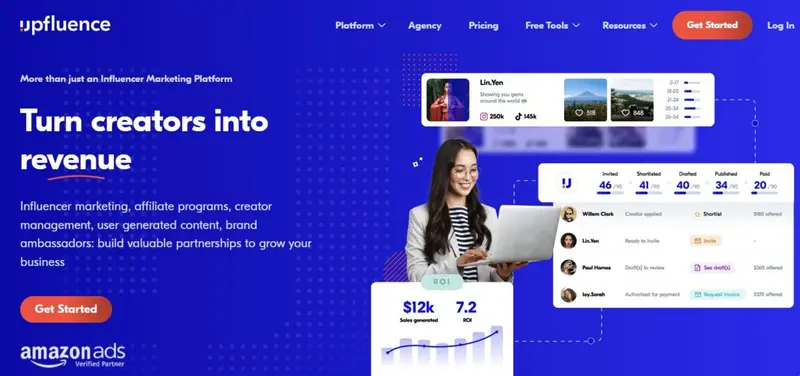
Upfluence is an AI-powered creator marketing platform built to help brands turn influencer marketing into a scalable growth channel. Trusted by 1,600+ brands, including Marriott, ASICS, Yamaha, and HelloFresh, it brings creator discovery, outreach, campaign management, affiliate tracking, payments, and analytics into one workspace so teams can replace manual campaign workflows with faster, smarter, revenue-focused execution.
AI-Powered Creator Discovery and Live Creator Intelligence
Upfluence’s discovery engine uses AI to analyze 12M+ creators across Instagram, TikTok, YouTube, and Twitch. The algorithm weighs audience demographics, brand affinity, and engagement quality to pinpoint creators who truly fit your target profile instead of forcing teams to manually search, compare, and qualify creator lists.
Its unique edge: customer-to-creator identification. Upfluence helps brands identify existing customers who already love the brand and are 7× more likely to collaborate and convert, giving marketers a more efficient path to authentic creator partnerships.
Through the Upfluence Marketplace, brands can skip manual outreach; creators apply directly via one-click applications, letting campaigns launch in hours instead of weeks. That shift is where the platform’s AI positioning becomes especially valuable: creator matching, outreach, and campaign setup move from slow manual work to a more scalable creator growth system.
Creator Relationship & Affiliate Management
Inside its Creator Relationship Management (CRM) system, you can coordinate outreach, contracts, content drafts, and approvals with automated workflows. Teams can generate unique promo codes compatible with Shopify, WooCommerce, Magento, BigCommerce, and Amazon, connecting influencer campaigns to live commerce results.
This makes Upfluence particularly effective for DTC and retail marketers who need to link influencer activity to real-world sales and prove how creator partnerships contribute to revenue, not just reach or engagement.
Payments and Gifting Simplified
With Upfluence Pay, brands can handle global influencer and affiliate payouts in one click—automating commission calculations and sending funds through PayPal, Stripe, or wire transfer in any currency.
The integrated product-gifting tool lets creators pick items directly from your store, including size, color, and shipping details, creating frictionless collaboration and faster turnaround. For teams managing creator programs at scale, that means fewer manual follow-ups, fewer operational bottlenecks, and a smoother experience for both marketers and creators.
Real-Time ROI and Revenue Attribution
Upfluence’s analytics dashboard aggregates clicks, conversions, and revenue for each creator. Individual tracking links show which influencers drive the most engagement and sales, producing precise ROI calculations.
The platform integrates with major tools like Shopify, Amazon Attribution, Klaviyo, and Hootsuite, offering a unified view of social, e-commerce, and affiliate performance. This gives brands the attribution layer needed to connect creator activity to measurable business impact and make influencer marketing easier to defend as a performance channel.
Proof of Performance
Customer results highlight its commercial impact:
+350% sales and 75% faster discovery for The Atfluence Agency
10× ROI from integrated Amazon campaigns for Branded
$384K sales/20× ROI for Nocibé Group
1.86M reach at $0.02 CPV for Marriott
Pros:
AI-powered creator discovery across 12M+ creators
Integrated marketplace and CRM
Commerce-native promo code & attribution tracking
One-click global payouts and gifting
Proven enterprise results and strong integrations
Cons:
Pricing best suited to mid-market → enterprise users
A broad feature set requires onboarding time
Why It Stands Out
Upfluence stands out because it connects AI-powered creator discovery, live creator intelligence, customer-to-creator identification, campaign management, payments, and ROI tracking in one platform. Instead of treating influencer marketing as a manual relationship-management process, it helps brands build a more scalable creator marketing engine where creator selection is faster, workflows are automated, and performance is tied directly to revenue attribution.
Best for: Small to mid-sized brands seeking an affordable, AI-powered platform to manage UGC, influencer collaborations, and affiliate ROI in one place.
Pricing: Tailored plans from $460 per month
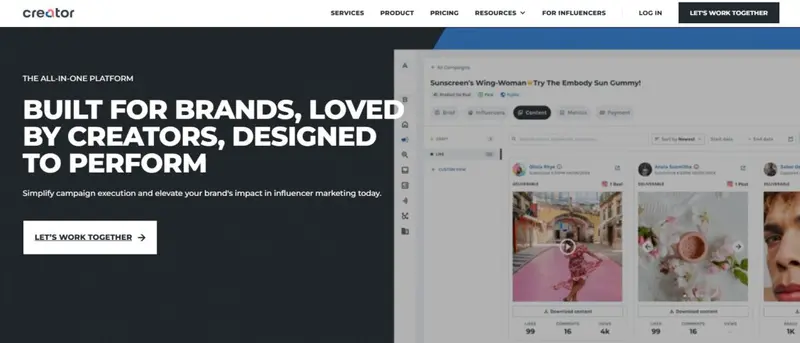
Creator.co is an AI-powered influencer and affiliate marketing platform built to simplify campaign execution for growing brands. Trusted by teams at Bellroy, Hund Denmark, and Think!, the platform merges creator discovery, campaign management, and performance analytics into one centralized workspace.
With an emphasis on automation and e-commerce integrations, Creator.co helps marketing teams scale UGC programs, manage product seeding through Shopify, and connect social engagement directly to tracked sales.
Brands can search across a database of 250 million+ creators spanning Instagram, YouTube, and TikTok. Advanced AI filters identify influencers by niche, audience demographics, and engagement quality, while automated outreach sequences streamline recruitment using personalized email templates.
The Collaboration Hub, a marketplace of 250K+ opt-in creators, lets brands post briefs or affiliate programs and receive qualified applications instantly, removing the manual outreach barrier that slows most SMB campaigns.
All-in-One Campaign Management
Creator.co’s dashboard functions as a real-time campaign control center. Teams can review influencer submissions, chat directly in-platform, approve content, and track product shipments through Shopify integration. Payment tracking and contract management are handled inside the same workflow, keeping campaigns organized from pitch to payout.
Analytics, Attribution & Optimization
Every campaign connects marketing actions to outcomes. Through Google Analytics, affiliate-network integrations (Awin, Rakuten, Impact), and Shopify coupon tracking, Creator.co links influencer posts to clicks, conversions, and total ROAS.
Custom dashboards visualize top-performing creators, while automated reports reveal which partnerships deliver the strongest lifetime value.
7 million+ views generated for Bellroy through creator collaborations
427% higher reach achieved for Hund Denmark via targeted influencer activation
50% increase in sales for Think! Products after integrating Shopify tracking and affiliate analytics
Pros
250M+ creator database with AI discovery and automated outreach
Centralized campaign workflow with Shopify shipping and payments
Real-time GA and affiliate-network integrations for ROI tracking
Collaboration Hub of 250K+ ready-to-work influencers
Intuitive UX and quick onboarding for smaller teams
Cons
Limited enterprise governance controls compared to legacy suites
Best suited for consumer brands rather than multi-region enterprises
Why It Stands Out
Creator.co bridges influencer and affiliate marketing for fast-moving brands. By combining AI-driven recruitment, campaign automation, and end-to-end attribution, it empowers teams to convert social reach into measurable e-commerce growth without the overhead of larger enterprise platforms.
Best for: Enterprises and agencies needing unified influencer discovery, management, and campaign reporting within a single ecosystem.
Pricing: Custom enterprise pricing
Brandwatch’s Influence solution extends its trusted analytics and social-intelligence suite into influencer marketing, giving large brands a full-cycle system that covers discovery, relationship management, and performance tracking. Backed by the same data infrastructure that powers Brandwatch Consumer Intelligence, it’s ideal for organizations managing hundreds of creators or running complex, multi-market campaigns.
Marketers can search and segment a network of 50 million+ global creators across Instagram, YouTube, and TikTok, filtering by audience, region, or content niche. Its search engine focuses on relevance and brand alignment rather than follower volume, helping teams identify thought leaders and trusted voices—including journalists, employees, or industry experts—who can amplify authentic messaging.
Centralized Relationship Management
Where most influencer tools stop at discovery, Brandwatch excels in relationship governance. It replaces manual spreadsheets with a secure, centralized workspace that stores contracts, payment details, and campaign plans. Teams can build a private influencer network and keep every file, message, and approval accessible to cross-functional stakeholders, eliminating email silos and version confusion.
Campaign Tracking and Real-Time Reporting
Reporting is another Brandwatch strength. The platform delivers real-time dashboards showing content deliverables, engagement metrics, and ROI across every campaign.
Users can generate shareable URLs or custom dashboards that update automatically, streamlining stakeholder visibility and sales-material creation. For enterprise teams, this translates into measurable efficiency and transparent performance monitoring.
Enterprise-Grade Reliability
As part of Brandwatch’s broader suite (Consumer Intelligence, Social Media Management, and Media Insights), Influence benefits from robust security standards, multi-user governance, and global infrastructure. It’s built for organizations where compliance, scalability, and data accuracy are non-negotiable.
Proof of Performance
Brandwatch’s enterprise clients consistently report measurable efficiency and performance gains:
90× faster campaign reporting and 4,000+ partner relationships managed for Insta360, achieving $0.0004 cost per view across 680M+ video views.
40% market share and a #1 premium smartphone brand ranking in India for OnePlus, driven by real-time sentiment tracking and product feedback loops.
Major awareness lift and influencer alignment for Jack in the Box, identifying high-impact creators like @MirandaSings and driving viral engagement around #DeclarationOfDelicious during its Super Bowl campaign.
Pros
50M+ verified creator profiles across major networks
Secure influencer-CRM with contracts, payments, and data storage
Real-time campaign tracking and customizable reports
Seamless integration with Brandwatch analytics ecosystem
Strong enterprise compliance and governance features
Cons
Lacks e-commerce affiliate integrations
Advanced analytics and reporting come at enterprise pricing tiers
Why It Stands Out
Brandwatch Influence unifies discovery, relationship management, and analytics under one enterprise-ready platform. For brands that prioritize accuracy, control, and real-time insight over volume-based outreach, it’s one of the most dependable influencer-management solutions on the market.
Best For: Enterprise brands focused on performance-driven influencer campaigns
Pricing: Custom pricing
Linqia is both an influencer marketing platform and an agency built for Fortune 500 brands that need measurable outcomes. Their platform, Resonate, combines influencer discovery, content production, and paid media into a single system, allowing brands to manage campaigns from strategy through execution and optimization.
Its model is built around guaranteed deliverables and performance accountability tied to KPIs.
The platform is powered by over 1.5B data points and analyzes more than 25M influencer posts to inform creator selection and creative strategy. Resonate uses image, video, and text recognition to evaluate both influencers and their audiences, enabling more precise targeting across campaigns.
This data-first approach supports consistent performance across verticals, including CPG, retail, and healthcare & wellness, tech, travel & hospitality, and more.
Resonate also integrates paid media amplification directly into its workflow, extending influencer content into formats such as paid social, programmatic, and CTV. Campaigns are continuously optimized using multivariate testing, with performance insights applied in-flight to improve results and reduce wasted spend.
AI-Powered Influencer Discovery and Strategy
Resonate’s discovery engine is built on large-scale data analysis, combining influencer profile data, audience demographics, and content signals to identify high-performing creators.
The platform evaluates creators based on who they are, who they reach, and what they produce, using machine learning and Google Vision technology to surface relevant matches.
Creative strategy is informed by historical performance data across millions of posts, allowing brands to predict which content formats and messaging will perform best. The obvious benefit is reducing guesswork and aligning influencer selection with campaign objectives from the outset.
Campaign Execution, Content Scaling, and Measurement
Resonate centralizes campaign execution through a single workflow system that manages briefs, creator selection, approvals, and collaboration. Brands gain full visibility into campaign progress, with structured workflows that reduce operational complexity and streamline execution across teams.
Performance tracking spans both organic and paid media in real time, with machine learning insights used to optimize creative and media allocation. Influencer content is repurposed into paid assets across multiple channels, allowing brands to scale top-performing content beyond its initial organic reach.
Proof of Performance
One A Day campaign drove a 41.5% view-through rate, 102% increase in mentions, and $2.8M in carted value
Jersey Mike’s campaign generated 17M organic impressions, 34K engagements, and raised $20M for Special Olympics
Foster Farms campaign delivered 150+ content assets, 10K+ engagements, and an 83% higher CTR than benchmark
Pros
Strong data foundation with 1.5B+ data points informing campaigns
Integrated paid media amplification extends content performance
End-to-end platform covering discovery, execution, and measurement
Proven track record with enterprise and Fortune 500 brands
Cons
Minimum campaign size limits accessibility for smaller brands
Custom pricing reduces transparency in early evaluation stages
Why It Stands Out
Resonate connects influencer marketing directly to performance metrics by combining creator content, paid media, and measurement in a single platform with guaranteed outcomes.
Best for: Enterprise brands and agencies seeking AI-powered creator vetting, campaign management, and brand-safety intelligence at global scale.
Pricing: Custom enterprise plans (demo required)
Viral Nation unites AI-driven brand-safety technology with a full-stack creator-management ecosystem. Its two flagship platforms, CreatorOS and VN Secure, work together to help brands launch, track, and protect influencer campaigns with enterprise-level precision.
Where CreatorOS streamlines every workflow from discovery to ROI reporting, Secure acts as the industry’s most advanced reputation-management layer, powered by Google Gemini and capable of scanning 15 years of creator content across every major platform in under 48 hours.
CreatorOS: End-to-End Campaign Intelligence
CreatorOS centralizes every component of creator collaboration in one system of record:
Advanced Discovery & Look-Alike Search: Identify and recruit global creators based on topic, demographics, engagement, and performance benchmarks.
Unified Campaign Management: Oversee deliverables, budgets, and content approval workflows from a single dashboard.
Predictive Attribution Modeling: Connect campaign inputs to business outcomes using sentiment analysis and media-value visualization.
Collaborative Ecosystem: Invite internal teams, external agencies, and creators into shared workspaces for transparent progress tracking.
By consolidating data, communications, and performance metrics, CreatorOS removes the spreadsheet chaos typical of large-scale influencer programs and provides a complete view of impact, reach, and ROI.
VN Secure: AI-Powered Brand Safety and Fit
Viral Nation’s Secure solution brings brand reputation management into the age of AI. Built on Google Gemini, it analyzes text, video, audio, and imagery, including OCR and multilingual inputs, to detect risk signals before campaigns go live.
Key Capabilities:
Historical + Ongoing Vetting: Scans up to 15 years of creator activity across social channels for unsafe or off-brand content.
Customizable Risk Parameters: Adjust sensitivity levels across 10+ safety categories, from hate speech to drug use.
Brand-Fit Intelligence: Detects unpaid brand mentions, prior sponsorships, and logo appearances to identify authentic brand advocates.
Speed & Scale: Screens hundreds or thousands of creators simultaneously, delivering enterprise-grade due diligence at unprecedented speed.
Together, CreatorOS and Secure allow marketing, legal, and partnership teams to operate with shared visibility and confidence, ensuring every activation aligns with both performance goals and brand values.
48-hour vetting turnaround across text, image, and video for comprehensive brand safety
15 years of content screening per creator, with multilingual and multimedia analysis
Custom risk scoring across 10+ categories, enabling tailored brand-safety standards
Predictive attribution and ROI dashboards connecting creator output to revenue outcomes
Pros
Dual-platform ecosystem (CreatorOS + Secure) covering both campaign execution and brand-safety compliance
AI-powered vetting (via Google Gemini) capable of analyzing text, video, audio, and imagery in multiple languages
Historical data depth—scans up to 15 years of creator content for risk detection
Customizable safety thresholds across 10+ sensitive categories, from hate speech to drug use
Predictive attribution tools and ROI visualization within CreatorOS for measurable impact
Seamless collaboration between brands, agencies, and creators through shared workspaces
Cons
Enterprise-level pricing and setup may exceed budgets for smaller teams or startups
Requires creator authentication and content access to unlock full AI capabilities
Platform complexity can entail a longer onboarding curve compared to lighter SMB tools
Why It Stands Out
Viral Nation merges creative influence with corporate-grade governance. Its AI-powered Secure suite eliminates brand-safety blind spots, while CreatorOS turns creator collaboration into an accountable, data-driven discipline.
For global enterprises balancing innovation with compliance, Viral Nation delivers both performance intelligence and peace of mind.
Best for: E-commerce brands, Amazon sellers, and startups seeking a free, self-serve marketplace to run influencer and affiliate campaigns on Instagram and TikTok.
Pricing: Free to use (no platform fees)
Ainfluencer is a free, AI-powered influencer marketplace designed to connect brands with authentic creators across Instagram and TikTok. Built for accessibility and scale, it enables businesses, from micro brands to global sellers, to launch collaborations, track results, and pay securely, all without subscription costs.
The platform blends marketplace discovery, automated collaboration tools, and Shopify + Amazon integrations, making it a standout option for DTC brands that need to convert social engagement into measurable sales.
Ainfluencer provides instant access to over one million influencers worldwide, searchable by niche, geography, audience size, and engagement metrics.
Brands can:
Post unlimited campaigns and receive creator applications in real time
Filter by follower count, industry, and region
Invite influencers directly to collaborate without paying platform fees
With its AI search engine, Ainfluencer makes it easy to identify creators whose audiences genuinely match a brand’s customer profile, an advantage for teams prioritizing authenticity over reach.
Campaign Management and Secure Collaboration
Campaign creation is streamlined through a built-in collaboration dashboard where brands can manage briefs, content drafts, and publication approvals. A built-in Escrow payment system ensures funds are only released once posts are published as agreed, protecting both sides.
For Shopify merchants, Ainfluencer’s app integration syncs product listings, allowing creators to tag and promote inventory directly from the store. The upcoming affiliate management layer will extend this by linking influencer content to trackable coupon codes and pay-per-sale programs, ideal for Amazon sellers seeking incremental revenue.
Creative Formats and Niches
Ainfluencer focuses heavily on short-form video creation, TikToks, and Reels that emphasize unboxings, product demos, and lifestyle showcases. The marketplace supports creators across key verticals, including fashion, beauty, travel, pets, tech, and food.
Brands can tap both nano and macro influencers, creating campaigns that balance storytelling and performance, with engagement rates frequently exceeding typical platform averages.
Proof of Performance
Ainfluencer campaigns consistently deliver measurable growth for brands across categories:
CHEFMAN: 49 creator partnerships, 15M audience reach, and 20% engagement rate via macro-influencer TikTok and Instagram campaigns.
Canine Journal: 5 creator collaborations, 135K total reach, and 8% engagement rate, driving direct social-commerce sales through nano influencers.
Pros
100% free platform with unlimited campaigns and no subscription fees
Access to 1M+ global influencers across Instagram and TikTok
Secure Escrow payments and verified post tracking
Shopify and Amazon integrations for direct e-commerce attribution
Ideal for small teams, startups, and SMBs with limited budgets
Cons
Limited analytics depth compared to enterprise tools
No built-in AI sentiment or brand-safety analysis
Heavier reliance on manual selection and outreach at higher scales
Why It Stands Out
Ainfluencer democratizes influencer marketing by making collaboration accessible, transparent, and risk-free. Its combination of zero-fee campaign creation, AI-assisted discovery, and secure payment protection allows even the smallest brands to leverage creator partnerships that drive real product growth on TikTok and Instagram—without the complexity or cost of legacy platforms.
Best for: Global brands and agencies seeking to manage large-scale creator activations with transparency, verified performance data, and long-term partnership tools.
Humanz is an AI-powered influencer marketing and creator relationship platform designed to build authentic, scalable collaborations between brands and creators.
Developed “by creators, for creators,” it’s trusted by major brands including L’Oréal, Unilever, Zara, eBay, and Nestlé, and powers creator programs in over 40 markets.
Unlike basic marketplaces, Humanz focuses on relationship longevity and cross-market transparency, helping brands measure ROI, creators grow income sustainably, and agencies manage complex, multi-country campaigns with unified intelligence.
At the core of Humanz is an AI matching engine that connects brands with creators whose audience, tone, and engagement naturally align. Instead of superficial metrics, the system prioritizes authenticity and audience overlap, ensuring every collaboration feels organic and drives measurable engagement.
The dual-platform model—a creator-facing app and a brand dashboard—facilitates real-time communication, brief approvals, and content delivery, all while maintaining data accuracy and transparency for both sides.
Campaign Management and Multi-Market Execution
Humanz simplifies global campaign coordination through unified dashboards, enabling teams across different markets to share data, creative assets, and performance metrics seamlessly.
Its technology supports:
Cross-country campaign synchronization for regional or global activations
Automated reporting with engagement, impressions, and conversion insights
Revenue tracking that links creator performance directly to brand ROI
This makes Humanz ideal for large-scale agencies or multinational brands running multiple activations simultaneously.
Proof of Performance
L’Oréal Paris “GüzellikTok” Campaign: Adapted TikTok’s “BeautyTok” trend into a localized format using 22 beauty creators, setting a new creative benchmark for branded TikTok content.
Zara Africa’s Largest Influencer Campaign: Activated 550+ creators to launch Zara’s e-commerce platform in South Africa, achieving #1 trending status globally on X and driving thousands of online customers.
Absolut Vodka Passionfruit & Watermelon Launch: Partnered with micro, macro, and A-list creators, generating 2.94M impressions and 225,770 engagements, surpassing KPIs.
Cipla Pharmaceuticals #FafChallenge: Collaborated with Faf du Plessis to raise awareness for testicular cancer, with #FafChallenge trending #1 on South African Twitter for five consecutive days.
Pros
AI-powered creator matching focused on authenticity and audience alignment
Proven capability to execute cross-market influencer activations
Transparent collaboration tools for both brands and creators
End-to-end campaign management with verified performance metrics
Cons
Custom enterprise pricing may be out of reach for SMBs
Complex interface for small teams or one-off campaigns
Limited public-facing analytics compared to self-serve marketplaces
Why It Stands Out
Humanz has positioned itself as a global relationship platform for influencer marketing, connecting brands and creators through technology, trust, and verified performance data. Its focus on authentic partnerships and cross-market scalability makes it a preferred solution for multinational brands aiming to balance creative freedom with measurable ROI.
Best for: Brands, agencies, and UGC creators who want high-performing, native-feel ad creatives without building an in-house studio or doing constant outreach.
Pricing: Flexible pay-per-video credits with bulk discounts and no subscription or platform fees.
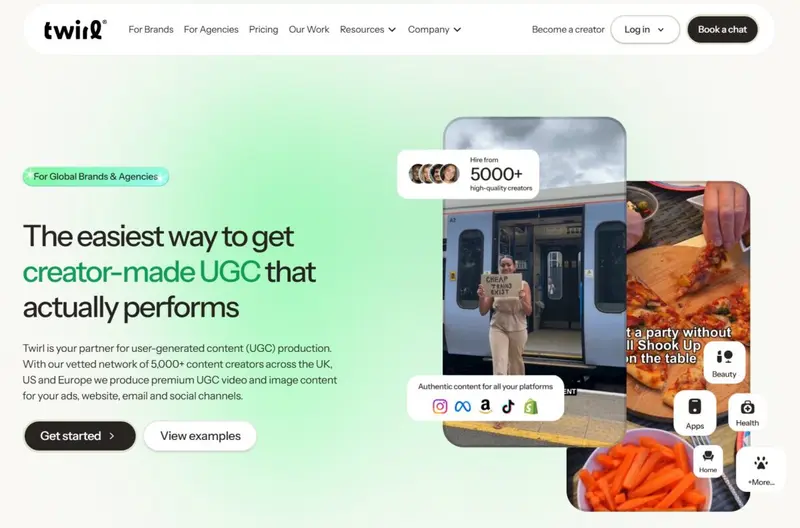
Twirl sits in the creator marketing world as a performance-oriented platform/service hybrid: it’s designed to help brands and agencies consistently produce creator-made assets that feel native on short-form channels—and are structured for paid-social iteration. The core promise is operational: turning creator production into a repeatable workflow instead of a one-off scramble.
Creator sourcing that feels more like “casting” than browsing
Instead of treating creator selection like endless scrolling and outreach, Twirl leans into matching and structured applications—so the work becomes choosing the right fit and directing execution. In practice, that means receiving applicants aligned to a brief (with relevant past work and a rationale), then selecting creators inside a single campaign flow. This is especially aligned with agencies that need predictable throughput across multiple clients without re-inventing their sourcing process every time.
Workflow designed for ad-ready deliverables (not just “content”)
Twirl’s deliverable packaging is built around deployment speed. A standard video includes a “clean/raw-style” edit and a “final” edit; the final version is set up for real ad usage (captions, copyright-free music, and attention to safe-area placement). It also includes two formats/aspect ratios, which matters when you’re repurposing across placements without re-cutting everything in-house. Two revision rounds are part of the baseline, and feedback is structured to be specific (time-stamped direction rather than vague notes), helping teams move through iterations faster.
A subtle but agency-friendly operational choice: timelines are protected by a defined review window, with auto-approval behavior if feedback doesn’t land in time—keeping campaigns from stalling in the “waiting for internal sign-off” zone.
Paid social readiness: usage rights, variations, and whitelisting
Twirl bakes in full usage rights for paid social (plus website and email usage), which is the kind of detail that keeps campaigns from getting slowed down later. It also productizes performance iteration with add-ons like variations (extra hooks/CTAs) and lifestyle images, so “testing more angles” becomes a planned lever rather than a messy scope creep conversation. Whitelisting/Spark Ads is positioned as available upon request, enabling brands to run ads from a creator handle while the creator posts for a defined window.
Performance signals (what this looks like when it works)
Twirl’s success-case reporting leans heavily into outcomes that matter to performance marketers: speed, volume, and measurable efficiency. Examples include one brand citing 50+ creator campaigns and nearly 100 purchases from a single creator video over a two-week window, and another citing higher monthly output, faster turnaround, and improved paid metrics (lower CPA, higher thumbstop rate, and higher CTR).
Why Twirl stands out from competitors
Twirl’s differentiation isn’t “more creators” or “more features” in the abstract—it’s the way it turns creator content into an ad-production system:
Deliverables are packaged for performance reuse (clean + final edits, safe-area awareness, multi-format delivery).
Iteration is built into the model (variations as a formal lever, not an afterthought).
Agency-style support is part of the positioning, not an add-on identity crisis—public messaging consistently emphasizes conversion-oriented output and a hands-on team.
Pros
Strong fit for paid-social teams that need a steady pipeline of creator-made ads and fresh testing angles.
Ad-ready deliverables (clean + final edits, two formats, safe-area considerations) reduce internal editing load.
Usage rights for paid social included, helping campaigns move faster.
Clear levers for scaling/testing: variations, lifestyle images, and whitelisting pathways.
Proof points emphasize speed + measurable performance lift in real paid contexts.
Cons
Best aligned to creator-made UGC for performance marketing rather than broad, relationship-driven creator programs.
The process rewards teams who can provide (or adopt) clear briefs and structured feedback—this is a system, not a free-form creator free-for-all.
Best for: Brands and agencies looking for a free, data-rich platform to discover creators, manage TikTok, Instagram, and YouTube campaigns, and benchmark competitors.
Pricing: Free access with premium campaign services available
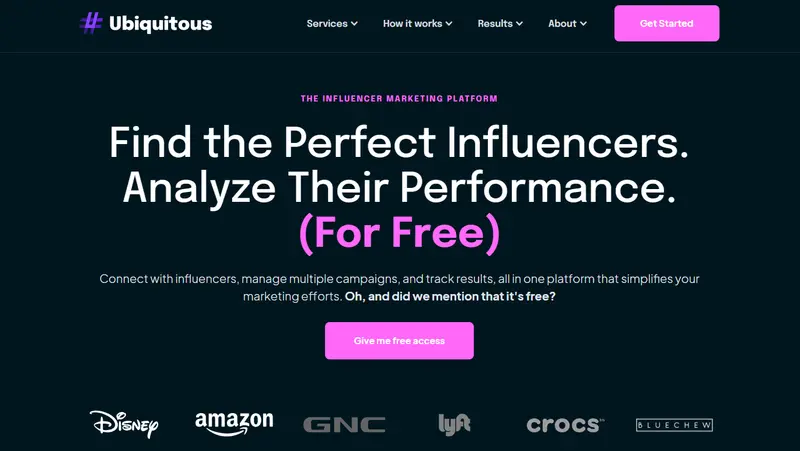
Ubiquitous combines an influencer search engine, campaign management dashboard, and analytics suite into one accessible platform. Unlike most influencer tools, it offers free access to core features, lowering the barrier for marketers to find creators, track performance, and compare competitive benchmarks across social networks.
With a database of 100M+ creators across TikTok, Instagram, and YouTube, Ubiquitous enables users to identify influencers, manage collaborations, and measure ROI in one place. The platform sits at the intersection of self-serve SaaS and managed service, providing flexibility for both in-house teams and brands seeking full-service campaign execution.
Creator Search and Campaign Management
The Creator Search Tool allows brands to filter millions of profiles by engagement rate, audience demographics, content type, and platform performance. Verified metrics ensure data reliability when evaluating creator potential across verticals.
The integrated Campaign Monitoring Dashboard brings all influencer activations under one roof, tracking views, engagement, conversions, and spend in real time. Users can export performance data with a single click, removing the need for manual spreadsheet tracking.
This simplicity makes Ubiquitous a strong fit for marketers running multiple influencer campaigns simultaneously, especially those balancing both organic and paid creator programs.
Competitive Insights and Performance Analytics
Ubiquitous extends beyond campaign tracking with built-in competitive brand analysis tools. Marketers can assess how many influencers competitors are working with, their engagement benchmarks, and how monthly campaign metrics evolve over time.
These insights provide a strategic edge in influencer negotiation and content strategy, helping teams benchmark performance, identify rising creators in their niche, and refine future spend allocation.
Proof of Performance
Lyft x Ubiquitous: The campaign generated 8.1 million views at a $4.31 CPM, driving a measurable spike in Google search volume for Lyft post-launch.
Triller Partnership: Described as “complex and time-consuming” by internal teams, Triller credited Ubiquitous for simplifying creator coordination and campaign execution across TikTok.
Pros
Free access to creator discovery, tracking, and analytics tools
Database of 100M+ creators across TikTok, Instagram, and YouTube
Built-in competitive benchmarking and performance exports
Real-time campaign monitoring in one dashboard
Option for full-service influencer management through Ubiquitous’ in-house team
Cons
Lacks deeper AI-driven audience analysis available in premium platforms
Reporting customization is limited compared to enterprise-grade tools
Best suited for brands focused on TikTok and short-form video, not full omnichannel influencer programs
Why It Stands Out
Ubiquitous stands apart as one of the only influencer marketing platforms offering free, unlimited creator discovery and performance tracking at scale. Its balance of self-serve analytics and agency-level campaign management makes it ideal for marketers who want flexibility—testing influencer collaborations without committing to a paid enterprise suite.
Best for: DTC and eCommerce teams that want one platform for creator discovery, automated outreach, influencer CRM, affiliate tracking, gifting, UGC capture, and payouts—especially if they’re running programs that need measurable performance and repeatable workflows.
Pricing: Standard plan starts at $649/month, Pro at $1,049/month, and Business at $2,490/month. Quarterly billing is positioned as 20% off and yearly billing as 30% off.
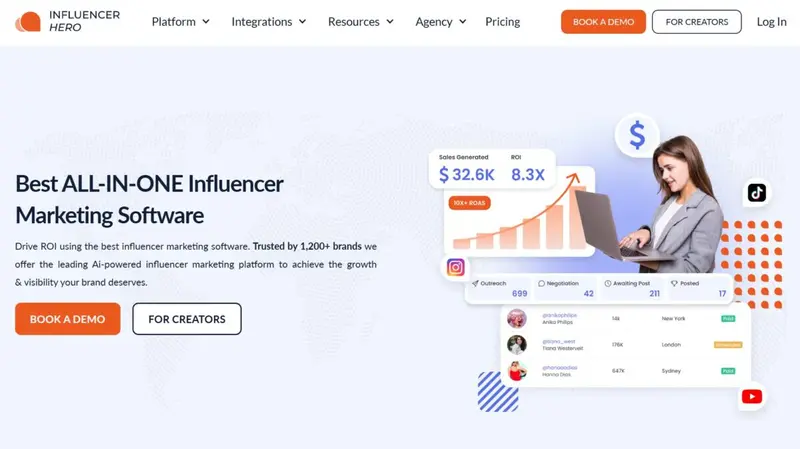
Influencer Hero is built as a performance-forward influencer marketing platform: find creators, outreach at scale, manage relationships inside a structured CRM, and connect results back to clicks and conversions through affiliate links and discount codes.
Where it tends to click for teams is the “single system” approach. You’re not stitching together discovery tools, spreadsheets, email tools, affiliate platforms, and UGC download workflows—Influencer Hero is trying to keep that entire operational chain inside one workspace, from first contact through reporting.
Creator Discovery and Outreach Automation
Influencer Hero’s discovery layer is designed around filtering and speed: detailed filters for finding relevant creators, plus a matching workflow to identify creators who already like the brand (existing influential customers).
On the outreach side, the platform emphasizes scale with control: bulk outreach, drip campaigns, automated follow-ups, and AI-assisted personalization (including an “AI-generated personalized sentence” concept).
It also supports multiple email connection methods—Gmail, Outlook, SMTP/IMAP, and a hosted option—so teams can run outreach without forcing a separate outbound-email stack.
If you’re building lists while researching, Influencer Hero also highlights a Chrome extension designed to add influencers to the CRM and view analytics while browsing.
CRM Workflow, Affiliate Tracking, Gifting, and Payments
Influencer Hero’s CRM is structured around two operational views: Outreach boards (with automated triggers) and Relationship boards for ongoing partnerships—useful if you want to separate recruiting pipelines from long-term creator management.
For performance measurement, the platform supports affiliate links and discount codes to track clicks and conversions.
Operationally, it also supports product gifting workflows (including dispatching products from within the CRM) and paying creators from the platform, with creators having their own dashboard to track earnings.
Content Library and UGC Capture
Influencer Hero leans into UGC capture as a core system, not a bolt-on. It describes automatic post capture across stories, reels, and feed posts, and a content library where teams can review, favorite, filter, and download UGC for reuse.
Integrations
For commerce teams, the platform highlights direct integrations with Shopify, WooCommerce, and Magento, plus custom integrations through an API.
It’s also listed as a Shopify app with plan packaging that includes monthly “reach outs” quotas tied to subscription level (for example, 1,000 reach outs/month on Standard and 5,000 on Pro).
Proof of Performance
Influencer Hero publishes detailed case studies that show how teams are using the platform in real programs:
Arabian Oud: 280+ influencer collaborations, 500+ UGC posts, 4.8M+ impressions, $86,200+ earned media value, and 60+ usage-rights pieces secured (among other reported outcomes).
TCL (UAE in-store activation): 1,644,947 total impressions, 59,352 total engagements, CPM $7.68, and a follow-up activation that added 400,000+ impressions (with re-engagement supported through CRM tagging and organization).
Olivida: 7.2X ROAS reported, plus identification of 7 top-performing influencers moved into a longer-term ambassador program.
Pros
Strong “one-platform” workflow across discovery, outreach, CRM, affiliate tracking, gifting, UGC capture, and payouts.
Outreach automation (drip + follow-ups) with AI personalization support.
Clear eCommerce integration story (Shopify/WooCommerce/Magento + API).
Case studies with concrete performance metrics and operational details.
Cons
Entry pricing begins at $649/month, which may be high for very early-stage brands.
Subscription tiers are quota-based in areas like monthly reach outs (and plan feature gates), which can matter for high-volume recruiting.
If your stack requires a wide range of native integrations beyond the highlighted commerce + email set, you may rely more on API/custom integration work.
Why It Stands Out
Influencer Hero’s differentiator is the tight coupling of outreach + CRM + affiliate attribution + UGC capture in an eCommerce-friendly setup. Teams that treat influencer marketing as a measurable channel (not just a branding tactic) get an operational spine: recruit creators at scale, track performance with links/codes, capture content automatically, and keep creators organized for reactivation
Best for: Agencies (especially SMB teams) that need fast influencer research, client-ready shortlists, and exportable reporting without building everything in slides and spreadsheets.
Pricing: Lite starts at €299/month (or €199/month billed yearly). Professional is €599/month (or €499/month billed yearly). Enterprise is custom. Free trial available; no credit card needed.
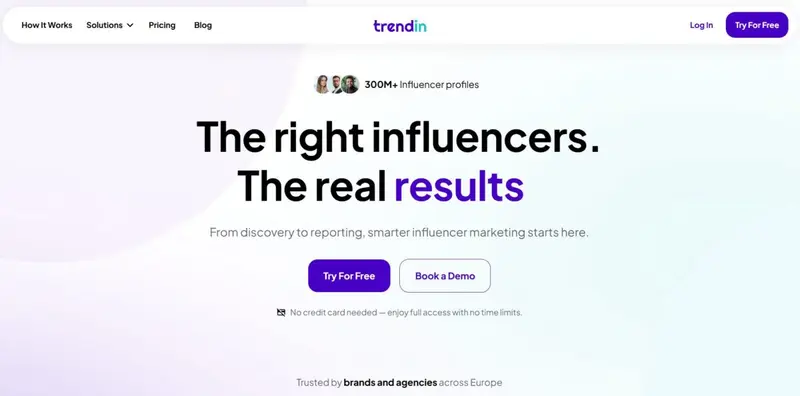
Trendin.io is built around a simple promise: give influencer teams a single workflow that moves from discovery to campaign execution to reporting—without the usual spreadsheet chaos. Its positioning is notably agency-forward (literally branded as an agency “secret weapon”), and that intent shows up in the product choices: fast casting, approval flows, and exports designed to be client-facing.
Trendin’s database is marketed as 300M+ profiles across Instagram, TikTok, and YouTube, with filters that include engagement rate, credibility, audience demographics, niche, and past partnerships. On top of basic search, the platform leans into pre-flight validation: audience quality checks (authenticity signals, bot detection, risk flags), plus audience overlap to reduce duplicated reach when stacking creators.
Agency workflow: casting, approvals, calendars, live monitoring
Trendin’s campaign hub is designed to keep coordination tight. Teams can build influencer shortlists with notes and pricing and share them via a link so clients can approve/reject without endless back-and-forth. It also supports collecting structured feedback on rejections (preset reasons + notes), a practical touch that helps agencies iterate faster on fit. A visual calendar adds operational visibility (spot overlaps/gaps; filter by creator/platform/status), while “real-time” monitoring is positioned as automatic data pulling into the dashboard.
Reporting built for client deliverables
Trendin is unusually explicit about deliverable formats: it supports exporting editable reports to PPTX and XLS, and sharing results as a link, with controls to add media, metrics, text, and branding. That aligns tightly with how agencies actually prove value—especially when reporting needs to be fast, consistent, and presentation-ready.
Proof signals
Trendin publishes agency testimonials highlighting overlap analysis, audience insights, and day-to-day workflow speed, including a quote from a GroupM influencer marketing specialist and a Lafluence leader citing faster setup and new-client momentum.
Emphasis on audience quality, overlap, and competitor intelligence (useful for risk reduction and planning).
Clear packaging and limits by tier (searches, details, overlap/partnership analyses, monitored influencers).
Cons
Lite plan is single-user and capped on key research actions (searches/details/overlap/partnership analyses).
Higher-volume monitoring and team access move you into Professional/Enterprise quickly by design.
Why It Stands Out
Trendin’s differentiation isn’t “more influencer data.” It’s the way it productizes the agency deliverable chain: validated creator selection, client alignment via approvals, and exportable reporting that’s ready for decks. Their social positioning reinforces the same strategy—agency focus, daily-updated stats, fake-fan detection, overlap analysis, and reporting automation—suggesting the platform is optimized for the operational realities of running multiple campaigns while staying client-ready.
Best for: Performance-driven brands and agencies that want repeatable creator asset production + testing + scaling (especially across Meta/TikTok-style amplification workflows).
Pricing: Starts from $500+ (includes Free access to explore creators)
Key Features: Billo IQ Brief Builder (4 brief variants + AI Creator Matching), approval-gated production + usage-rights transfer, Organic Posting (30 days), Partnership Ads (Meta + TikTok Spark ad codes + centralized management), Performance Hub (ROAS/CTR/Hook Rate guidance), AI Mashups (multi-creator iterations under ~10 minutes).
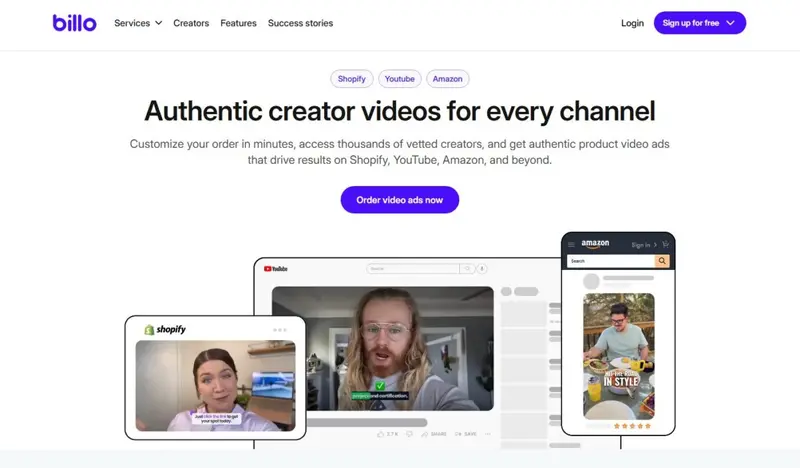
Billo is best understood as a performance-oriented creator marketing platform: it’s built to help brands generate creator-led assets, test them in paid environments, and then scale what works—without rebuilding the process from scratch every time. The platform frames creator marketing as a repeatable system (brief → match → produce → test → scale), and it emphasizes compounding learnings over one-off content buys.
That matters for brands because “influencer marketing platform” can mean many things—discovery-only tools, affiliate tracking suites, or relationship management CRMs. Billo leans hard into the asset-and-performance layer: helping you operationalize creator output as ad inventory and measurable growth inputs, especially across Meta and TikTok-style creator amplification formats.
Briefing and creator matching (where quality control starts)
Billo’s brief creation is engineered to reduce ambiguity and increase first-pass success. Billo IQ’s Brief Builder can generate four brief variants from a product URL, then lets you refine the brief with your own prompt, preferred duration, and editing add-ons before publishing to creators.
For teams that run frequent tests, this is a practical advantage: instead of rewriting briefs for every new hypothesis, you can generate structured starting points and iterate quickly while keeping the “what good looks like” consistent.
The Brief Builder also ties into AI Creator Matching, which is meant to speed up creator selection by recommending creators suited to the brief.
Production workflow and rights (brand-safe by design)
Billo’s production flow keeps the brand in control of the final version that gets used. You review and approve content; only after approval can the creator download and (if you ordered posting) publish that approved version. That approval gate is important when you’re using creator assets in regulated categories or performance ads—because the version you approve is the version that goes live.
For brands, another operational win is licensing clarity in the workflow: once the video is approved, the licensing/usage rights are transferred to the brand for marketing and promotional use. So your paid team isn’t stuck chasing permissions later, and you can treat approved assets as reusable building blocks in your creative pipeline.
Billo supports two adjacent distribution paths that brands typically manage manually:
Organic Posting: if selected during campaign creation, the creator posts the approved video on their profile for 30 days.
Partnership Ads: creators provide an Ad Code so you can run the content as ads from the creator’s handle (Meta partnership ads or TikTok Spark ads), which can make the unit feel more native than a standard brand-post ad.
Billo also centralizes management here: organic posts and partnership ad codes are grouped into dedicated “Manage Campaigns” tabs, and the platform notes you can extend ad permissions when they expire. That’s an underrated advantage for brands running many creators: it reduces scattered spreadsheets and “where’s the code?” chaos.
Performance intelligence: turning results into next actions
Billo’s Performance Hub is the mechanism that tries to close the loop between creative output and ad results. When your Meta ad account is connected, Performance Hub can label ads as Top/Average/Poor performers and guide “next best action” decisions (scale winners, iterate, or change approach).
It explicitly references ROAS, CTR, and Hook Rate as the key metrics used to judge creative direction, and it sets eligibility rules (ads active in last 12 weeks, sufficient spend, connected ad account running Billo video ads).
For newer accounts, it also mentions benchmarking against broader industry benchmarks when only 1–2 ads are running.
Scaling creative volume fast: AI Mashups
Once you have multiple approved creator videos for a product, AI Mashups can generate new ad variations by combining several creator videos into a single asset—positioned as a fast way to expand your test matrix.
Mashups are generated in under ~10 minutes, require at least three approved creator videos with voice, and output across three narrative styles (Problem–Solution, Benefit-Driven, Bold & Direct). For performance teams, this is essentially “iteration velocity”: more angles to test without restarting production logistics.
Operational model: wallet, packs, and multi-brand management
Billo uses a wallet + pack model. You can sign up free (explore creators without a credit card), then choose a pack to fund your Billo Wallet, with balances usable for up to 12 months and no subscriptions/contracts described in the pricing overview.
For agencies or multi-brand operators, the platform supports switching between brands (“My brands”), which helps keep campaigns separated without requiring separate logins.
Best for: Influencer Marketing Platforms, Agencies, Market Research Firms, and Tech Companies.
Core value: A data-first influencer intelligence layer: discovery (filters + lookalikes + semantic/topic matching), creator performance fields, audience demographics/psychographics/credibility, audience overlap, sponsored-post tracking, and a real-time social data API.
Coverage & scale: Stated access to public creators (1k+ followers) with database counts listed as 125M IG / 268M TikTok / 11M YouTube.
Workflow & outputs: Web dashboard + REST API, exports in XLS/CSV/JSON/PDF, and white-label reporting (PDF + branded subdomain).
Pricing: Public pricing is not posted as a fixed tier list; positioning is flexible by usage (dashboard, API, or both), including “pay only for successfully made request” language.
Very large stated creator database + cross-platform coverage (IG/TikTok/YouTube).
Audience credibility + overlap tooling to reduce wasted reach and bot-heavy partnerships.
Sponsored post search by hashtag/mention/brand handle for competitive tracking.
Real-time API (35+ endpoints) for teams that want to operationalize creator data.
Cons
Positioned as a data vendor (not a “run your whole influencer program inside one tool” operating system), so brands often pair it with separate tools/processes for outreach, contracting, and payments.
Why it stands out: It’s built around scale + verification + integration (semantic discovery, audience credibility, overlap, sponsored-post monitoring, and real-time API), plus white-label reporting for internal stakeholder sharing.
Best For: Mid-market to Enterprise Consumer brands
Pricing: Available upon request, demo also available
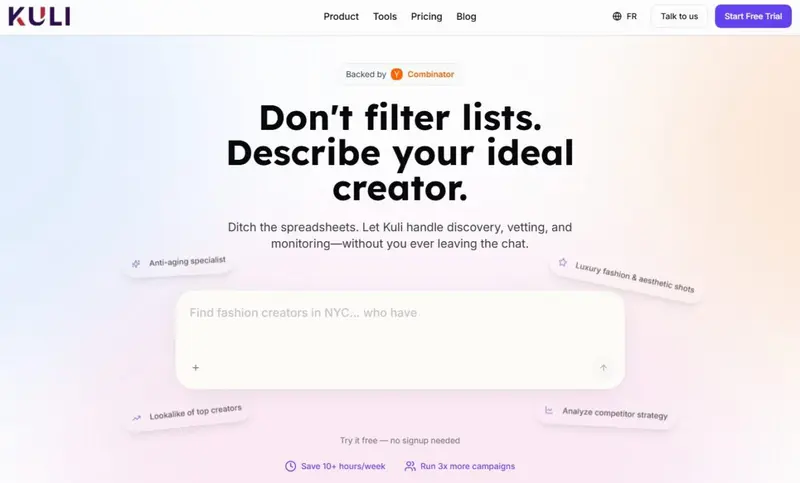
Kuli is an influencer marketing platform built around AI-first creator discovery and analysis. Unlike traditional platforms that rely on filters, hashtags, and engagement metrics, Kuli focuses on understanding the actual content creators produce.
The platform is designed to help brands identify influencers based on how they communicate, not just how they perform on surface-level metrics.
At its core, Kuli replaces database-driven discovery with content intelligence. Instead of manually searching through profiles, users can input a natural language prompt describing the type of creator they need.
The platform then analyzes video content across social platforms to identify creators whose tone, style, and messaging align with the campaign. This approach significantly reduces the time required to shortlist relevant influencers.
AI-Powered Content Analysis
Kuli’s main differentiator is its ability to analyze creator content at a granular level. The platform’s AI agent watches videos frame by frame, evaluating elements such as tone, visual style, messaging, and overall content themes.
This level of analysis is particularly valuable for brands that require strong alignment between messaging and content style. Instead of relying on assumptions based on engagement rates, teams can identify creators whose content naturally fits their brand voice.
As a result, campaigns are more likely to feel authentic and resonate with target audiences.
AI Creator Discovery and Vetting
Kuli streamlines the discovery process by allowing users to search using natural language. Brands can describe their ideal creator, and the AI generates a shortlist based on content relevance, audience fit, and contextual alignment. This eliminates the need for manual filtering and reduces the complexity of identifying suitable partners.
Beyond discovery, the platform also supports ongoing vetting and monitoring. Kuli continuously analyzes creator content to identify potential risks and ensure alignment with brand standards.
Pros
Content-first discovery provides deeper insight than traditional metrics
Natural language search simplifies the creator sourcing process
Identifies high-fit and emerging creators beyond obvious picks
Reduces manual research time significantly
Cons
Pricing is not publicly available
Limited visibility into full campaign execution features compared to some platforms
Why It Stands Out?
Kuli stands out by shifting influencer marketing from database filtering to content intelligence. While most platforms focus on metrics and audience size, Kuli analyzes how creators communicate, making it easier for brands to find partners that genuinely align with their voice.
Pricing: Minimum pricing size starts at $3,600 per quarter
SARAL is an influencer marketing platform built specifically for brands that want to move beyond one-off creator campaigns and build scalable, revenue-generating influencer programs.
Instead of treating influencers as isolated partnerships, SARAL structures the entire workflow around long-term relationships, affiliate monetization, and content reuse, aligning influencer activity directly with eCommerce performance.
The platform combines discovery, outreach automation, product seeding, affiliate tracking, and performance analytics into a single system. For brands operating in competitive DTC environments, this unified approach is particularly valuable, as it connects influencer marketing to CAC reduction, paid media efficiency, and consistent content production rather than vanity metrics like reach or impressions.
Influencer Discovery and Lookalike Expansion
SARAL’s discovery engine is designed for scale, allowing brands to search across a large pool of creators, 200 million+, without relying on opt-in marketplaces. What stands out is its lookalike functionality, which enables teams to take a set of high-performing influencers and instantly generate similar profiles.
This shifts discovery from manual prospecting to a repeatable system, helping brands continuously expand their creator pipeline with relevant partners.
Automated Outreach and Relationship Management
Outreach is fully automated through personalized email sequences with built-in follow-ups, allowing teams to contact hundreds of influencers without losing personalization.
SARAL’s CRM layer tracks each creator across stages such as outreach, product seeding, and affiliate activation, eliminating the need for spreadsheets and manual tracking. For brands managing high volumes of creators, this structure enables consistent execution without scaling headcount.
Affiliate Tracking and Revenue Attribution
SARAL integrates directly with eCommerce platforms like Shopify to tie influencer activity to revenue outcomes. Brands can generate discount codes, track conversions, and measure ROAS at the creator level.
The platform also provides funnel visibility, showing where influencers drop off between outreach and content creation, which helps teams optimize their programs based on performance rather than assumptions.
Proof of Performance
Reduced Meta ad spend by 70% for Slumberkins while maintaining revenue, using influencer-led content and whitelisting
Scaled Spacegoods to 1,000+ active influencer partnerships with a team of 2, creating a self-funding affiliate and content engine
Enabled Sunsama to build a 600+ ambassador program, cutting discovery time from hours to minutes and halving weekly management time
Pros
End-to-end workflow covering discovery, outreach, affiliate tracking, and content management
Strong automation reduces manual workload and enables high-volume influencer programs
Built for eCommerce with direct revenue attribution and Shopify integration
Supports content reuse, turning influencer output into paid media creative
Combines software with strategy support, including onboarding and consulting
Cons
Quarterly pricing structure may limit flexibility for smaller or early-stage brands
Primarily optimized for DTC and eCommerce, less suited for non-commerce campaigns
Why It Stands Out
SARAL stands out by turning influencer marketing into a structured growth system, where creators consistently generate both content and revenue rather than being used for one-off campaigns.
Best for: Consumer brands that need to generate thousands of micro-influencer posts without manual outreach or negotiation.
Pricing: Custom plans available upon request
Statusphere is an AI-drivenmicro-influencer platform designed for brands that want to scale without the spreadsheets. Its proprietary system, StevieOps™, automates everything from influencer matching to fulfillment and post verification, eliminating the manual back-and-forth that slows traditional programs.
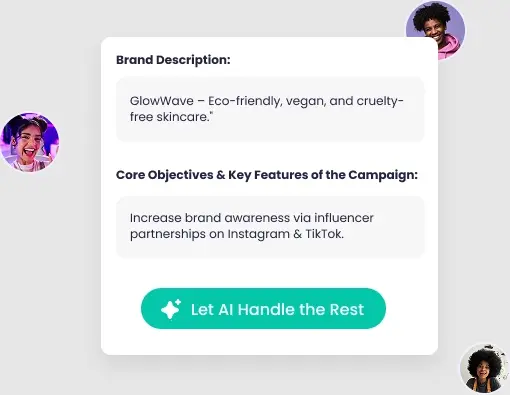
Instead of recruiting creators one by one, marketers simply define campaign goals, product details, and talking points. StevieOps then activates 1,000+ vetted creators within hours, each producing content optimized for TikTok and Instagram search visibility.
Trusted by hundreds of leading consumer brands, including FEKKAI, GreenPan, Spin Master, Pamprin, and Afia Foods, Statusphere turns influencer marketing into an always-on content engine.
AI-Powered Campaign Automation (StevieOps™)
StevieOps is the operational backbone of Statusphere. Acting as an autonomous campaign manager, it handles:
Creator matching based on 300+ first-party data points (audience, interests, purchase intent, and past content).
Fulfillment logistics, shipping products directly to creators.
Guaranteed post delivery, with content rights secured automatically for reuse in ads, PDPs, and retail listings.
For social teams balancing paid and organic UGC workflows, StevieOps provides a rare combination of speed and predictability, with new campaigns activating in as little as one hour.
UGC, Retail Impact, and Social SEO
Beyond creator scale, Statusphere specializes in rights-ready UGC that feeds both organic discovery and paid performance. Every post is built to rank in TikTok and Instagram search, leveraging keyword-optimized captions and topical clustering to increase product visibility.
The platform’s retail-ready workflows also extend creator activations in-store. Brands can geo-target influencer visits to retail partners, generating on-location content that supports shelf visibility and retailer confidence, particularly valuable for CPG and beauty brands.
Proof of Performance
GreenPan: Achieved 3-5× ROAS on UGC produced through Statusphere, hitting content-volume targets without manual oversight.
Spin Master: Reported that Statusphere was “the only influencer software that truly scales,” eliminating manual management entirely.
FEKKAI: Generated guaranteed creator posts that could be repurposed across paid and owned channels, improving campaign ROI.
Afia Foods: Used Statusphere to drive affordable, widespread awareness via real people’s voices, sustaining brand lift over 12 months.
Pros
Fully automated influencer activation via StevieOps™
Guaranteed posts with built-in content rights for reuse
Optimized for TikTok and Instagram SEO visibility
Retail and TikTok Shopintegration for direct sales impact
Cons
Limited customization for one-off influencer collaborations
Pricing transparency requires direct consultation
Currently focused on micro- and nano-influencer scale, not celebrity partnerships
Why It Stands Out
Statusphere has effectively productized influencer marketing. By automating discovery, contracting, and delivery, it eliminates the operational chaos that plagues large-scale UGC programs. Its AI-powered “StevieOps” engine makes influencer output predictable, measurable, and search-optimized — turning creator content into a consistent, high-ROI growth channel for consumer brands.
Top Influencer Marketing Platforms: As Voted By The Community
Who better to highlight the top influencer marketing platforms than the professionals using them every day? We asked industry experts to share which platforms they rely on most, and these rankings are based on their votes, giving you an insider’s look at the tools driving the influencer marketing industry forward:
Choosing an influencer platform can feel overwhelming when each promises end-to-end automation, AI insights, and measurable ROI. To simplify the decision, the table below highlights which platforms perform best for specific marketing goals, from affiliate ROI tracking and UGC seeding to enterprise-level governance.
Use this as a shortcut to shortlist the right vendors for your next campaign.
Use Case/Goal
Best Platform(s)
Why They Excels
Full-Funnel Enterprise Management
Influencity, Brandwatch Influence, Sprout Social
Unify discovery, CRM, analytics, and reporting with role-based governance and API integrations for large teams.
E-Commerce Attribution & Shopify Integration
LTK, Modash, Creator.co
Closed-loop attribution directly links influencer content to Shopify and WooCommerce conversions.
Automate gifting, product seeding, and guaranteed content creation at scale—ideal for DTC and CPG brands.
Free or Low-Cost Marketplaces
Ainfluencer, Collabstr, Ubiquitous
No subscription fees, transparent pay-per-creator pricing, and instant campaign activation for startups.
Affiliate & Performance Marketing
Upfluence, IMAI, Creator.co
Integrate affiliate links, promo codes, and revenue tracking to prove ROI at the conversion level.
Global, Multilingual Campaigns
Humanz, indaHash, Digimind
Support multi-market activations, sentiment tracking, and localized influencer pools across 20+ languages.
Competitive Intelligence & Benchmarking
Digimind, InsightIQ, IMAI
Compare share of voice, audience overlap, and campaign sentiment to refine strategic positioning.
Creator Relationship Management (CRM Focus)
Brandwatch Influence, Influencity, Upfluence
Replace spreadsheets with centralized influencer databases, contracts, and communication logs.
Rapid UGC Production for Paid Ads
Statusphere, Skeepers, #Paid
Rights-ready, ad-optimized creator content for Spark Ads, PDPs, and retargeting campaigns.
Key Features to Consider When Choosing an Influencer Marketing Platform for Your Brand
Selecting an influencer marketing platform is about finding the right mix of automation, attribution, and brand safety for your business model. Below are the core pillars marketers and agencies should evaluate, backed by real-world platform examples from today’s top performers.
Discovery, Vetting & Brand Safety
The most critical capability remains creator discovery and audience analysis. Platforms like Influencity and Upfluence lead here with AI-driven search filters spanning niche, engagement, location, and brand affinity, while flagging suspicious follower activity in real time.
In this Upfluence tutorial, they show you exactly how these filters work and how they help you narrow down the search to find the ideal influencer for your campaign.
For teams managing reputation risk, Viral Nation and InsightIQ go further—both integrate GARM-aligned brand-safety scanning and historical content vetting. Viral Nation’s Secure module even analyzes 15 years of social history across video, text, and imagery to catch hidden red flags before sign-off.
Meanwhile, Digimind’s social-listening intelligence identifies not just influencers but emerging advocates and sentiment leaders across 20+ languages—ideal for global teams tracking brand safety and advocacy trends simultaneously.
At the same time, platforms like Linqia leverage Google Vision and up to 1.5 billion data points to help identify qualified influencers for campaigns.
Creator CRM & Workflow Automation
Modern influencer programs demand CRM-style structure. Brandwatch Influence and Sprout Social exemplify this with centralized databases for every creator relationship—complete with contract storage, multi-user permissions, and approval logs.
Influencity and IMAI also offer full-cycle automation: AI-generated briefs, bulk outreach, and auto-synced deliverable tracking.
Source: IMAI AI-Powered Briefs
These features replace spreadsheets and email chains with true operational visibility. For agencies managing multiple clients, workspaces and role-based access keep data siloed yet reportable across teams.
Commerce Integrations & Real Attribution
Proving ROI has become non-negotiable. LTK and Modash set the benchmark for closed-loop attribution—linking creator posts to Shopify, WooCommerce, or Amazon conversions and calculating ROI per creator automatically. Modash even simplifies the product-gifting process by allowing brands to send products directly to influencers from third-party storefronts.
Creator.co also merges affiliate and influencer performance in a single dashboard, tracking coupon-code sales and affiliate commissions in real time. For large DTC brands, this transparency turns influencer budgets into measurable performance channels instead of soft-metric spend.
Content Rights, UGC Reuse & Paid Amplification
Strong content governance is key when repurposing creator assets. #Paid and Statusphere automatically secure rights for paid amplification and multi-channel reuse, saving teams from legal follow-ups.
Platforms like Skeepers specialize in royalty-free UGC for e-commerce—embedding creator photos and videos on product pages to double add-to-cart rates.
Meanwhile, Sprout Social integrates direct Partnership Ad permissions, letting marketers turn high-performing organic influencer posts into paid ads instantly. Clear rights metadata and usage timelines prevent costly compliance missteps down the line.
Payments, Gifting & Global Operations
Frictionless payment is another differentiator. Upfluence Pay and indaHash streamline global payouts with automated tax compliance and multi-currency support, while Ainfluencer offers escrow-style protection so funds are released only after verified post delivery.
If gifting and seeding are central to your workflow, Skeepers and Creator.co sync directly with Shopify, letting creators select products and sizes, confirm shipping, and track fulfillment—completely eliminating manual product management.
A modern platform should unify performance tracking across every creator, post, and region. IMAI’s predictive analytics estimate engagement and conversions before launch, while Digimind and InsightIQ enrich dashboards with sentiment scoring and competitor benchmarking.
Source: InsightIQ Sentiment Score
For enterprise users, Brandwatch Influence and Sprout Social stand out for real-time ROI visualization—combining influencer performance with owned and paid social metrics to give executives a single source of truth.
Compliance, Governance & Security
For regulated categories like finance, health, or beauty, governance must extend beyond content approval. Viral Nation Secure offers the most advanced AI vetting for reputational and compliance risks, while Sprout Social adds customizable safety thresholds and disclosure monitoring.
Look for SOC-2, GDPR, or ISO certifications, single sign-on (SSO), and audit trails to meet enterprise standards.
Pricing, Support & Time-to-Value
Finally, balance feature depth against onboarding friction. Self-serve marketplaces such as Collabstr or Ainfluencer provide quick wins and low barriers for SMBs, while enterprise ecosystems like Viral Nation, Influencity, or Sprout Social deliver broader functionality but require structured onboarding.
Strong customer success and training resources—like LTK’s campaign support and Brandwatch’s enterprise account teams—ensure your investment translates into measurable time-to-value.
lHow to Evaluate ROI Before Signing Up With an Influencer Platform
Even the most feature-rich influencer platform can fall short if it doesn’t fit your campaign goals or data ecosystem. Before signing a contract, test its real impact on your workflow and revenue.
Use this quick checklist to validate ROI before you commit.
✅ Run a live campaign test.
Skip the sales demo and pilot the platform on a real campaign, like a product drop or holiday activation. This helps you see how fast your team can source creators, launch briefs, and track results. Tools like Collabstr and Ubiquitous allow instant setup for short-term tests, while enterprise suites like Influencity or Sprout Social offer guided trials with full analytics access.
✅ Check data freshness.
Ask how often influencer stats refresh. Some tools rely on monthly scrapes, while others like InsightIQ and IMAI update weekly or pull live metrics via social APIs. The more frequent the updates, the more reliable your targeting and reporting will be.
✅ Confirm integrations early.
True ROI comes from connected data. Verify compatibility with Shopify, Amazon Attribution, Google Analytics, or your CRM. Platforms such as Upfluence, Creator.co, and LTK link influencer activity directly to tracked conversions—saving hours of reconciliation later.
✅ Test the reporting depth.
Don’t just ask for engagement numbers; check how each tool attributes sales. Look for cost-per-engagement, click-through, or affiliate ROI metrics. Platforms like IMAI and Viral Nation excel here, connecting campaign inputs to real revenue outcomes instead of vanity metrics.
✅ Gauge team usability.
If your team finds the interface confusing, adoption will lag and ROI will vanish. During the trial, track setup time, content approvals, and report generation. Lightweight systems such as Statusphere and Skeepers are plug-and-play, while enterprise options like Brandwatch Influence take longer to learn but deliver richer analytics once onboarded.
✅ Evaluate support and governance.
Strong ROI isn’t just about analytics—it’s about protection. Confirm access to onboarding, account support, and brand-safety features. Sprout Social offers customizable risk filters, and Viral Nation Secure runs AI moderation across text, image, and video, reducing compliance headaches for regulated sectors.
Bottom Line
Run the platform under real conditions—one campaign, one product, one reporting cycle. Measure how much time it saves, how cleanly it integrates, and whether it ties influencer activity to actual sales. The best influencer platform doesn’t just automate your workflow—it proves its ROI in days, not quarters.
Insights from Industry Leaders: Expert Perspectives and Trends
If you still can’t make up your mind about whether you need to invest in a platform to find influencers, consider what some of the following thought leaders have to say. Here’s more insight into the strengths and weaknesses of a couple of the above-mentioned influencer marketing tools.
Shae Sattler, former Head of Partnerships and Community Marketing at Outer - a D2C outdoor furniture brand, highlighted Aspire’s support and intuitiveness:
“I highly recommend Aspire. Their team is SO available and helpful, and the platform saved me so much time and increased my results by a ton.”
Brandwatch Influence is another tool that’s praised for its level of customer support. Alex Garcia, Head of Partnerships at Insta360, added the following:
“Customer support is very responsive and teaches you when in doubt or helps you report/solve technical problems. At an enterprise level, you get assigned an account manager that helps you keep it more personal and is someone who understands your company needs very well.”
In addition to customer support, he also highlights automatic post collection, live data update, and reporting as strengths.
One area where Brandwatch Influence can improve, though, is the campaign feature that you can use to track the releases and report. For Insta360’s use case, there are two limitations:
It supports only 150 accounts per campaign.
Alex explains,
“Sometimes we work with 300+ influencers in one campaign across all regions. This makes us have several campaigns for the same project.”
The second weakness is the 90-day limitation.
“For some one-off campaigns it's not a problem, like a product launch, but for always-on projects that require tracking during the whole year it's annoying because it makes us duplicate the campaigns every three months, with the same influencers in it but just another timeframe.”
Limitations aside, Insta360 still manages to generate loads of engagement. They’ve recently won the YouTube Streamy Award for Brand Engagement for their “No Drone? No Problem!” campaign. The campaign’s hashtag #NoDroneNoProblem generated 238.9 million views on TikTok alone.
If you want to combine video content with ease of use, gen.video is a tool that stands out.
Denise Vitola, an award-winning marketing pro and VP of Brand Integration PR, Social and Influencer at Bayer, the multinational pharmaceutical and biotechnology company, has this to say about gen.video:
“I think the biggest strength is the ease of use, being able to view campaigns, influencers and content in one place. Being able to look things up and review metrics for each campaign right on the platform.”
While she also appreciates its sharing functionality, the content editing capabilities are lacking.
“I think the editing content could be better. Instead of a cut-and-paste feature, I would like to track changes.”
Turning Influencer Marketing Platforms Into Profit Engines
The influencer marketing landscape in 2026 has shifted from guesswork to precision. With AI-driven discovery, real-time attribution, and built-in compliance tools, today’s platforms are no longer just creator databases—they’re profit engines that connect content to commerce.
Whether you’re a DTC brand automating UGC, an enterprise optimizing global ROI, or a startup testing creators, the goal is the same: Measurable, repeatable growth.
Choosing the right platform means balancing data accuracy, usability, and integration depth—not chasing feature lists. Start small, run a live test, and expand based on real ROI.
As creators become an extension of the marketing stack, brands that invest in scalable, insight-rich platforms will own the next wave of social commerce. The tools are ready. The data is live. The advantage goes to the marketers who know how to connect them.
Frequently Asked Questions
How can brands choose the right influencer mix for their campaigns?
Selecting the right mix often means balancing reach with engagement quality. Many marketers now lean on micro-influencer marketing strategies that emphasize authenticity over follower count, producing higher engagement and more targeted conversions.
What are the most effective tactics to boost influencer ROI?
Modern brands combine data analytics, A/B testing, and ongoing content iteration to refine their campaigns. Incorporating proven influencer marketing tactics—like storytelling formats and niche segmentation—helps drive stronger returns and audience loyalty.
How can marketers accurately measure influencer campaign success?
Tracking goes far beyond likes or views. Using UTM tagging, promo codes, and sales attribution models help you measure influencer campaigns, ensuring every post ties back to concrete performance data.
What makes TikTok influencer marketing different from other platforms?
TikTok’s algorithm prioritizes discoverability over follower size, allowing smaller creators to achieve viral reach. Brands that follow proven TikTok influencer marketing guides learn to align short-form creativity with conversion metrics.
How should B2B marketers approach influencer collaborations on LinkedIn?
Unlike consumer platforms, LinkedIn thrives on expertise and trust. Leveraging LinkedIn influencer marketing helps B2B brands turn industry thought leaders into high-value advocates for complex products or services.
Comparing Influencer Marketing Platforms
These platforms cater to a wide range of industries, including Fashion & Beauty, Health & Wellness, Gaming, Technology, and Lifestyle, among others. Explore the sections below for an overview of Influencer Marketing Platforms categorized by:
Why does Instagram remain central to influencer marketing?
Despite emerging rivals, Instagram still dominates lifestyle and commerce content. The rise of influencer marketing on Instagram underscores its unmatched visual storytelling and shoppable ecosystem for brand growth.
What are the key pillars of a strong influencer marketing strategy?
A robust plan integrates audience research, creator selection, compliance, and ROI measurement. Building a holistic influencer marketing strategy ensures consistent results across channels and campaign types.
Can studying real-world influencer campaigns improve results?
Nadica Naceva writes, edits, and wrangles content at Influencer Marketing Hub, where she keeps the wheels turning behind the scenes. She’s reviewed more articles than she can count, making sure they don’t go out sounding like AI wrote them in a hurry. When she’s not knee-deep in drafts, she’s training others to spot fluff from miles away (so she doesn’t have to).