
Influencer Marketing Hub sets itself apart from conventional review platforms through the involvement of Affiliate Marketing experts such as Werner Geyser, Djanan Kasumovic, Camille Kennedy, Dave Eagle, and other notable industry figures. This expert team brings a profound understanding of the Affiliate Marketing landscape, assessing tools and platforms with an insider’s perspective on capabilities, experience, and industry acumen. Unlike user-generated review platforms, Influencer Marketing Hub’s evaluations are rooted in extensive firsthand experience and direct interactions with the tools and platforms in question. This ensures that the reviews are not only trustworthy but also deeply informed. High-caliber brands like Hamster Garage powered by Swipehouse, Versa Marketing, and Acceleration Partners undergo rigorous monthly evaluations, highlighting the platform’s commitment to identifying and showcasing top-tier solutions in Affiliate Marketing and beyond.
Influencer Marketing Hub has consistently been recognized by leading media outlets for our authoritative data, findings, and insights within the Affiliate Marketing landscape. Our platform is frequently cited as a trusted source of information, demonstrating the value and impact of our work in shaping industry standards and practices.






Influencer Marketing Hub employs an expert-driven methodology to evaluate Affiliate Marketing agencies, ensuring that our recommendations are both reliable and comprehensive. This approach is designed to help businesses and individuals find the best agencies to meet their specific Affiliate Marketing needs. Here’s how we assess the various agencies like Hamster Garage powered by Swipehouse, Versa Marketing, and Acceleration Partners:
Creator affiliate marketing is no longer a niche channel inside performance programs. For eCommerce brands and DTC operators, it has become a structured lever for customer acquisition, margin protection, and scalable partner growth.
At the same time, execution has become more complex. Creator acquisition costs have increased, with industry estimates quoting a 171% increase in influencer budgets.
On the other hand, affiliate ecosystems are saturated. Coupon leakage, attribution overlap, and cross-channel commission conflicts can erode profitability if governance is weak.
Performance marketing teams are now expected to justify every commission payout with transparent reporting and defensible tracking logic.
This shift has elevated the role of agencies that combine creator sourcing with affiliate infrastructure. Rather than running one-off influencer campaigns, these firms build structured creator partner programs supported by affiliate platforms, commission modeling, fraud controls, and measurable reporting frameworks.
The agencies in this evaluation were selected based on their ability to integrate creator partnerships with affiliate performance architecture, giving brands a more accountable way to scale creator-driven revenue in 2026.
- The Evolution of Creator Affiliate Marketing in 2026
- Creator Affiliate Marketing Agencies For 2026
- 1. Hamster Garage powered by Swipehouse
- 2. Versa Marketing
- 3. PartnerCentric
- 4. Peekabo
- 5. Sociablestack
- Evaluation Methodology
- Best Creator Affiliate Marketing Agency by Use Case
- From Creator Hype to Performance Discipline
- Frequently Asked Questions
The Evolution of Creator Affiliate Marketing in 2026
Creator affiliate marketing has transitioned from a supplementary tactic to a core performance channel. Affiliate marketing is estimated to drive roughly 16% of total eCommerce sales in the United States, and global industry spend is projected to exceed $17 billion in 2026.
This growth reflects sustained investment in performance-based partner models rather than purely impression-driven campaigns.
More than 80% of brands now operate affiliate programs, increasing competition across traditional publisher networks. As saturation rises, brands are turning to creators as differentiated distribution partners who combine audience trust with trackable conversion pathways.
Influencers and content creators increasingly function as revenue partners through affiliate links, storefront integrations, and commission-based structures.
Affiliate platforms such as Impact, Partnerize, Rakuten Advertising, ShareASale, and Awin provide the infrastructure that enables this shift. Managing attribution rules, commission tiers, partner segmentation, and fraud controls has become essential to maintaining margin integrity.
Hybrid compensation models that combine flat fees with CPA or revenue share structures are now common, requiring disciplined governance.
In 2026, success in creator affiliate marketing depends less on creator reach and more on structured tracking, transparent reporting, and sustainable commission economics.
Creator Affiliate Marketing Agencies For 2026
1. Hamster Garage powered by Swipehouse
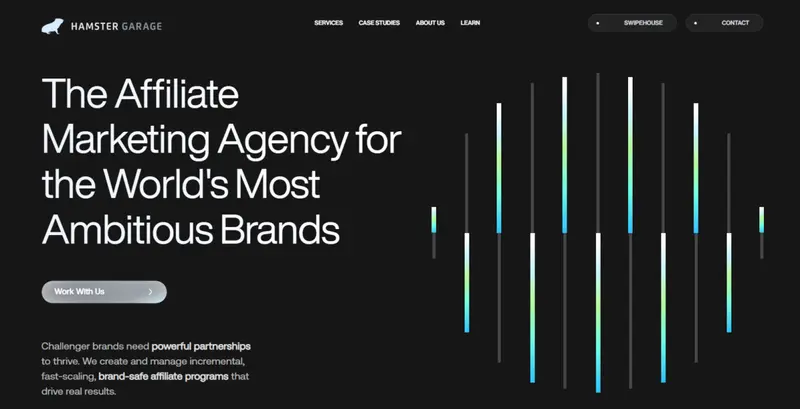
Best For: DTC, eCommerce, and growth-stage brands that want to scale creator affiliates as a measurable revenue channel (not a one-off influencer push)
Designed For: Brands with an existing (or planned) affiliate program that want to layer creator activation on top of CPA tracking
Core Strength: Swipehouse-powered creator affiliate sourcing + affiliate-program operations run like an in-house growth team
Affiliate Model: CPA-first creator activation (with revenue share and hybrid structures supported through the underlying affiliate program rules)
Industries Served: DTC/eCommerce, B2B SaaS, marketplaces, financial services, subscription brands
Minimum Campaign Size: $5,000+
Typical Starting Price: $8,000/month retainer + performance bonus (commonly structured on a 12-month engagement)
Notable Clients: Uber, Airbnb, Tesla, Xero, Slack, MasterClass, Reddit, Canva, Faire, Bill, Brinks
Read More2. Versa Marketing
Best For: Amazon-first brands that want to turn creator affiliates and publisher partnerships into a scalable, performance-driven revenue channel
Designed For: Brands selling on Amazon that need external traffic, creator activation, and affiliate infrastructure working together under one measurable system
Core Strength: Building structured creator + publisher ecosystems that drive high-intent traffic, improve Best Seller Rank, and generate trackable affiliate revenue
Affiliate Model: Performance-based CPA model with customizable commissions, layered across creators, publishers, and affiliate partners
Industries Served: Beauty, wellness, consumer goods, fitness, lifestyle, home, and multi-category Amazon sellers
Minimum Campaign Size: Custom (typically aligned to program scale and partner activation goals)
Typical Starting Price: Custom pricing (performance-based, scope dependent)
Read More3. PartnerCentric

Best For: Data-driven eCommerce brands seeking structured affiliate and creator performance growth
Designed For: Affiliate program managers and performance teams prioritizing measurable revenue expansion
Core Strength: Performance-led affiliate management supported by structured reporting and partner recruitment
Affiliate Model: CPA, revenue share, tiered commissions, and hybrid structures
Industries Served: Consumer goods, travel, health, subscription services, technology, cannabis, home appliances
Minimum Campaign Size: Typical range from $10,000 to $200,000+
Notable Clients: TikTok, Hers, The Motley Fool
PartnerCentric operates as a performance-oriented affiliate and influencer marketing agency with a strong emphasis on structured program management and measurable revenue contribution.
Read More4. Peekabo
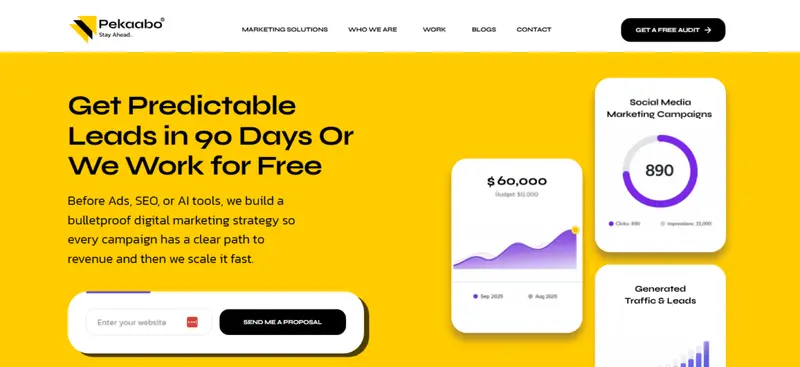
Best For: DTC brands seeking integrated influencer and affiliate program development
Designed For: Emerging to mid-market eCommerce brands building structured creator-driven revenue channels
Core Strength: Blending influencer activation with affiliate monetization models
Affiliate Model: CPA, revenue share, and hybrid influencer + affiliate structures
Industries Served: Consumer brands, lifestyle, retail, growing eCommerce businesses
Minimum Campaign Size: Typically from $1,000 per project
Notable Clients: Movo, StackEase, Nexright
Pekaabo positions itself as a hybrid influencer and affiliate marketing agency, integrating creator discovery with performance-based monetization. Rather than operating solely within traditional affiliate publisher networks, the agency emphasizes creator outreach and influencer relationship management alongside affiliate program development.
Read More5. Sociablestack

Best For: Growth-stage eCommerce brands seeking creator and affiliate campaign support
Designed For: DTC and performance teams expanding influencer programs into affiliate-driven models
Core Strength: Integrated influencer and affiliate marketing services
Affiliate Model: CPA, revenue share, and hybrid creator compensation structures
Industries Served: eCommerce and consumer brands
Minimum Campaign Size: From $1,500 per month
Notable Clients: Consumer and eCommerce brands
Sociablestack positions itself as an agency that combines influencer marketing and affiliate marketing services within a unified offering.
Read MoreEvaluation Methodology
The agencies in this review were assessed using a structured framework focused on performance infrastructure, creator integration depth, and commercial governance.
The goal was to evaluate how effectively each firm connects influencer activity with affiliate-driven revenue accountability.
Evaluation criteria included:
- Creator sourcing and vetting structure
- Affiliate platform integration capability
- Compensation model flexibility, including CPA and revenue share
- Attribution transparency and commission governance
- Reporting cadence and performance visibility
- Demonstrated revenue growth indicators, where publicly available
- Operational scalability for eCommerce and DTC brands
- Clarity around minimum engagement scope
Publicly available case studies, client reviews, and stated service positioning were considered where accessible. Where third-party validation was limited, this was noted in the analysis.
Best Creator Affiliate Marketing Agency by Use Case
Different creator affiliate programs require different levels of infrastructure, governance, and execution depth. Based on operational fit, the agencies reviewed align to the following use cases:
- Best for enterprise-scale affiliate programs → Acceleration Partners
Well-suited for global brands managing multi-market affiliate ecosystems that require structured governance, cross-platform attribution alignment, and standardized reporting processes.
- Best for Amazon-native creator affiliate programs → Versa Marketing
Ideal for brands looking to turn creators and publishers into a unified, performance-driven affiliate engine that drives external traffic, sales, and organic ranking on Amazon.
- Best for data-driven performance growth → PartnerCentric
Strong fit for brands prioritizing measurable revenue expansion, structured onboarding, and transparent reporting within established affiliate networks.
- Best for expanding social commerce affiliate activation → Hamster Garage
Appropriate for DTC brands integrating creator affiliates into existing affiliate frameworks, particularly in commerce-driven social channels.
- Best for growth-stage DTC creator programs → Sociablestack
Aligned with brands seeking integrated influencer and affiliate support while building structured performance visibility.
- Best for transitioning from influencer to hybrid affiliate models → Pekaabo
Suitable for brands moving from flat-fee influencer campaigns toward commission-based creator partnerships.
|
Agency |
Best For | Core Strength | Affiliate Model | Creator Network Type | Minimum Campaign Size |
Ideal Brand Stage |
| Hamster Garage | Social commerce affiliate expansion | Creator-integrated affiliate activation | CPA, revenue share, hybrid | Hybrid curated creator affiliates | $5000+ | Scaling DTC brands |
| Versa Marketing | Amazon-focused creator affiliate growth | Creator + publisher ecosystems driving external traffic and ranking | CPA, performance-based commissions | Hybrid creator, publisher, and affiliate ecosystem | Custom | Amazon-native and multi-channel eCommerce brands |
| Acceleration Partners | Enterprise global programs | Governance-driven partnership architecture | CPA, revenue share, tiered, hybrid | Curated global partner ecosystem | Undisclosed | Mature multi-market brands |
| PartnerCentric | Performance-focused growth | Data-driven affiliate management | CPA, revenue share, hybrid | Curated affiliate + influencer partners | $10,000 to $200,000+ | Mid-market to enterprise |
| Pekaabo | Influencer-to-affiliate transition | Hybrid influencer monetization | CPA, revenue share, hybrid | Curated influencer + affiliate mix | Typically from $1,000 per project | Emerging to mid-market DTC |
| Sociablestack | Creator-first affiliate campaigns | Influencer + affiliate integration | CPA, revenue share, hybrid | Curated influencer affiliates | From $1,500 per month | Growth-stage eCommerce |
From Creator Hype to Performance Discipline
Creator affiliate marketing has evolved into a performance channel that demands operational rigor. As affiliate ecosystems mature and competition increases, brands can no longer rely on influencer reach alone. Commission structures, attribution clarity, and partner governance now determine whether creator programs generate incremental revenue or dilute margins.
For eCommerce and DTC brands, the key shift is structural. Hybrid compensation models, disciplined onboarding, and transparent reporting frameworks are essential to sustaining long-term growth. Creator volume without tracking integrity introduces risk, particularly when affiliate commissions intersect with paid media and discount strategies.
In 2026, scaling creator-driven revenue requires more than campaign execution. It requires measurable contribution, clear commission logic, and infrastructure capable of supporting expansion. Brands that evaluate partners through this performance lens will be better positioned to build sustainable creator affiliate programs.
Frequently Asked Questions
What tools are commonly used to manage creator affiliate programs?
Creator affiliate programs typically rely on structured tracking platforms to manage links, commissions, and partner reporting. Many brands evaluate established affiliate marketing tools to handle attribution, fraud monitoring, and partner onboarding while integrating creator-specific workflows into broader affiliate systems.
How do brands structure effective creator affiliate strategies?
Effective programs balance commission incentives with margin protection and attribution clarity. Brands often align compensation tiers with conversion thresholds and content performance, drawing from established affiliate marketing strategies that prioritize measurable revenue contribution over engagement metrics alone.
Can B2B companies use creator affiliate marketing?
Yes. While often associated with DTC brands, structured B2B influencer affiliate programs are increasingly used in software, professional services, and industrial sectors where trusted subject-matter experts can drive qualified lead generation through trackable affiliate frameworks.
What is the difference between affiliate marketing and influencer marketing?
Affiliate marketing centers on performance-based compensation tied to measurable sales or leads, while influencer marketing traditionally emphasizes content visibility and brand exposure. The distinction becomes clearer when comparing affiliate marketing vs influencer marketing, particularly in how commissions and attribution are structured.
Should B2B brands work with specialized agencies?
In complex industries, governance and compliance considerations can differ significantly from consumer markets. Some brands evaluate dedicated B2B influencer marketing agencies to ensure partnership models align with longer sales cycles and lead-based attribution frameworks.
What is performance influencer marketing?
Performance influencer marketing blends creator partnerships with measurable compensation structures. Rather than paying solely for content placement, brands adopt performance influencer marketing models that tie payouts to conversions, revenue milestones, or qualified leads.
Is affiliate marketing effective for eCommerce brands?
Affiliate marketing can serve as a scalable acquisition channel when commission logic is aligned with product margins. Many DTC brands leverage affiliate marketing for eCommerce to diversify traffic sources and reduce dependency on paid media while maintaining performance visibility.
What trends are shaping creator affiliate marketing in 2026?
Hybrid compensation models, social commerce integration, and increased attribution scrutiny are reshaping the channel. Emerging affiliate marketing trends also include creator storefront monetization, platform-native tracking, and stronger fraud mitigation controls.


